
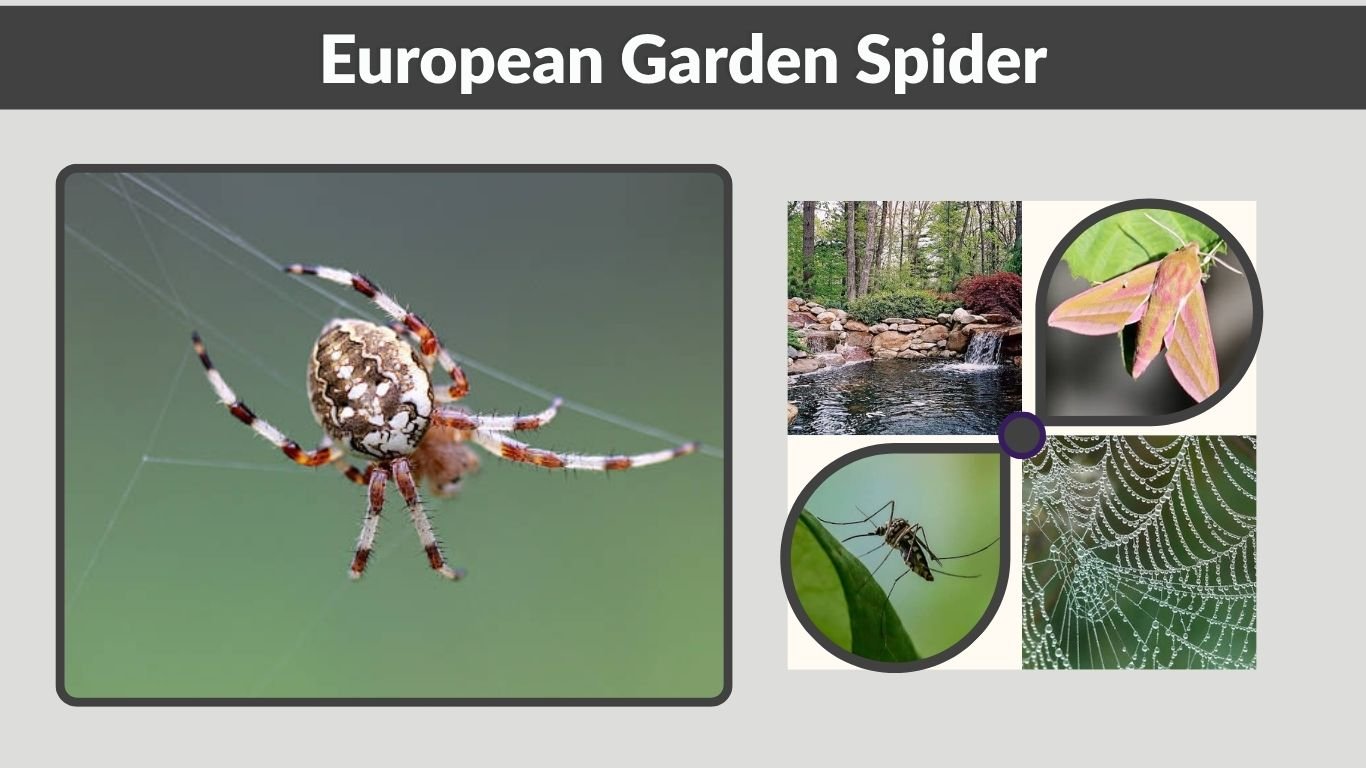
The European garden spider (Araneus diadematus) is a familiar orb-weaver recognized by the pale cross-shaped markings on its abdomen. Also called the cross spider or cross orb-weaver, it commonly builds large circular webs across gardens, hedges, fences, and woodland edges. Although its size and web may look intimidating, this spider is shy and rarely bites people. Its presence is generally beneficial because it captures flies, mosquitoes, wasps, and other insects.
What Is a European Garden Spider?
The European garden spider belongs to the orb-weaver family Araneidae. It is native across Europe and parts of temperate Asia and has also become established in North America. In the UK, it is considered one of the most common and recognizable outdoor spiders.
Scientific Classification
| Classification | Information |
| Scientific name | Araneus diadematus |
| Family | Araneidae |
| Order | Araneae |
| Common names | European garden spider, cross spider, diadem spider, cross orb-weaver |
| Diet | Flying insects and other small arthropods |
| Typical habitat | Gardens, hedges, meadows, woodland edges and scrub |
How to Identify It
The easiest identification feature is the group of white dots and streaks forming a cross on the upper abdomen. The body may be:
- Pale yellow or straw-colored
- Orange or reddish-brown
- Medium brown
- Dark grayish-brown
The abdomen is rounded with noticeable “shoulders” near the front. Its legs are hairy or spiny and usually display alternating light and dark bands. The underside may appear darker and does not show the prominent white cross visible from above.
An orange European garden spider is therefore not a different species. Color varies naturally with age, surroundings and the individual spider. Claims of an “albino European garden spider” usually refer to an unusually pale individual rather than true albinism.
European Garden Spider Size
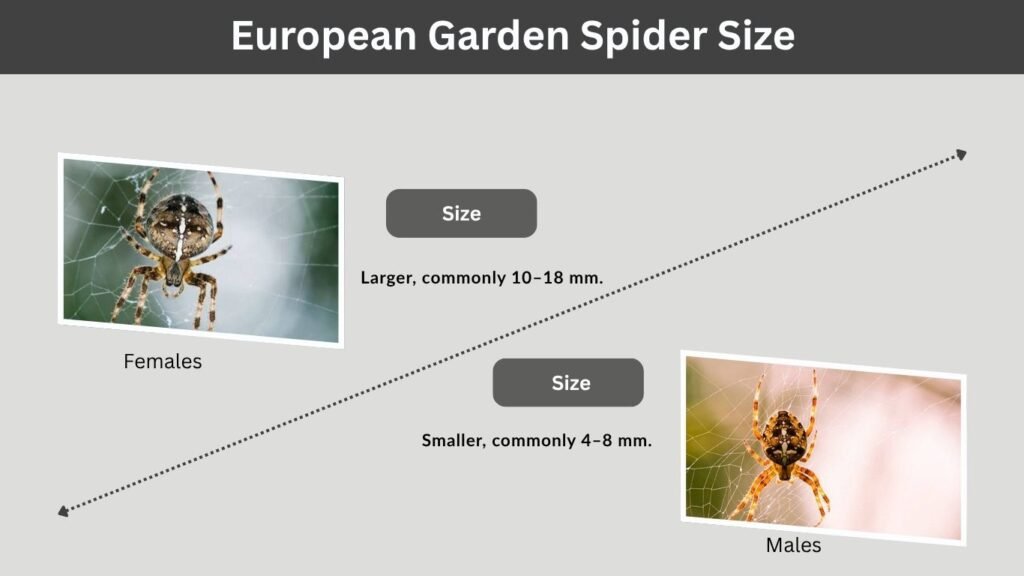
Females are considerably larger and heavier-bodied than males. Measurements vary among sources and populations, but adult females commonly reach approximately 10–18 millimeters in body length, while adult males are often around 4–8 millimeters. Some records give a wider possible range of about 6.5–20 millimeters for females and 5.5–13 millimeters for males.
European Garden Spider Male vs Female
| Feature | Female | Male |
| Body size | Larger, commonly 10–18 mm | Smaller, commonly 4–8 mm |
| Abdomen | Large, rounded and often swollen before egg laying | Narrower and less rounded |
| Web behavior | Builds and occupies a large orb web | Often stops building capture webs after maturity |
| Pedipalps | Small and leg-like | Enlarged tips resembling boxing gloves |
| Main activity | Capturing food and producing eggs | Searching for mature females |
A “pregnant European garden spider” is more accurately described as a gravid female. Her abdomen becomes noticeably swollen in late summer or autumn as eggs develop.
European Garden Spider Web
The European garden spider produces the classic wheel-shaped structure associated with spider webs. Its web contains strong radial support lines crossed by a spiral of sticky capture silk.
How the Orb Web Works
A mature female usually hangs head-down near the center. In some cases, she waits in nearby vegetation while touching a signal thread connected to the web. Vibrations tell her when an insect has become trapped.
The spider quickly approaches the prey, wraps it in silk and delivers a venomous bite. The meal may be eaten immediately or left wrapped for later. Large webs can reach roughly 40 centimeters across, although web size depends on the spider and available supporting structures.
European garden spiders frequently repair or rebuild their webs. Dust, pollen, weather and struggling prey gradually damage the sticky spiral. The spider may eat the old silk before constructing a fresh web, allowing it to recycle some of the silk proteins.
Where Webs Are Built
Webs are commonly stretched between:
- Shrubs and tall flowers
- Fence posts and railings
- Tree branches
- Shed corners
- Window frames
- Outdoor lights and nearby vegetation
Lights attract flying insects, making illuminated buildings productive hunting locations.
What Does a European Garden Spider Eat?
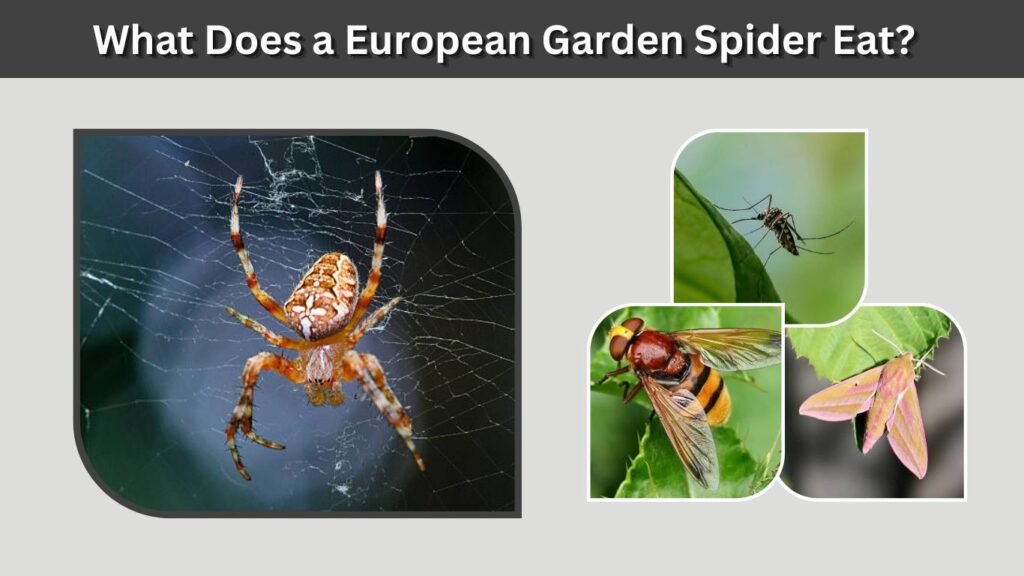
The European garden spider is a carnivorous predator that mainly feeds on insects caught in its web. Common prey includes flies, mosquitoes, moths, small beetles, midges and wasps. It may also capture other small arthropods when they enter the web.
These spiders do not eat plants, damage flowers or attack garden produce. Instead, they help limit populations of insects, including some considered household or garden pests.
Is the European Garden Spider Poisonous?
The European garden spider is venomous, not poisonous. Venom is injected through fangs to immobilize prey, whereas a poisonous animal causes harm when touched or eaten.
Its venom is effective against insects but is not considered medically significant for most people. The spider normally retreats, hides or vibrates its web when disturbed rather than attempting to bite.
Does the European Garden Spider Bite?
A bite is possible when a spider is squeezed against the skin, trapped in clothing or handled roughly. Verified bites have been associated with temporary pain, redness and swelling, but serious effects are unusual.
Basic care includes washing the area with soap and water and applying a cold pack wrapped in cloth for 10–20 minutes. Avoid scratching the skin. Obtain medical advice if pain or swelling becomes severe, the area appears infected, or symptoms continue to worsen. Difficulty breathing or swelling involving the face, mouth or throat requires urgent medical attention.
Habitat and Geographic Range
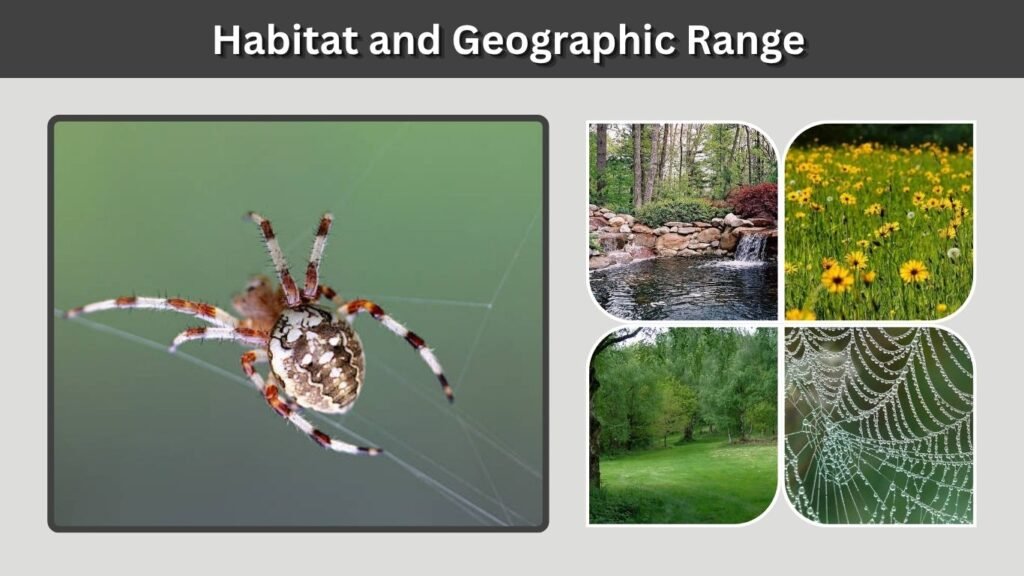
European garden spiders thrive wherever there are insects and suitable supports for their webs. They occupy gardens, meadows, hedgerows, woodland clearings, heathland, scrub and urban green spaces. They are mainly outdoor spiders and generally survive poorly inside dry homes.
European Garden Spider in the UK
The species is widespread and extremely common across Britain. Adults and their webs become especially noticeable from late summer through autumn, when females have reached their largest size.
European Garden Spider in North America
The species was introduced from Europe and is now established in parts of the United States and Canada. Records occur in areas such as California, Oregon, Washington, Colorado, Michigan, Ohio, Pennsylvania, New York and portions of southern Canada.
Although it is non-native in North America, the term introduced does not automatically mean that a species is environmentally invasive. Its status and abundance can vary by region.
Life Cycle, Mating and Egg Sacs
European garden spiders generally mature during late summer or autumn. Mature males leave their capture webs and search for females, following chemical signals associated with female silk.
Mating Behavior
A male approaches cautiously and plucks strands at the edge of a female’s web. These controlled vibrations help distinguish him from trapped prey. The male must retreat quickly after mating because the much larger female may attack or occasionally eat him.
Eggs and Spiderlings
After mating, the female feeds heavily while her eggs develop. She eventually abandons her main web and creates a tough, yellowish silk egg sac in a protected location, such as dense vegetation, a wall crevice or an outbuilding.
The adult female dies after guarding the sac briefly. Young spiderlings emerge later, initially clustering together in a yellow or golden group. They eventually disperse, sometimes releasing silk threads that carry them through the air in a process known as ballooning.
FAQs
Are European garden spiders dangerous?
No. They possess venom for capturing insects, but they are not considered dangerous to most people. Bites are uncommon and generally cause only temporary localized symptoms.
How long does a European garden spider live?
Its development commonly extends across roughly one to two seasonal cycles, depending on climate. Adults generally die after mating and egg laying, while eggs or immature spiders survive the colder months.
Should I remove a European garden spider?
Removal is usually unnecessary when the web is outdoors and not blocking a walkway. The spider helps control flying insects. A web in an inconvenient location can be gently disturbed so the spider rebuilds elsewhere.
What is the difference between a cross orb-weaver and a European garden spider?
There is no species difference. European garden spider, cross spider and cross orb-weaver are common names for Araneus diadematus.
Why do European garden spiders appear in autumn?
They become more noticeable in autumn because females have reached maturity, grown larger and often have swollen abdomens containing developing eggs. Their large webs are also easier to see when covered with morning dew.
