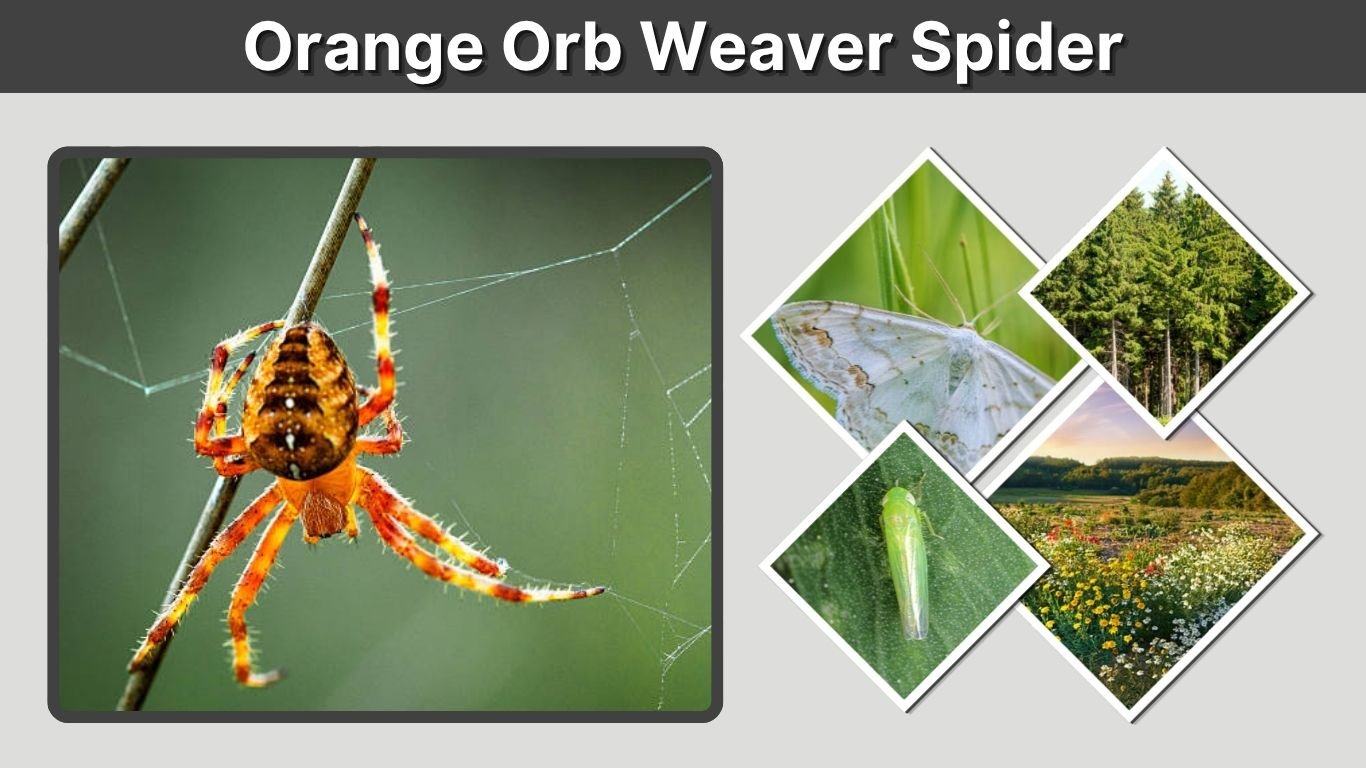
The orange orb weaver is a brightly colored spider commonly noticed in gardens, forests, and yards during late summer and fall. The name does not describe one specific species. Instead, it may refer to several orb-weaving spiders with orange bodies, markings, bellies, or legs. The orange marbled orb weaver is one of the most recognizable examples because of its round, pumpkin-like abdomen. Although these spiders can appear large and intimidating, they are generally harmless to people and beneficial because they capture many flying insects.
What Is an Orange Orb Weaver?
An orange orb weaver is any orange-colored spider belonging to the orb-weaver family, Araneidae. Members of this family are best known for constructing circular webs with radiating support lines and sticky spiral threads.
The term “orange orb weaver” is commonly used for several different spiders rather than one formally recognized species. Depending on the location, the spider may be a marbled orb weaver, cross orb weaver, spotted orb weaver, garden orb weaver, four-spot orb weaver, or another related species.
Orange Marbled Orb Weaver
The marbled orb weaver, scientifically known as Araneus marmoreus, is frequently responsible for orange orb-weaver sightings in North America. It can have a bright orange, pale orange, yellow, beige, cream, or almost white abdomen. Dark marbled lines or patches often cover the upper surface.
Bright orange individuals are sometimes called pumpkin spiders because their swollen abdomens resemble small pumpkins. However, color alone is not enough for certain identification because this species is highly variable.
Orange Cross Orb Weaver
Cross orb weavers may appear brown, tan, reddish-orange, yellow-orange, or gray. They typically have pale spots on the abdomen that form a cross-shaped pattern.
An orange cross orb weaver may be confused with a marbled orb weaver. However, cross orb weavers usually have a more distinct white cross, while marbled orb weavers frequently display irregular marbling or dark vein-like patterns.
Orange Spotted Orb Weaver
Spotted orb weavers can have orange, reddish-brown, tan, or gray abdomens. Some have pale spots, dark patches, or fuzzy-looking bodies. They are frequently encountered near buildings, porches, woodland edges, and outdoor lights where flying insects gather.
Orange Spiny Orb Weaver
An orange spiny orb weaver has a broad, flattened abdomen with several spine-like projections. Some individuals have an orange or reddish shell marked with black or white.
Its body shape makes it easy to distinguish from the rounded marbled orb weaver. Although the spines look threatening, they are defensive body structures and are not used to sting people.
Orange Orb Weaver Identification
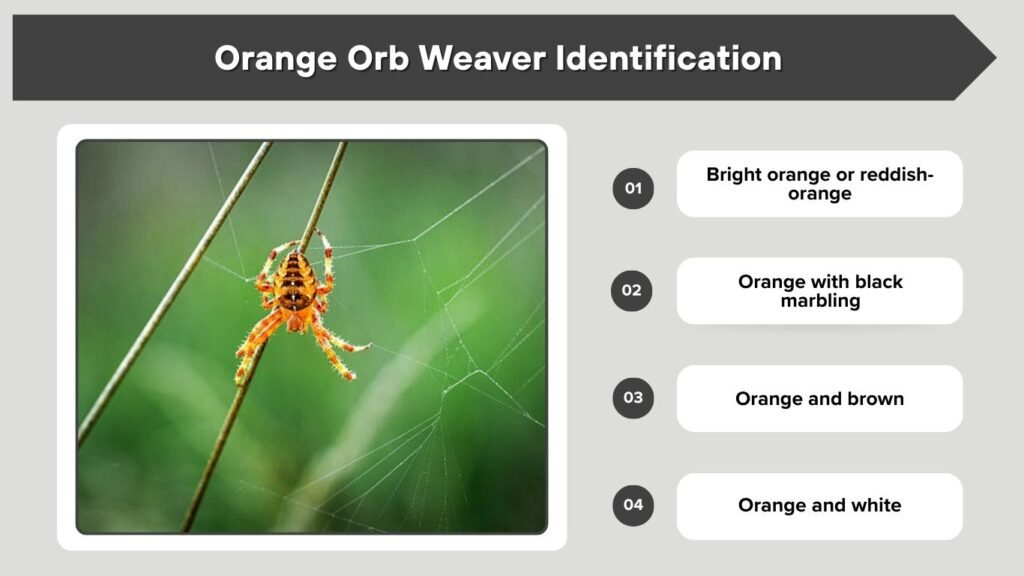
Orange orb weavers vary greatly in color and appearance. Identification should therefore consider body shape, markings, leg pattern, web structure, habitat, and geographic location.
Orb weavers generally have rounded or enlarged abdomens, relatively small head regions, and eight legs that may appear hairy or banded. The University of Minnesota Extension notes that orb weavers can range from approximately 1/8 inch to one inch in body length and occur in many colors.
Body and Abdomen
A large orange orb weaver often has a noticeably swollen abdomen, especially when the spider is a mature female. The abdomen may be:
- Bright orange or reddish-orange
- Orange with black marbling
- Orange and brown
- Orange and white
- Orange and yellow
- Orange with dark spots
- Gray with orange markings
The abdomen can be almost spherical, oval, triangular, or flattened, depending on the species.
Legs
The legs may be orange, brown, black, reddish, or covered with alternating light and dark bands. An orb weaver with orange and black legs could belong to several species, so leg color should not be used as the only identification feature.
Orb weavers frequently rest with their legs grouped in pairs. When disturbed, some drop from the web, hide in nearby vegetation, or remain motionless to avoid detection.
Size
Female orb weavers are usually much larger than males. A large orange orb weaver may look especially impressive because its abdomen becomes plump as it matures or produces eggs.
The apparent size can also be exaggerated by long legs and the spider’s position in the center of a large web. Males tend to be smaller, thinner, and less colorful.
Orange Belly or Underside
A spider with an orange belly is not automatically an orb weaver. Black widows and several harmless cobweb spiders can also have red or orange markings underneath their abdomens.
Orb weavers are most reliably identified by their rounded body and organized circular web. A brown, hairy spider with a bright orange hourglass underneath should not be handled, because an hourglass-shaped marking may suggest a widow spider rather than an orb weaver.
What Does an Orange Orb Weaver Web Look Like?
The web is one of the clearest identification features. Orb weavers create the familiar wheel-shaped web commonly associated with spiders.
The structure contains strong lines that radiate outward from the center and spiral threads that capture insects. University of Minnesota Extension describes these webs as having concentric circles connected by radiating lines.
Web Location
Orange orb-weaver webs may be constructed:
- Between shrubs or tall plants
- Across woodland paths
- Near porch lights
- Between tree branches
- Along fences and decks
- Around sheds and barns
- Near garden flowers
- Under roof edges
Many orb weavers are most active from evening through early morning. A spider may consume or remove part of its old web and rebuild it at night.
Why the Spider Sits in the Center
Some species rest openly at the center of the web while waiting for prey. Others hide along the edge in a curled leaf or silk shelter.
When an insect becomes trapped, vibrations travel through the web. The orb weaver quickly approaches, immobilizes the prey, wraps it in silk, and feeds on it.
Where Do Orange Orb Weavers Live?
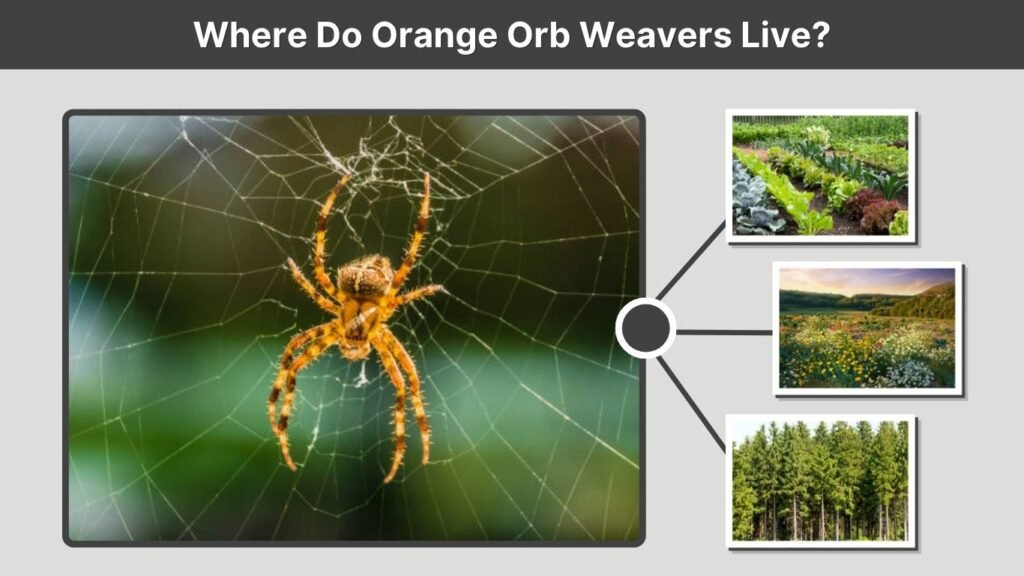
Orange orb weavers occur in gardens, meadows, woodland edges, forests, fields, wetlands, and residential landscapes. They prefer locations with vegetation or solid structures that can support a large web.
Marbled orb weavers occur across much of Canada and the United States. Penn State Extension reports a range extending through Canada and Alaska, across parts of the northern Rockies, south into Texas, and east to the Atlantic.
Orange Orb Weavers in Different States
Searches for orange orb weavers are common in California, Colorado, Arkansas, Florida, Georgia, Illinois, Kentucky, Maryland, Michigan, Minnesota, North Carolina, Ohio, Oregon, Tennessee, West Virginia, and other states.
However, an orange spider seen in California or Oregon may not be the same species as one found in Minnesota or North Carolina. Local climate and habitat affect which orb-weaver species are present.
The marbled orb weaver is particularly associated with moist woodland areas and is more widely distributed in eastern and northern parts of North America.
Orange Orb Weaver in the UK
Orange orb weavers in the United Kingdom may include orange forms of the European garden spider, four-spot orb weaver, marbled orb weaver, or other members of the genera Araneus and Araneus-like groups.
Photographs showing the abdomen, underside, legs, and web are usually necessary for accurate identification.
Are Orange Orb Weaver Spiders Poisonous?
Orange orb weavers are venomous, as are most spiders, but the word “poisonous” is not technically accurate. Venom is injected through a bite, while poison causes harm when touched, swallowed, or absorbed.
Orb weavers use venom to immobilize small insects. Their venom is not considered medically significant to healthy humans, and these spiders are not regarded as dangerous. Despite their size and bright coloration, orb weavers are generally harmless to people.
Will an Orange Orb Weaver Bite?
An orange orb weaver may bite if it is trapped against the skin, squeezed, or handled roughly. Bites are uncommon because these spiders usually attempt to escape rather than defend themselves.
A bite may cause:
- Brief pain
- Mild redness
- Local swelling
- Itching or irritation
- Temporary tenderness
Serious reactions are unusual. Clean the area with soap and water, apply a cold compress, and avoid scratching it.
Seek medical advice if symptoms rapidly worsen, severe pain develops, breathing becomes difficult, or the spider’s identity is uncertain.
Are Marbled Orb Weavers Poisonous?
Orange marbled orb weavers are not considered dangerous to humans. Their intimidating coloration and large abdomen are not signs of medically important venom.
They should still be observed rather than handled. Allowing the spider to remain in the garden helps control insects without creating a meaningful risk to people or pets.
What Do Orange Orb Weavers Eat?
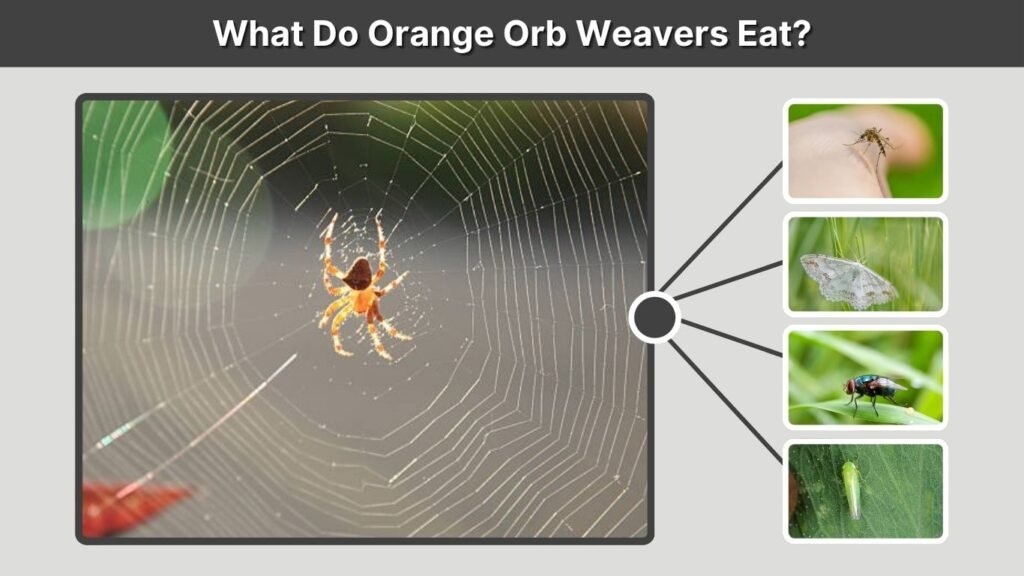
Orange orb weavers are insect predators. Their webs intercept flying and jumping prey that moves through gardens and woodland openings.
Common prey includes:
- Mosquitoes
- Moths
- Flies
- Gnats
- Small beetles
- Leafhoppers
- Wasps
- Flying ants
- Other small insects
The spider normally avoids prey that is too large or dangerous. It may cut an unwanted insect from the web rather than attempt to capture it.
Because they consume numerous insects, orb weavers are valuable natural pest controllers. They do not feed on plants, damage garden crops, infest stored food, or attack wooden structures.
Orange Orb Weaver Life Cycle
Most garden orb weavers follow an annual life cycle. Spiderlings emerge from egg sacs, grow through several molts, and reach maturity later in the year.
Adults are especially noticeable during late summer and fall, when females become larger and their webs reach their greatest size.
Mating and Egg Sacs
A much smaller male approaches the female’s web carefully and signals his presence by plucking silk strands. After mating, a female produces one or more egg sacs containing numerous eggs.
The sacs are placed in protected locations such as beneath bark, inside curled leaves, under roof edges, or among dense vegetation.
In colder climates, adult orb weavers commonly die as winter arrives, while their protected eggs survive until the following season. Reports also indicate that the orange coloration of marbled orb weavers can become particularly noticeable as they mature in autumn.
Should You Remove an Orange Orb Weaver?
Removal is usually unnecessary when an orb weaver builds its web away from doors, paths, play areas, or frequently used spaces. The spider provides free insect control and rarely enters homes intentionally.
When a web blocks an entrance, gently relocate the spider using a container and a piece of stiff paper. Move it to shrubs, trees, or another sheltered area where it can rebuild.
Avoid spraying pesticides. Chemicals may kill beneficial spiders and other helpful organisms while providing little long-term prevention.
FAQs
Is a bright orange orb weaver dangerous?
No. Bright orange coloration can make an orb weaver appear dangerous, but color does not indicate highly toxic venom. Orb weavers are reluctant to bite and generally pose little risk to humans. They should nevertheless be left undisturbed and not handled unnecessarily.
Why is an orb weaver orange?
Orange coloration may be a normal feature of the species or one variation within a highly variable species. Age, genetics, sex, season, and individual development may influence appearance. Marbled orb weavers can range from bright orange to yellow, beige, cream, or nearly white.
What is a big orange spider in my garden?
A large orange spider sitting in a round web is likely an orb weaver. In North America, it may be a marbled orb weaver, cross orb weaver, spotted orb weaver, or another garden species. Clear photographs are needed for precise identification.
Can an orange orb weaver hurt a dog or cat?
Orange orb weavers are unlikely to harm dogs or cats. They are not aggressive and their venom is adapted for small insect prey. A curious pet might receive a minor bite after disturbing one, but serious effects are not normally expected.
Is an orange orb weaver the same as an orange wolf spider?
No. Orb weavers and wolf spiders belong to different families. Orb weavers have large abdomens and capture prey in circular webs. Wolf spiders are active ground hunters that do not build capture webs and usually have more elongated, camouflaged bodies.
