
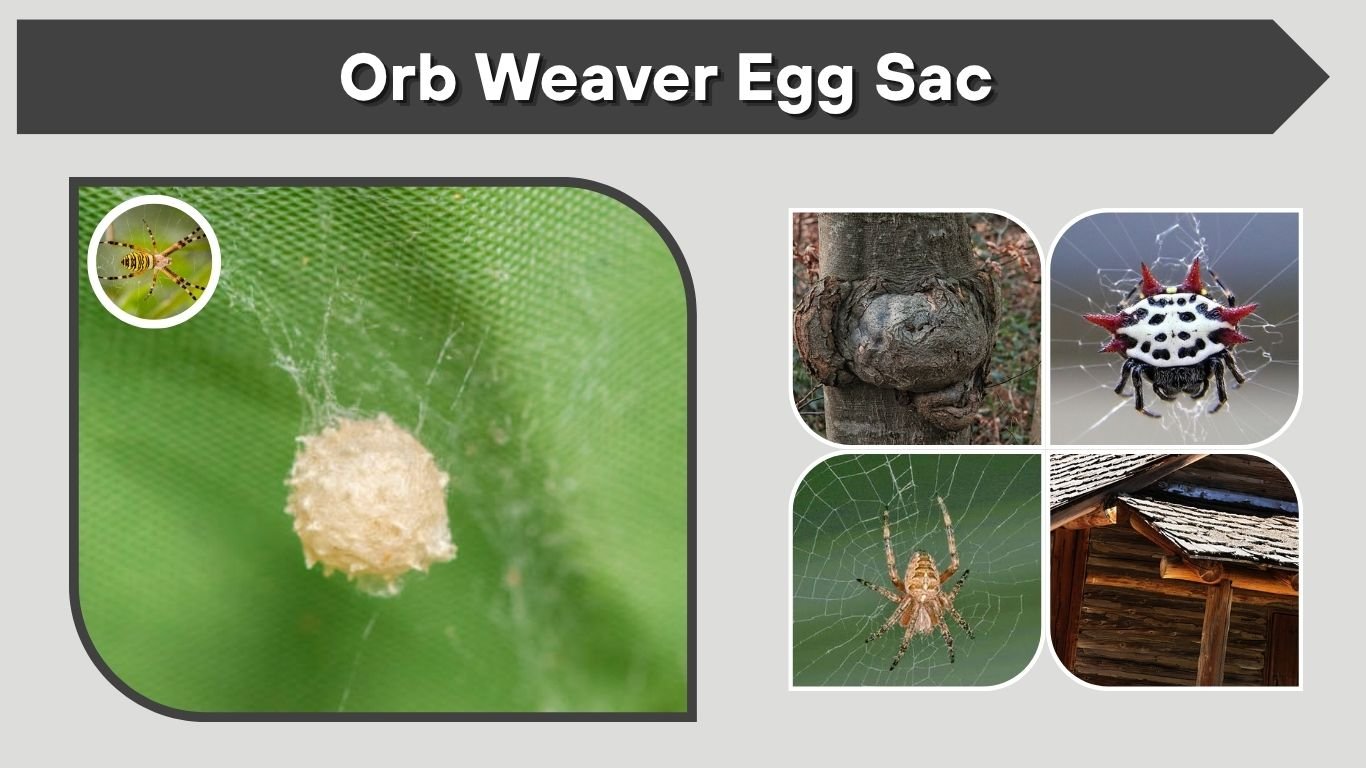
An orb weaver egg sac is a protective silk case containing the eggs or newly hatched spiderlings of an orb-weaving spider. Depending on the species, it may look like a small tan paper pouch, a fluffy yellow ball, a white teardrop, or a greenish bundle attached to a leaf. Orb weavers generally place their sacs in sheltered outdoor locations where the eggs are protected from weather and predators. The exact appearance, number of eggs, and hatching time vary greatly among golden, cross, spiny, spotted, garden, marbled, and other orb weavers.
What Does an Orb Weaver Egg Sac Look Like?
Orb weaver egg sacs are made from multiple layers of silk. The inner layers surround the eggs, while the outer layers may provide insulation, camouflage, and protection from changing humidity or temperature. Spider egg sacs are particularly important for reducing environmental stress on developing embryos.
Most orb weaver egg sacs share several general characteristics:
- Round, oval, pear-shaped, or teardrop-shaped form
- White, cream, yellow, tan, brown, or green coloring
- Papery, cottony, woolly, or loosely tangled texture
- Attached to a leaf, twig, bark, wall, porch, or web support
- Usually surrounded by additional anchoring silk
An orb weaver egg sac should not be identified from color alone. Weather exposure can darken the silk, and debris may become attached to its surface. The species, location, shape, texture, and nearby adult spider provide better identification clues.
Orb Weaver Egg Sac Identification by Species
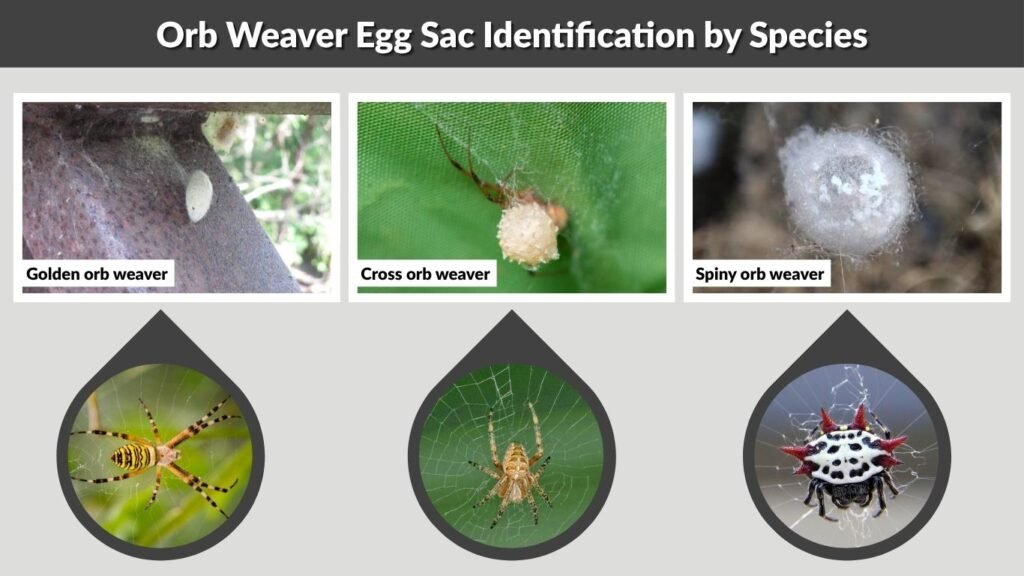
Different orb weavers produce noticeably different sacs. Some are prominently suspended near the web, while others are rolled inside leaves or hidden among vegetation.
| Orb weaver | Typical egg-sac appearance | Eggs and hatching pattern |
|---|---|---|
| Golden orb weaver | Fluffy golden or yellowish silk hidden in foliage | Commonly remains protected through the cooler season |
| Cross orb weaver | Large silken sac hidden near the web | May contain up to about 800 eggs |
| Spiny orb weaver | Oval sac with white, yellow, and green silk | Eggs may hatch in approximately 11–13 days |
| Spotted orb weaver | Yellow, fluffy silk inside a rolled leaf | May contain as many as 1,000 eggs |
| Yellow garden spider | Papery, teardrop-shaped or spherical sac | Commonly contains 500–1,000 spiderlings |
| Marbled orb weaver | Silken sac hidden among leaves and twigs | Usually overwinters and releases young in spring |
These are general descriptions rather than universal rules. Egg-sac size, color, and timing may vary with climate and the individual spider.
Golden Orb Weaver Egg Sac
A golden orb weaver egg sac is often wrapped in a conspicuous mass of yellow or golden silk. The female commonly places it away from the central capture web, hiding it under a broad leaf, inside curled foliage, or among a small cluster of twigs. This concealed placement reduces its visibility to birds, parasitic insects, and other predators.
In some golden silk orb weaver species, the young hatch but remain within the protective silk during unfavorable winter conditions. They emerge when warmer weather provides better opportunities for dispersal and feeding.
Cross Orb Weaver Egg Sac
The female cross orb weaver generally hides her egg sac near the area occupied by her web. A large female may produce a sac containing hundreds of eggs, sometimes as many as approximately 800. She may stay near and guard it during the final part of her life.
Cross orb weavers are seasonal in many temperate areas. Adult spiders are especially noticeable during late summer and fall, while their protected offspring survive the colder period and emerge later.
Spiny Orb Weaver Egg Sac
A spiny orb weaver egg sac can be unusually colorful and complex. The eggs are placed on a white silk sheet and covered with loose white or yellowish silk. The female then adds dark green strands and a canopy of coarse green and yellow silk. The complete oval mass may measure around 20–25 millimeters.
Unlike many temperate orb weavers whose offspring remain protected until spring, spiny-backed orb weaver eggs may hatch after only 11–13 days. The immature spiders then pass through a brief developmental stage before their first molt.
Spotted Orb Weaver Egg Sac
The spotted orb weaver Neoscona crucifera produces a mass of fluffy yellow silk, commonly protected inside a rolled leaf. Its egg mass may measure approximately 5–12 millimeters and can contain up to around 1,000 eggs.
This rolled-leaf structure can make the sac difficult to notice. A homeowner may see only a dry or folded leaf held together by silk rather than an obvious round egg case.
Garden Orb Weaver Egg Sac
The term garden orb weaver egg sac can refer to sacs made by several species. One of the best-known examples belongs to the yellow garden spider, Argiope aurantia. Its sac is generally spherical or teardrop-shaped, with a wool-like insulating layer and a tough outer covering. The silk may initially appear white before becoming tan or brown.
A female yellow garden spider may produce one to four sacs. Each can be close to an inch wide and may hold more than 1,000 eggs. Although the eggs may hatch before winter, the spiderlings often remain together inside the sac and emerge during spring.
Marbled and Furrow Orb Weaver Egg Sacs
Marbled orb weavers usually deposit egg sacs in fall. Each sac may contain several hundred eggs and is commonly concealed among leaves or twigs. The eggs survive the winter, and immature spiders emerge in spring.
Furrow orb weavers also deposit protected groups of eggs in silk. Because several brown and gray orb weavers occupy similar habitats, distinguishing a furrow orb weaver sac from a spotted or cross orb weaver sac based only on appearance can be difficult.
Where Do Orb Weavers Lay Their Egg Sacs?
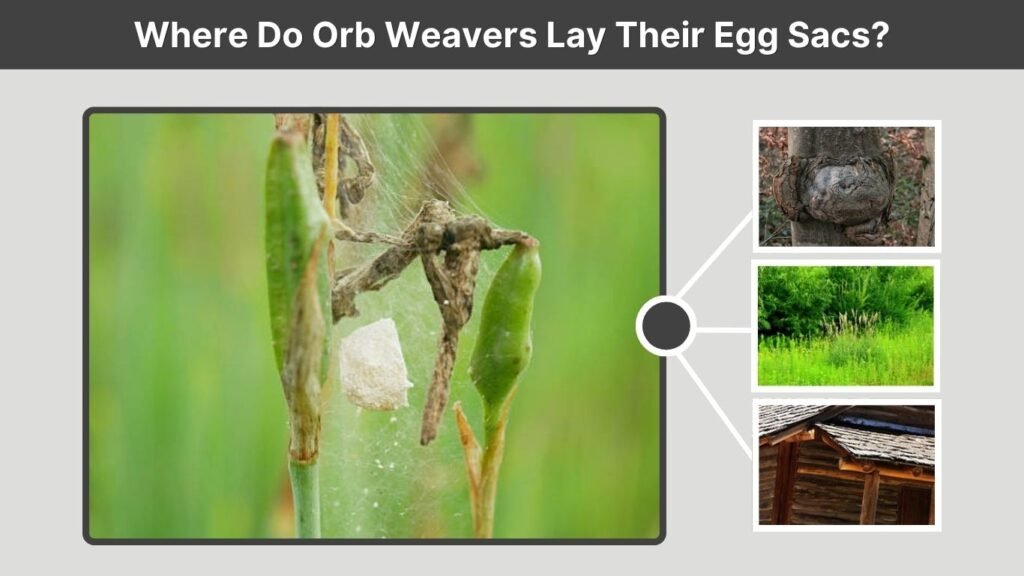
Females choose locations that shield the eggs from heavy rain, wind, direct sunlight, and predators. Common locations include:
- Undersides of leaves
- Rolled or folded foliage
- Crevices in tree bark
- Dense shrubs and tall grasses
- Under porch roofs and deck railings
- Corners of sheds and exterior walls
- Twigs near the original web
- Garden plants and window frames
A sac does not necessarily remain inside the circular web. Many females leave their hunting web and place the eggs in a more protected location. Golden orb weavers, for example, commonly hide the sac in foliage away from the main web.
How Many Egg Sacs Can an Orb Weaver Lay?
The answer depends on the species, the female’s condition, and environmental factors. Some females produce only one major egg sac, while others may produce several.
Yellow garden spiders may create between one and four sacs. Cat-faced orb weavers commonly produce a sac near their web and may make a second one when food and temperature remain favorable.
The number of eggs also varies. A sac may contain dozens, several hundred, or more than 1,000 eggs. However, only a small percentage of the spiderlings normally survive to adulthood. Egg parasites, birds, wasps, weather, food shortages, and cannibalism reduce their numbers. Some yellow garden spider sacs are attacked by parasitic wasps and flies before the spiderlings emerge.
How Long Does an Orb Weaver Egg Sac Take to Hatch?
There is no single hatching period for all orb weavers.
In warm conditions, some species hatch quickly. Spiny-backed orb weaver eggs, for example, may hatch in approximately 11–13 days. Temperate garden, cross, marbled, and golden silk orb weavers often follow a seasonal cycle instead. Eggs may be laid during late summer or fall, with the young remaining protected until spring.
Hatching and emergence are not always the same event. Spiderlings can hatch inside the sac but remain there for weeks or months. They leave only when temperature and environmental conditions become suitable.
Signs that a sac may have hatched include:
- A small opening in the outer silk
- Looser or collapsed material
- Tiny spiderlings gathering nearby
- Fine strands extending from the sac
- Young spiders dispersing through the air
The spiderlings may initially remain clustered together. Later, many climb to an exposed point, release silk into the wind, and disperse through a process called ballooning.
Are Orb Weaver Egg Sacs Dangerous?
Orb weaver egg sacs are not dangerous to people, pets, plants, or buildings. The eggs do not bite, sting, or release harmful substances. Newly emerged spiderlings are tiny and generally disperse rather than establishing a concentrated infestation.
Orb weavers are also not considered dangerous spiders. They are outdoor predators that capture flies, moths, mosquitoes, beetles, and other insects in their webs.
Seeing hundreds of tiny spiderlings can be surprising, but most will leave the immediate area, and relatively few will survive to become adults.
Should You Remove an Orb Weaver Egg Sac?
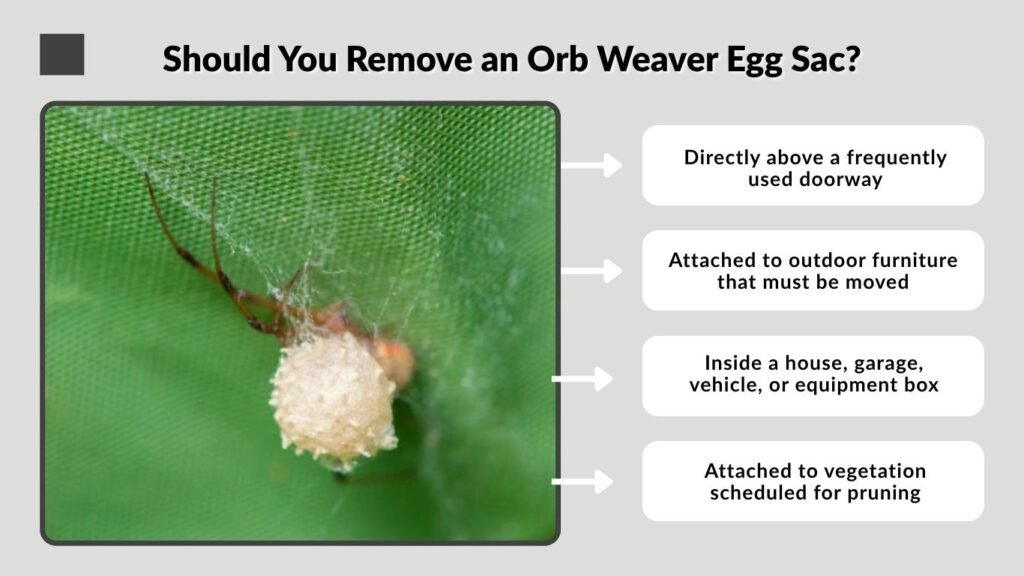
An egg sac in a garden, tree, or unused outdoor corner can usually be left in place. Orb weavers provide natural insect control and rarely create indoor infestations.
Removal may be reasonable when the sac is:
- Directly above a frequently used doorway
- Attached to outdoor furniture that must be moved
- Inside a house, garage, vehicle, or equipment box
- In a location where emerging spiders would cause concern
- Attached to vegetation scheduled for pruning
To remove it, wear gloves and gently detach the surrounding silk with a container, stick, or small garden tool. The sac can be relocated to a sheltered shrub, tree branch, or other protected outdoor area. Avoid crushing it when relocation is the goal.
For unwanted sacs around buildings, extension guidance recommends physically removing webs and egg sacs with a broom, vacuum, or strong spray of water. Reducing exterior lighting and sealing damaged screens can also make the area less attractive to spiders by reducing available insect prey.
FAQs
How can I tell whether an orb weaver egg sac is empty?
An empty sac may appear collapsed, torn, faded, or unusually light. A small emergence opening may also be visible. However, spiderlings sometimes remain inside after hatching, so an intact-looking sac should not automatically be assumed to contain unhatched eggs.
Will an orb weaver egg sac hatch inside my house?
It can hatch indoors when accidentally brought inside with plants, firewood, decorations, or outdoor equipment. The spiderlings are not dangerous, but many tiny spiders may appear at once. Vacuum them gently or collect and release them outdoors.
What time of year do orb weaver eggs hatch?
Many temperate orb weavers emerge in spring after overwintering inside their sacs. Other species living in warm climates can hatch within weeks. The timing depends on species, temperature, humidity, season, and whether the spiderlings remain inside after initially hatching.
Can I move an orb weaver egg sac without damaging it?
A sac can sometimes be relocated successfully when the supporting leaf, twig, or surrounding silk is moved with it. Place it in a protected outdoor location with similar shade and weather exposure. Handling the sac directly may crush the eggs or damage its protective layers.
Is a green egg sac made by an orb weaver?
Possibly. Spiny-backed orb weavers add green silk strands to their egg masses, producing a green, yellow, and white appearance. However, color alone cannot confirm the species because silk can become stained by plants, moisture, algae, weather, or attached debris.
