Spiders move in different ways depending on their species, hunting habits, and body structure. Some crawl slowly, while others run quickly or make sudden jumps to catch prey and escape danger. Wolf spiders are known for their speed and hunting abilities, but can they actually jump? Although they are not specialized jumpers like jumping spiders, wolf spiders can make quick lunges and pouncing movements. Understanding how wolf spiders move, which spiders can jump, and whether they jump toward people helps explain their unusual behavior.
Can Wolf Spiders Jump?
Wolf spiders are primarily ground-dwelling hunters that rely on running to catch insects. Unlike jumping spiders, they do not have a specialized jumping lifestyle. However, they can make sudden forward movements and pounce on prey, which may look like jumping.
Wolf spiders belong to the family Lycosidae. They have strong, hairy legs that help them move quickly across soil, grass, leaf litter, and other surfaces. Instead of building webs to catch insects, they usually hunt by chasing or rushing toward their prey.
When startled, a wolf spider may suddenly change direction or make a short lunge. This movement can surprise people who expect spiders to crawl slowly. However, there is no established jumping distance or height that applies to all wolf spiders.
Why Do Wolf Spiders Appear to Jump?
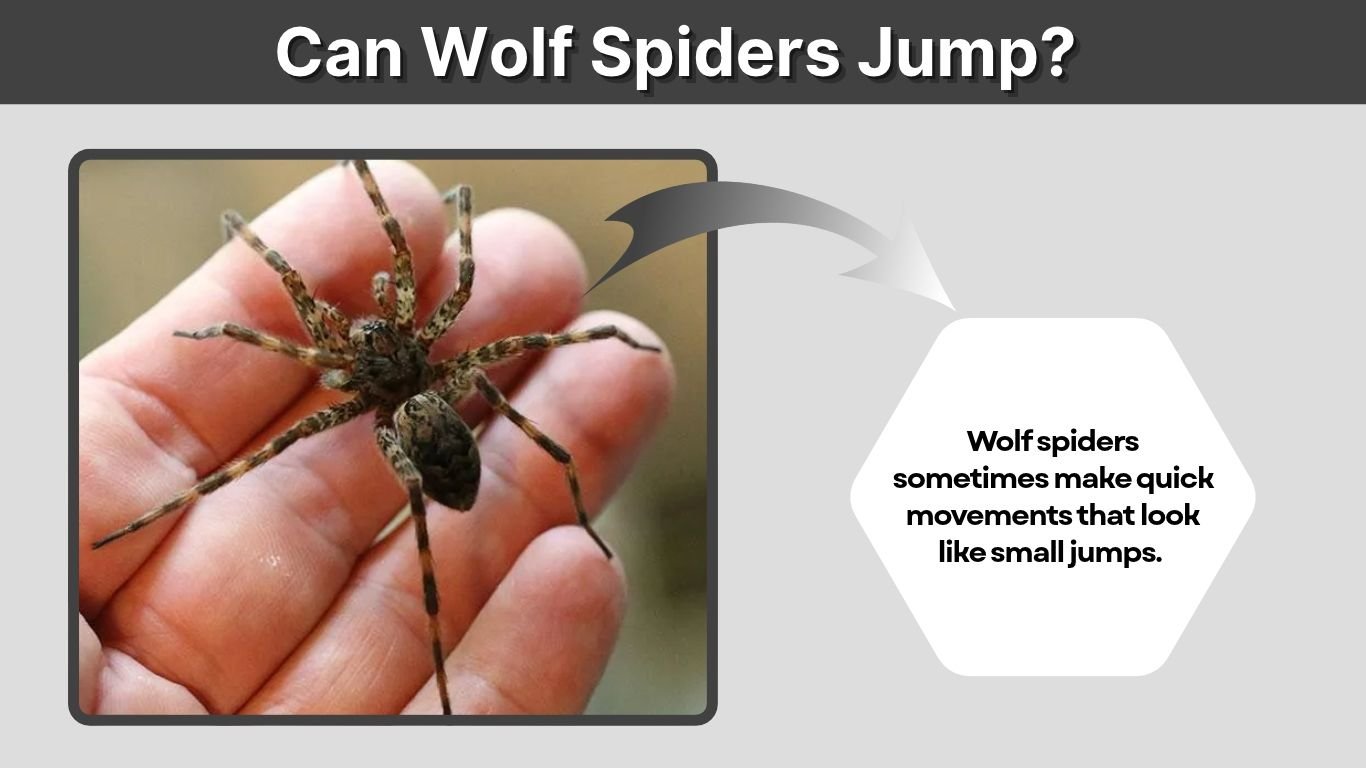
Wolf spiders sometimes make quick movements that look like small jumps. Their hunting behavior involves rushing toward prey, while their defensive behavior often involves escaping quickly.
Their strong legs allow them to accelerate over short distances. When a spider suddenly moves toward an insect or away from a disturbance, its body may briefly leave the surface, making the movement appear like a leap.
According to the University of Nebraska–Lincoln Extension, wolf spiders are ground-hunting spiders that run and capture prey rather than relying on webs. Their legs are adapted for running.
How Far and High Can Wolf Spiders Jump?
There is no reliable, widely accepted measurement for how far or high wolf spiders can jump. Their primary movement is running, and their hunting strategy involves quickly approaching prey on the ground.
Their movement depends on body size, age, physical condition, and the surface they are crossing. A wolf spider may make a brief pouncing movement when catching an insect, but it should not be compared with the impressive leaps of jumping spiders.
Jumping spiders, by comparison, can cover several times their body length in a single leap. Researchers at the University of Manchester studied a regal jumping spider (Phidippus regius) that could jump up to six times its body length from a standing position.
This difference is important because wolf spiders and jumping spiders belong to separate families with different movement and hunting behaviors.
Which Spiders Can Jump?
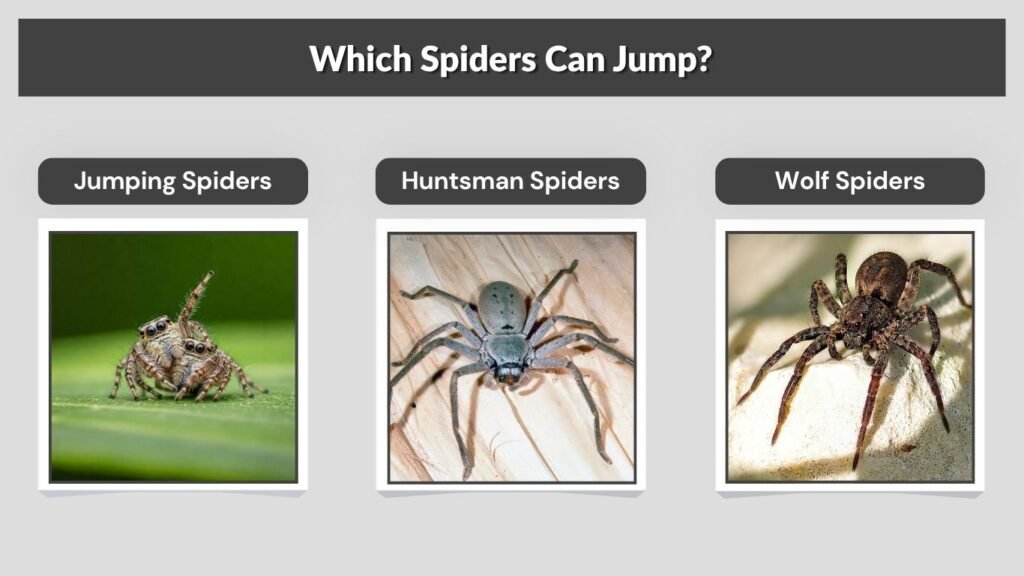
Not all spiders have the same jumping ability. Some species are specialized jumpers, while others mainly crawl, run, climb, or use webs to capture prey. Several spider groups are known for making noticeable leaps.
1. Jumping Spiders
Jumping spiders belong to the family Salticidae and are among the best-known jumping arachnids. They have excellent eyesight and use their powerful legs to leap toward insects, move between surfaces, and escape predators.
Many jumping spiders can travel several times their body length in one jump. Their ability to judge distances accurately helps them land on small targets.
They also produce a silk safety line before jumping. If they miss their target, this line can help prevent them from falling.
2. Huntsman Spiders
Huntsman spiders are large, fast-moving spiders that can make spring-like movements. They sometimes appear to jump when escaping predators or avoiding people.
However, according to the University of the Sunshine Coast, this movement can be more like a tactical fall than a true controlled jump. Their long legs can make the movement look like a sudden leap.
3. Wolf Spiders
Wolf spiders are active hunters that use speed and powerful legs to capture insects. They usually run along the ground rather than performing the long, accurate jumps associated with jumping spiders.
Their sudden pouncing movements may look like small jumps, especially when they capture nearby prey.
4. Other Hunting Spiders
Some other hunting spiders can make short leaps or sudden lunges during movement. However, their jumping abilities vary considerably.
Spiders use different locomotion strategies depending on their body structure, hunting methods, and environment. Not every hunting spider is capable of the same type of jump.
Can Other Common Spiders Jump?
Many people wonder whether familiar household and garden spiders can jump. The answer depends on the species. Some are capable of short jumping movements, while others mainly rely on walking, running, or climbing.
- Brown recluse spiders: They do not normally jump. According to the Alabama Cooperative Extension System, they generally flee when threatened and rely on running rather than jumping.
- Black widow spiders: They are not specialized jumpers. They typically remain associated with their irregular webs and move across the web or nearby surfaces.
- House spiders: Most common house spiders rely on walking, climbing, and web-building. Their jumping ability varies by species.
- Cellar spiders: These spiders have long, thin legs and usually remain near their webs. They are better known for their web-building behavior than jumping.
- Crab spiders: They generally walk or move sideways while waiting to ambush insects. Some may make short sudden movements when disturbed.
- Garden spiders: Most orb-weaving garden spiders depend on webs to capture insects rather than jumping after prey.
Therefore, seeing a spider move suddenly does not necessarily mean it is a specialized jumping species.
Why Do Spiders Jump?
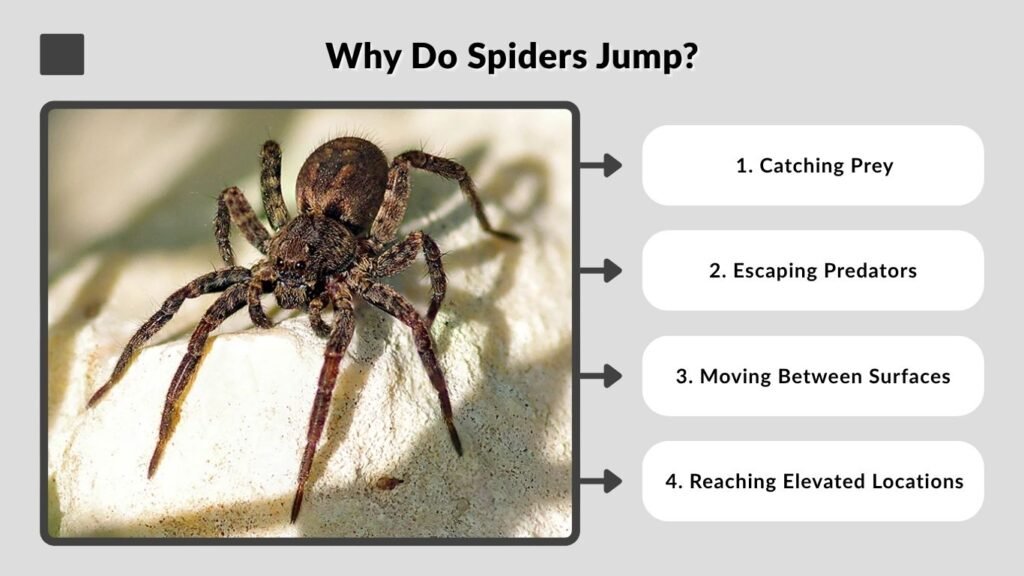
Spiders that can jump use this ability for several purposes. Jumping helps them capture prey, move between surfaces, and avoid potential threats. It is particularly useful for small spiders that need to travel quickly through vegetation.
1. Catching Prey
Jumping spiders use their eyesight to locate insects before moving closer. Once they are within a suitable distance, they leap toward the prey and capture it with their legs and mouthparts.
This hunting technique allows them to catch insects without building traditional prey-catching webs.
2. Escaping Predators
Some spiders jump or make sudden leaps when they sense danger. This quick movement can help them escape predators such as birds, lizards, frogs, and larger spiders.
Jumping away from danger can also help them reach nearby hiding places.
3. Moving Between Surfaces
Jumping can help spiders cross gaps between leaves, branches, rocks, and other surfaces. It is particularly useful for jumping spiders that actively explore their surroundings.
Their silk safety lines provide additional protection when they make these movements.
4. Reaching Elevated Locations
Some jumping spiders use leaps to reach higher surfaces or move between different levels of vegetation. Their excellent vision helps them judge distances and select suitable landing locations.
Can Wolf Spiders Jump at You?
Wolf spiders do not normally jump toward people intentionally. They are generally more interested in catching insects or escaping disturbances than approaching humans.
If you move close to a wolf spider, it may suddenly run in another direction. This quick movement can make it appear as though the spider is jumping at you, even when it is simply trying to escape.
Wolf spiders are not considered aggressive toward people. However, like other spiders, they may bite if handled, trapped, or repeatedly disturbed.
If you find one indoors, avoid touching it with your hands. You can gently guide it into a container and release it outside.
FAQs
1. Can wolf spiders jump high?
Wolf spiders are primarily runners rather than specialized jumpers. They can make sudden pouncing movements, but there is no established measurement for how high they can jump. Jumping spiders are much better adapted for controlled leaps.
2. How far can wolf spiders jump?
There is no reliable standard measurement for wolf spider jumping distance. They generally chase prey by running across the ground and making short pouncing movements rather than performing long-distance jumps.
3. Can wolf spiders jump at humans?
Wolf spiders do not normally jump at humans intentionally. They usually try to escape when disturbed. Their sudden movements may appear directed toward someone, but they are generally trying to find a safe place.
4. Can brown recluse spiders jump?
Brown recluse spiders do not normally jump. They rely on walking and running to move around. When disturbed, they generally attempt to escape rather than leap toward people or other animals.
5. What spiders can jump the farthest?
Jumping spiders are among the best-known jumping arachnids. Some can leap several times their body length. Research on a regal jumping spider documented jumps of up to six body lengths from a standing position.
