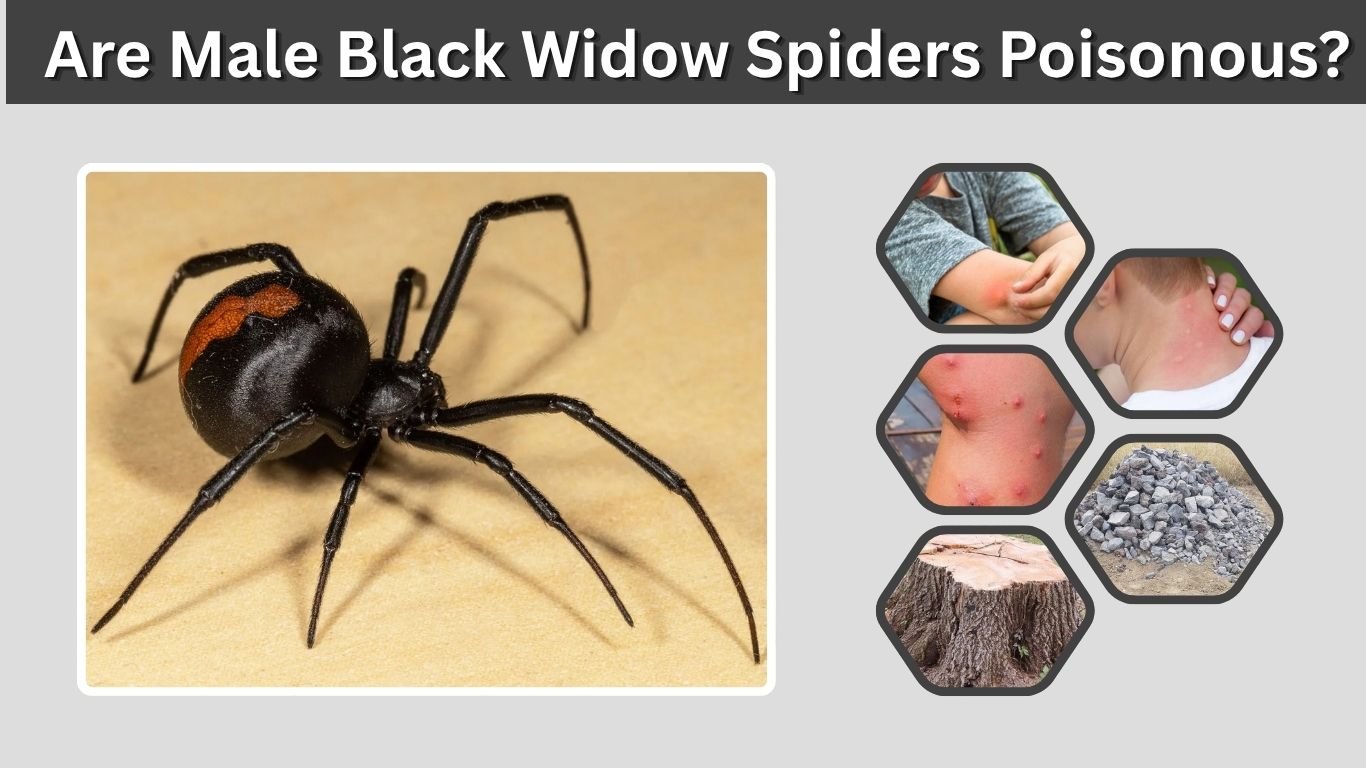
Male black widow spiders are venomous, but they are generally harmless to humans because their tiny fangs cannot effectively penetrate human skin. Unlike female black widows, which can deliver medically significant venom through their bites, males are much smaller and pose little danger. These spiders possess venom glands, but their physical characteristics make serious human envenomation extremely unlikely. Understanding whether male black widow spiders are poisonous, how their venom works, and how they differ from females can help people identify them correctly and avoid unnecessary fear.
Are Male Black Widow Spiders Poisonous or Venomous?
Male black widow spiders are venomous rather than poisonous. They belong to the genus Latrodectus, a group of spiders known for producing neurotoxic venom. However, the presence of venom does not automatically make an animal dangerous to humans. Male black widows have relatively small venom glands and short fangs, greatly reducing their ability to deliver venom through human skin.
Do Male Black Widow Spiders Have Venom?
Yes, male black widow spiders possess venom glands, just like females. Their venom is part of the biological system that widow spiders use to subdue prey.
Black widow venom contains neuroactive toxins, including substances from the latrotoxin family. These chemicals can interfere with nerve signaling in susceptible animals.
However, male spiders have smaller venom-delivery structures than females. Their venom generally does not present a medically significant threat to humans because their fangs are too short to penetrate ordinary human skin.
What Is the Difference Between Poisonous and Venomous?
The terms poisonous and venomous describe different ways toxins enter another organism.
A poisonous animal causes harm when its toxins are swallowed, absorbed, or otherwise contacted. A venomous animal actively delivers toxins, usually through a bite or sting.
Black widow spiders are classified as venomous because their specialized fangs deliver venom. Therefore, “Are male black widow spiders venomous?” is the scientifically accurate version of the commonly searched question.
Can Male Black Widow Spiders Bite Humans?
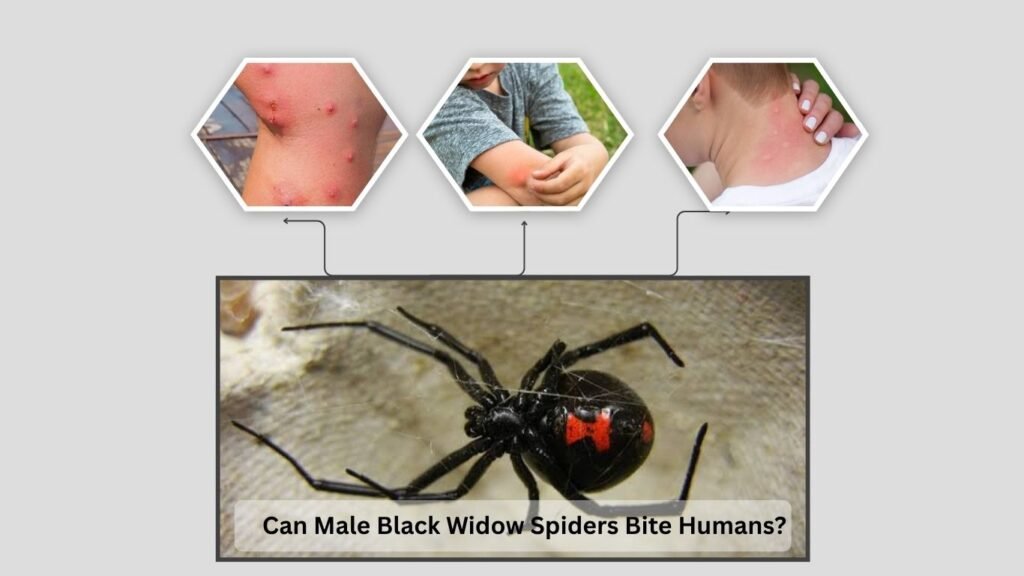
Male black widow spiders have fangs, but their ability to bite humans is extremely limited. Unlike adult females, males typically cannot penetrate human skin effectively. They are also not aggressive toward people and generally avoid unnecessary encounters. Although their venom is biologically active, documented medically significant black widow bites overwhelmingly involve adult females rather than males.
Can a Male Black Widow Spider Bite You?
Male black widow spiders possess biting structures called chelicerae, which contain their fangs.
However, these structures are very small compared with those of females. Their short fangs generally cannot pierce human skin, preventing effective venom injection.
Consequently, male black widows are not considered a significant human bite hazard. Even when disturbed, they are more likely to retreat than attempt to defend themselves.
What Happens If a Male Black Widow Bites You?
A confirmed medically significant male black widow bite is exceptionally unlikely. Their small fangs normally prevent them from injecting venom into human skin.
If someone notices redness, itching, or discomfort after encountering a small spider, these symptoms do not establish that a male black widow caused the problem.
Possible concerns following an unidentified spider encounter include:
- Localized redness: Mild irritation may develop for several reasons.
- Itching: Skin reactions can result from other insects or irritants.
- Minor discomfort: Temporary pain does not confirm venom injection.
- Uncertain identification: A juvenile female may be mistaken for an adult male.
Severe symptoms should never be dismissed simply because the spider was believed to be male.
Male vs. Female Black Widow Spiders: Key Differences
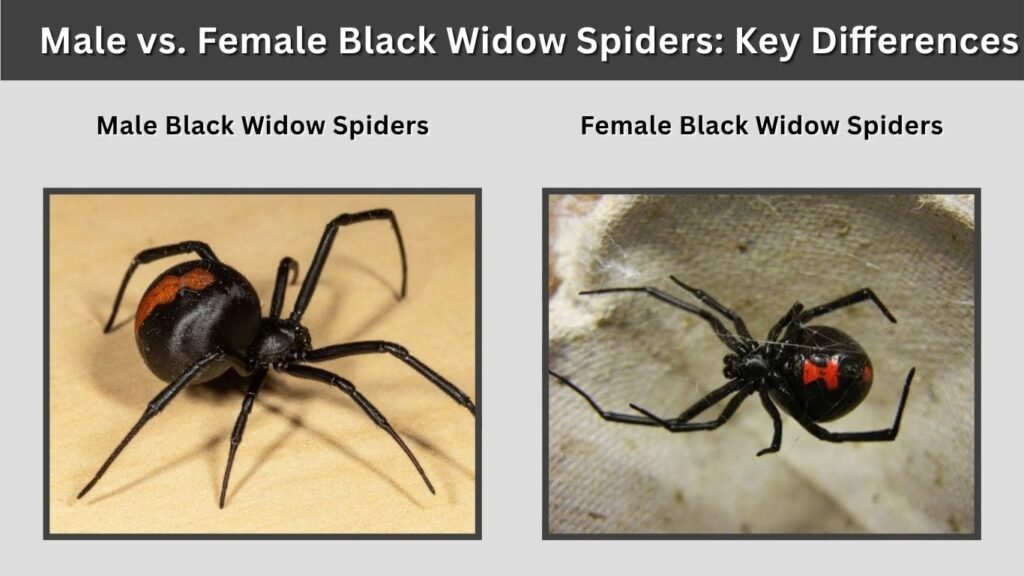
Male and female black widow spiders differ considerably in body size, coloration, appearance, and medical significance. Adult females are typically larger, with rounded black abdomens and conspicuous red markings. Males are much smaller and often display brownish coloration with lighter patterns. Understanding these differences is particularly useful because young female black widows can resemble adult males.
Differences in Size and Appearance
Adult female black widows typically have body lengths of approximately 8–13 millimeters, although measurements vary by species.
Males are often around 3–6 millimeters long, with relatively slender bodies and smaller abdomens.
Important visual differences include:
- Body size: Females are generally considerably larger.
- Body color: Mature females are often glossy black, while males may be brown or grayish.
- Abdomen: Females have larger, more rounded abdomens.
- Markings: Males frequently retain pale stripes and reddish or orange spots.
- Legs: Males have slender legs that appear relatively long compared with their bodies.
Differences in Venom and Bite Danger
The most important difference between male and female black widows is their ability to deliver venom to humans.
| Feature | Male black widow | Female black widow |
| Possesses venom | Yes | Yes |
| Fang size | Very small | Larger |
| Can penetrate human skin | Generally no | Yes |
| Medical significance | Negligible | Potentially serious |
| Human bite risk | Extremely low | Low, but greater than males |
Female black widow venom can produce a condition called latrodectism, involving severe muscle pain, cramping, sweating, and other nervous-system symptoms.
However, females are not naturally aggressive toward humans and usually bite when trapped, pressed against skin, or threatened.
How to Identify a Male Black Widow Spider
Identifying male black widow spiders can be challenging because they look noticeably different from the familiar glossy black females. Their smaller size, slender bodies, and contrasting markings may cause people to mistake them for unrelated spider species. Examining several characteristics together provides better identification than relying on coloration or a single abdominal marking.
Physical Characteristics of Male Black Widows
Adult males possess distinctive features that can help separate them from mature females.
Look for the following characteristics:
- Small body: Usually only a few millimeters long.
- Slender abdomen: Less rounded than an adult female’s.
- Brownish coloration: Often mixed with gray or darker markings.
- Pale stripes: Light markings may appear along the abdomen.
- Long, thin legs: Sometimes marked with alternating light and dark bands.
- Enlarged pedipalps: Mature males have bulbous structures near the mouth used during mating.
Coloration varies among southern, northern, and western black widow species.
Can Juvenile Female Black Widows Look Like Males?
Yes, immature female black widows can resemble adult males because they may have lighter coloration, smaller bodies, and patterned abdomens.
Young females gradually change appearance as they mature. In many species, they become darker and develop the characteristic appearance associated with adult black widows.
This resemblance is important because an unidentified small widow spider should not automatically be assumed harmless. Avoid direct handling, especially when its sex or maturity is uncertain.
Where Do Male Black Widow Spiders Live?
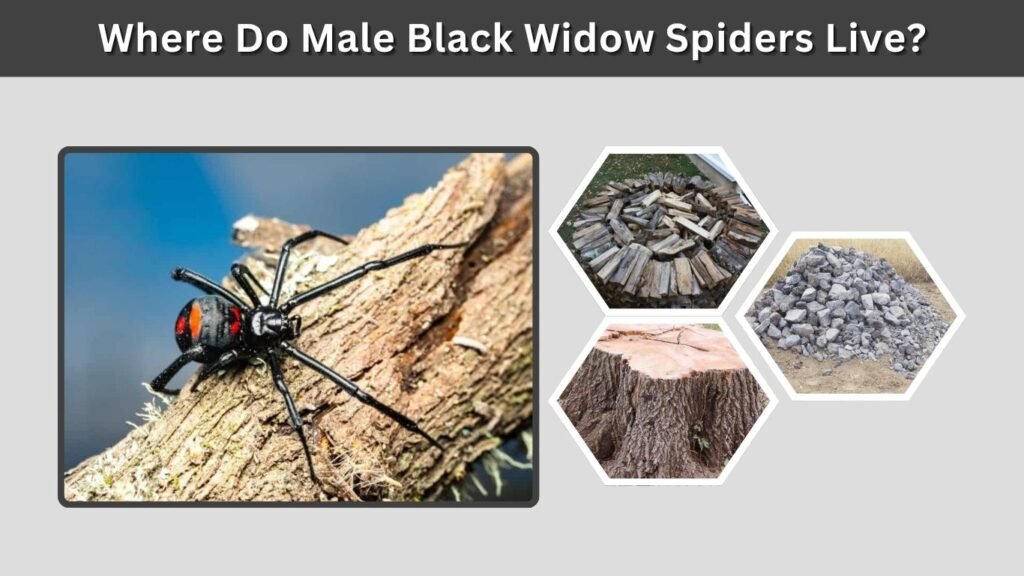
Male black widow spiders inhabit many of the same general environments as females, including gardens, woodpiles, sheds, and sheltered outdoor structures. However, their behavior changes as they mature. While females typically remain near established webs, adult males may travel in search of potential mates. This movement sometimes brings males into residential areas where people encounter them unexpectedly.
Common Hiding Places of Male Black Widows
Male black widows can occur in protected environments where suitable prey and potential mates are available.
Common locations include:
- Woodpiles: Gaps between logs provide sheltered spaces.
- Garages: Quiet corners offer protection from disturbance.
- Garden sheds: Stored tools and equipment create hiding places.
- Rock crevices: Narrow openings provide natural shelter.
- Outdoor furniture: Undersides and protected corners may contain webs.
- Basements: Occasionally suitable when access and shelter are available.
Male black widows may also be found near female webs during the breeding period.
Are Male Black Widow Spiders Aggressive?
Male black widow spiders are not considered aggressive toward humans. Their primary activities involve survival, locating potential mates, and avoiding threats.
Adult males may move between webs while searching for females, making them more mobile than web-dwelling adult females.
If a male black widow is discovered, avoid touching or squeezing it. Use caution when moving stored belongings, wear gloves during outdoor work, and keep clutter away from frequently used areas.
FAQs
1. Are Male Black Widow Spiders Dangerous to Humans?
No, male black widow spiders are not considered medically dangerous to humans. Although they possess venom, their small fangs generally cannot penetrate human skin. Adult female black widows are responsible for medically significant bites, making accurate identification important when encountering an unfamiliar widow spider.
2. Do Male Black Widow Spiders Have Poison?
Male black widow spiders possess venom rather than poison. Their venom glands contain toxins associated with their predatory biology, but their small venom-delivery structures make harmful human bites extremely unlikely. The term “venomous” is more scientifically accurate than “poisonous” when describing black widow spiders.
3. Can Male Black Widow Spiders Kill Humans?
Male black widow spiders are not regarded as a fatal threat to humans. Their tiny fangs generally cannot penetrate human skin to deliver venom. Serious black widow envenomation is associated with adult females, although fatalities from black widow bites are rare with modern medical care.
4. Are Baby Black Widow Spiders Poisonous?
Young black widow spiders possess venom, but their small size generally prevents them from delivering medically significant bites to humans. However, juvenile females can resemble adult males, so identification is important. Avoid handling any unidentified black widow spider, regardless of its size or apparent age.
5. Are Female Black Widow Spiders More Venomous Than Males?
Female black widow spiders are substantially more dangerous to humans because they have larger venom glands and longer fangs capable of penetrating skin. Males also possess venom, but their physical limitations make medically significant bites extremely unlikely. The difference concerns venom delivery as well as body size.
