
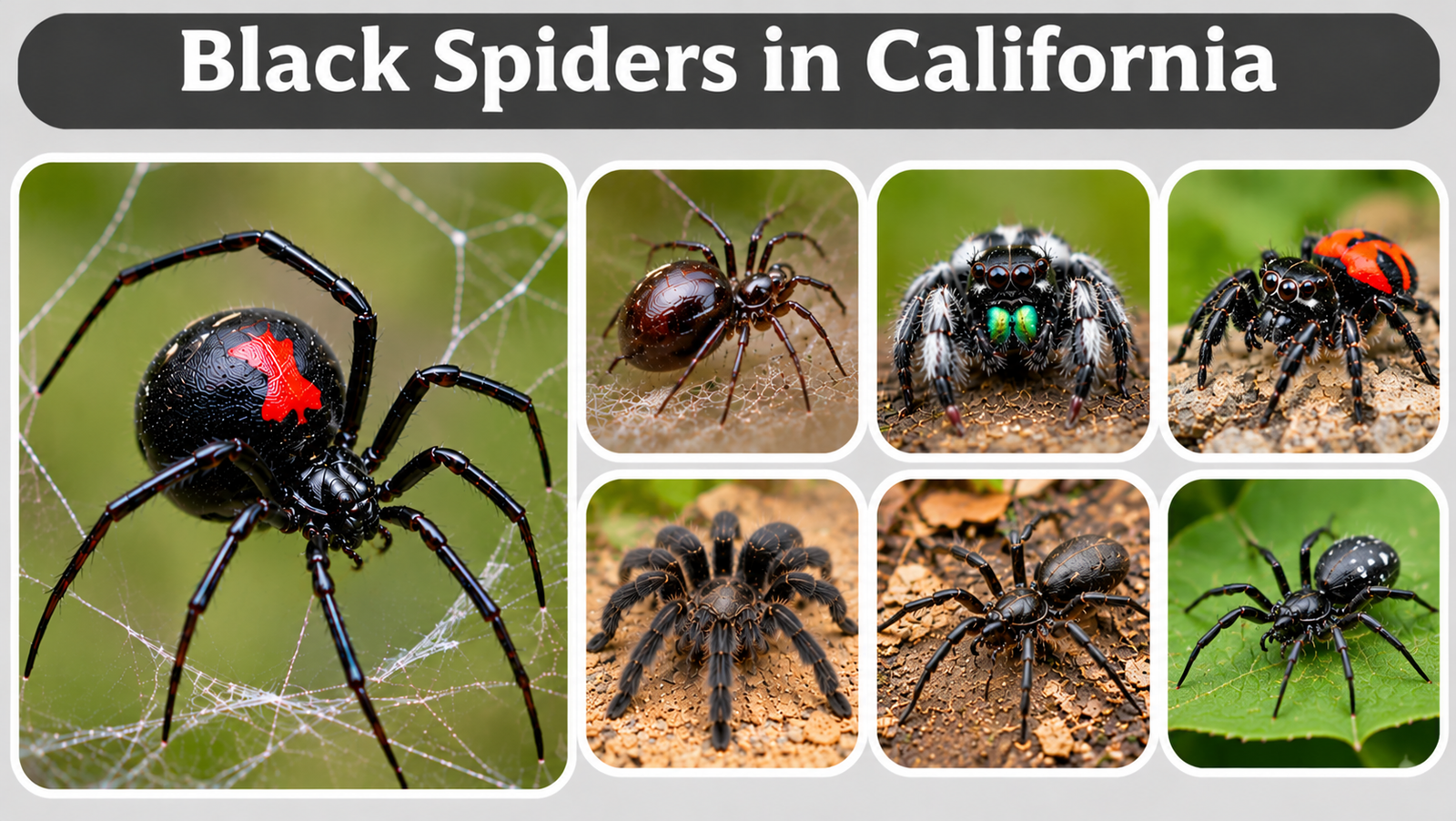
Black spiders in California are commonly found in gardens, garages, forests, and residential neighborhoods. Some have shiny black bodies with distinctive red markings, while others are covered in dark hairs or display white spots. Although black widow spiders attract the most attention because of their venom, most dark-colored spiders in California are harmless to humans. Identifying them correctly requires examining their body shape, size, markings, and habitat. This guide explores eight types of black spiders in California, including common house spiders, jumping spiders, tarantulas, and black widow lookalikes.
8 Common Types of Black Spiders in California
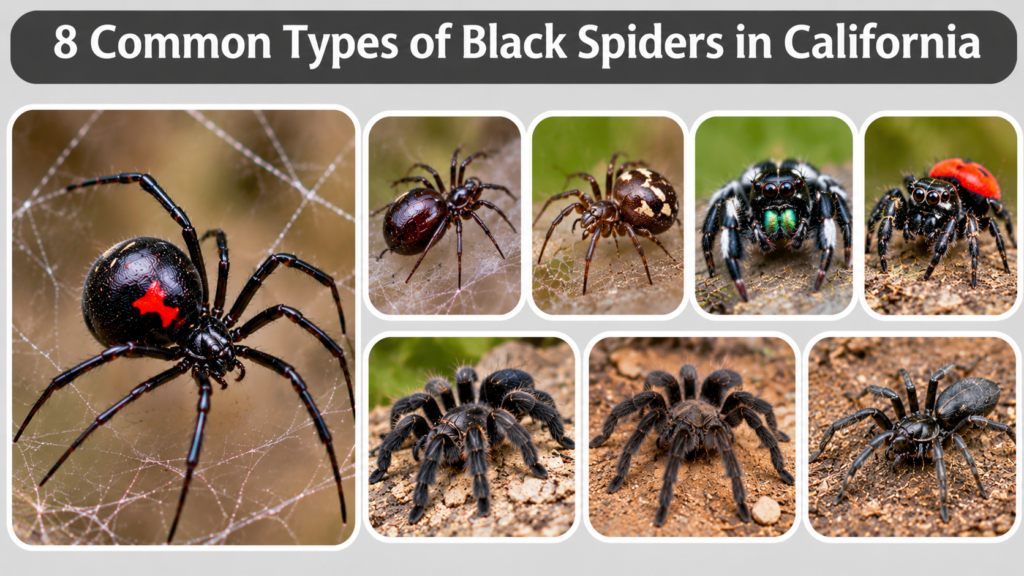
California supports a wide variety of spider species because of its diverse habitats, including deserts, coastal regions, mountains, and urban landscapes. Several species have predominantly black or very dark bodies, while others display black-and-white or black-and-red patterns. The following eight spiders and spider groups are useful starting points for identification.
1. Western Black Widow Spider (Latrodectus hesperus)
The western black widow is one of the most recognizable black spiders in California. Adult females have glossy black bodies, rounded abdomens, and reddish-orange hourglass markings underneath their abdomens.
Identification features:
- Glossy black body and long, slender legs.
- Rounded abdomen with a red hourglass underneath.
- Adult female body length around 0.5 inch.
- Irregular, tangled webs.
- Common around woodpiles, garages, and sheds.
Western black widows occur throughout California, including both Northern and Southern California. They prefer dark, sheltered areas and are usually active at night.
Their venom can cause medically significant symptoms, but they rarely bite unless disturbed or trapped against the skin.
2. False Black Widow Spider (Steatoda grossa)
The false black widow is a common dark-colored house spider in California. It closely resembles a true black widow but typically has a chocolate-brown or purplish-black body.
Identification features:
- Dark brown to nearly black appearance.
- Large, rounded abdomen.
- No red hourglass marking.
- Body length up to approximately 0.4 inch.
- Irregular cobwebs in sheltered locations.
False black widows frequently inhabit cupboards, garages, storage spaces, and areas underneath furniture.
Unlike western black widows, they can thrive indoors. Their bites may cause localized pain or swelling but are generally much less medically concerning than true black widow bites.
3. Noble False Widow Spider (Steatoda nobilis)
The noble false widow is another black widow lookalike found in California, particularly in coastal areas.
Its body is usually dark brown rather than completely black, with lighter cream or tan markings across the abdomen.
Identification features:
- Dark, glossy abdomen with pale markings.
- Rounded body and relatively slender legs.
- Female body length reaches about 0.6 inch.
- Irregular cobwebs.
- Often found around buildings and sheltered spaces.
Noble false widows have been recorded in coastal Southern California and parts of the San Francisco Bay Area.
Although bites may be painful, most reported reactions are relatively mild.
4. Bold Jumping Spider (Phidippus audax)
The bold jumping spider is a distinctive black-and-white spider found in parts of California.
It has a compact, hairy body, powerful legs, and large forward-facing eyes. Adults typically display three white spots on their black abdomens.
Identification features:
- Black body with three white abdominal spots.
- Metallic green or blue mouthparts.
- Short, strong legs.
- Large forward-facing eyes.
- Excellent jumping ability.
Bold jumping spiders have established populations in the Central Valley and parts of Southern California.
They hunt insects during daylight rather than using webs to capture prey. They are generally harmless to people and beneficial in gardens.
5. Johnson Jumping Spider (Phidippus johnsoni)
Johnson jumping spiders, also called red-backed jumping spiders, are found across California.
They typically have black bodies with prominent red or orange-red markings on their abdomens.
Identification features:
- Black, hairy body.
- Bright red or orange-red abdominal coloration.
- Large front-facing eyes.
- Compact, muscular legs.
- Fast movements and short jumps.
These spiders inhabit gardens, shrubs, rocky environments, and areas around buildings.
Johnson jumping spiders are active predators that capture flies, moths, and other insects. They do not build traditional prey-catching webs and rarely present a danger to humans.
6. California Ebony Tarantula (Aphonopelma eutylenum)
The California ebony tarantula is one of the large, dark, hairy spiders found in Southern California.
Its body may appear dark brown, charcoal, or nearly black, depending on the individual and lighting.
Identification features:
- Large, heavily built body.
- Dark brown or blackish coloration.
- Thick, hairy legs.
- Ground-dwelling behavior.
- Burrows in soil and sheltered terrain.
California ebony tarantulas inhabit parts of Southern California, including coastal mountains and surrounding inland regions.
Mature males may wander during the breeding season, making them more visible on trails and roads.
Their bites are generally not medically dangerous, although defensive hairs can irritate the skin and eyes.
7. Johnny Cash Tarantula (Aphonopelma johnnycashi)
The Johnny Cash tarantula is a California species named in honor of the famous musician.
Adult males have particularly dark bodies, giving them a striking black appearance.
Identification features:
- Dark or nearly black adult males.
- Large, hairy body and legs.
- Strong, ground-dwelling build.
- Burrows in natural habitats.
- Males wander during mating season.
This tarantula occurs along the western foothills of the Sierra Nevada Mountains.
It spends much of its life underground, emerging primarily for feeding and reproduction.
Despite its intimidating appearance, it generally avoids people and is not considered medically dangerous.
8. Ground Spiders (Family Gnaphosidae)
Ground spiders are a diverse family that includes several dark brown, charcoal, and black species found in California.
Many have elongated bodies and move rapidly across soil, rocks, and indoor floors.
Identification features:
- Dark brown, gray, or black bodies.
- Elongated abdomen.
- Relatively fast ground movements.
- Little or no visible prey-catching web.
- Common underneath stones and debris.
Ground spiders actively hunt insects rather than relying on traditional webs.
They may occasionally enter homes while searching for prey or shelter. Most are not medically significant to humans.
Black Spiders in Southern vs. Northern California
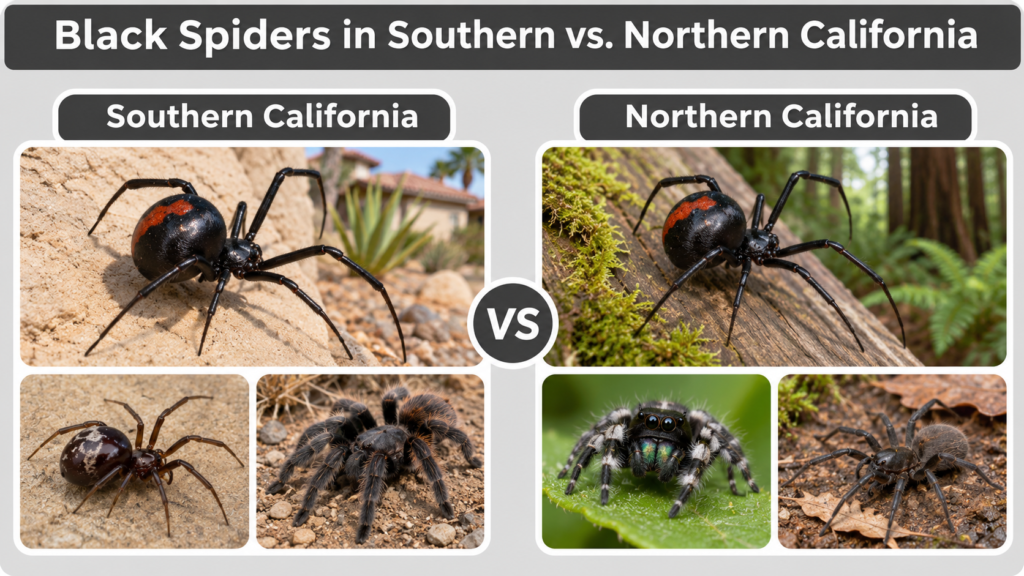
The types of black spiders encountered in California depend on regional climate, vegetation, and available habitats. Warm desert areas, coastal neighborhoods, and cooler northern forests support different spider communities. However, many species have broad distributions and can appear in several regions of the state.
Black Spiders in Southern California
Southern California provides favorable conditions for western black widows, false widows, jumping spiders, and several tarantula species.
Black widows commonly inhabit sheltered outdoor locations, while brown widows may also be abundant around patio furniture and residential structures.
Large, dark tarantulas are more likely to be encountered in natural habitats, particularly during their mating seasons.
Black Spiders in Northern California
Northern California supports western black widows, false black widows, jumping spiders, ground spiders, and tarantulas in suitable habitats.
Around houses, dark cobweb spiders may be mistaken for black widows.
In foothills and grasslands, tarantulas can occasionally be spotted moving across the ground, especially when mature males search for mates.
How to Identify Black Spiders in California
Black coloration alone is not enough to identify a spider. Body shape, markings, movement, and web structure provide more reliable clues. Some medically significant spiders resemble harmless species, so homeowners should avoid handling unfamiliar spiders during identification.
Identification by Color and Markings
Use these characteristics as a starting point:
| Appearance | Possible Identification |
| Shiny black with red hourglass | Western black widow |
| Dark brown, rounded abdomen | False black widow |
| Black with three white spots | Bold jumping spider |
| Black with red abdomen | Johnson jumping spider |
| Large, black, and hairy | Dark-colored tarantula |
| Dark, elongated, fast-moving | Ground spider |
Examine photographs from a safe distance when possible. Multiple features should support the identification.
Identification by Size and Behavior
Small black spiders that jump frequently belong to the jumping spider family.
Large, hairy spiders walking along trails may be tarantulas.
Glossy black spiders remaining in irregular webs could be western black widows or closely related cobweb spiders.
Fast-moving dark spiders on floors may belong to ground spider or other hunting spider families.
Are Black Spiders in California Dangerous?

Most black spiders in California are not dangerous to humans. They generally avoid confrontation and help reduce insect populations. However, identifying western black widows is important because their venom can cause significant pain and other symptoms.
Which Black Spiders Are Venomous?
Nearly all spiders possess venom used to capture prey, but only a small proportion are medically significant to humans.
The western black widow is the primary spider of medical concern in California.
A black widow bite may cause muscle cramps, abdominal pain, sweating, nausea, and other symptoms.
Anyone who suspects a black widow bite should seek prompt medical advice. Severe symptoms require emergency medical attention.
How to Keep Black Spiders Out of Your House
Reducing sheltered hiding places and insect populations can discourage spiders from entering homes.
Helpful measures include:
- Seal cracks around doors and windows.
- Remove unnecessary clutter from garages.
- Store firewood away from exterior walls.
- Repair damaged window screens.
- Vacuum unused corners and storage areas.
- Inspect gardening equipment before handling it.
Avoid touching unfamiliar spiders with bare hands. Professional pest control may be appropriate when black widows repeatedly appear near frequently occupied areas.
FAQs
1. What Are the Most Common Black Spiders in California?
Western black widows, false black widows, jumping spiders, and various ground spiders are frequently encountered in California. Their abundance varies by region and habitat. Black widows are particularly recognizable because mature females have shiny black bodies and distinctive red hourglass markings.
2. Are There Black Widow Spiders in California?
Yes. Western black widows (Latrodectus hesperus) occur throughout much of California, including Northern and Southern California. They commonly inhabit garages, sheds, woodpiles, and sheltered outdoor spaces. Although their venom can cause serious symptoms, bites are relatively uncommon.
3. What Are the Big Black Spiders in California?
Large black or dark-colored spiders in California may be tarantulas, including California ebony and Johnny Cash tarantulas. Some other large hunting spiders may also appear dark. Most tarantulas avoid people and are not considered medically dangerous.
4. What Are the Small Black Spiders With White Spots in California?
Small black spiders with white spots may be bold jumping spiders (Phidippus audax). These spiders have compact bodies, large forward-facing eyes, and prominent pale abdominal markings. They actively hunt insects during daylight and are generally harmless to humans.
5. Are Black House Spiders in California Poisonous?
Most dark-colored house spiders in California are not medically dangerous. False black widows and jumping spiders are commonly mistaken for more dangerous species. However, adult female western black widows have medically significant venom and should never be handled directly.
