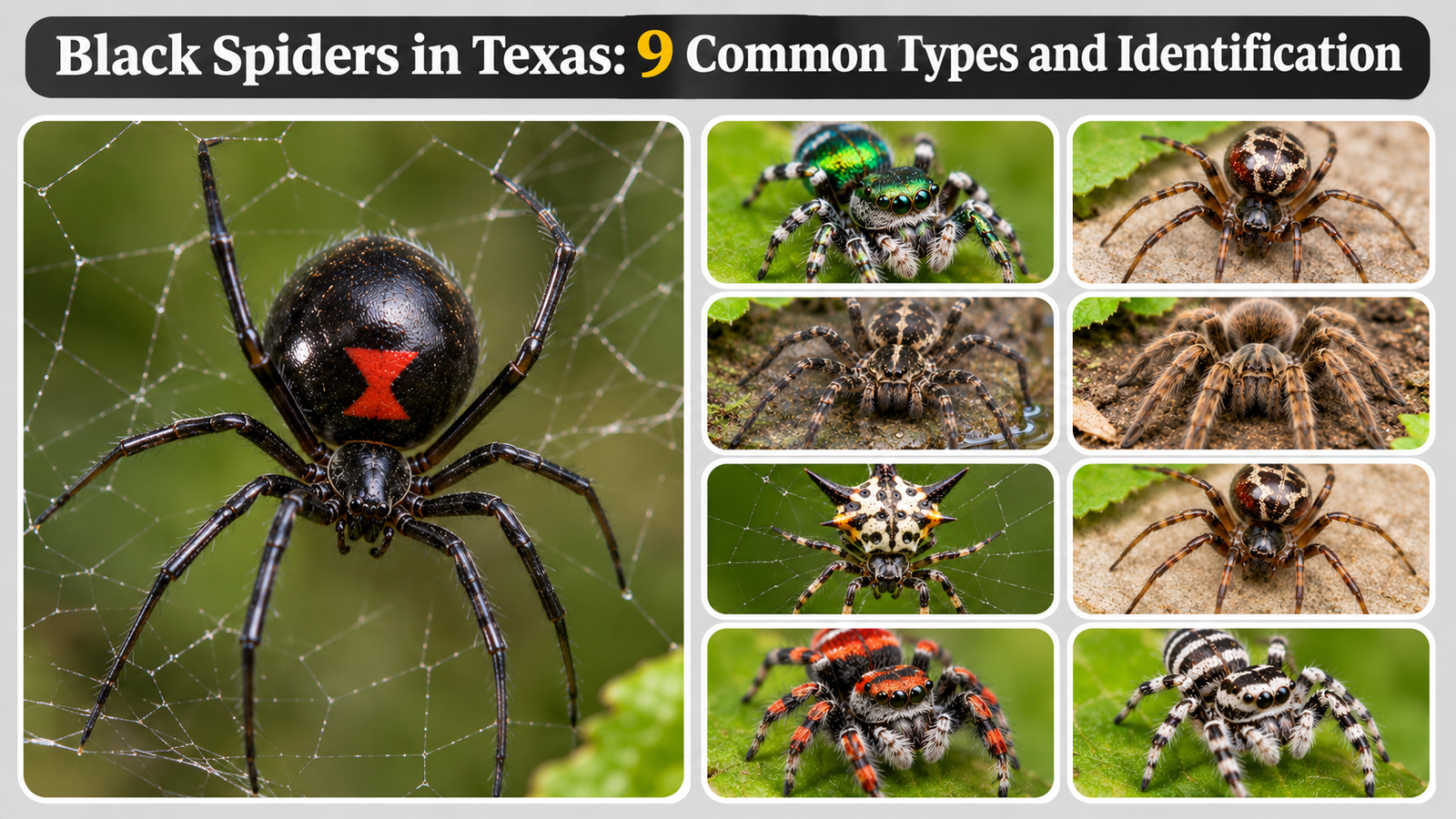
Texas is home to several fascinating black spider species, ranging from tiny jumping spiders to large, hairy tarantulas. Some have completely black bodies, while others display striking white, yellow, or red markings. Although black spiders in Texas may look intimidating, most are harmless to humans and help control insect populations. However, certain species, particularly black widows, require caution. Understanding their appearance, behavior, and preferred habitats can help you identify them correctly. This guide explores nine types of black spiders commonly found in Texas.
9 Common Types of Black Spiders in Texas
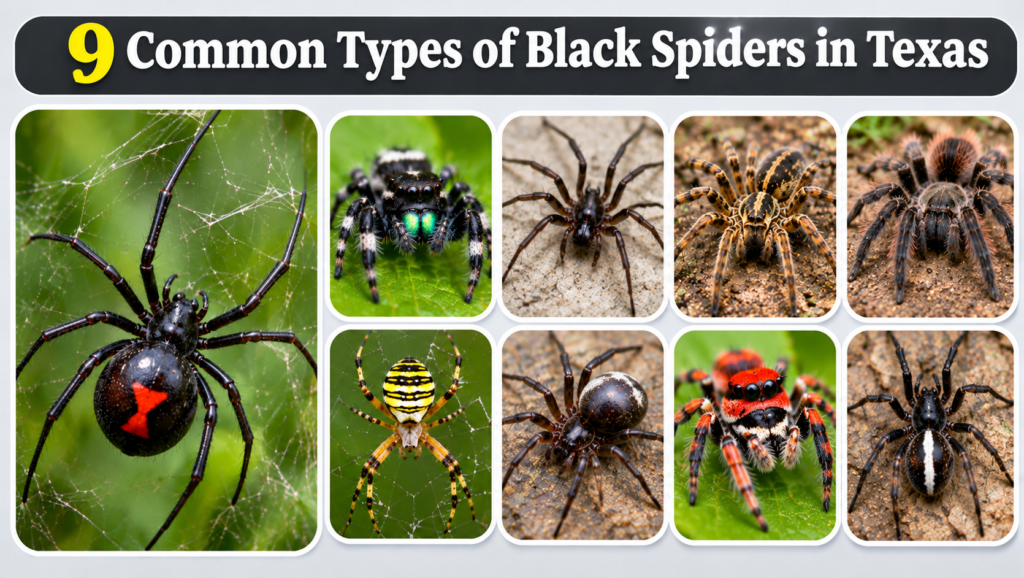
Black spiders vary considerably in size, body shape, and behavior. Some build irregular webs in sheltered corners, while others actively hunt insects in gardens and around homes. Their markings can help distinguish one species from another, although color alone is not enough for positive identification. Here are nine black or predominantly dark-colored spiders found across Texas.
1. Southern Black Widow (Latrodectus mactans)
The southern black widow is among the most recognizable black spiders in Texas. Adult females have glossy black bodies, rounded abdomens, and distinctive red hourglass-shaped markings underneath. They typically build irregular, tangled webs in protected locations, including garages, woodpiles, outdoor furniture, and storage sheds.
Southern black widows occur across much of Texas. Western and northern black widow species also inhabit parts of the state. Although these spiders generally avoid people, their venom can cause severe pain, muscle cramps, and other systemic symptoms. Medical attention is important after a suspected bite.
2. Bold Jumping Spider (Phidippus audax)
The bold jumping spider is one of the most familiar small black spiders in Texas. It has a compact, fuzzy black body, prominent forward-facing eyes, and distinctive white spots on its abdomen. Its mouthparts can appear metallic green or blue under suitable lighting.
Unlike web-building spiders, bold jumping spiders actively chase and capture their prey. They are frequently encountered on fences, garden plants, windowsills, and exterior walls. Their excellent eyesight helps them locate insects and navigate their surroundings. Although they can bite when handled roughly, they are not considered medically dangerous.
3. Southern House Spider (Kukulcania hibernalis)
Southern house spiders are frequently mistaken for other dark-colored spiders found indoors. Females have relatively large, dark brown bodies that may appear nearly black in poor lighting. Males are generally lighter-colored and have longer, more slender legs.
These spiders prefer cracks, wall cavities, window frames, barns, and other sheltered spaces. Their webs often extend outward from a central hiding place. Despite their intimidating appearance, southern house spiders are generally harmless and help reduce indoor insect populations.
4. Dark-Colored Wolf Spiders (Family Lycosidae)
Wolf spiders are robust, fast-moving hunters that range from brown to nearly black. They have hairy bodies, powerful legs, and prominent eyes. Many species display dark stripes or contrasting markings along the upper body.
These spiders are commonly found in lawns, gardens, wooded areas, and occasionally inside Texas homes. Unlike typical web-building spiders, they hunt prey on the ground. Female wolf spiders carry their egg sacs attached to their spinnerets and later transport newly hatched spiderlings on their backs. Their bites are generally not dangerous to humans.
5. Texas Brown Tarantula (Aphonopelma hentzi)
The Texas brown tarantula is one of the state’s most recognizable large spiders. Although commonly brown, its body and legs can appear extremely dark, sometimes almost black. Thick hairs cover its body, giving it a distinctly furry appearance.
Tarantulas generally live in underground burrows, beneath rocks, or in natural cavities. They are especially associated with grasslands, scrublands, and other suitable habitats. Despite their large size, these spiders are usually reluctant to bite. However, their defensive hairs can irritate skin and eyes, making direct handling inadvisable.
6. Black and Yellow Garden Spider (Argiope aurantia)
The black and yellow garden spider is one of the most striking spiders found in Texas gardens. Adult females have large abdomens decorated with bright yellow and black patterns, along with long legs featuring darker bands.
These spiders construct impressive circular webs between plants, fences, and shrubs. Many webs feature a distinctive zigzag arrangement of silk near the center. Although their appearance may be alarming, black and yellow garden spiders are generally harmless to people. They are beneficial predators that catch flying insects and other garden pests.
7. False Black Widow (Steatoda grossa)
False black widows resemble true black widows because of their rounded abdomens and dark coloration. However, they usually have brownish-black bodies and lack the characteristic red hourglass marking underneath.
These spiders commonly inhabit protected corners, storage spaces, garages, and other structures. They build irregular cobwebs that capture small insects. False black widows are not considered as medically dangerous as true black widows, although bites can cause localized pain and discomfort. Their similar appearance makes careful identification particularly important.
8. Cardinal Jumping Spider (Phidippus cardinalis)
The cardinal jumping spider is an eye-catching species with a striking combination of reddish-orange and black coloration. Its compact body, hairy appearance, and strong legs are characteristic of jumping spiders.
This species occurs in Texas and other parts of the southern United States. Cardinal jumping spiders actively stalk insects rather than trapping them in large webs. They are usually encountered around vegetation and other outdoor habitats. Their bright markings sometimes cause confusion with more dangerous spiders, but cardinal jumping spiders are not considered medically significant.
9. Eastern Parson Spider (Herpyllus ecclesiasticus)
The eastern parson spider is a dark ground-dwelling spider distinguished by a pale, irregular marking along its abdomen. This marking can resemble a narrow white necktie, which inspired its common name.
Eastern parson spiders occur in Texas, particularly in suitable habitats across the eastern part of the state. They hunt insects at night and shelter beneath rocks, leaves, boards, and other materials during the day. Sometimes they enter houses while searching for shelter or prey. Their bites can be uncomfortable but are generally not medically serious.
How to Identify Black Spiders in Texas
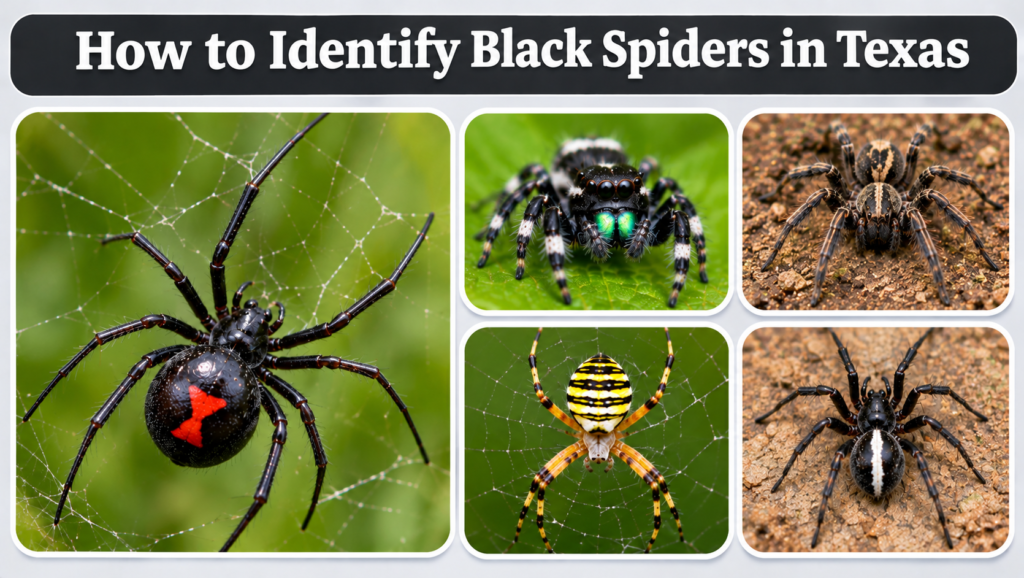
Correct identification involves examining more than the spider’s color. Body proportions, markings, web structure, and movement patterns provide valuable clues. Learning these features makes it easier to distinguish small jumping spiders from black widows, dark house spiders, and larger ground-dwelling species.
Identification by Color and Markings
- All-black spiders: Some adult female black widows have glossy black bodies, while certain jumping spiders appear mostly black.
- Black and white spiders: Bold jumping spiders have white abdominal spots, while parson spiders display pale abdominal markings.
- Black and yellow spiders: Yellow garden spiders feature bold contrasting patterns.
- Red and black spiders: Black widows have red markings, while cardinal jumping spiders display red or orange upper-body coloration.
- Large black hairy spiders: Dark tarantulas and wolf spiders can have thick hair and robust bodies.
Identification by Size and Behavior
Small black spiders seen jumping across walls or garden furniture are often jumping spiders. Larger, hairy spiders running across lawns may belong to the wolf spider family. Very large, heavily built spiders with thick legs may be tarantulas.
Web patterns also help identification. Black widows create tangled, irregular webs, while yellow garden spiders construct organized circular webs. Observing these differences from a safe distance can improve identification without disturbing the spider.
Are Black Spiders in Texas Dangerous?

Most black spiders found in Texas pose little danger to humans. Jumping spiders, wolf spiders, garden spiders, and tarantulas generally avoid confrontation. Their presence around homes can even be beneficial because they consume flies, mosquitoes, and other insects.
However, black widow spiders are medically significant because their venom can affect the nervous system. The brown recluse is another medically significant spider in Texas, although it is typically brown rather than black.
If a suspected black widow bite occurs, wash the affected area with soap and water, apply a cold compress, and seek prompt medical advice. Severe muscle cramps, difficulty breathing, or other serious symptoms require emergency attention.
Where Do Black Spiders Live in Texas?
Black spiders occur throughout Texas, but their distribution depends on habitat, climate, food availability, and shelter. Some species prefer warmer outdoor environments, while others can thrive around human buildings.
In North Texas, jumping spiders, wolf spiders, and black widows may appear in gardens, garages, and yards. Central Texas supports similar species, along with tarantulas in suitable habitats. East Texas offers wooded environments for numerous dark-colored ground spiders, while South and West Texas provide suitable conditions for several widow species and tarantulas.
Keeping storage spaces organized, sealing building gaps, and reducing unnecessary outdoor clutter can discourage unwanted spiders from settling around homes.
FAQs
1. Are there black widow spiders in Texas?
Yes. Texas is home to southern, western, and northern black widow spiders. They typically inhabit sheltered outdoor spaces, garages, woodpiles, and other undisturbed locations. Their bites can cause significant symptoms, so these spiders should never be handled directly.
2. What are the small black spiders in Texas houses?
Small black spiders inside Texas homes are often jumping spiders, dark cobweb spiders, or other harmless house-associated species. Bold jumping spiders are especially recognizable by their compact bodies, white spots, and distinctive jumping movements.
3. What are the big black hairy spiders in Texas?
Large, dark, hairy spiders in Texas may be tarantulas or wolf spiders. Tarantulas typically have heavier bodies and thicker legs, while wolf spiders are generally faster-moving ground hunters. Both are usually reluctant to bite humans.
4. Are all black spiders in Texas poisonous?
No. Most black spiders in Texas are not medically dangerous. Although nearly all spiders use venom to capture prey, only certain groups, especially widow spiders and recluses, are considered medically significant to humans in Texas.
5. Where do black spiders usually hide in Texas homes?
Black spiders may shelter in garages, storage rooms, window frames, wall cracks, and other quiet locations. Some also build webs beneath outdoor furniture or around entryways. Reducing clutter and sealing openings can help discourage unwanted indoor spiders.
