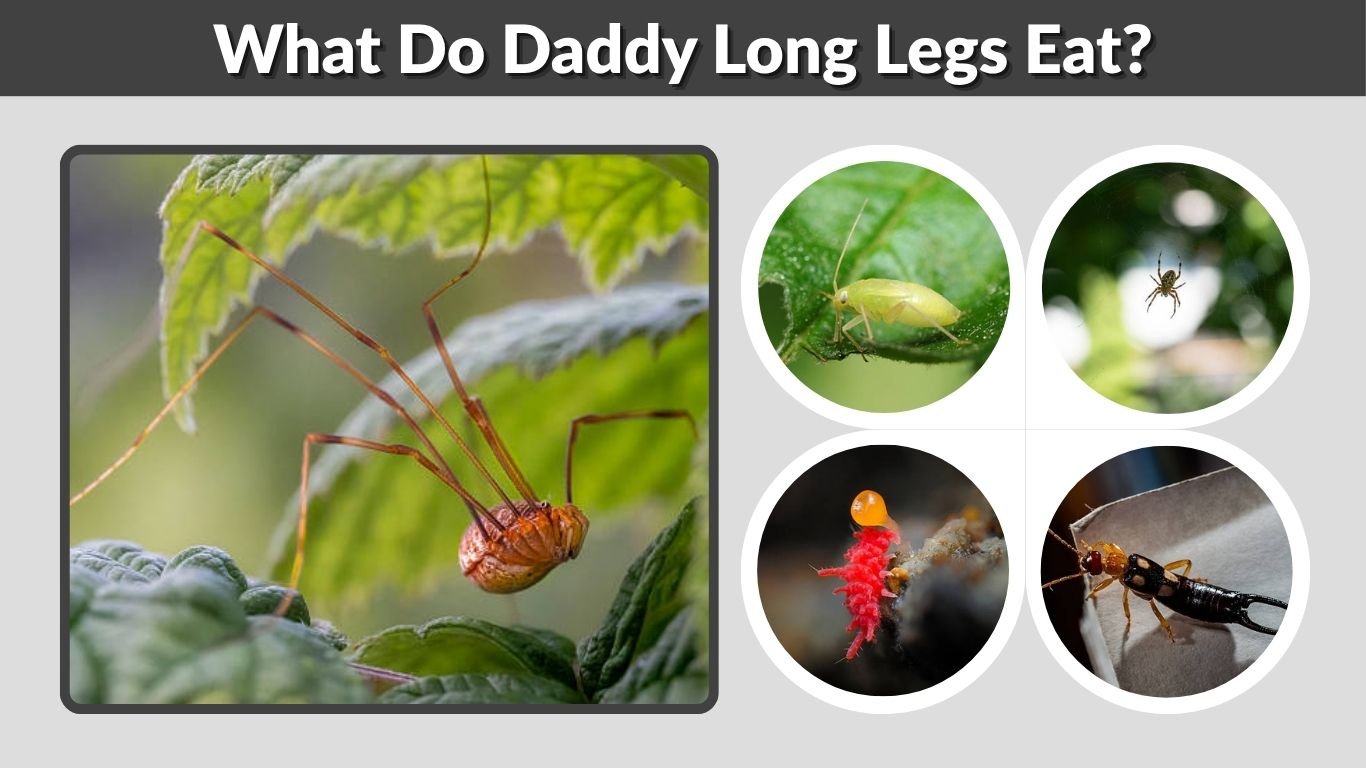
Daddy long legs eat different foods depending on which animal the name refers to. Harvestmen eat small invertebrates, dead arthropods, fungi, and some plant material, while daddy long legs spiders—better known as cellar spiders—mainly capture insects and other spiders. Flying daddy long legs, or crane flies, have a very different diet, and many adults barely feed at all. Understanding these differences explains what daddy long legs eat in houses, gardens, and natural habitats, as well as what their young consume.
What Do Daddy Long Legs Eat?
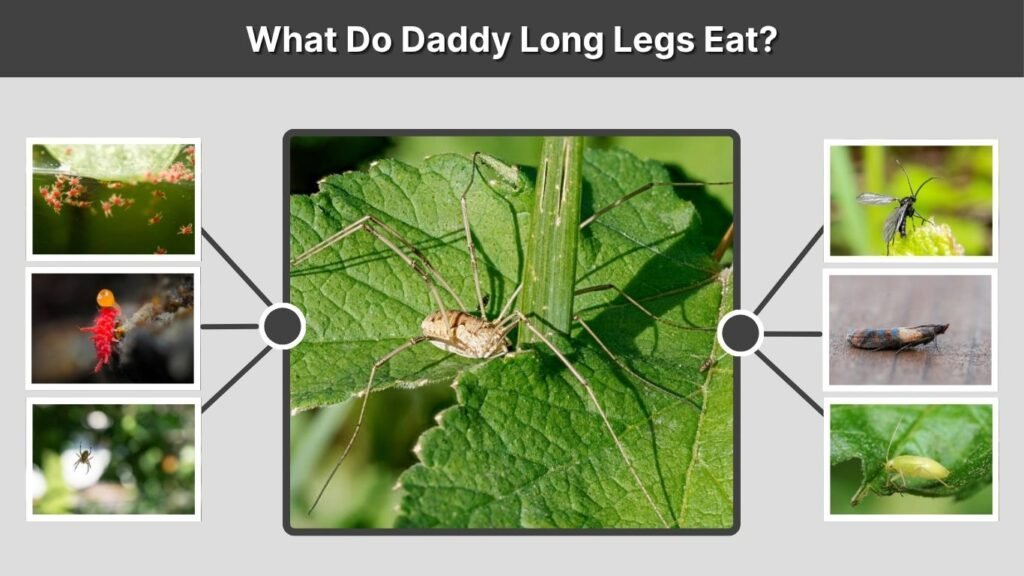
The term “daddy long legs” is confusing because it is commonly applied to several unrelated long-legged animals. Their feeding habits therefore vary considerably. Harvestmen are opportunistic omnivores and scavengers, cellar spiders are predators, and crane flies have feeding habits that change dramatically between the larval and adult stages. Identifying which type you have is the first step toward understanding its diet.
Common Foods Daddy Long Legs Eat
Depending on the type, their food may include:
- Small insects
- Flies and mosquitoes caught opportunistically
- Moths
- Aphids
- Mites
- Springtails
- Small spiders
- Dead insects and other arthropods
- Fungi
- Soft plant material or plant juices
- Decaying organic matter
- Grass roots and shoots in some crane fly larvae
Harvestmen are especially flexible feeders, functioning as both predators and scavengers rather than depending exclusively on live prey.
Do Daddy Long Legs Eat and Drink?
Harvestmen can obtain moisture from prey, plant juices, and moist surroundings. Cellar spiders digest prey externally and consume the resulting fluids rather than chewing solid food as humans do. Australian Museum notes that daddy long legs spiders inject venom, release digestive fluids onto prey, and then consume the liquefied material.
Which Daddy Long Legs Do You Mean?
Three animals are commonly called daddy long legs, and they should not be treated as the same creature. Harvestmen belong to the order Opiliones and are arachnids but not spiders. Cellar spiders belong to the family Pholcidae and are true spiders. Crane flies are winged insects in the family Tipulidae. Their different biology produces very different feeding behaviors.
Harvestmen or Grand Daddy Long Legs
Harvestmen are the animals often called grand daddy long legs. They have a single broadly fused-looking body and do not make silk webs or possess venom glands.
They eat small arthropods as well as dead animals and some plant-derived foods. University of Minnesota Extension describes harvestmen as beneficial predators that also eat dead arthropods and plant juices. Other documented foods include small insects, mites, woodlice, and similar invertebrates.
Daddy Long Legs Spiders or Cellar Spiders
Cellar spiders have two distinct body sections and construct loose, messy webs, often in basements, garages, ceilings, sheds, and other protected areas.
These daddy long legs spiders are carnivorous. They capture insects and also prey on other spiders. Their webs allow them to immobilize prey before feeding.
Flying Daddy Long Legs or Crane Flies
A flying daddy long legs is generally a crane fly, not a spider or harvestman. Adults have six long legs and a pair of wings.
Many adult crane flies do not feed at all and live primarily long enough to mate and reproduce. Crane fly larvae usually consume decomposing organic matter, although some species feed on grass roots and shoots, while some aquatic larvae prey on small soft-bodied animals.
What Bugs Do Daddy Long Legs Eat?
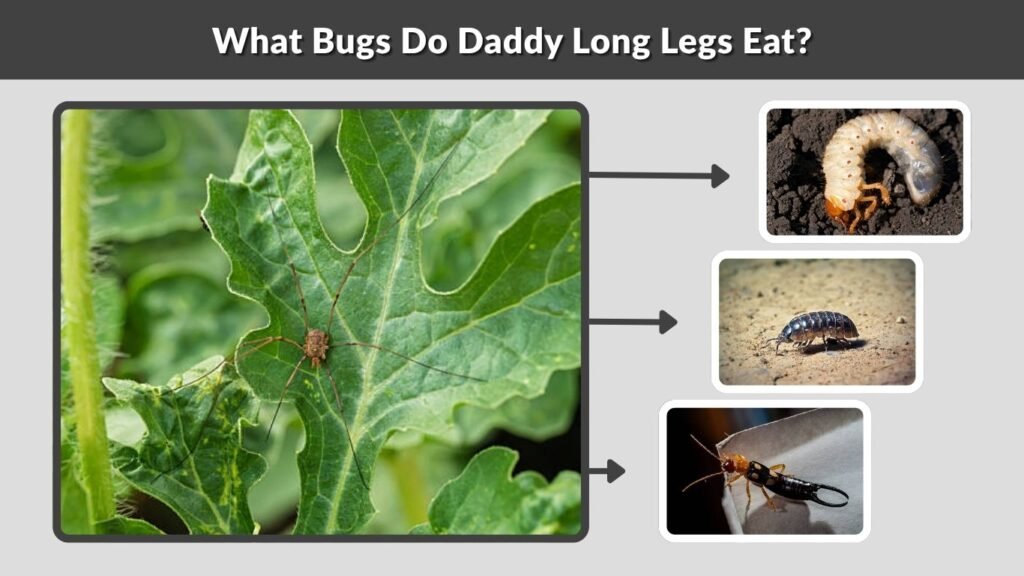
Predatory daddy long legs can contribute to the removal of small arthropods from gardens, buildings, and other habitats. Cellar spiders catch prey that wanders into their webs, while harvestmen actively encounter or scavenge food as they move across vegetation, soil, leaf litter, and sheltered areas. Neither should be considered a complete pest-control solution, but both can consume other arthropods.
Insects and Arthropods They May Eat
Their prey can include:
- Small flies
- Moths
- Aphids
- Mites
- Springtails
- Beetle larvae
- Woodlice
- Earwigs
- Small spiders
- Other soft-bodied arthropods
Harvestmen have been observed acting as generalist predators in agricultural environments, where they can contribute to natural pest control.
Do Daddy Long Legs Eat Other Spiders?
Cellar spiders do. The Australian Museum specifically describes the daddy-long-legs spider Pholcus phalangioides as feeding on insects and other spiders. Its long legs and silk allow it to immobilize potentially dangerous prey while maintaining some distance from it.
Harvestmen can also consume smaller arachnids, but their feeding strategy is quite different because they do not make webs or inject venom.
Do Daddy Long Legs Eat Black Widows?
Cellar spiders can attack other spiders, but it would be misleading to assume they routinely control black widows everywhere. A closely related and well-documented example comes from Australia: daddy-long-legs spiders are known to capture and kill redback spiders, which belong to the same genus, Latrodectus, as black widows.
Their success against another venomous spider does not mean their venom is exceptionally dangerous to humans.
What Do Daddy Long Legs Eat in the House?
The daddy long legs most commonly encountered living permanently inside houses is usually a cellar spider. It builds irregular webs in quiet corners, basements, crawl spaces, garages, and similar areas. Indoor prey comes from whatever small insects or spiders move into the web, so food availability often determines where these spiders establish themselves.
Common Indoor Food Sources
Inside a home, cellar spiders may capture:
- Small flies
- Moths
- Gnats
- Small wandering insects
- Other house spiders
- Arthropods caught accidentally in their webs
They are therefore generally considered beneficial predators rather than insects that damage food, furniture, clothing, or the building itself.
What Do Baby Daddy Long Legs Eat?
Young harvestmen generally consume appropriately small prey and other available organic foods according to their species. As they increase in size, they become capable of handling larger food items.
Young cellar spiders begin as tiny predators. They eventually capture small arthropods appropriate to their size and grow through repeated molts. They do not need a completely different adult-style diet; the main difference is the size of prey they can successfully handle.
What Do Australian Daddy Long Legs Eat?
In Australia, “daddy-long-legs spider” commonly refers to Pholcus phalangioides. The species is widespread in urban environments and frequently inhabits houses. Australian Museum classifies it as a carnivorous arthropod predator that eats insects and other spiders.
Daddy Long Legs and Redback Spiders
An especially interesting part of the Australian daddy long legs diet is its ability to prey on redback spiders.
The Australian Museum confirms that daddy-long-legs spiders can catch and kill redbacks. Their success relies partly on behavior and web use, rather than on possessing extraordinarily powerful venom. This observation probably contributed to the popular but incorrect myth that daddy long legs possess the world’s most dangerous spider venom.
Do Daddy Long Legs Help Control Pests?
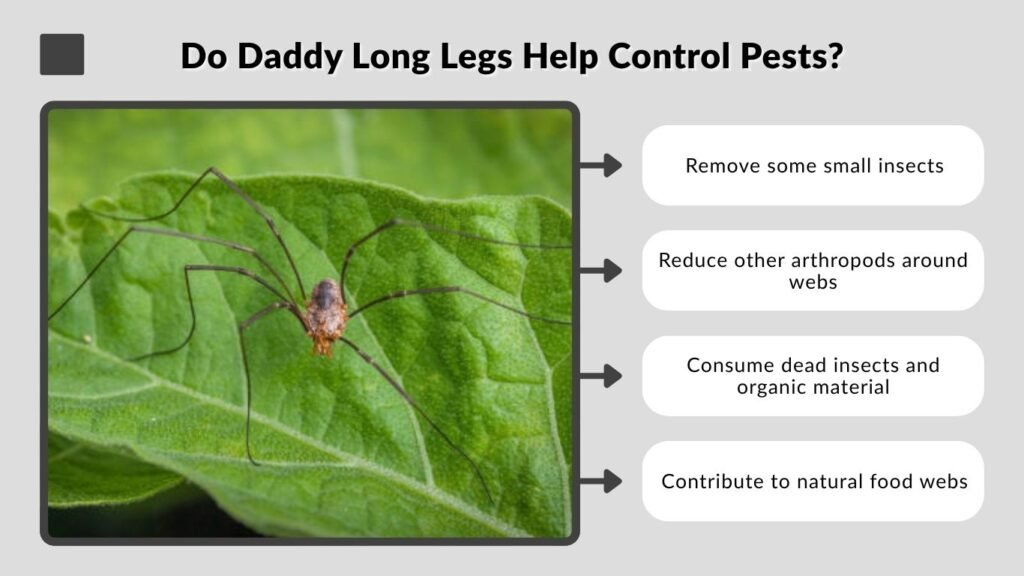
Daddy long legs can play useful ecological roles. Harvestmen consume living and dead arthropods and participate in decomposition as scavengers. Cellar spiders catch insects and other spiders indoors. Their impact varies according to species, prey abundance, and habitat, so they should be viewed as opportunistic natural predators rather than replacements for managing a serious pest infestation.
Benefits of Their Feeding Habits
Their feeding can:
- Remove some small insects
- Reduce other arthropods around webs
- Consume dead insects and organic material
- Contribute to natural food webs
- Provide some biological pest suppression
- Recycle nutrients through scavenging
For these reasons, harvestmen and cellar spiders are generally more useful than harmful when they occur in modest numbers.
FAQs
The answer to what daddy long legs eat depends heavily on whether the animal is a harvestman, cellar spider, or crane fly. Their diets range from other arthropods to decaying organic material. These quick answers address several of the most common questions about their feeding habits.
1. What Do Grand Daddy Long Legs Eat?
Grand daddy long legs usually refers to harvestmen. They eat small arthropods, dead insects, plant juices, and, in some species, fungi or other organic material.
2. What Do Daddy Long Legs Spiders Eat?
Cellar spiders mainly eat insects and other spiders that they capture in their loose, tangled webs.
3. Do Daddy Long Legs Eat Mosquitoes?
A cellar spider may consume a mosquito if it becomes trapped in its web, but daddy long legs should not be viewed as specialized mosquito predators. Adult crane flies, despite being called “mosquito hawks,” do not hunt mosquitoes.
4. What Do Flying Daddy Long Legs Eat?
Flying daddy long legs are usually crane flies. Many adults do not feed, while their larvae commonly consume decaying vegetation; some species eat grass roots and a few aquatic larvae are predatory.
5. Do Daddy Long Legs Eat Other Daddy Long Legs?
It can occur, but it is not their primary food source. Harvestmen and spiders are opportunistic feeders, and interactions such as predation or cannibalism may happen depending on species, size, hunger, and circumstances.
