
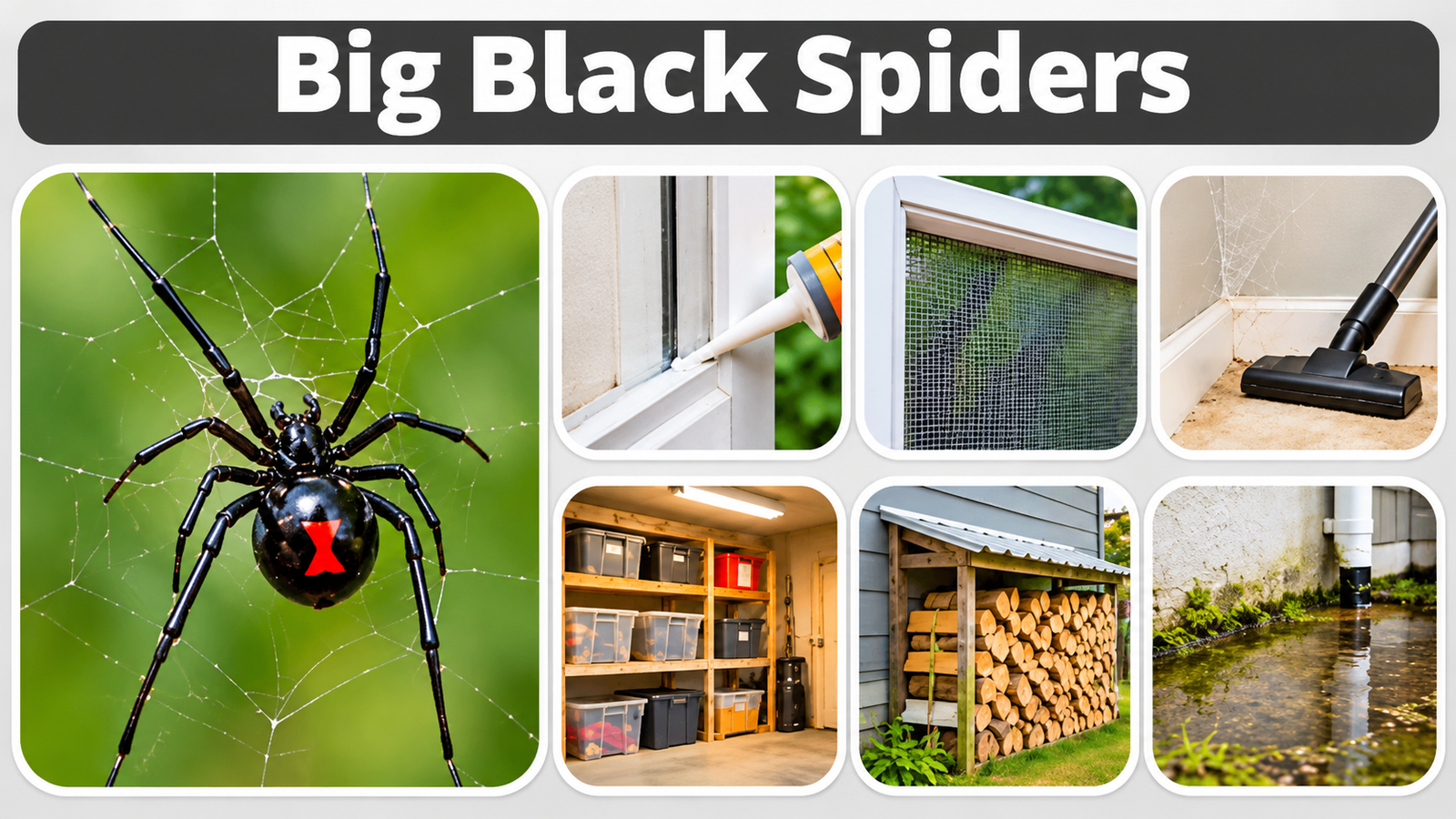
Big black spiders can look frightening, especially when they appear unexpectedly in basements, bedrooms, garages, or gardens. However, most large, dark-colored spiders are harmless to humans and help control household insects. Common examples include wolf spiders, fishing spiders, black house spiders, and black widows. Their sizes, markings, and behaviors vary considerably depending on the species and location. Understanding how to identify big black spiders, where they live, and whether they are dangerous can help you respond safely whenever you encounter one.
What Are Big Black Spiders?
Big black spiders are not a single species. The term describes several types of spiders with dark bodies, relatively large sizes, or long legs. Some have solid black coloring, while others appear dark brown, charcoal gray, or nearly black. Their appearance often changes with lighting, age, and sex. Identifying the spider requires examining its body shape, markings, habitat, and behavior.
Common Characteristics of Big Black Spiders
Although individual species differ, several physical features can help with identification.
- Body color: Black, charcoal gray, or dark brown.
- Body size: Varies from less than half an inch to more than an inch.
- Leg span: Some species reach several inches across.
- Body texture: Smooth, glossy, hairy, or velvety.
- Markings: White spots, pale stripes, or red abdominal patterns.
- Habitat: Basements, gardens, garages, woodpiles, and building crevices.
How Big Can Black Spiders Get?
The size depends on the species. Some wolf spiders have bodies exceeding one inch, while large fishing spiders can reach approximately four inches across with their legs extended.
Black widows are considerably smaller than many people expect. Adult female southern black widows usually measure about 8–13 millimeters in body length, with a leg span of roughly 25–35 millimeters.
8 Common Types of Big Black Spiders
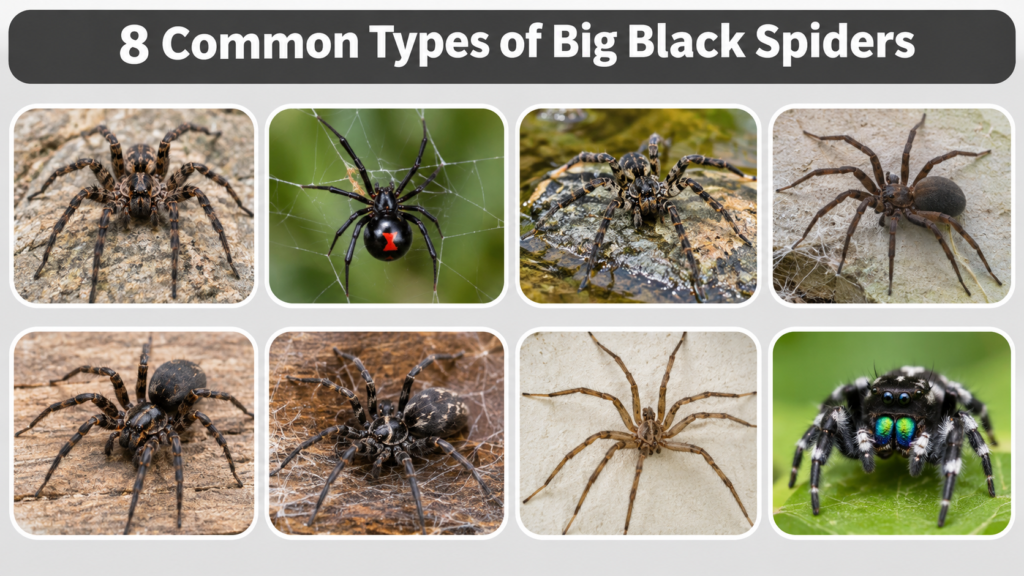
Several spiders found around homes can appear black or unusually large. Some are active hunters, while others build webs and remain hidden throughout the day. Their physical features and preferred habitats provide useful clues for identification. The following species are among the spiders homeowners may encounter in North America, the United Kingdom, and Australia.
1. Wolf Spider (Lycosidae)
Wolf spiders are large, fast-moving hunters with hairy, dark brown or gray bodies that sometimes appear black. They frequently enter homes through open doors or small gaps near foundations.
Unlike many household spiders, wolf spiders do not build capture webs. Instead, they actively hunt insects across floors, gardens, and grassy areas. They are generally not aggressive toward people.
2. Black Widow Spider (Latrodectus)
Black widow spiders have shiny black bodies and rounded abdomens. Adult females of many species display distinctive red markings underneath their bodies, often resembling an hourglass.
They prefer sheltered locations such as garages, woodpiles, sheds, and outdoor storage areas. Although black widows are not usually large compared with wolf spiders, their venom can cause serious symptoms.
3. Dark Fishing Spider (Dolomedes tenebrosus)
Dark fishing spiders are among the largest spiders encountered in parts of North America. Their bodies appear mottled brown, gray, and black, with long legs that create an impressive overall size.
These spiders inhabit wooded areas, tree trunks, and locations near water. They occasionally enter buildings, particularly cabins, basements, and homes surrounded by vegetation.
4. Southern House Spider (Kukulcania hibernalis)
Female southern house spiders have charcoal-gray to dark brown bodies with a velvety appearance. They commonly occupy cracks, window frames, and sheltered areas around buildings.
These spiders occur in the southeastern United States, including Florida and Georgia. Females build irregular webs around their retreats, while males have lighter bodies and longer, thinner legs.
5. Black Lace-Weaver Spider (Amaurobius ferox)
Black lace-weavers have dark, robust bodies and relatively short, strong legs. They are commonly found in Britain, especially in gardens, cellars, walls, and damp sheltered areas.
Their webs have a distinctive woolly, lace-like appearance surrounding a narrow hiding place. Although their dark coloring may seem intimidating, they are not considered medically dangerous.
6. Black House Spider (Badumna insignis)
Black house spiders are common around buildings in Australia. They have dark brown to black legs, charcoal-colored abdomens, and small grayish or whitish markings.
These spiders construct tangled, lace-like webs around window frames, walls, and exterior crevices. They generally remain inside their retreats and rarely bite unless disturbed.
7. Giant House Spider (Eratigena Species)
Giant house spiders are large, dark brown spiders with long legs and hairy bodies. Some have leg spans reaching approximately three inches.
They commonly inhabit houses, sheds, and garages throughout Britain and parts of Europe. Despite their impressive size and rapid movements, they generally avoid human contact.
8. Bold Jumping Spider (Phidippus audax)
Bold jumping spiders have compact black bodies, distinctive white spots, and often metallic green or blue mouthparts.
They are smaller than many spiders in this guide but can appear surprisingly large because of their stocky shape. These curious spiders actively hunt insects on walls, windows, fences, and garden plants.
How to Identify Big Black Spiders in Your House
Finding a big black spider indoors does not automatically mean it is dangerous. Many spiders accidentally enter buildings while searching for insects, shelter, or potential mates. Accurate identification involves more than simply observing color or size. The most useful clues include body proportions, abdominal markings, leg structure, and whether the spider builds a web.
Identify Spiders by Their Appearance
Look for these distinguishing characteristics without handling the spider.
- Large, hairy body: Often associated with wolf spiders.
- Glossy black abdomen: May indicate a widow or similar cobweb spider.
- Long, slender legs: Common in giant house spiders.
- White abdominal spots: Characteristic of bold jumping spiders.
- Dark, velvety body: Possible southern house spider.
- Large, rounded abdomen: Seen in widows, false widows, and some other web-building spiders.
Identify Spiders by Their Behavior
Spiders that move rapidly across floors without building capture webs may be wolf spiders or other active hunters.
Spiders resting inside tangled webs are more likely to be web-building species. Jumping spiders move in short bursts and frequently turn toward nearby movement.
These behaviors provide clues but cannot guarantee identification.
Where Are Big Black Spiders Commonly Found?
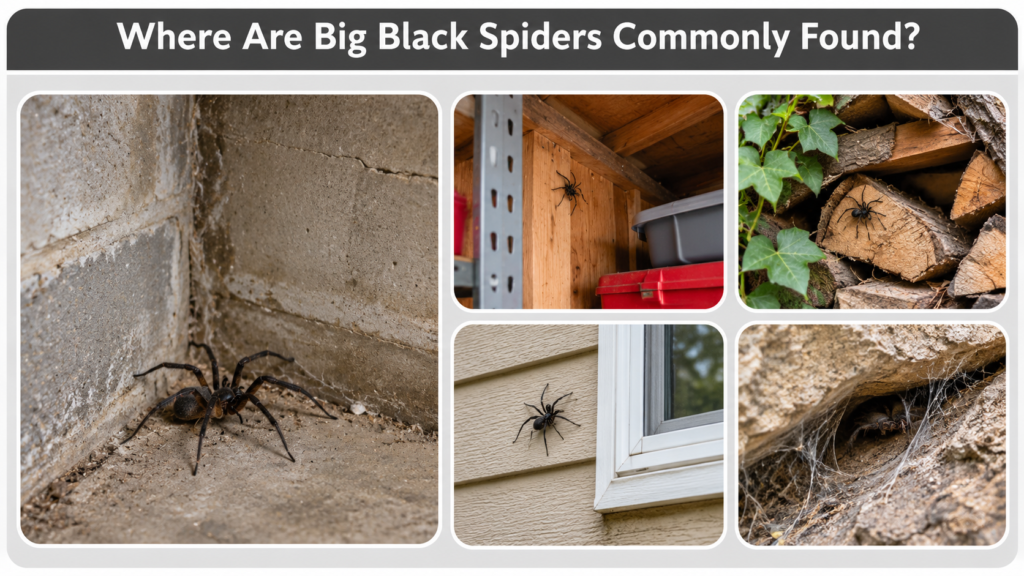
Big black spiders occupy different environments depending on climate, available prey, and suitable shelter. Some species prefer dry indoor spaces, while others inhabit forests, wetlands, and gardens. Their distribution also varies by region, so identifying a spider is easier when you consider the location where it was discovered.
Big Black Spiders in Michigan
Large dark spiders in Michigan commonly include wolf spiders and fishing spiders. Dark fishing spiders may appear particularly impressive because of their long legs.
These species occur around woodlands, damp environments, basements, and buildings surrounded by vegetation. Most encounters do not present a serious danger.
Big Black Spiders in Florida and Other US States
Florida and Georgia are home to southern house spiders, wolf spiders, and several widow species. California, Texas, and Arizona also have black widows and various dark-colored hunting spiders.
Pennsylvania, Ohio, and Maryland have their own combinations of wolf spiders, fishing spiders, and dark web-building species. Distribution varies within individual states.
Big Black Spiders in the UK
In Britain, giant house spiders are among the most noticeable large indoor spiders. Black lace-weavers and some false widow species are also found around homes.
These spiders commonly appear in sheltered spaces, particularly when mature males wander in search of mates.
Why Are Big Black Spiders in My House?
Large spiders frequently enter homes while searching for food, shelter, or mates. Houses with insects, cluttered storage areas, and accessible openings can provide attractive environments. However, finding a single spider does not necessarily indicate an infestation. Seasonal changes and natural spider movements also influence how often homeowners notice them.
Why Big Black Spiders Appear in Basements
Basements often provide dark, quiet areas with relatively stable temperatures. Storage boxes, cracks, and unused corners create suitable hiding places.
Moisture and the presence of insects may also attract some species. Wolf spiders, fishing spiders, and various web-building spiders can occasionally be discovered in these locations.
Why Spiders Enter Bedrooms and Living Rooms
Spiders may enter living spaces through open doors, damaged screens, and gaps around windows.
Some wander indoors accidentally, while mature males may search for females during breeding periods. Most do not deliberately seek human contact.
Are Big Black Spiders Dangerous?
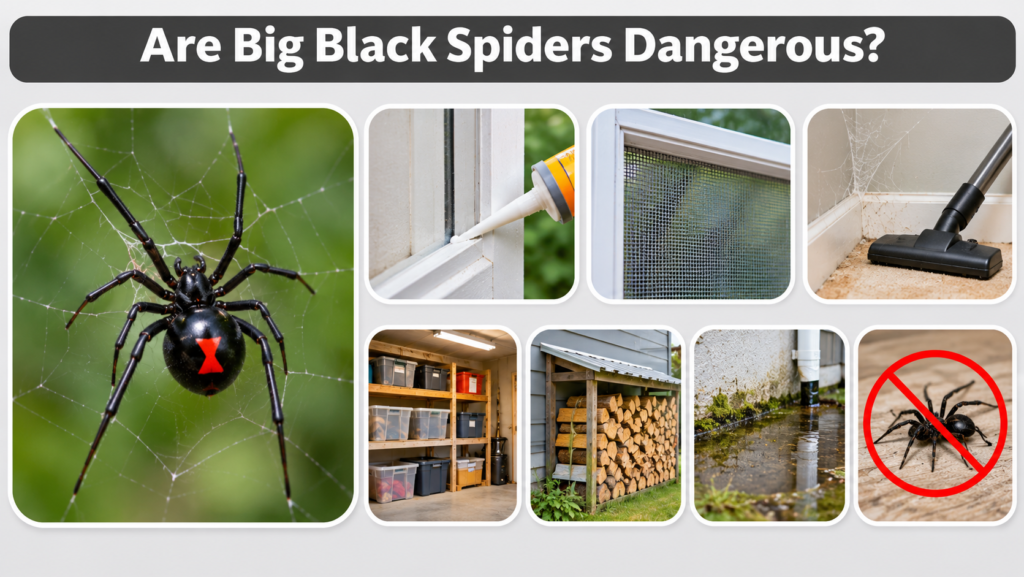
Most big black spiders are not dangerous to people, even when their appearance seems intimidating. Spider bites are relatively uncommon and usually occur when a spider is trapped against the skin or handled. Nevertheless, some species, particularly black widows, have medically significant venom and should never be handled directly.
Which Big Black Spiders Are Harmful?
Black widow spiders deserve particular caution because their venom can cause severe pain, sweating, nausea, and muscle cramps.
Most wolf spiders, fishing spiders, giant house spiders, and jumping spiders pose little danger to healthy adults. However, bites can occasionally produce localized pain, redness, or swelling.
Seek prompt medical care for a suspected black widow bite, severe symptoms, or difficulty breathing.
How to Get Rid of Big Black Spiders Safely
Reducing spider activity involves removing hiding places, limiting insect populations, and preventing outdoor spiders from entering the house.
- Seal cracks around doors, windows, and foundations.
- Install or repair damaged window screens.
- Vacuum webs and neglected corners regularly.
- Reduce unnecessary clutter in basements and garages.
- Store firewood away from exterior walls.
- Address moisture problems and insect infestations.
- Avoid handling unidentified spiders directly.
For a harmless spider, a container and stiff card can be used for relocation without touching it. Contact a pest professional if potentially dangerous spiders are repeatedly discovered.
FAQs
1. What are the big black spiders in my house?
Large black-looking house spiders may be wolf spiders, fishing spiders, southern house spiders, or giant house spiders, depending on your location. Examining their markings, body shape, and behavior can help identify the species.
2. Are big black spiders poisonous?
Most spiders are venomous rather than poisonous, meaning they inject venom through bites. However, the vast majority pose little medical danger to humans. Black widows are an important exception and require caution.
3. What are big black spiders with long legs?
Dark fishing spiders and giant house spiders are common examples of large, dark spiders with long legs. Wolf spiders can also appear long-legged, although their legs are generally thicker and hairier.
4. What are big black and yellow spiders called?
Large black and yellow spiders are often black-and-yellow garden spiders (Argiope aurantia). These orb-weavers build large circular webs outdoors and are generally harmless to humans.
5. Why do I suddenly have big black spiders in my house?
An increase in visible spiders may result from seasonal breeding activity, increased insect populations, or easier access through structural gaps. Regular cleaning, sealing openings, and reducing indoor insects can help limit encounters.
