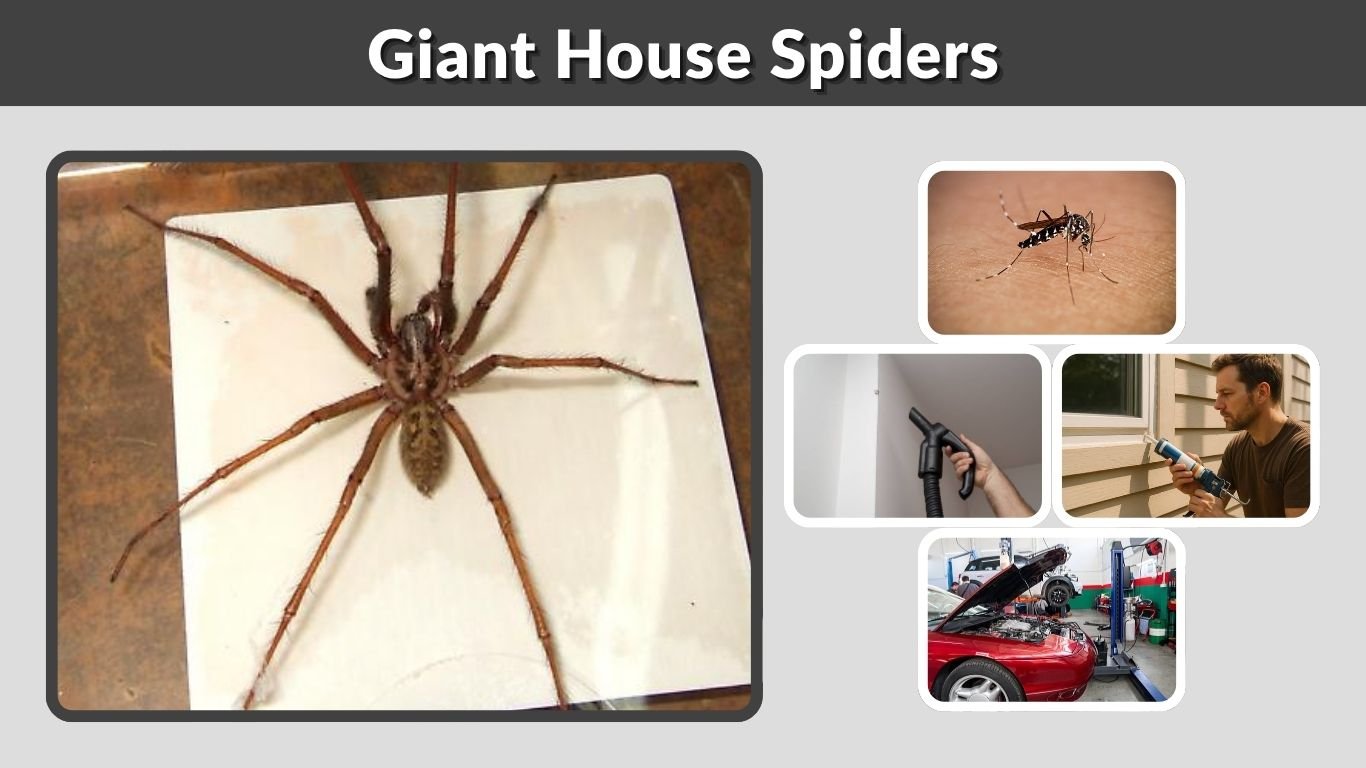
Giant house spiders are large, fast-moving arachnids commonly found in homes, garages, basements, and dark corners. Their long legs and sudden movements can be frightening, but these spiders are generally harmless to humans. Common in the United Kingdom and parts of the Pacific Northwest, including Oregon and Washington, they help control household insects. Although giant house spiders can bite when threatened, such encounters are uncommon. Understanding their appearance, behavior, habitat, lifespan, and feeding habits can help homeowners identify them and manage their presence safely.
What Are Giant House Spiders?
Giant house spiders belong to the genus Eratigena and the funnel-weaver family Agelenidae. The name commonly refers to closely related species in the Eratigena atrica group, including Eratigena duellica. Scientific classifications and names have changed over time.
These spiders are known for their long legs, brown bodies, and impressive running speed. They prefer sheltered environments where they can build sheet-like webs and capture insects.
Despite their intimidating appearance, giant house spiders are generally nonaggressive. They usually retreat when approached and play a beneficial role in controlling household pests.
How to Identify Giant House Spiders
Giant house spiders have several recognizable physical characteristics. Their body structure, markings, long legs, and web-building habits help distinguish them from other large household spiders.
However, closely related species can be difficult to identify without expert examination.
Appearance and Color
Giant house spiders typically have brown, grayish-brown, or dark brown bodies. Their abdomens often feature darker chevron-shaped markings, while the front body has contrasting longitudinal patterns.
Their legs are long, slender, and covered with fine hairs. The body appears somewhat hairy rather than smooth or glossy.
Males generally have smaller, slimmer bodies with relatively long legs. Females usually have broader abdomens, particularly when carrying developing eggs.
How Big Are Giant House Spiders?
Giant house spiders are among the larger spiders commonly encountered inside homes.
Their body length is typically around 0.5–1 inch (1.3–2.5 cm), depending on the species and individual. Large adults can have leg spans approaching 4 inches (10 cm).
Their extended legs make them appear considerably larger than their bodies suggest.
Although size helps distinguish them from smaller house spiders, several other species can reach similar dimensions.
Are Giant House Spiders Dangerous?
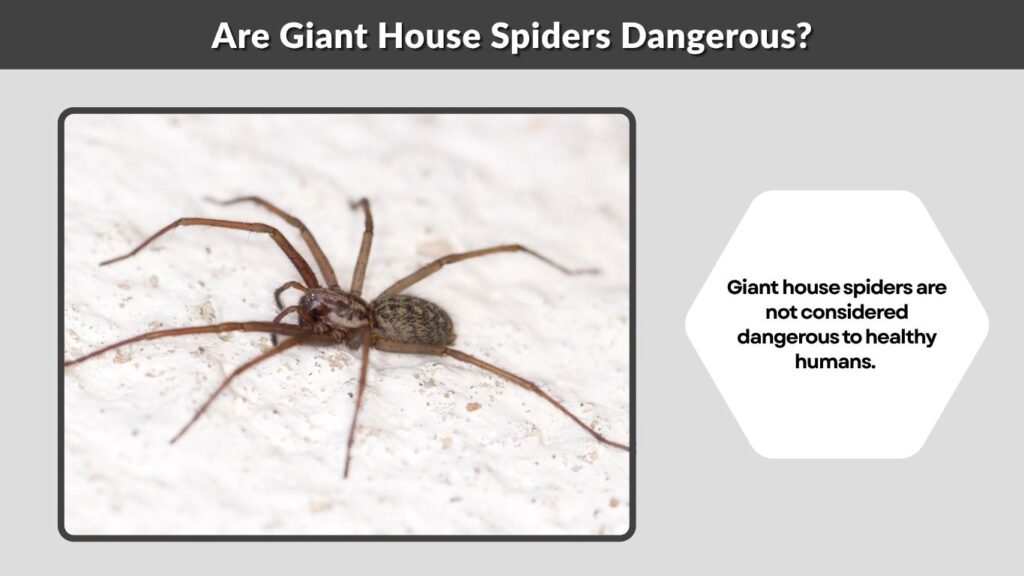
Giant house spiders are not considered dangerous to healthy humans. Their large size and rapid movements may be alarming, but they generally avoid confrontation.
They typically escape into crevices or sheltered areas when disturbed.
Their bites are not known to cause medically significant problems in people. However, handling any unfamiliar spider should be avoided because identification based on appearance alone can be unreliable.
Are Giant House Spiders Poisonous or Venomous?
Giant house spiders are venomous, not poisonous. They produce venom that helps immobilize small insects.
However, their venom is not considered medically significant to humans.
The term poisonous generally describes organisms that cause harm when eaten or touched, while venomous animals deliver toxins through specialized structures such as fangs.
Do Giant House Spiders Bite?
Yes, giant house spiders can bite, but bites are rare. They usually attempt to escape rather than defend themselves.
A bite may occur if a spider becomes trapped against the skin or is handled roughly.
Possible symptoms include temporary discomfort, mild redness, or localized swelling. Wash a suspected bite with soap and water and apply a cold compress.
Seek medical attention for severe symptoms, worsening skin changes, or uncertainty about the spider’s identity.
Where Do Giant House Spiders Live?
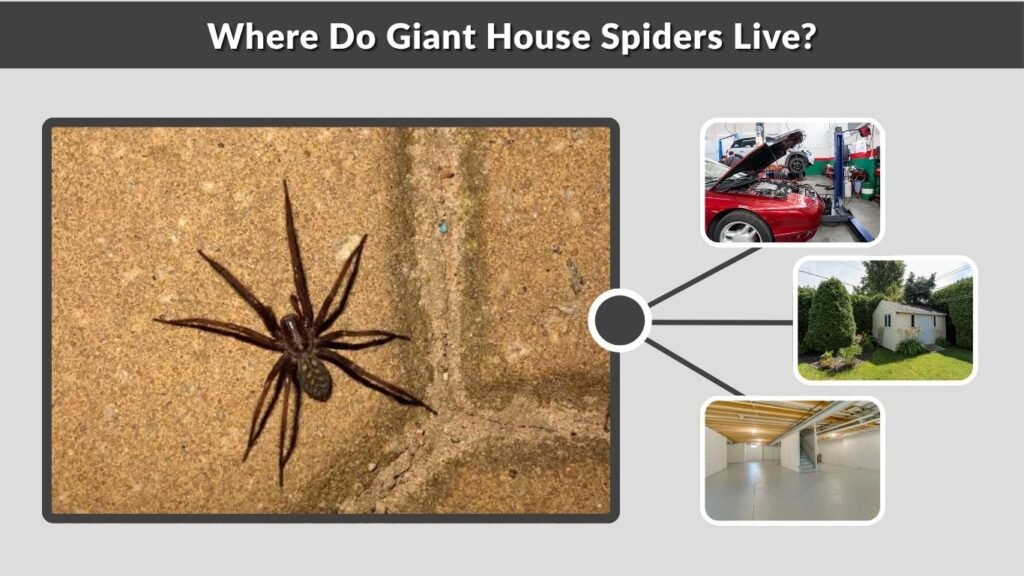
Giant house spiders are associated with sheltered environments in parts of Europe and North America. They occupy both indoor spaces and protected outdoor locations.
Their preferred habitats provide darkness, shelter, and access to insect prey.
Giant House Spiders in the UK
Giant house spiders are widespread in the United Kingdom and are frequently seen during late summer and autumn.
They commonly inhabit garages, sheds, basements, and quiet household corners.
Adult males become especially noticeable during mating season because they leave their webs to search for females.
These spiders can also be encountered in Ireland and other parts of Europe.
Giant House Spiders in Oregon
Giant house spiders occur in Oregon, particularly in western and coastal areas.
They frequently inhabit basements, garages, crawl spaces, and sheltered spaces around buildings.
According to the Oregon Department of Agriculture, giant house spiders are among the spiders commonly submitted for identification.
Their appearance can resemble that of hobo spiders, making careful identification important.
Giant House Spiders in Washington State
Giant house spiders are well established in western Washington, particularly around Seattle and the Puget Sound region.
Washington State University reports that they are common west of the Cascade Mountains.
They are often noticed from midsummer through early autumn, when adult males become more mobile.
These spiders are also found in parts of coastal British Columbia.
Why Do Giant House Spiders Come Inside?
Giant house spiders enter homes or establish webs indoors when buildings provide suitable shelter and access to prey.
Garages, basements, and storage areas are attractive because they contain undisturbed corners and hiding places.
Some spiders enter through open windows, gaps beneath doors, or cracks around foundations.
During mating season, males leave their established webs and wander in search of females. This behavior explains why homeowners sometimes notice unusually large spiders running across floors.
An increase in sightings does not necessarily indicate an infestation.
What Do Giant House Spiders Eat?
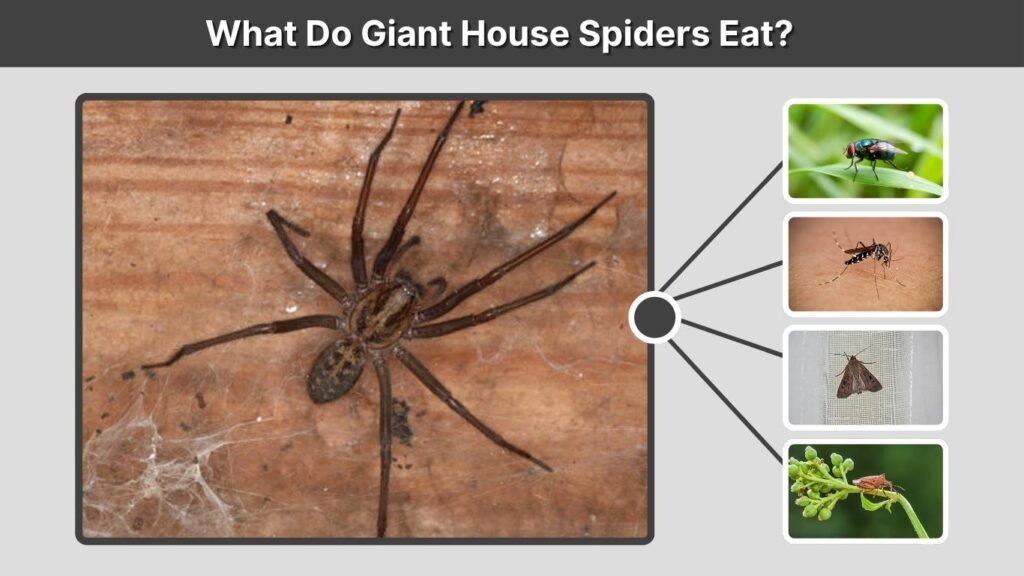
Giant house spiders are carnivorous predators that feed primarily on small arthropods.
Their diet may include:
- Flies and mosquitoes.
- Small moths and beetles.
- Cockroaches and other crawling insects.
- Woodlice and similar small invertebrates.
- Occasionally, other spiders.
They construct sheet-like webs connected to funnel-shaped retreats.
When an insect moves across the web, the spider quickly emerges from its hiding place and captures the prey.
Because they consume nuisance insects, giant house spiders can be beneficial in household environments.
How Long Do Giant House Spiders Live?
The lifespan of giant house spiders depends on their species, sex, and environmental conditions.
Females can survive for several years in suitable environments, while adult males generally have shorter remaining lifespans after reaching maturity.
Males often die following the mating season.
Females produce egg sacs in protected locations associated with their webs. After hatching, young spiderlings develop through successive molts before reaching adulthood.
Food availability, temperature, and suitable shelter influence their development and survival.
Are Giant House Spiders Fast?
Giant house spiders are exceptionally fast runners compared with many other household spiders.
They can move at approximately half a meter per second during rapid bursts.
Their long legs allow them to cover short distances quickly, particularly when escaping danger or searching for mates.
They can climb some vertical surfaces, although smooth bathtubs and sinks may trap them.
Unlike jumping spiders, giant house spiders primarily rely on running rather than jumping to capture prey or escape threats.
They are also frequently active at night.
How to Get Rid of Giant House Spiders
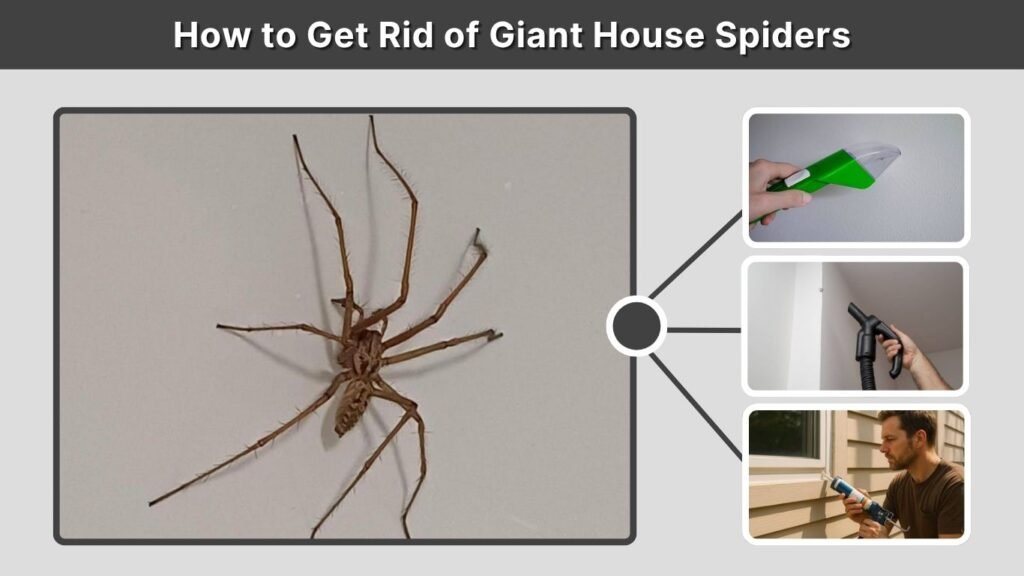
Giant house spiders generally do not require chemical treatment. Preventing entry and reducing suitable hiding areas can help manage their presence.
Follow these steps:
- Remove spiders safely: Place a container over the spider, slide stiff paper underneath, and relocate it to a suitable sheltered location.
- Seal entry points: Repair damaged screens and close gaps around doors, windows, and foundations.
- Reduce clutter: Organize storage boxes, clothing, and unused household materials.
- Vacuum webs: Regularly clean undisturbed corners, garages, basements, and storage areas.
- Control insect populations: Reduce the insects that provide spiders with food.
- Inspect outdoor spaces: Keep firewood and stored materials away from entrances when practical.
Avoid unnecessary pesticide applications. If spider activity becomes difficult to manage, consult a qualified pest management professional.
Giant House Spiders vs. Wolf Spiders
Giant house spiders and wolf spiders are often confused because both can be large, brown, and fast-moving.
However, their hunting strategies and body structures differ.
| Feature | Giant House Spider | Wolf Spider |
| Family | Agelenidae | Lycosidae |
| Body shape | Slender, long-legged | Often stockier |
| Hunting | Sheet web and funnel retreat | Primarily active hunting |
| Web construction | Builds prey-catching webs | Does not use prey-catching webs |
| Eye arrangement | Small eyes in two rows | Distinctive arrangement with two large eyes |
Both groups are generally nonaggressive, and most species pose little danger to humans.
FAQs
1. Are Giant House Spiders Dangerous to Dogs and Cats?
Giant house spiders are not generally considered dangerous to dogs or cats. However, pets may occasionally receive defensive bites. Contact a veterinarian if a pet develops unusual symptoms.
2. Do Giant House Spiders Jump?
Giant house spiders are not specialized jumping spiders. They primarily move by running, although they may make short sudden movements or drop from surfaces.
3. Do Giant House Spiders Live in Groups?
Giant house spiders are generally solitary. Several may occupy the same building when suitable shelter and food are available, but they do not form organized social colonies.
4. Should You Kill Giant House Spiders?
Killing giant house spiders is usually unnecessary. They are beneficial predators that help control insects. Safe relocation or leaving undisturbed spiders alone is generally preferable.
5. When Do Giant House Spiders Come Out?
Giant house spiders can be active throughout the year, particularly at night. Homeowners often notice more wandering males during late summer and early autumn when mating activity increases.
