
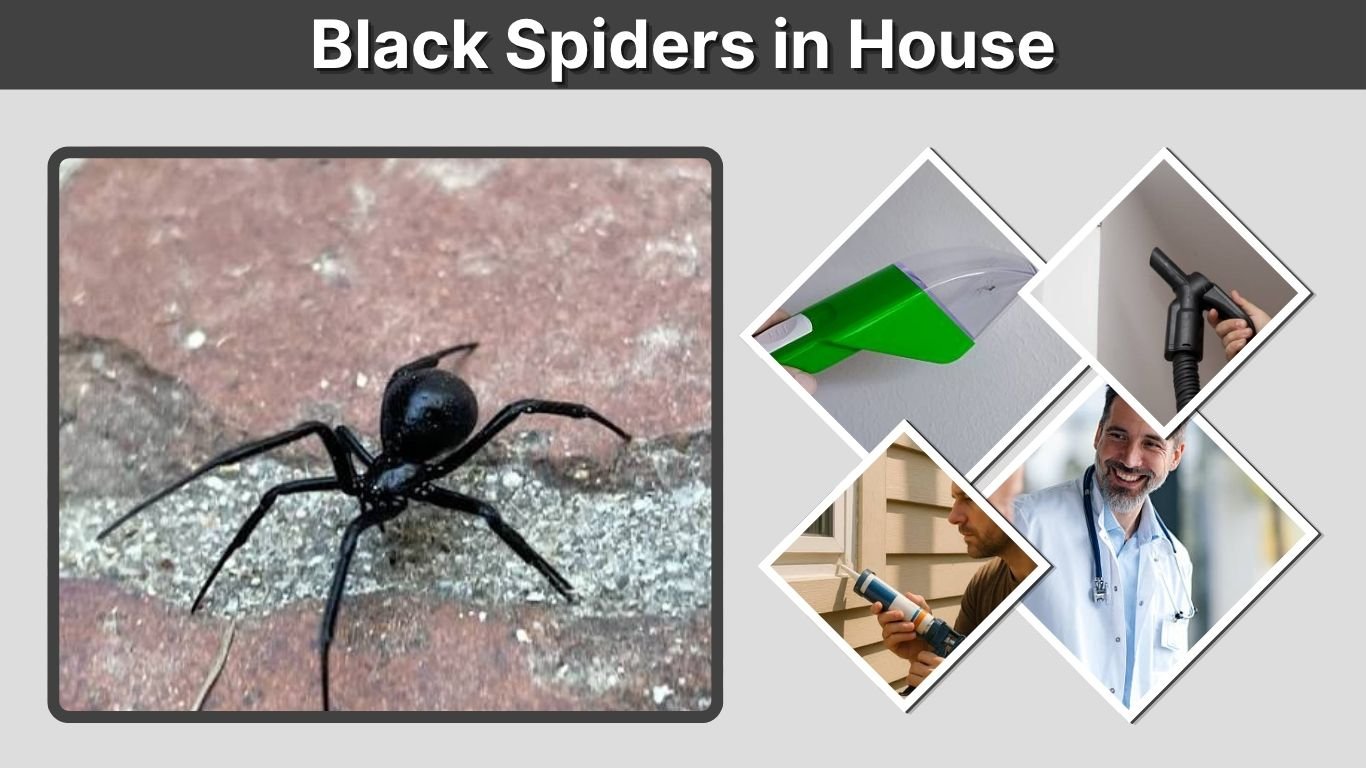
Finding black spiders in your house can be alarming, especially when they appear in bedrooms, bathrooms, basements, or dark corners. Some are tiny jumping spiders, while others are large, fast-moving hunters that enter homes looking for food or shelter. Although most common black house spiders are harmless to humans, certain species, including black widows, require caution. Understanding their appearance, behavior, and preferred hiding places can help you identify the spiders in your home and prevent unwanted encounters.
What Are the Black Spiders in My House?
Black spiders found indoors belong to several different species. Their appearance varies depending on their size, body shape, markings, and geographic location.
Some have shiny black bodies and rounded abdomens, while others are hairy, dark brown, or charcoal-colored. Many enter through windows, doors, and foundation cracks, while certain species can live and reproduce indoors.
Color alone cannot identify a spider. Its markings, web structure, behavior, and location provide more reliable identification clues.
6 Common Types of Black Spiders in House
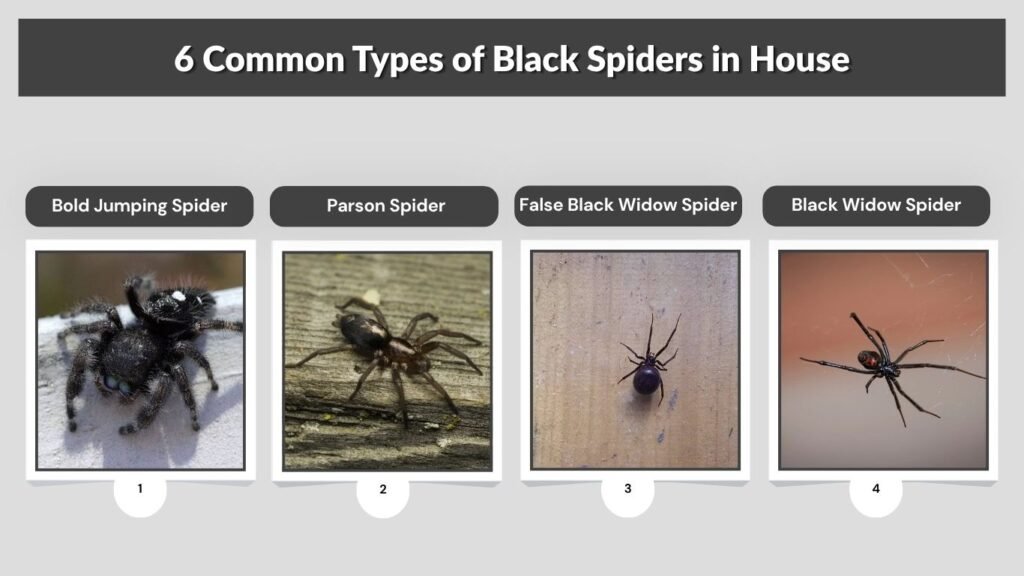
Several black or dark-colored spiders commonly occur around residential buildings. Some actively hunt insects, while others construct webs in quiet areas. Identifying the type helps determine whether it is beneficial, harmless, or potentially dangerous.
1. Bold Jumping Spider
The bold jumping spider (Phidippus audax) is one of the most recognizable black spiders found around American homes. It has a compact, hairy black body, prominent front-facing eyes, and distinctive white spots on its abdomen.
These spiders often appear on windowsills, walls, and sunny indoor surfaces. Unlike web-building spiders, they actively chase and jump onto insects.
Bold jumping spiders are generally harmless to people and rarely bite unless handled or trapped against the skin. Their excellent vision and quick movements make them easy to recognize.
2. Parson Spider
Parson spiders are dark, fast-moving hunters commonly encountered in houses, particularly at night. The eastern parson spider (Herpyllus ecclesiasticus) has a dark brown to black body with a distinctive pale marking along its abdomen.
They frequently hide beneath furniture, inside closets, or near floorboards during daylight hours.
These spiders do not build webs to capture insects. Instead, they actively search for small prey. Their bites are uncommon but can cause temporary pain, redness, or swelling if the spider becomes trapped against someone’s skin.
3. Southern House Spider
The southern house spider (Kukulcania hibernalis) is a relatively large species commonly found in Florida, Georgia, Texas, and other southern states.
Female southern house spiders have velvety charcoal or nearly black bodies with thick-looking legs. Males are generally lighter brown and more slender.
These spiders often construct messy, flattened webs around window frames, wall crevices, and sheltered building surfaces.
Despite their intimidating appearance, southern house spiders are not considered medically dangerous to humans and usually remain hidden rather than approaching people.
4. False Black Widow Spider
The false black widow (Steatoda grossa) has a glossy, dark brown to almost black body and a rounded abdomen. It resembles a true black widow but lacks the characteristic red hourglass marking.
False widows commonly inhabit garages, storage rooms, closets, and other undisturbed spaces.
They create irregular cobwebs to capture insects and occasionally other spiders. Their bites are uncommon and generally less serious than those of true black widows, although localized discomfort and other symptoms can occur.
5. Black Widow Spider
Black widow spiders (Latrodectus species) are among the few black spiders in North America that can cause medically significant bites.
Adult females generally have glossy black bodies with rounded abdomens. Many have a red or orange hourglass-shaped marking underneath, although markings vary by species and age.
They prefer sheltered locations such as garages, woodpiles, sheds, and cluttered storage areas.
Black widows are usually nonaggressive, but their bites can cause severe muscle cramps, sweating, and abdominal pain. Avoid handling a suspected black widow and seek prompt medical advice after a suspected bite.
6. Black House Spider
The black house spider (Badumna insignis) is a species primarily associated with Australia rather than being a typical American house spider.
It has a robust, dark-colored body, charcoal-gray abdomen, and hairy legs. Females are generally larger than males.
These spiders construct tangled, lacy webs with sheltered funnel-like entrances around windows, walls, and building crevices.
Although their bites can be painful, serious reactions are uncommon. Their web structure and appearance distinguish them from many other dark-colored household spiders.
Why Are Tiny Black Spiders in My House?
Tiny black spiders in houses may be young spiders, small jumping spiders, or other naturally small species.
Spiderlings sometimes appear in groups after an egg sac hatches. They may disperse across ceilings, walls, windows, and furniture.
Small spiders are especially noticeable around windows because flying insects gather near natural or artificial light.
Finding several tiny spiders does not necessarily mean a serious infestation exists. However, repeated sightings may indicate accessible entry points, indoor breeding, or abundant insect prey.
What Are the Big Black Spiders in My House?
Large black spiders found indoors may include southern house spiders, dark-colored wolf spiders, or other wandering species.
Wolf spiders are usually brown, gray, or darkly patterned rather than solid black. They have strong legs and can move rapidly across floors.
Large spiders sometimes enter through open doors, damaged screens, or gaps around foundations.
Although their size can be frightening, most large household spiders are not medically dangerous. Identifying their body markings and geographical distribution is more useful than judging them by size.
Are Black Spiders in the House Dangerous?
Most black spiders found in houses are not dangerous to humans. They generally avoid contact and help control flies, mosquitoes, and other small insects.
However, certain species deserve additional caution.
Black widow spiders can deliver medically significant bites, while most jumping spiders, parson spiders, and southern house spiders present much lower risks.
If bitten, wash the area with soap and water and apply a cool compress. Seek medical attention for severe pain, muscle cramping, breathing difficulties, or a suspected black widow bite.
Never assume that a spider is safe or dangerous based on its color alone.
Why Do I Keep Finding Black Spiders in My House?
Black spiders may repeatedly appear indoors when suitable conditions support their survival.
Common contributing factors include accessible insects, sheltered hiding spots, gaps around windows, and cluttered storage areas.
Seasonal movement also plays a role. Some male spiders wander more frequently while searching for mates, making them more noticeable inside buildings.
Outdoor lighting can attract insects near doors and windows, indirectly drawing spiders toward those areas.
Frequent sightings may also occur when spiderlings disperse after hatching. Addressing entry points and reducing available prey can help limit recurring encounters.
How to Get Rid of Black Spiders in House
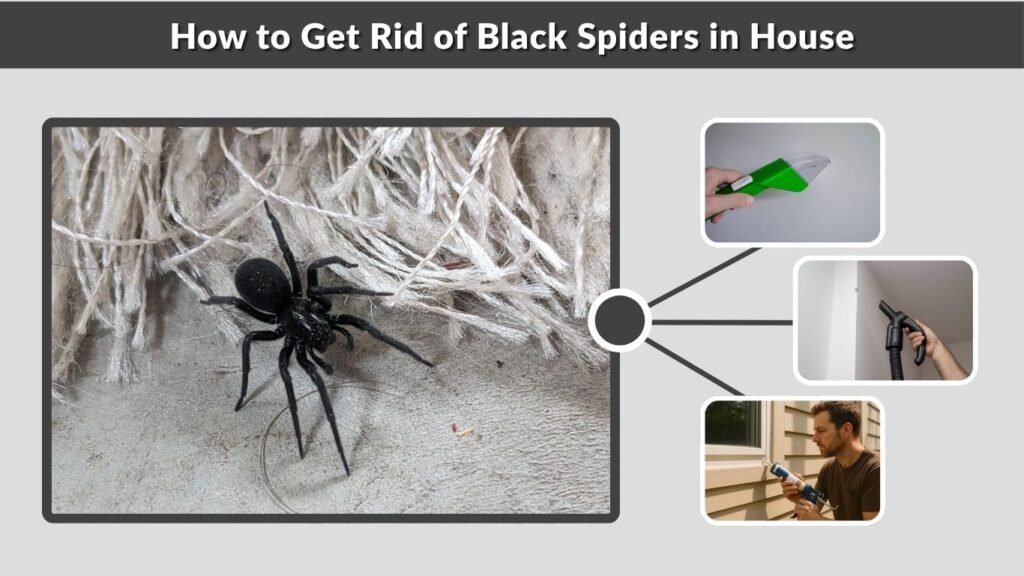
Removing black spiders usually does not require extensive chemical treatment. Regular cleaning, exclusion, and reducing insect activity are often effective.
Follow these practical steps:
- Remove spiders safely: Use a container and stiff paper to capture ordinary, confidently identified harmless spiders without touching them.
- Vacuum webs and egg sacs: Clean corners, window frames, ceilings, and storage areas regularly.
- Seal entry points: Repair damaged screens and close gaps around doors, windows, pipes, and foundations.
- Reduce indoor insects: Address insect problems that provide spiders with a steady food supply.
- Eliminate clutter: Organize boxes, clothing, firewood, and unused household materials.
- Check hidden spaces: Inspect garages, basements, sheds, and storage rooms without reaching blindly into concealed areas.
If you repeatedly encounter suspected black widows or cannot safely identify a spider, contact a qualified pest management professional.
Where Are Black House Spiders Common in the USA?
Black or dark-colored spiders occur throughout the United States, but their species differ by region.
In Virginia, Maryland, and Pennsylvania, homeowners may encounter bold jumping spiders, parson spiders, and black lace-weavers.
Southern house spiders are more commonly associated with warmer states such as Florida, Georgia, and Texas.
In California and other western states, jumping spiders, false widows, and certain black widow species may occur around buildings.
Because spider distributions overlap, geographic location alone cannot confirm an identification.
FAQs
1. What Are the Little Black Spiders in My House?
Little black spiders may be jumping spiders, young parson spiders, or spiderlings. Their markings, body shape, and behavior help determine their species.
2. Are Tiny Black Spiders in Houses Harmful?
Most tiny black spiders are harmless to people. However, small size does not guarantee safety, so avoid handling unfamiliar species.
3. Why Are Black Spiders Suddenly Appearing in My House?
Sudden sightings may result from seasonal movement, emerging spiderlings, increased insect activity, or spiders entering through openings around the building.
4. Do Black Widow Spiders Live in Houses?
Yes. Black widow spiders sometimes occupy garages, basements, storage areas, and other sheltered places around homes. They usually prefer quiet, undisturbed spaces.
5. Are Black Spiders in the House Good or Bad?
Most black spiders are beneficial because they feed on nuisance insects. However, potentially dangerous species should be identified carefully and managed safely.
