
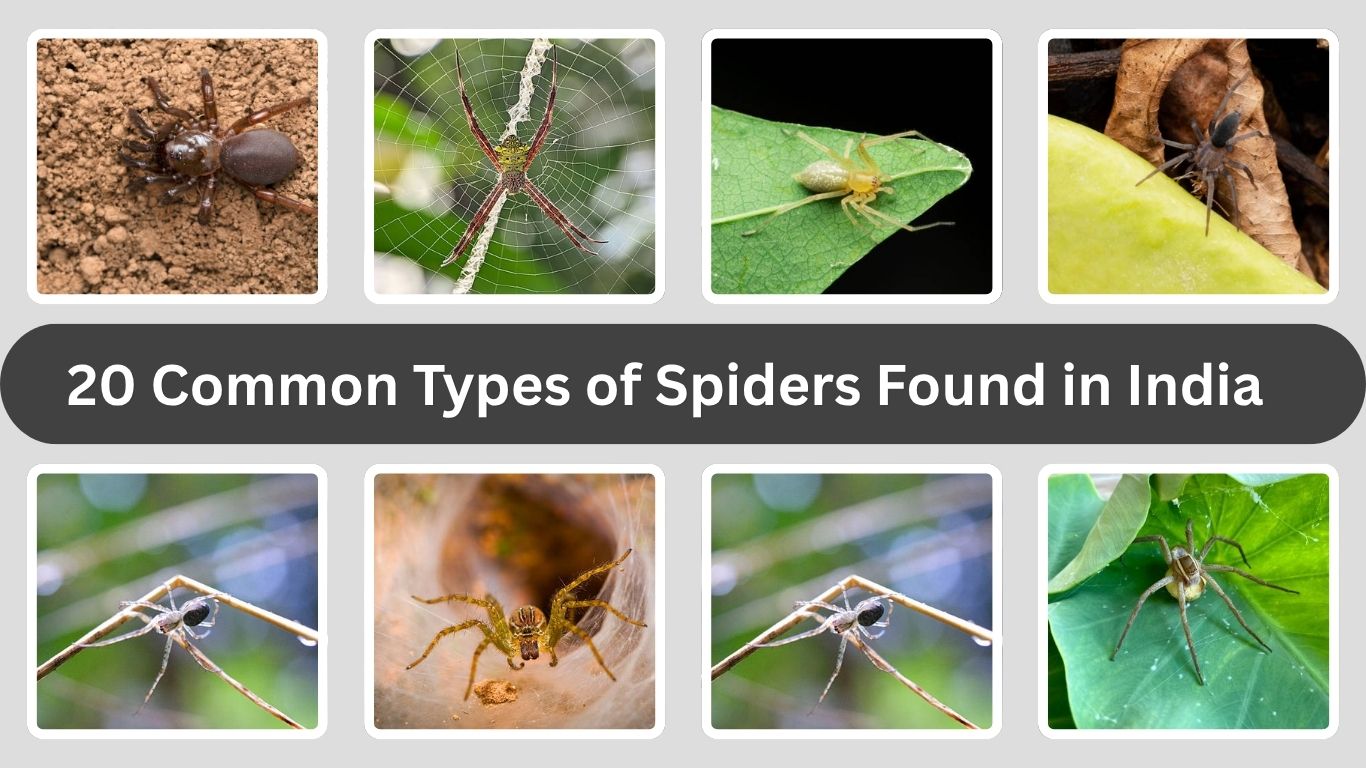
India is home to a wide variety of spiders, ranging from tiny house-dwelling species to large, colorful forest dwellers. These spiders play an important role in maintaining ecological balance by controlling insect populations. While some may look intimidating, most are harmless to humans and contribute positively to their environments.
In this guide, you’ll discover 20 common types of spiders found in India, each with unique features, habitats, and behaviors. Whether seen in gardens, forests, or inside homes, these fascinating creatures are an essential part of the natural world.
1. Indian Ornamental Tarantula

The Indian Ornamental Tarantula is one of the most striking and well-known spiders found in India. Belonging to the genus Poecilotheria, it is admired for its vivid patterns and impressive size. This arboreal species is commonly found in forests, where it lives on trees and remains mostly hidden during the day.
Identification
- Large body with a leg span reaching up to 20 cm
- Distinct black and white patterns with yellow markings on legs
- Flattened body adapted for climbing tree surfaces
- Hairy legs with strong claws for gripping bark
- Noticeable underside markings, often bright yellow or orange
Habitat and Distribution
This species is mainly found in the forests of southern India, especially in states like Andhra Pradesh, Tamil Nadu, and parts of Karnataka. It prefers old trees with holes or crevices, which provide shelter and protection. Being arboreal, it rarely comes to the ground unless necessary.
Behavior and Diet
The Indian Ornamental Tarantula is nocturnal and spends most of the day hiding in tree cavities. At night, it becomes active and hunts insects, small reptiles, and occasionally small birds. It is a fast-moving spider and can be defensive if threatened, often raising its front legs as a warning.
Venom and Interaction with Humans
Although not considered deadly, its venom can cause significant pain, muscle cramps, and discomfort in humans. Bites are rare and usually occur only when the spider feels threatened. Due to its appearance, it is sometimes kept by experienced collectors, but handling is not recommended.
2. Giant Wood Spider

The Giant Wood Spider is one of the largest web-building spiders found in India, known for its impressive size and beautifully woven golden webs. It belongs to the Nephila genus and is often seen in gardens, forests, and even near human settlements where vegetation is dense.
Identification
- Very large size with long, slender legs
- Females significantly larger than males
- Bright yellow, black, and sometimes red markings on the body
- Long cylindrical abdomen
- Spins large, golden-colored orb webs
Habitat and Distribution
The Giant Wood Spider is widely distributed across India, especially in tropical and subtropical regions. It prefers areas with abundant trees and shrubs, such as forests, plantations, and gardens. Its webs are usually built between branches, often at considerable heights.
Behavior and Diet
This spider is known for its skill in building large orb-shaped webs that can span several feet. The golden silk is not only strong but also helps attract prey. It primarily feeds on flying insects like flies, beetles, and butterflies. The female remains at the center of the web, while the much smaller male stays nearby.
Venom and Interaction with Humans
The venom of the Giant Wood Spider is mild and not dangerous to humans. A bite may cause slight pain or irritation but rarely leads to serious symptoms. These spiders are generally non-aggressive and prefer to stay undisturbed, making them beneficial for controlling insect populations.
3. Common House Spider

The Common House Spider is frequently found inside homes across India. It is a small, unobtrusive species that builds messy webs in corners, ceilings, and undisturbed areas. Despite its presence indoors, it plays a helpful role by controlling insect populations.
Identification
- Small body, usually brown or gray
- Long, thin legs
- Rounded abdomen with faint patterns
- Builds irregular, tangled webs
- Often found in corners or behind furniture
Habitat and Distribution
This spider is widely distributed throughout India and thrives in human dwellings. It prefers quiet, undisturbed places such as ceilings, storage rooms, and wall corners. It can also be found in sheds, garages, and outdoor structures.
Behavior and Diet
The Common House Spider is non-aggressive and spends most of its time on its web, waiting for prey. It feeds on small insects like flies, mosquitoes, and ants. Its web is not sticky like orb webs but works by trapping insects in its tangled structure.
Venom and Interaction with Humans
Its venom is harmless to humans and rarely causes any noticeable reaction. Bites are extremely uncommon and usually happen only if the spider is handled. Overall, it is considered beneficial and safe to have around the home.
4. Redback Spider

The Redback Spider is a member of the widow spider group and is known for its distinctive appearance. Though more commonly associated with Australia, it has been reported in parts of India, especially in port cities due to trade.
Identification
- Small, black body with a distinctive red stripe on the back
- Females larger than males
- Round abdomen with glossy appearance
- Long, slender legs
- Web is messy and irregular
Habitat and Distribution
In India, the Redback Spider is mostly found in urban and coastal regions. It prefers sheltered locations such as under rocks, in sheds, or around buildings. It thrives in warm climates and often stays close to human habitation.
Behavior and Diet
This spider is mostly nocturnal and builds tangled webs close to the ground. It feeds on insects and sometimes small animals that get caught in its web. The female remains in the web, while males are rarely seen.
Venom and Interaction with Humans
The Redback Spider is venomous and can deliver a painful bite. Symptoms may include pain, sweating, and nausea, though severe cases are rare. It is not aggressive but may bite if disturbed, so caution is advised around its habitat.
5. Jumping Spider

Jumping Spiders are small, active hunters known for their excellent vision and quick movements. Belonging to the family Salticidae, they are commonly seen in homes, gardens, and walls across India. Their curious behavior and ability to jump make them one of the most easily recognizable spiders.
Identification
- Small and compact body
- Large front-facing eyes giving a “cute” appearance
- Short, sturdy legs adapted for jumping
- Often brightly colored or patterned
- Moves in quick, jerky motions
Habitat and Distribution
Jumping Spiders are found all over India in both urban and rural areas. They prefer sunny spots such as walls, windows, plants, and tree trunks. Unlike web-building spiders, they do not rely on webs to catch prey.
Behavior and Diet
These spiders are active during the day and rely on their sharp eyesight to hunt. They stalk and pounce on insects like flies, mosquitoes, and small bugs. Their jumping ability helps them capture prey with precision and escape threats quickly.
Venom and Interaction with Humans
Jumping Spiders are harmless to humans. Their bites are rare and usually cause little to no reaction. They are considered beneficial as they help reduce pest insects and are generally non-aggressive.
6. Wolf Spider

Wolf Spiders are ground-dwelling hunters known for their speed and agility. They do not spin webs to catch prey but instead chase and capture it. These spiders are commonly found in fields, gardens, and even inside homes in India.
Identification
- Medium to large size with a robust body
- Brown or gray coloration with stripe patterns
- Strong, long legs for running
- Eight eyes arranged in three rows
- Hairy appearance
Habitat and Distribution
Wolf Spiders are widely distributed across India and prefer open areas like grasslands, agricultural fields, and gardens. They may also enter homes, especially during the rainy season, in search of shelter.
Behavior and Diet
These spiders are nocturnal hunters and actively roam in search of prey. They feed on insects such as beetles, ants, and other small invertebrates. Female Wolf Spiders are known for carrying their egg sacs and even their young on their backs.
Venom and Interaction with Humans
Wolf Spider bites are not dangerous but can cause mild pain and irritation. They are not aggressive and usually flee when disturbed. Their presence is beneficial as they help control insect populations naturally.
7. Lynx Spider

The Lynx Spider is a fast-moving, agile hunter commonly found on plants and shrubs across India. Named for its cat-like hunting style, it relies on speed and sharp vision rather than webs to capture prey. It is often seen in gardens and agricultural fields.
Identification
- Slender body with long, spiny legs
- Bright green, brown, or mixed coloration
- Sharp eyesight with prominent eyes
- Body often covered with fine hairs
- Active and quick movements
Habitat and Distribution
Lynx Spiders are widely distributed across India, especially in grassy areas, gardens, and crop fields. They prefer vegetation where they can easily hide and hunt insects. They are commonly found on leaves, flowers, and stems.
Behavior and Diet
These spiders are active hunters and do not build webs to trap prey. They wait on plants and quickly leap onto passing insects. Their diet mainly includes flies, moths, and other small insects, making them useful for pest control in agriculture.
Venom and Interaction with Humans
Lynx Spiders are not dangerous to humans. Bites are rare and usually occur only when handled. Any bite typically causes mild irritation. They are considered beneficial due to their role in reducing harmful insect populations.
8. Huntsman Spider

The Huntsman Spider is a large, fast-moving spider known for its crab-like appearance and wide leg span. It is commonly found in homes, forests, and tree bark across India. Despite its intimidating look, it is generally harmless.
Identification
- Large body with long, laterally extended legs
- Flattened appearance
- Brown or gray coloration for camouflage
- Crab-like movement
- Can grow quite large in size
Habitat and Distribution
Huntsman Spiders are found throughout India in both rural and urban areas. They prefer tree bark, rocks, and sometimes enter homes, hiding behind furniture, curtains, or walls.
Behavior and Diet
These spiders are nocturnal hunters and do not spin webs for catching prey. They actively chase insects such as cockroaches, moths, and other pests. Their speed and agility make them effective predators.
Venom and Interaction with Humans
The Huntsman Spider’s venom is not harmful to humans. A bite may cause slight pain or swelling but is not medically significant. They are non-aggressive and usually run away when disturbed, making them more helpful than harmful.
9. Golden Orb Weaver

The Golden Orb Weaver is a large and visually striking spider known for spinning strong, golden-colored webs. It belongs to the Nephila group and is commonly seen in gardens and forested areas across India. Its impressive web structure makes it easy to spot.
Identification
- Large size with long, slender legs
- Bright yellow and black body coloration
- Long, cylindrical abdomen
- Produces golden-hued silk
- Females much larger than males
Habitat and Distribution
Golden Orb Weavers are widely found in India, especially in warm, humid regions. They prefer forests, gardens, and areas with tall vegetation where they can anchor their large webs between branches.
Behavior and Diet
These spiders build large, orb-shaped webs that can span several feet. The golden silk helps reflect light and attract insects. They feed mainly on flying insects such as flies, beetles, and moths. The female stays in the center while the male remains nearby.
Venom and Interaction with Humans
Their venom is mild and not dangerous to humans. Bites are rare and usually cause only minor irritation. These spiders are non-aggressive and are beneficial for controlling insect populations.
10. Black Widow Spider

The Black Widow Spider is one of the most well-known venomous spiders, recognized for its glossy black body and distinctive markings. While more common in other parts of the world, similar widow species are found in India.
Identification
- Shiny black body with a round abdomen
- Distinct red or orange marking (often hourglass-shaped)
- Long, thin legs
- Females larger than males
- Builds irregular, messy webs
Habitat and Distribution
In India, widow spiders are found in warm regions, often in rural or undisturbed areas. They prefer dark, sheltered places like woodpiles, sheds, and under rocks.
Behavior and Diet
Black Widow Spiders are nocturnal and remain in their webs most of the time. They feed on insects and small invertebrates caught in their sticky webs. The female is dominant, and males are rarely noticed.
Venom and Interaction with Humans
Their venom is potent and can cause pain, muscle cramps, and other symptoms. However, serious cases are rare with proper medical care. They are not aggressive and usually bite only when disturbed or threatened.
11. Garden Spider

The Garden Spider is a common and easily recognizable spider found in gardens across India. Known for its beautifully patterned body and symmetrical webs, it plays an important role in controlling insect populations in natural and cultivated areas.
Identification
- Medium to large size
- Brightly colored body, often with yellow, black, or white patterns
- Rounded abdomen with distinct markings
- Long legs with banded patterns
- Builds circular orb webs
Habitat and Distribution
Garden Spiders are widely found throughout India in gardens, parks, and agricultural fields. They prefer areas with plants, shrubs, and flowers where they can anchor their webs securely between stems and branches.
Behavior and Diet
These spiders are known for spinning neat, circular webs to trap flying insects. They remain in the center or hide nearby, waiting for prey like flies, mosquitoes, and beetles. They are mostly active during the day and rebuild their webs regularly.
Venom and Interaction with Humans
Garden Spiders are harmless to humans. Their bites are rare and usually cause minimal irritation. They are non-aggressive and beneficial, helping to naturally reduce pest insects in gardens and farms.
12. Crab Spider

Crab Spiders are unique spiders known for their sideways movement and ability to blend into flowers. They do not build webs to catch prey but instead rely on camouflage and ambush tactics.
Identification
- Small to medium size
- Flattened body with long front legs
- Legs spread sideways like a crab
- Color varies (white, yellow, green) to match surroundings
- Ability to change color in some species
Habitat and Distribution
Crab Spiders are found all over India, especially in gardens, forests, and fields. They are often seen on flowers and leaves, where they wait for prey while remaining nearly invisible.
Behavior and Diet
These spiders are ambush predators and do not spin webs for hunting. They sit still on flowers and grab insects like bees, butterflies, and flies when they come close. Their camouflage makes them highly effective hunters.
Venom and Interaction with Humans
Crab Spiders are not dangerous to humans. Bites are extremely rare and usually occur only if the spider is handled. Their venom is mild and mainly used to immobilize prey, making them safe and beneficial in natural environments.
13. Cellar Spider

The Cellar Spider, often called “Daddy Long Legs,” is commonly found in homes across India. It is known for its extremely long, thin legs and delicate appearance. Despite its fragile look, it is an effective predator of small insects.
Identification
- Very long, thin legs compared to body
- Small, oval-shaped body
- Pale yellow, gray, or light brown color
- Builds loose, irregular webs
- Often hangs upside down in webs
Habitat and Distribution
Cellar Spiders are widely distributed across India and are mostly found indoors. They prefer damp, dark areas such as basements, ceilings, corners, and storage spaces. They may also live in caves and under rocks outdoors.
Behavior and Diet
These spiders create messy, tangled webs and remain suspended upside down. When disturbed, they vibrate rapidly in their web to confuse predators. They feed on small insects like mosquitoes, flies, and even other spiders.
Venom and Interaction with Humans
Cellar Spiders are harmless to humans. Their venom is very weak and not medically significant. Bites are extremely rare, and they are generally considered beneficial for controlling indoor insect pests.
14. Fishing Spider

Fishing Spiders are semi-aquatic spiders known for their ability to walk on water and hunt near ponds and streams. They are skilled predators and can even catch small fish or aquatic insects.
Identification
- Medium to large size with long legs
- Brown or gray body with stripe patterns
- Hairy legs that help in water movement
- Strong body adapted for hunting
- Can move quickly on water surfaces
Habitat and Distribution
Fishing Spiders are found in parts of India near freshwater sources such as ponds, lakes, and streams. They prefer areas with vegetation along the water’s edge, where they can hunt and hide.
Behavior and Diet
These spiders do not rely on webs to catch prey. Instead, they sit near water and detect vibrations to locate insects or small aquatic animals. They can dive underwater briefly to escape predators or catch prey.
Venom and Interaction with Humans
Fishing Spiders are not dangerous to humans. A bite may cause mild pain or irritation but is not serious. They are generally shy and avoid human contact, making them safe to observe in their natural habitat.
15. Funnel Web Spider

The Funnel Web Spider is known for its distinctive funnel-shaped web and fast movements. While true funnel-web spiders are more famous in Australia, similar funnel-building species are found in India, especially in grassy and bushy areas.
Identification
- Medium-sized body with a dark brown or black color
- Strong legs built for quick movement
- Shiny or slightly glossy appearance
- Creates funnel-shaped webs in ground or vegetation
- Often stays hidden inside the funnel
Habitat and Distribution
In India, funnel web-type spiders are commonly found in grasslands, gardens, and forest edges. They prefer moist environments where they can build their funnel-shaped webs in soil, between rocks, or among dense plants.
Behavior and Diet
These spiders build a tunnel-like web with a narrow retreat. They wait inside the funnel and rush out quickly when prey touches the web. Their diet mainly includes insects such as ants, beetles, and small invertebrates.
Venom and Interaction with Humans
Most funnel web-type spiders in India are not dangerous to humans. Bites are rare and usually result in mild pain or irritation. They are generally shy and prefer to stay hidden rather than confront threats.
16. Grass Spider

The Grass Spider is a fast-moving spider commonly found in lawns and grassy areas. It is known for building sheet webs with a funnel retreat, which helps it catch prey efficiently.
Identification
- Small to medium size
- Brown or gray body with darker stripes
- Long legs adapted for running
- Spinnerets visible at the rear
- Builds flat sheet webs with a funnel opening
Habitat and Distribution
Grass Spiders are widely distributed across India, especially in fields, gardens, and lawns. They prefer areas with tall grass or low vegetation where they can easily construct their webs.
Behavior and Diet
These spiders build sheet-like webs close to the ground with a funnel retreat where they hide. When insects land on the web, they quickly rush out to capture them. Their diet mainly consists of small insects like flies and beetles.
Venom and Interaction with Humans
Grass Spiders are harmless to humans. Their venom is mild and used only for subduing prey. Bites are extremely rare, and they are beneficial for controlling insect populations in outdoor environments.
17. Spitting Spider

The Spitting Spider is a small but unique spider known for its unusual hunting method of “spitting” a sticky, venomous silk onto its prey. It is commonly found in homes and quiet indoor spaces across India.
Identification
- Small size with a pale yellow or light brown color
- Dome-shaped cephalothorax (front body part)
- Long, thin legs
- Dark spots or markings on the body
- Slow-moving compared to other spiders
Habitat and Distribution
Spitting Spiders are widely found in India, especially indoors. They prefer dark, undisturbed places such as walls, ceilings, corners, and behind furniture. They may also be found under rocks or bark outdoors.
Behavior and Diet
Unlike web-building spiders, they actively hunt prey. They spray a sticky silk mixed with venom to immobilize insects from a distance. Their diet includes small insects like flies, ants, and other tiny arthropods.
Venom and Interaction with Humans
Spitting Spiders are harmless to humans. Their venom is very mild and designed only for small prey. Bites are extremely rare, making them safe and even helpful in controlling indoor pests.
18. Sac Spider

Sac Spiders are small, active hunters known for creating silk “sacs” where they rest during the day. They are commonly found in homes, gardens, and agricultural areas across India.
Identification
- Small, pale yellow or cream-colored body
- Long, slender legs
- Smooth and soft appearance
- Builds small silk sacs in corners or leaves
- Active mostly at night
Habitat and Distribution
Sac Spiders are widely distributed throughout India. They are commonly found indoors on walls and ceilings, as well as outdoors in gardens, plants, and crop fields.
Behavior and Diet
These spiders do not rely on webs to catch prey. Instead, they roam at night searching for insects like mosquitoes, flies, and small bugs. During the day, they hide inside their silk sacs for protection.
Venom and Interaction with Humans
Sac Spider bites can occasionally cause mild irritation or redness. While not dangerous, their bite may feel similar to a bee sting. They are not aggressive and only bite when threatened, making them generally harmless.
19. Orb Weaver Spider

Orb Weaver Spiders are among the most common and easily recognizable spiders due to their perfectly circular webs. They belong to the family Araneidae and are widely seen in gardens, forests, and agricultural fields across India.
Identification
- Medium size with a rounded abdomen
- Bright or earthy colors depending on species
- Distinct patterns on the back
- Long legs often with bands
- Builds symmetrical, circular orb webs
Habitat and Distribution
Orb Weaver Spiders are found throughout India in a variety of habitats, including gardens, forests, and farmlands. They prefer areas with vegetation where they can anchor their webs between branches or structures.
Behavior and Diet
These spiders are known for spinning intricate orb-shaped webs, usually rebuilt daily. They remain in or near the web, waiting for flying insects such as flies, moths, and beetles to get trapped. Most are active during the evening or night.
Venom and Interaction with Humans
Orb Weaver Spiders are harmless to humans. Their venom is mild and used only to immobilize prey. Bites are rare and usually cause little to no discomfort, making them beneficial for natural pest control.
20. Trapdoor Spider

Trapdoor Spiders are fascinating ground-dwelling spiders known for building burrows with hidden “trapdoors.” They are rarely seen because they spend most of their lives underground.
Identification
- Medium to large, stout body
- Dark brown or black coloration
- Strong legs adapted for digging
- Large fangs
- Builds burrows with a camouflaged lid
Habitat and Distribution
Trapdoor Spiders are found in parts of India with loose soil, such as forests, grasslands, and rural areas. They prefer dry, sheltered environments where they can dig and maintain their burrows.
Behavior and Diet
These spiders are ambush predators. They stay hidden inside their burrow and wait for vibrations caused by passing insects. When prey comes close, they quickly open the trapdoor and capture it.
Venom and Interaction with Humans
Trapdoor Spiders are not dangerous to humans. While they can bite if provoked, their venom is not medically significant. They are shy and rarely encountered, posing little to no threat to people.
