
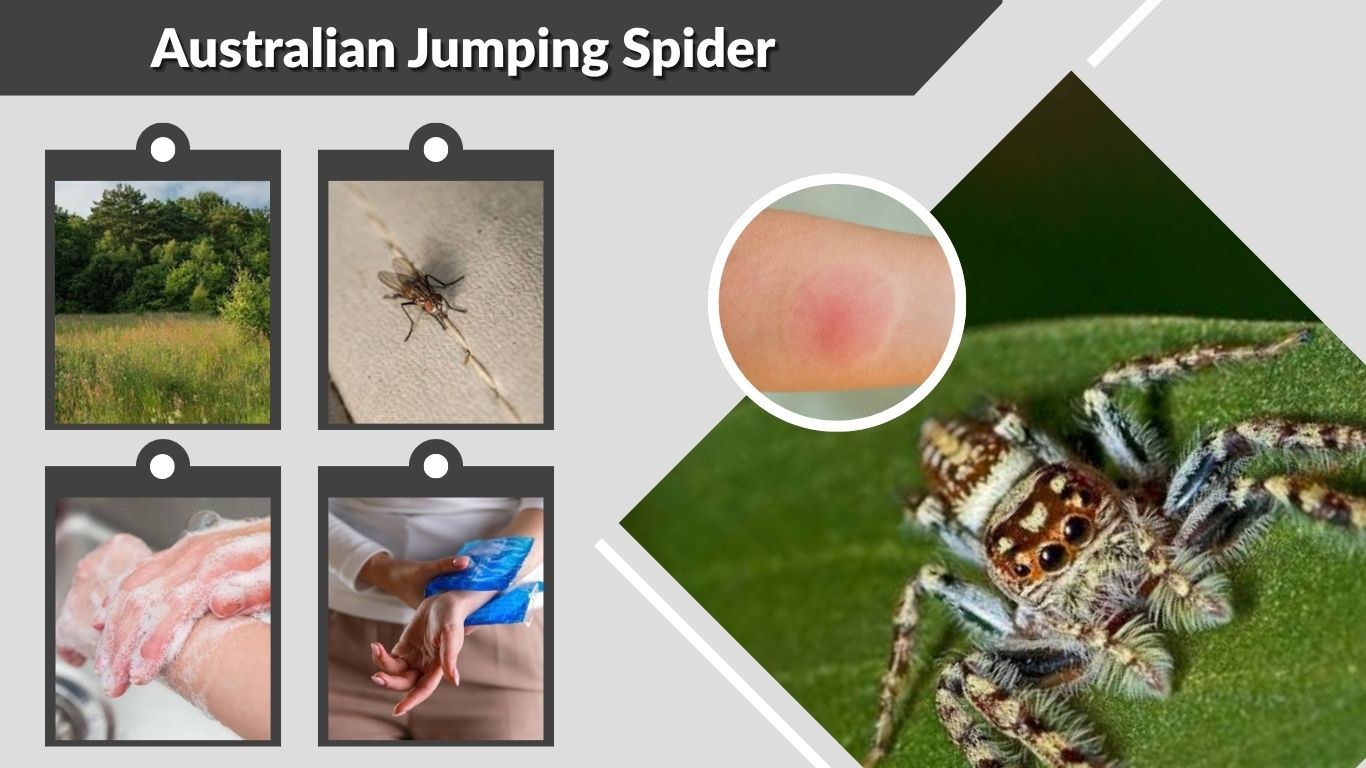
Australian jumping spiders are small, sharp-eyed spiders known for their quick leaps, curious behavior, and often striking colors. They can be black, brown, green, bronze, white, blue, yellow, or patterned, depending on the species. Although they may look bold when they turn toward you or jump from a wall, most are harmless to people and are useful predators of small insects around homes, gardens, forests, and bushland.
What Is an Australian Jumping Spider?
An Australian jumping spider is a spider from the family Salticidae found in Australia. Jumping spiders are active hunters rather than web-trappers. They use excellent eyesight to locate prey, stalk it carefully, and leap when close enough.
The Australian Museum describes jumping spiders as generally small spiders with large eyes, strong jumping ability, bright colors, and inquisitive daytime activity. They hunt by tracking, stalking, judging distance, and suddenly leaping on prey with their strong back legs.
Why They Are Easy to Notice
Jumping spiders behave differently from many house spiders. They do not usually wait in a large web. Instead, they walk, pause, look around, and jump. Because of this, people often describe them as alert, bold, or even “friendly-looking.”
You may see an Australian jumping spider on:
- Walls and fences
- Tree trunks and leaves
- Windowsills and door frames
- Garden plants
- Outdoor furniture
- Sheds, garages, and verandas
- Sunny rocks, bark, or leaf litter
They are most active during the day because vision is central to how they hunt.
Are Australian Jumping Spiders True Spiders?
Yes. They are true spiders, but they are not the same as dangerous Australian spiders such as funnel-web spiders, redbacks, or mouse spiders. Jumping spiders belong to Salticidae, one of the most recognizable spider families because of their large forward-facing eyes and compact bodies.
Australian Jumping Spider Identification
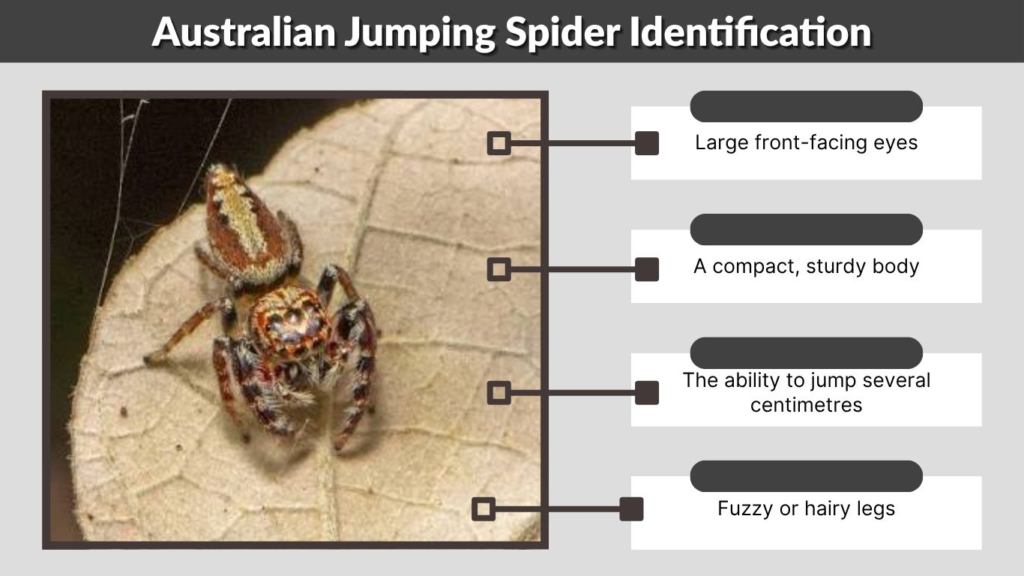
The easiest way to identify a jumping spider is by looking at its eyes, movement, and body shape. Color alone is not enough because Australian jumping spiders come in many shades and patterns.
Key Identification Features
Australian jumping spiders usually have:
- Large front-facing eyes
- A compact, sturdy body
- Short, quick movement
- The ability to jump several centimetres
- A curious habit of turning toward movement
- Fuzzy or hairy legs
- Bright or patterned markings in some species
- Little or no prey-catching web
Atlas of Living Australia notes that Salticidae are active hunters able to jump several centimetres to catch prey, and they build silk retreats for resting, moulting, and protecting egg sacs.
Eye Pattern
Jumping spiders have some of the most distinctive eyes in the spider world. Their front pair of eyes is large and forward-facing, giving them a face-like appearance. Brisbane Insects notes that jumping spiders are easily recognized by their eye pattern, with very large front eyes and smaller eyes arranged around the head, giving them broad visual coverage.
Movement
A jumping spider may walk in short bursts, stop suddenly, and then leap. If it appears to look at you before moving, that is normal. It is using its vision to understand nearby movement, not preparing to attack.
Common Australian Jumping Spider Species
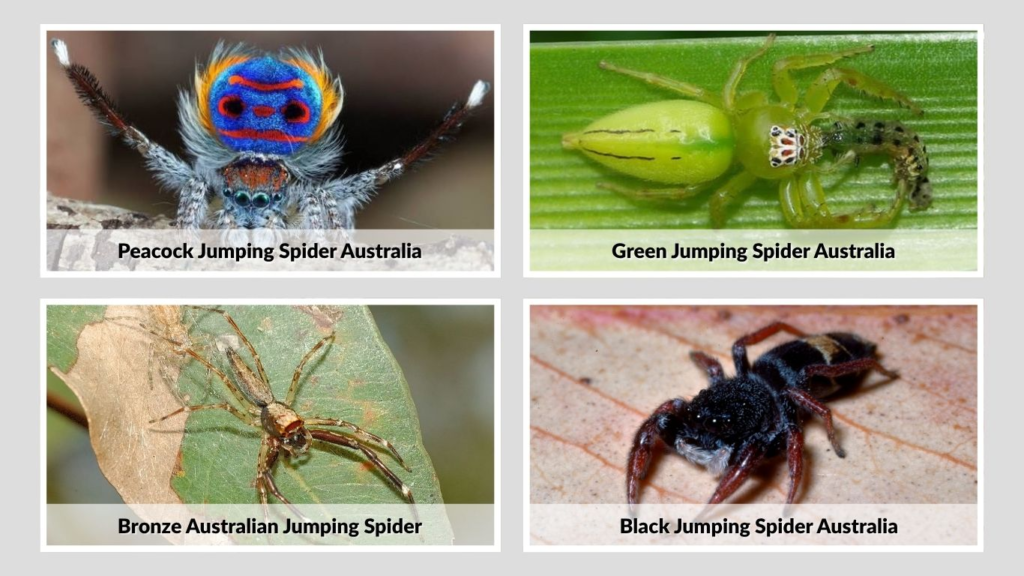
Australia has many jumping spider species, and exact identification often requires a clear close-up photo. Still, several types are commonly searched because of their size, color, or unusual behavior.
Peacock Jumping Spider Australia
Peacock spiders are among the most famous Australian jumping spiders. They belong to the genus Maratus and are known for the colorful courtship displays of males. During mating displays, males may raise bright abdominal flaps, wave their legs, and perform a dance-like movement.
Australian Geographic notes that peacock spiders occur across southern and eastern Australia in habitats such as coastal forests, scrublands, grasslands, and open woodlands. Many species are small and have restricted local distributions.
Peacock spiders are often searched as:
- Australian peacock jumping spider
- Peacock spider Australia
- Australian jumping spider dance
- Australian jumping spider mating dance
- Blue jumping spider Australia
- Australian jumping spider video
Despite their dramatic colors and displays, they are tiny spiders and are not considered dangerous to people.
Green Jumping Spider Australia
The green jumping spider is another popular search. Some Australian green jumping spiders are bright green, yellow-green, or translucent-looking, helping them blend with leaves.
One well-known species is the northern green jumping spider, often associated with eastern Australia and New Guinea. It is sometimes described as one of Australia’s largest jumping spiders. Some sources report females reaching up to about 18 mm in body length, while males are smaller.
Green jumping spiders are often found on broad leaves, tree trunks, garden plants, and outdoor vegetation.
Bronze Australian Jumping Spider
A bronze Australian jumping spider may refer to several species with metallic, golden, brown, or bronze-colored markings. These spiders may look shiny in sunlight and are often found on bark, leaves, or fences.
Because “bronze jumping spider” can describe appearance rather than a single species, identification should be based on a photo, region, size, and markings.
Black Jumping Spider Australia
Black jumping spiders in Australia may have white spots, pale bands, orange markings, or metallic coloring. Some are tiny and found on walls, while others are larger and more noticeable outdoors.
A small black jumping spider in Australia is usually harmless. Black color alone does not mean the spider is dangerous. Look for the classic jumping spider features: compact body, large front eyes, and quick hopping movement.
Brown Jumping Spider Australia
A brown jumping spider in Australia may be tan, dark brown, gray-brown, or striped. Many species have earthy colors that help them blend with bark, soil, dry leaves, or house walls.
Brown jumping spiders are sometimes confused with more concerning spiders, but a compact body and large front eyes strongly suggest a jumping spider. If the spider jumps, watches movement, and does not sit in a messy web, it is likely a harmless salticid.
White, Yellow, Orange, and Blue Jumping Spiders
Searches for white, yellow, orange, and blue jumping spiders in Australia usually come from people trying to identify a colorful spider from a photo. Some colors may appear as body color, leg bands, face markings, or iridescent scales.
Color can help narrow identification, but it should not be used alone. Age, sex, lighting, and moulting stage can change how a spider looks.
Australian Jumping Spider Size
Most Australian jumping spiders are small to medium-sized. Museums Victoria lists jumping spiders as small spiders with two large eyes that move by jumping, with colors including grey, brown, and black, and a maximum size of about 15 mm for the listed Salticidae profile.
Typical Size Range
Many jumping spiders are only a few millimetres long. Larger species may reach around 10–18 mm in body length, depending on the species and sex. Females are often larger and broader, while males may be slimmer or more colorful.
Giant Australian Jumping Spider
People often search for “giant Australian jumping spider” or “Australia’s largest jumping spider,” but even the largest jumping spiders are not giant compared with huntsman spiders or tarantulas. A large jumping spider may look big because it is stocky, hairy, and bold, but it is still usually much smaller than many other Australian spiders.
The green jumping spider is often mentioned in discussions of large Australian jumping spiders, especially because females may reach larger body sizes than many other salticids.
Australian Jumping Spider Bite
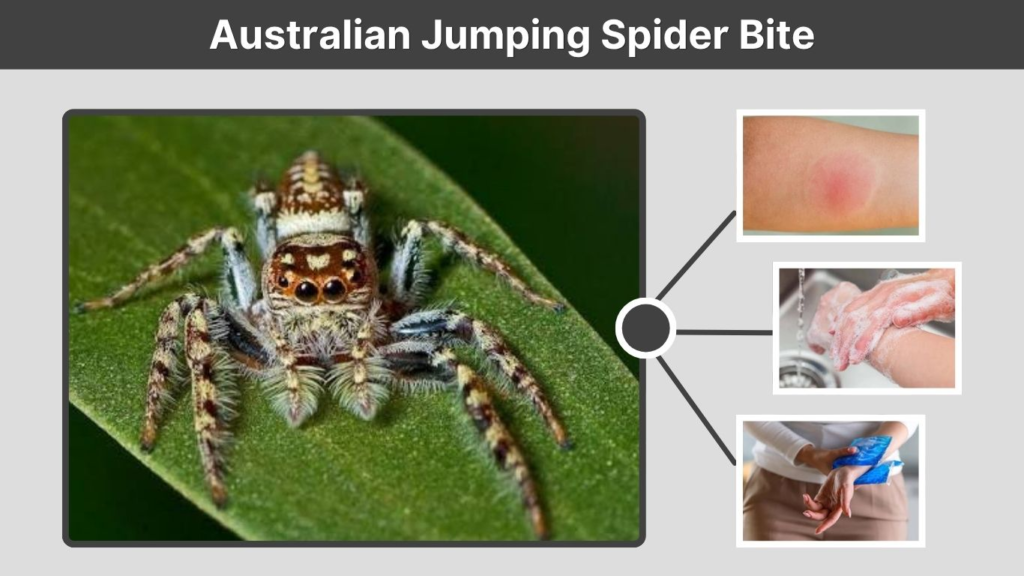
An Australian jumping spider bite is uncommon and usually mild. Jumping spiders are timid around people and prefer to escape. They may bite only if trapped, squeezed, or handled roughly.
Museums Victoria describes jumping spiders as timid spiders that rarely bite, with possible local reaction such as redness, swelling, burning, or itching at the bite site.
Are Australian Jumping Spiders Poisonous?
People often ask whether Australian jumping spiders are poisonous. The better word is “venomous,” because spiders use venom to subdue prey. Australian jumping spiders do have venom, but they are not considered dangerous to most humans.
Their venom is used for small insects and other tiny invertebrates. A bite may cause local irritation, but serious effects are not expected for most people.
What to Do After a Bite
If you think a jumping spider bit you:
- Wash the area with soap and water
- Apply a cold compress
- Avoid scratching
- Monitor for swelling, spreading redness, or worsening pain
- Seek medical advice if symptoms are severe or unusual
If you did not see the spider clearly, avoid assuming the bite came from a jumping spider. Many skin reactions are caused by insects, irritation, infections, or other conditions.
Australian Spider That Jumps on Man From Wall
Viral searches such as “Australian spider jumps on man from wall,” “spider jumps on broom,” or “giant Australian spider jumps off wall” often come from videos where a spider suddenly leaps or drops while someone is trying to move it.
In many cases, the spider may not be a jumping spider. Australia has huntsman spiders and other fast-moving spiders that can suddenly run, drop, or lunge when disturbed. This behavior can look like jumping.
Do Jumping Spiders Attack People?
No. Jumping spiders do not attack people. They may jump to escape, hunt, or move between surfaces. If one jumps toward a person, it is usually accidental or defensive movement, not an attack.
Why They Seem Bold
Jumping spiders have excellent vision and often turn toward movement. This can make them seem confident or confrontational. In reality, they are trying to understand their surroundings.
Where Australian Jumping Spiders Live
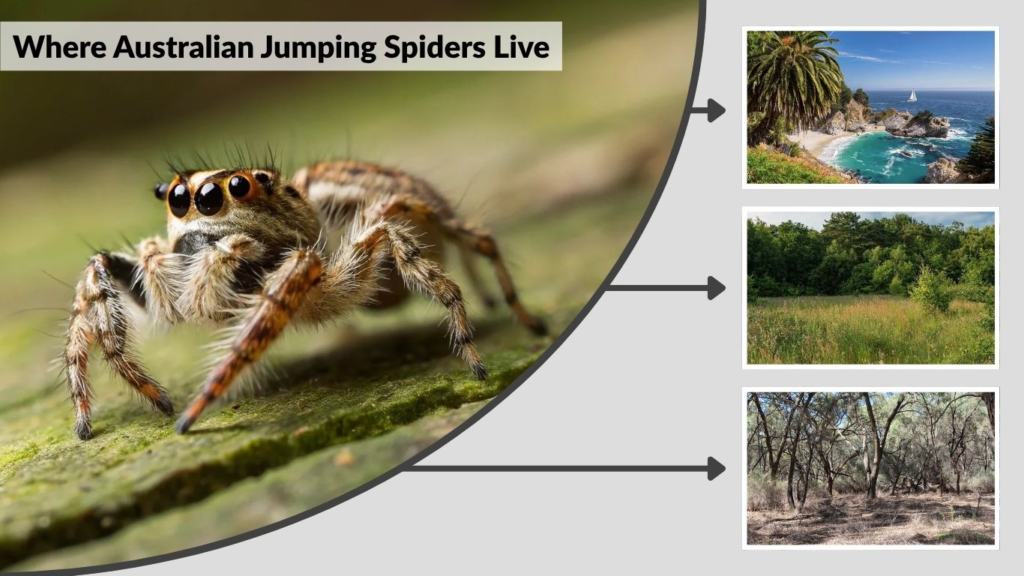
Australian jumping spiders live in many habitats, from urban areas to forests and scrublands. They can be found in gardens, bushland, coastal areas, grasslands, dry forests, wetlands, and around buildings.
Museums Victoria lists jumping spider habitats including wetland, urban areas, and dry forest, and says they may be found outside and in gardens.
Around Homes
A jumping house spider in Australia may appear indoors or around buildings. It may be searching for flies, gnats, mosquitoes, or other small prey.
Common household locations include:
- Windowsills
- Door frames
- Bathroom walls
- Kitchen windows
- Indoor plants
- Garage walls
- Ceiling corners
- Verandas and balconies
They do not usually infest homes. Seeing one or two is normal, especially in warmer months.
In Gardens
Gardens are excellent habitats for jumping spiders because they provide insects, leaves, bark, flowers, and hiding places. Jumping spiders help control small garden pests naturally.
Jumping Spider Pet Australia
Many people search for “jumping spider pet Australia,” “pet jumping spider Australia,” or “jumping spider for sale Australia.” Jumping spiders are popular among hobbyists because of their small size, active behavior, and expressive appearance.
However, laws, collection rules, and seller availability can vary by state or territory. Native wildlife rules may apply. Before buying, keeping, or collecting a jumping spider in Australia, check local regulations and use ethical, legal sources.
Basic Care Considerations
A pet jumping spider needs:
- A secure, ventilated enclosure
- Small live prey
- Safe moisture access
- Perches and hiding spots
- Protection from overheating
- Gentle handling or no handling
Jumping spiders are delicate. They can be injured by falls, rough handling, pesticides, or unsuitable enclosures.
Are Australian Jumping Spiders Good to Have Around?
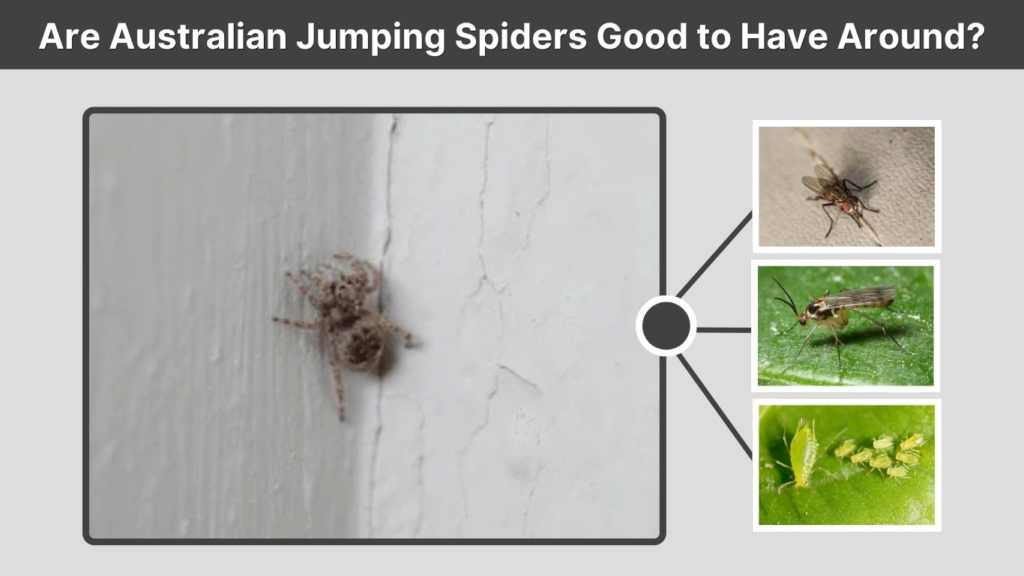
Yes, Australian jumping spiders are generally beneficial. They eat small insects and do not damage homes, furniture, food, clothing, or timber.
They may help reduce:
- Flies
- Gnats
- Mosquitoes
- Aphids
- Small moths
- Other tiny insects
If you find one indoors and do not want it there, relocate it outside with a cup and paper.
How to Remove an Australian Jumping Spider Safely
You usually do not need pest control for a single jumping spider. Use a gentle removal method instead.
Safe Removal Steps
- Place a clear cup over the spider.
- Slide paper or cardboard underneath.
- Carry it outside carefully.
- Release it near plants, bark, or a sheltered area.
Avoid spraying insecticide directly on a single spider. Sprays may create unnecessary chemical exposure and can harm beneficial insects and spiders.
FAQs
Are Australian jumping spiders poisonous?
Australian jumping spiders are venomous, not poisonous, but they are not considered dangerous to most people. Their venom is used to catch tiny prey. Bites are rare and usually cause only mild local symptoms such as redness, swelling, itching, or brief pain.
What is the most common Australian jumping spider?
There is no single common species for all of Australia because species vary by region and habitat. Commonly noticed types include black, brown, green, bronze, and peacock jumping spiders. In gardens and around homes, people often see small salticids on walls, fences, leaves, and windows.
How big is an Australian jumping spider?
Most Australian jumping spiders are small, often only a few millimetres long. Many are under 15 mm in body length, though some larger species, such as green jumping spiders, may be bigger. Even large jumping spiders are usually much smaller than huntsman spiders.
Do Australian jumping spiders bite?
Australian jumping spiders can bite, but they rarely do. A bite is most likely if the spider is trapped, squeezed, or handled. Most bites cause mild local irritation only. Seek medical advice if symptoms are severe, spreading, infected-looking, or if you are unsure what spider was involved.
Can you keep a jumping spider as a pet in Australia?
Some people keep jumping spiders as pets, but rules may vary by location and species. Before buying or collecting one, check state or territory regulations and choose ethical sources. A pet jumping spider needs a secure enclosure, small live prey, moisture, hiding spaces, and careful handling.
