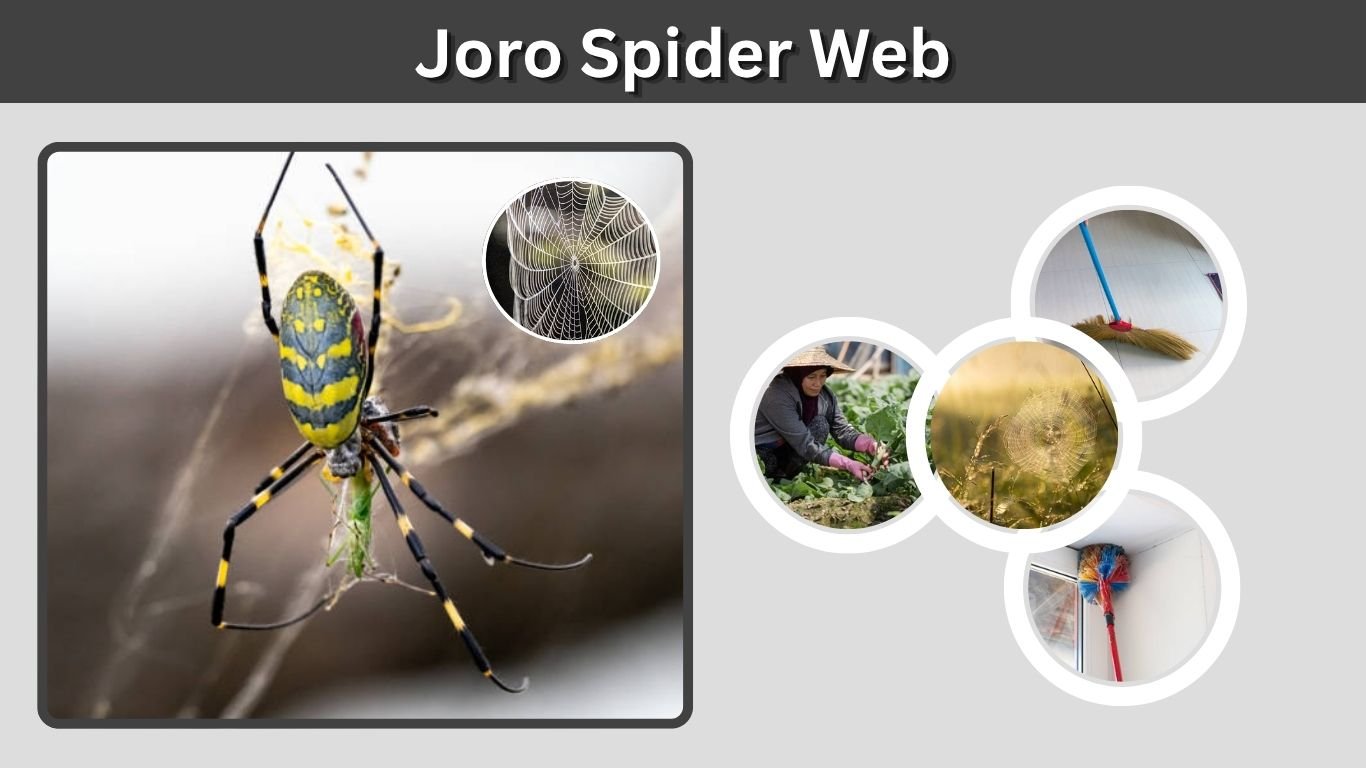
A Joro spider web is a large, multi-layered orb web made from distinctive yellow or golden silk. Mature females often build these webs between trees, porch supports, utility lines, and other widely separated structures. A single web may span more than 10 feet, while its supporting strands can stretch 20 feet or farther. Although the silk feels unusually strong and sticky, claims that an entire Joro web is simply “stronger than steel” need context.
What Does a Joro Spider Web Look Like?
The Joro spider, Trichonephila clavata, belongs to a group commonly called golden orb-weavers. Its web has a circular prey-catching section supported by a larger network of anchor lines and irregular barrier silk.
Identification Features
A mature Joro spider web typically has:
- Yellow or golden silk
- A large, circular orb at its center
- Long support lines attached to trees or buildings
- Multiple layers of silk around the main orb
- A strong and noticeably sticky texture
- An adult female positioned near the center
- One or more much smaller males nearby
Young Joro spiders initially produce clearer silk that resembles that of other orb-weavers. As the female matures, her silk becomes thicker, stronger, stickier, and more golden in appearance.
How Big Is a Joro Spider Web?
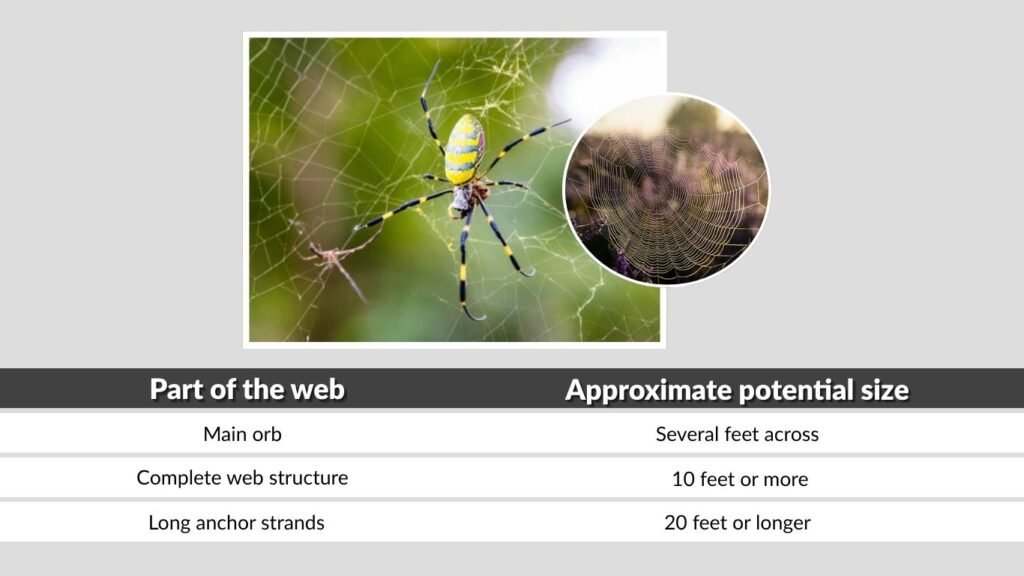
A mature female can create an orb web measuring several feet across. The full structure, including its supporting lines, may be much larger than the visible circular portion.
| Part of the web | Approximate potential size |
| Main orb | Several feet across |
| Complete web structure | 10 feet or more |
| Long anchor strands | 20 feet or longer |
| Spider’s position | Usually near the orb’s center |
University of Georgia Extension reports that mature webs can span at least 10 feet, with support lines extending more than 20 feet between trees, porch columns, and other structures. Exact dimensions depend on the available space and attachment points.
Why Are Some Webs So Large?
Large adult females need enough catching area to intercept flying insects. Widely spaced trees, poles, railings, and building supports provide suitable anchor points for an expanded web.
Several Joro spiders may also construct webs near one another. Their overlapping support lines can make the entire area look like one enormous communal web, although each female generally maintains her own prey-catching orb.
Why Are Joro Spider Webs Yellow?
The golden color is produced by pigments in the silk rather than sunlight merely reflecting from ordinary clear strands. Research has identified xanthurenic acid as the main pigment responsible for the gold coloration of Joro dragline silk.
Possible Functions of Golden Silk
Scientists have proposed that golden silk may help:
- Make the web less noticeable under certain light conditions
- Blend the strands with sunlit vegetation
- attract insects under particular lighting conditions
- Protect silk against environmental exposure
The precise ecological role may involve more than one function. Research on golden orb-weavers suggests that yellow silk can potentially serve as camouflage or a visual lure, but these interpretations should not be treated as fully settled for every Joro web.
Is Every Joro Web Golden?
No. Web color can vary with the spider’s age, silk type, lighting, and viewing angle. Juvenile webs may appear mostly clear or white, while webs made by mature females usually display the strongest yellow or golden color.
How Is a Joro Spider Web Structured?
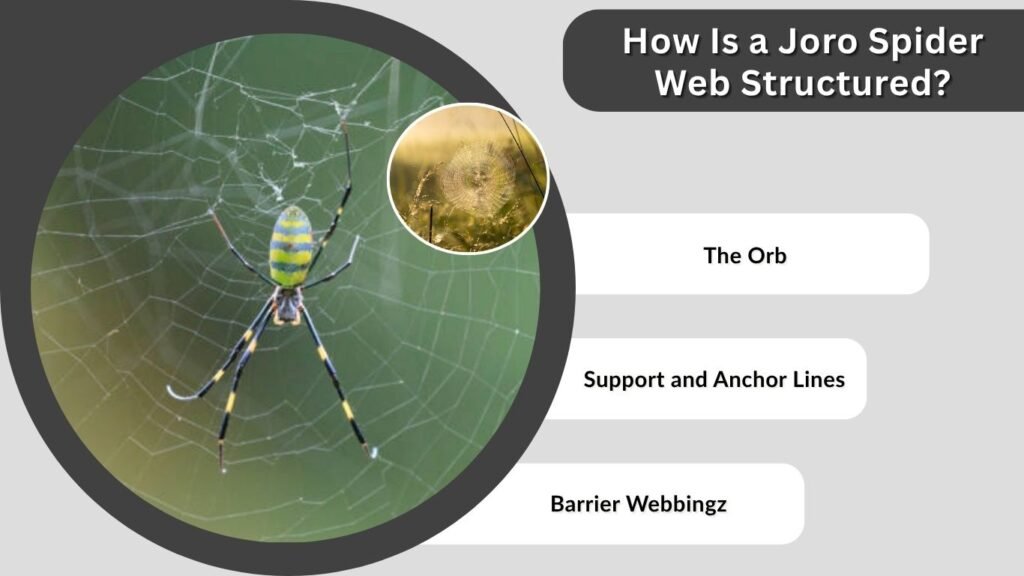
The web is more complex than a single flat circle. It contains several forms of silk arranged for support, movement, protection, and prey capture.
The Orb
The orb is the organized, wheel-shaped section. Radial threads extend from the center like spokes, while a sticky spiral crosses them and intercepts flying insects.
The female generally waits at or near the hub. When an insect strikes the web, vibrations travel through the silk and alert her to its location.
Support and Anchor Lines
Thicker support strands connect the orb to branches, posts, wires, and other stable surfaces. These lines carry the web’s weight and keep it suspended across open spaces.
Because the anchor lines can be much longer than the orb itself, a person may encounter a strand several feet before reaching the spider’s main web.
Barrier Webbing
Irregular silk may surround the organized orb. This three-dimensional barrier can slow approaching insects, reinforce the structure, and offer some protection from large animals or falling debris.
Damaged portions can be repaired, and a spider may rebuild a frequently disturbed web if the location remains suitable.
How Strong Is Joro Spider Silk?
Joro silk combines tensile strength with flexibility, allowing it to absorb the impact of flying insects and movement caused by wind. Laboratory research on Joro dragline silk measured fracture stress at approximately 1,500 megapascals, placing it in the range of high-performance manufactured fibers such as aramids.
Is Joro Silk Stronger Than Steel?
The phrase “stronger than steel” is too simplistic. Comparisons depend on the type of steel, the silk strand tested, whether strength is measured by weight or cross-sectional area, and whether tensile strength, toughness, or elasticity is being compared.
Individual Joro silk fibers can have impressive tensile properties, but the thin strands of a natural web can still be broken by a person, broom, falling branch, or large animal. The remarkable feature is how much strength and flexibility the silk provides despite its extremely small diameter.
Why Does the Web Feel So Tough?
A Joro web may feel stronger than an ordinary indoor cobweb because it contains:
- Thick draglines and anchor strands
- Multiple layers of supporting silk
- Elastic fibers that stretch under pressure
- Sticky capture threads
- Numerous attachment points
Pulling one strand may also place tension on several interconnected parts, making the structure feel tougher than a single thread.
What Is a Joro Spider Parachute Web?
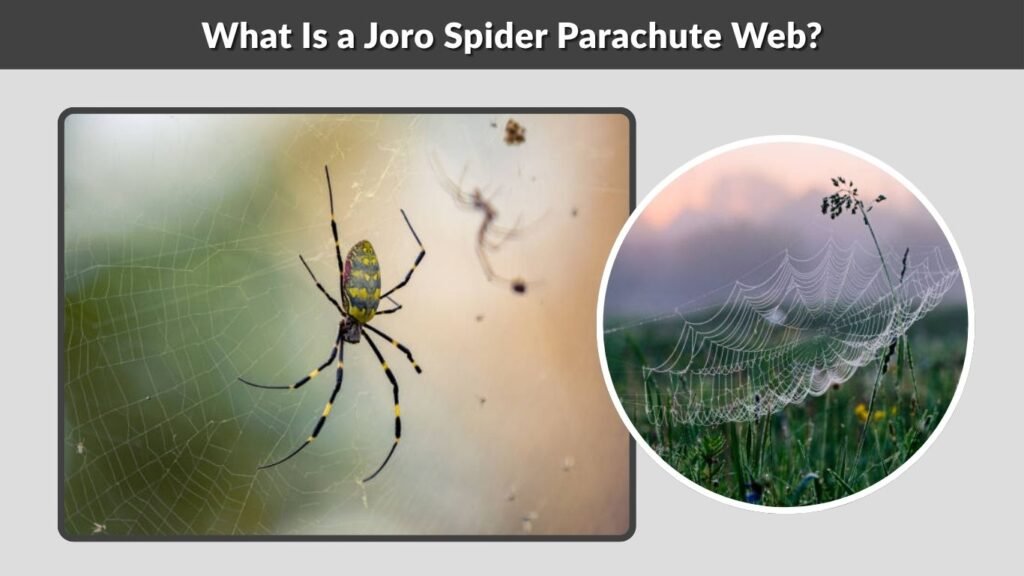
Adult Joro spiders do not fly through the air on their full-sized orb webs. The “flying spider” description refers to ballooning by newly hatched spiderlings.
How Ballooning Works
A spiderling climbs to an exposed location, raises its abdomen, and releases fine silk threads. Wind and atmospheric forces lift the lightweight spider and carry it away from the original egg sac.
This silk acts more like a parachute or sail than an orb web. Ballooning is considered an important natural dispersal method contributing to the species’ expansion, although accidental transportation by vehicles and cargo may also move spiders.
Joro Spider Webs in Georgia
Joro spiders were first scientifically documented in Georgia in 2014, although they may have arrived earlier. They became especially noticeable because mature females built large golden webs around homes, roadsides, forests, porches, and utility structures.
Webs are usually most conspicuous from late summer into fall, when females have reached their largest size and produce thicker golden silk. Egg sacs overwinter, and spiderlings emerge during spring.
How to Get Rid of Joro Spider Webs
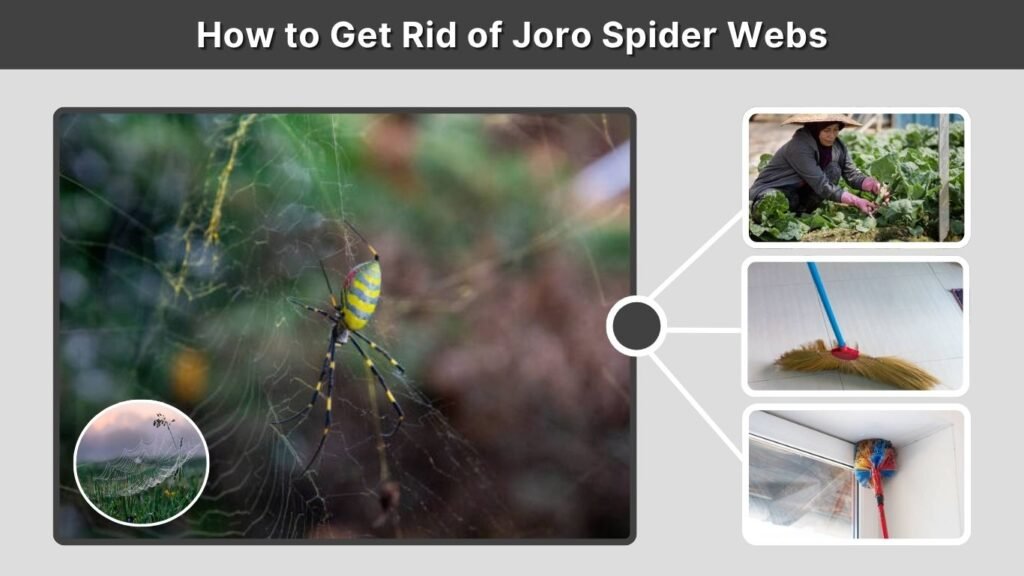
Joro spiders are shy and generally attempt to escape rather than confront people. Webs that are away from doors, walkways, play areas, or frequently used outdoor spaces can usually be left alone.
Removing a Web Safely
To remove an inconvenient web:
- Wear gloves and long sleeves.
- Use a long-handled broom or web-removal tool.
- Stand to the side rather than directly beneath the spider.
- Wind the silk around the tool instead of pulling it by hand.
- Remove nearby egg sacs when population reduction is necessary.
- Check the area again because the spider may rebuild.
Repeatedly knocking down a web can encourage the spider to relocate, although it may rebuild when strong anchor points and abundant prey remain available.
Chemical treatment is rarely necessary for an isolated outdoor spider. Avoid indiscriminate pesticide use because it may affect pollinators, predators, and other beneficial organisms.
FAQs
Are Joro spider webs dangerous?
The web itself is not venomous or medically dangerous. However, long anchor strands can be unpleasant to walk into, and webs across stairs or doorways should be removed to prevent surprise or obstruction.
Are Joro spider webs always yellow?
Mature females generally create yellow or golden silk, but young spiders may produce clearer strands. Light, viewing angle, weathering, and the type of silk within the web can also affect its visible color.
How long does a Joro spider web last?
A web can remain for days or longer when it is sheltered and undisturbed. Wind, rain, prey impacts, animals, and human activity cause damage, so the spider regularly repairs or replaces sections.
Can a Joro web catch birds?
The web is designed for insects, not birds. A small bird might briefly become tangled in a large web, but birds are not the spider’s normal prey and can generally break the silk.
Do Joro spiders reuse their webs?
They repair usable sections and replace damaged silk as needed. When a site becomes unsuitable or is disturbed repeatedly, the spider may abandon it and build a new web elsewhere.
