
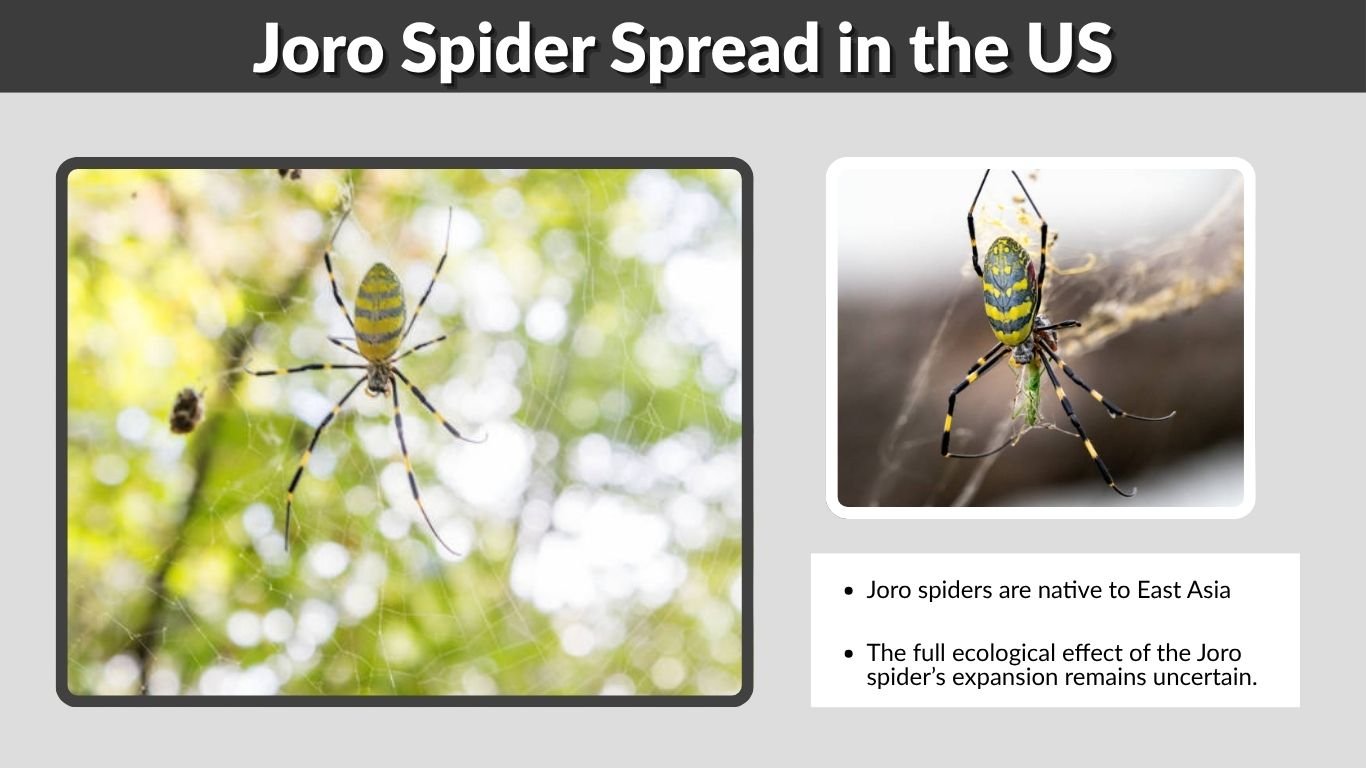
The Joro spider (Trichonephila clavata) is spreading through the eastern United States after becoming established in northeastern Georgia. Its main range now covers large parts of Georgia and neighboring southeastern states, with smaller, separated populations farther north. Young spiders can travel on wind-carried silk, while cars, cargo, plants, and outdoor equipment may move them much farther. Although future expansion is expected, Joro spiders do not pose a significant bite risk to people.
Where Are Joro Spiders Found in the US?
The Joro spider’s core American population remains concentrated in the Southeast. As of 2026, it is established in Georgia, North Carolina, South Carolina, Tennessee, and Alabama, with its range continuing to expand into neighboring areas. Smaller or isolated populations have also been reported in Maryland, Virginia, and Pennsylvania.
A single spider found far from the main range does not necessarily indicate a breeding population. Some distant records may represent spiders accidentally carried on vehicles, luggage, nursery plants, or other transported materials.
| US region | Current status |
| Northern and central Georgia | Densely established |
| South Carolina and North Carolina | Established and expanding |
| Tennessee and Alabama | Established in parts of both states |
| Maryland | Localized established population reported |
| Virginia and Pennsylvania | Isolated or developing populations |
| Other states | Occasional individual reports may occur |
Because distribution data come partly from public observations, the known range can lag behind the spider’s actual range. Joro Watch and EDDMapS continue collecting verified photographs and location reports.
How Did Joro Spiders Reach the United States?
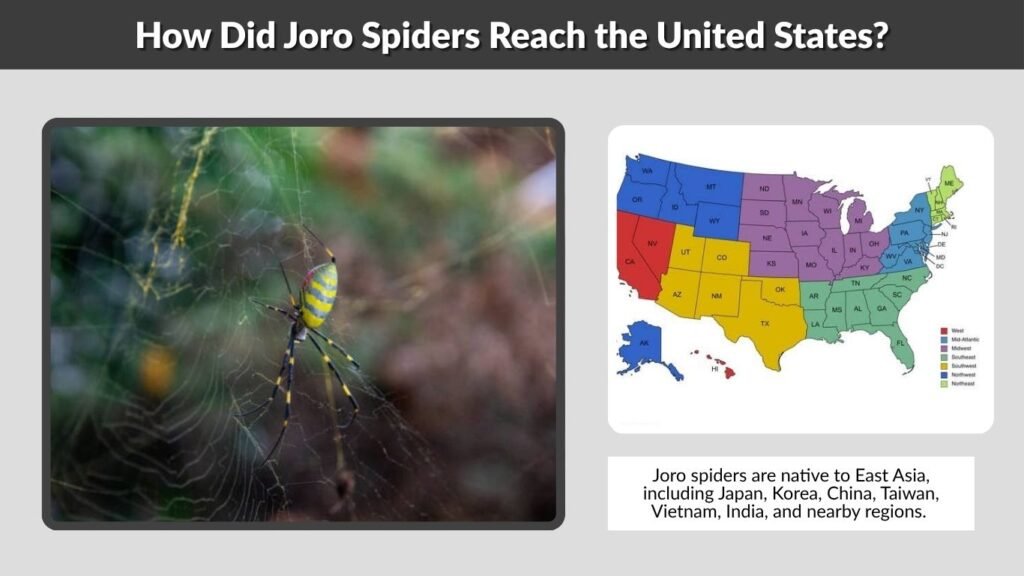
Joro spiders are native to East Asia, including Japan, Korea, China, Taiwan, Vietnam, India, and nearby regions. They were probably transported accidentally to the United States in international cargo, shipping containers, or plant material.
The species was officially documented in northeastern Georgia in 2014. Its earliest recognized population was centered near Braselton and Hoschton along the Interstate 85 corridor, an area with substantial commercial transportation and distribution activity.
By 2022, Joro spiders had expanded approximately 75 miles from the original detection area in several directions. Recent records show that this expansion is continuing.
How Do Joro Spiders Spread?
Joro spiders can expand through both natural dispersal and accidental human transportation. These processes operate at different speeds and explain why isolated populations sometimes appear far from the spider’s main range.
Ballooning Spiderlings
Adult Joro spiders do not fly. However, newly hatched spiderlings can release strands of silk that catch moving air. This behavior, called ballooning, carries the tiny spiders away from the egg sac.
Most probably land relatively close to where they hatched, but strong winds and storms can potentially move some spiderlings tens or even hundreds of miles.
Joro spiders have spread outward from their original Georgia population at an estimated average of about 10 miles per year. This is a general estimate rather than a fixed annual rate because terrain, weather, reproduction, and transportation affect expansion.
Accidental Human Transportation
Human activity can produce much larger jumps than ordinary ballooning. Joro spiders or their egg sacs may be transported on:
- Cars, trailers, and recreational vehicles
- Outdoor furniture and equipment
- Nursery plants and landscaping materials
- Shipping containers and cargo
- Firewood and building supplies
- Luggage and stored household belongings
Separated reports from places beyond the main southeastern population suggest that accidental transportation contributes to long-distance spread.
How Quickly Are Joro Spiders Spreading?
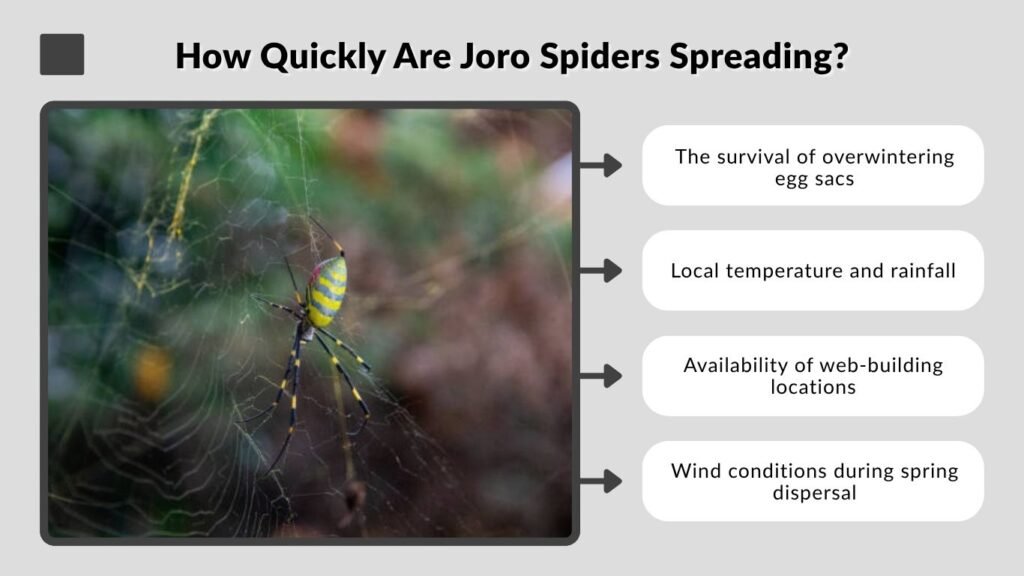
The Joro spider is expanding steadily, but claims that it will immediately cover the entire United States are exaggerated. The continuous population has grown gradually outward from Georgia, while occasional transported spiders have appeared farther away.
During the 2025 Joro Watch reporting event, volunteers submitted 3,602 verified records across 112 counties in five states. These observations helped document continuing expansion across the Southeast and toward more northern regions.
The speed of future spread will depend on several factors:
- The survival of overwintering egg sacs
- Local temperature and rainfall
- Availability of web-building locations
- Wind conditions during spring dispersal
- Accidental transportation by people
- Whether isolated spiders find mates and establish populations
A lone female does not always create a lasting population, especially if she is not carrying fertile eggs or suitable habitat is unavailable.
How Far Could Joro Spiders Spread?
Climate models indicate that large areas of eastern North America could support Joro spiders. Suitable conditions may extend from the Gulf Coast through much of the eastern United States and into parts of southern Canada, particularly in temperate forests and coastal areas.
The species already survives cold winters as eggs. Its native distribution includes parts of Japan with winter temperatures comparable to those found in portions of the northeastern United States. This suggests that winter weather alone will not restrict it to Georgia and the Deep South.
However, climate suitability does not guarantee that Joro spiders will occupy every suitable location. Food availability, vegetation, competitors, predators, transportation routes, and reproduction will also influence their final range.
Will Joro Spiders Spread Across the Entire US?
Joro spiders are expected to spread broadly through the eastern United States, but western expansion is less certain. Current modeling identifies many suitable areas along the East Coast, in the Southeast, and around temperate coastal and mountain regions.
Dry climates, unsuitable seasonal conditions, geographic barriers, and limited transportation may slow their movement into some western regions. Individual spiders could still be carried anywhere in the country, but an isolated sighting is different from a reproducing population.
The species is therefore better described as an expanding eastern-US spider than as one that is certain to occupy every American state.
What Time of Year Do Joro Spiders Spread?
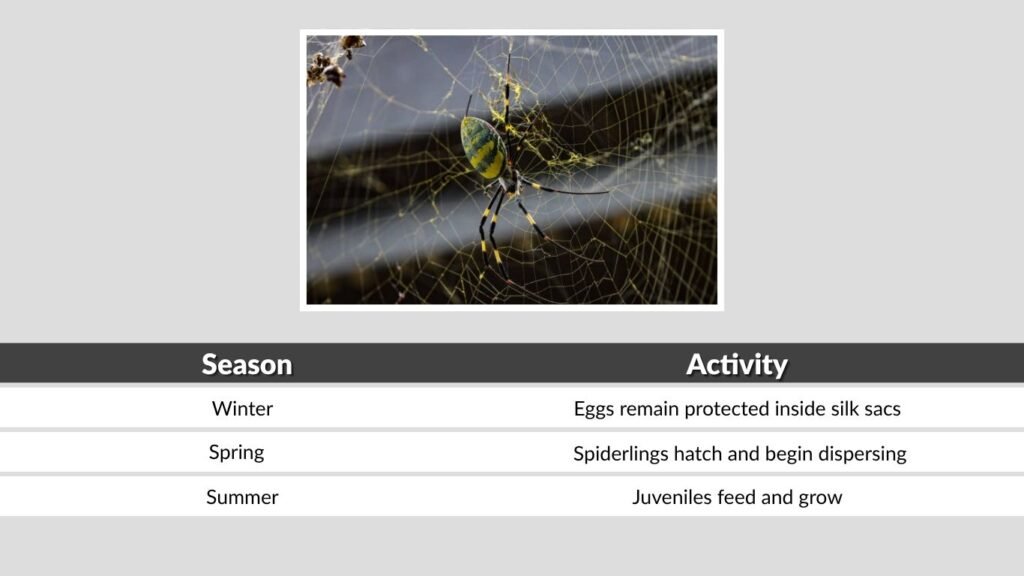
Joro spiders overwinter as eggs inside dense silk sacs. Spiderlings hatch during spring and early summer, when ballooning dispersal is most likely.
The spiders remain relatively small and difficult to recognize throughout early summer. Mature females become conspicuous from late August through October, when their bright colors and large webs are fully developed. Females produce egg sacs during fall before adult spiders die in freezing weather.
| Season | Activity |
| Winter | Eggs remain protected inside silk sacs |
| Spring | Spiderlings hatch and begin dispersing |
| Summer | Juveniles feed and grow |
| Late summer–fall | Large adults and webs become noticeable |
| Fall | Mating and egg-sac production occur |
Are Spreading Joro Spiders Dangerous?
Joro spiders are venomous because they use venom to subdue insects, but they are not considered medically dangerous to people. Research involving direct human contact found that the spiders usually attempted to escape and rarely bit unless forcibly restrained. When bites occurred, symptoms were limited mainly to temporary redness, swelling, and low-level pain.
They do not chase people, jump toward them, or fly as adults. Walking into a web may be startling, but the spider will generally retreat, drop, or remain motionless.
Will Joro Spiders Harm Native Ecosystems?
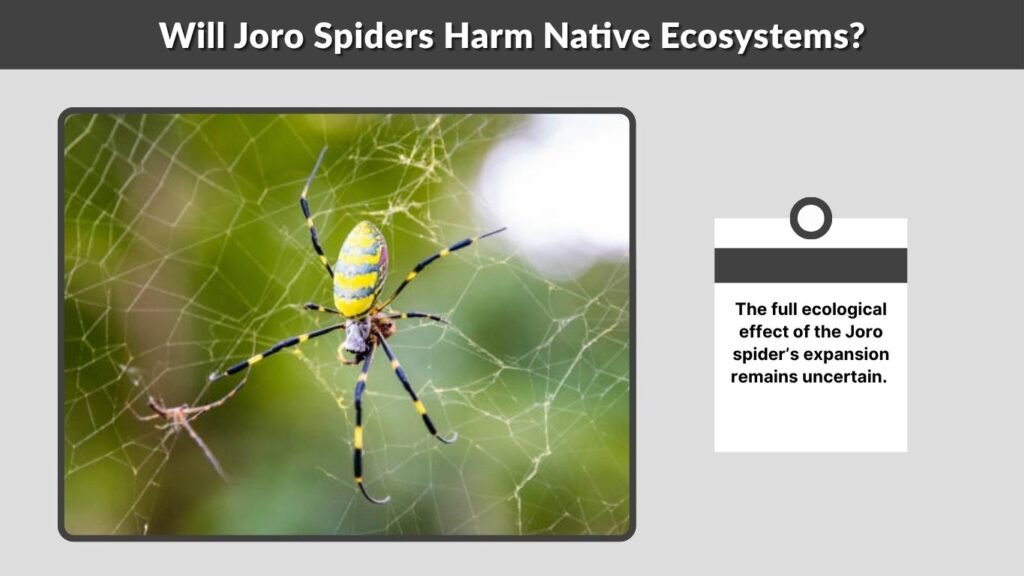
The full ecological effect of the Joro spider’s expansion remains uncertain. Joros capture numerous flying insects and can become extremely abundant in places where they have been established for several years.
Researchers are investigating whether they compete with native orb-weavers, change local food webs, or affect pollinators and other insects. Their ability to live near roads, buildings, gardens, and other human-modified habitats may help them spread without depending entirely on undisturbed natural areas.
Because the long-term consequences are still being studied, it is inaccurate to describe Joro spiders as either completely harmless to ecosystems or certain to cause severe environmental damage.
What Should You Do After Finding a Joro Spider?
Photograph the spider clearly and record its location. Sightings outside the established southeastern range are particularly valuable to researchers.
Report observations through Joro Watch or EDDMapS rather than transporting the spider. Before moving vehicles, outdoor furniture, plants, trailers, or equipment from an infested area, inspect them for spiders and white silk egg sacs.
A web in an inconvenient location can be removed with a long broom or pole. Large-scale pesticide treatment is usually unnecessary, particularly because broad-spectrum pesticides can affect native spiders, insects, and pollinators.
FAQs
What states currently have Joro spiders?
Established populations occur primarily in Georgia, North Carolina, South Carolina, Tennessee, and Alabama. Smaller or separated populations have been reported in Maryland, Virginia, and Pennsylvania. Individual records elsewhere do not always indicate that a breeding population exists.
Are Joro spiders moving north?
Yes. Verified records show expansion northward from the main southeastern range, including localized populations in Mid-Atlantic states. Their cold tolerance and native Asian distribution suggest that they could survive in much of the eastern United States.
Can Joro spiders fly hundreds of miles?
Adult Joro spiders cannot fly. Tiny spiderlings travel by ballooning on silk strands. Strong winds may carry some considerable distances, but accidental transportation on vehicles, cargo, and plants is more likely to explain many distant sightings.
Will Joro spiders reach New York?
Climate models suggest that parts of New York and other northeastern states may be suitable, but this does not establish a reliable arrival date. Natural expansion is gradual, while accidental transport could create isolated sightings much sooner.
Should Joro spiders be killed to stop their spread?
Killing individual spiders will not stop the regional expansion of an established population. Removing spiders or webs from doorways and paths is reasonable, but reporting new locations and avoiding accidental transportation are more useful for monitoring and slowing long-distance spread.
