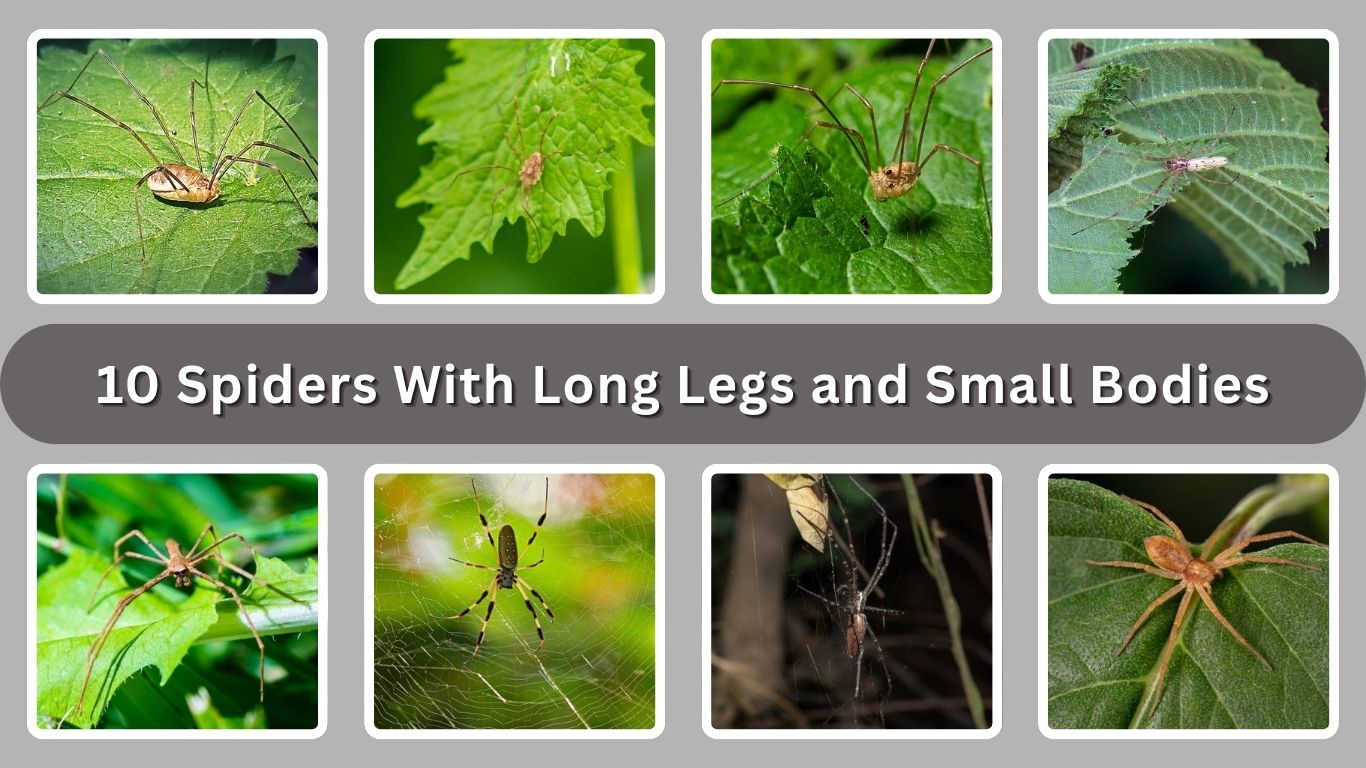
Spiders with long legs and small bodies are some of the most unusual and fascinating arachnids. Their unique body structure often helps them move quickly, sense vibrations, and capture prey efficiently. While some may look intimidating due to their long, thin legs, most of these spiders are completely harmless to humans. In this list, we explore 10 different species known for this distinctive appearance, highlighting their features, habitats, and behaviors that make them both interesting and important in nature.
1. Daddy Longlegs (Cellar Spider)

The Daddy Longlegs, commonly known as the Cellar Spider (Pholcidae family), is famous for its extremely long, thin legs and tiny body. Often found in homes, it is harmless to humans and plays a helpful role by feeding on insects and even other spiders. Its delicate appearance makes it one of the most easily recognizable spiders worldwide.
Identification
- Very small, narrow body
- Extremely long, thin legs compared to body size
- Pale yellow, light brown, or gray coloration
- Often seen hanging upside down in webs
- Fragile appearance with a cylindrical abdomen
Habitat and Distribution
Cellar Spiders are found all over the world, especially in warm and temperate regions. They commonly live indoors in basements, ceilings, corners of rooms, and garages. Outdoors, they may be found in caves, under rocks, or in sheltered spaces. They prefer quiet, undisturbed environments where they can build their loose, irregular webs.
Behavior and Diet
Daddy Longlegs are non-aggressive and tend to remain in their webs. When disturbed, they often vibrate rapidly, making it difficult for predators to detect them. Their diet includes small insects, flies, mosquitoes, and even other spiders. They are skilled at capturing prey using their messy webs and may invade other spiders’ webs to feed.
Venom and Medical Importance
Despite common myths, Daddy Longlegs are not dangerous to humans. Their venom is very mild and not harmful, and their fangs are too small to penetrate human skin effectively. Bites are extremely rare and cause no serious symptoms. Overall, they are beneficial spiders that help reduce pest populations indoors.
2. Harvestman

The Harvestman, often confused with spiders, belongs to the order Opiliones. Unlike true spiders, they have a single, fused body segment and do not produce silk or venom. Known for their extremely long legs and small body, they are harmless creatures commonly seen in gardens and fields.
Identification
- Small, round body with no clear separation between segments
- Very long, thin legs
- Usually brown, gray, or black in color
- No silk glands or fangs
- Body appears as a single oval shape
Habitat and Distribution
Harvestmen are found worldwide in a variety of environments, including forests, grasslands, and gardens. They prefer moist areas and are often seen under rocks, logs, or leaf litter. They may also gather in large groups, especially in damp, shaded locations.
Behavior and Diet
These creatures are scavengers rather than hunters. They feed on small insects, plant material, fungi, and even dead organisms. Harvestmen are mostly active at night and tend to hide during the day to avoid predators and dry conditions.
Venom and Medical Importance
Harvestmen are completely harmless to humans. They do not possess venom glands or the ability to bite. Despite common myths, they pose no danger and are beneficial as they help clean up organic matter in the environment.
3. Long-bodied Cellar Spider

The Long-bodied Cellar Spider (Pholcus phalangioides) is one of the most common indoor spiders, easily recognized by its tiny body and extremely long legs. It is often found in corners of homes and is known for its gentle nature and usefulness in controlling insect populations.
Identification
- Very small, elongated body
- Extremely long, delicate legs
- Pale gray or light brown color
- Cylindrical abdomen
- Often hangs upside down in its web
Habitat and Distribution
This spider is widely distributed across the world and is commonly found indoors. It prefers ceilings, basements, and quiet corners of buildings. Outdoors, it may live in caves, under rocks, or in sheltered spaces with minimal disturbance.
Behavior and Diet
Long-bodied Cellar Spiders build loose, irregular webs and remain in them most of the time. When threatened, they vibrate rapidly to confuse predators. They feed on small insects and are known to capture and eat other spiders, including more dangerous species.
Venom and Medical Importance
These spiders are harmless to humans. Their venom is weak and not medically significant. Bites are extremely rare and cause little to no reaction. They are considered beneficial because they help reduce indoor pests and other spider populations.
4. Giant House Spider

The Giant House Spider (Eratigena species) is a fast-moving spider known for its long legs and relatively small body. Commonly found in homes, especially in cooler regions, it may look intimidating but is harmless to humans. It is one of the fastest spiders and an effective hunter of indoor pests.
Identification
- Long, slender legs with noticeable hair
- Medium-sized body compared to leg span
- Brown coloration with subtle patterns
- Leg span can reach up to 7–10 cm
- Males are slimmer and more active than females
Habitat and Distribution
Giant House Spiders are commonly found in Europe and have spread to other regions. They prefer indoor environments such as basements, garages, and corners of rooms. Outdoors, they may live under rocks, logs, or in crevices. They build funnel-shaped webs in quiet, undisturbed areas.
Behavior and Diet
These spiders are active hunters, especially at night. While they build webs, they often leave them to chase prey. Their diet includes insects like flies, beetles, and other small arthropods. They are fast runners and rely on speed to capture prey rather than just webs.
Venom and Medical Importance
The venom of the Giant House Spider is mild and not dangerous to humans. Bites are rare and usually occur only if the spider is handled. Any symptoms are typically minor, such as slight pain or redness. They are beneficial spiders that help control household pests.
5. Stretch Spider

The Stretch Spider (Tetragnatha species), also known as the long-jawed orb-weaver, is recognized for its slender body and extremely long legs. It often rests in a stretched posture along plant stems, making it well-camouflaged. This spider is harmless and commonly found near water.
Identification
- Very long, thin body with elongated abdomen
- Extremely long legs held straight along the body
- Brown, green, or yellowish coloration
- Long jaws (chelicerae) visible in some species
- Slim and delicate appearance
Habitat and Distribution
Stretch Spiders are found worldwide, especially near lakes, rivers, and wetlands. They prefer vegetation near water where flying insects are abundant. Their orb webs are often built horizontally or at slight angles between grasses or branches.
Behavior and Diet
These spiders are calm and rely on camouflage to avoid predators. They align their bodies with plant stems to blend in. Their diet mainly includes flying insects such as mosquitoes and flies. They build orb webs but may also actively capture prey nearby.
Venom and Medical Importance
Stretch Spiders are not dangerous to humans. Their venom is very mild, and bites are extremely rare. Even if a bite occurs, it usually results in minor irritation only. They are beneficial spiders, especially in areas near water, as they help control insect populations.
6. Crane Fly Spider (Pholcid type)

The Crane Fly Spider, often confused with crane flies due to its long legs, belongs to the cellar spider group (Pholcidae). It has a tiny body with extremely long, delicate legs, giving it a fragile appearance. Commonly found indoors, it is harmless and helps control small insect populations.
Identification
- Very small body with extremely long, thin legs
- Pale gray, yellowish, or light brown color
- Fragile and delicate appearance
- Long legs often spread widely like a crane fly
- Hangs upside down in loose webs
Habitat and Distribution
This spider is widely distributed across the world and is commonly found in homes, basements, garages, and ceilings. It prefers quiet, undisturbed areas where it can build irregular webs. Outdoors, it may live in sheltered places like caves, under rocks, or in crevices.
Behavior and Diet
Crane Fly Spiders are non-aggressive and spend most of their time in their webs. When disturbed, they vibrate rapidly to confuse predators. Their diet consists of small insects such as flies and mosquitoes, and they may also prey on other spiders.
Venom and Medical Importance
These spiders are harmless to humans. Their venom is weak and not medically significant, and their fangs are too small to cause harm. Bites are extremely rare and result in little to no symptoms. They are beneficial for controlling pests indoors.
7. Golden Silk Orb-Weaver (Juvenile)

The juvenile Golden Silk Orb-Weaver (Nephila species) has a small body with long, slender legs, making it resemble other long-legged spiders. As it matures, the body becomes larger, but young individuals are especially delicate in appearance. It is known for spinning strong, golden-colored webs.
Identification
- Small body in juvenile stage with long legs
- Yellow, black, or golden markings
- Slender legs often with dark bands
- Delicate appearance when young
- Females grow much larger than males
Habitat and Distribution
Golden Silk Orb-Weavers are found in tropical and subtropical regions around the world. They live in forests, gardens, and areas with tall vegetation. Their large orb webs are usually built between trees or shrubs, often in sunny locations.
Behavior and Diet
These spiders are web-builders and remain in the center of their large, strong webs. They feed on flying insects such as flies, moths, and even small birds in rare cases. Juveniles behave similarly but are less noticeable due to their smaller size.
Venom and Medical Importance
The venom of the Golden Silk Orb-Weaver is mild and not dangerous to humans. Bites are uncommon and usually cause only minor irritation. These spiders are beneficial as they help reduce insect populations and are not considered a threat.
8. Net-Casting Spider

The Net-Casting Spider (Deinopidae family) is a unique spider known for its long legs and small, narrow body. It gets its name from its unusual hunting technique, where it uses a small silk net to capture prey. Its large eyes and stretched posture make it quite distinctive.
Identification
- Slender, elongated body
- Long, thin legs
- Very large forward-facing eyes
- Brown or gray coloration for camouflage
- Often hangs with front legs extended
Habitat and Distribution
Net-Casting Spiders are found in tropical and subtropical regions, including parts of Asia, Australia, and the Americas. They prefer forests, gardens, and areas with vegetation. During the day, they rest motionless on branches, blending in with their surroundings.
Behavior and Diet
Unlike typical web-builders, these spiders actively hunt at night. They hold a small rectangular web between their front legs and stretch it over passing prey. Their diet includes insects such as flies, moths, and crickets. Their excellent night vision helps them detect movement in low light.
Venom and Medical Importance
The venom of Net-Casting Spiders is mild and not harmful to humans. Bites are extremely rare due to their shy nature. Even if a bite occurs, it usually results in minor irritation. They are harmless and beneficial predators in their ecosystems.
9. Running Crab Spider

The Running Crab Spider (Philodromidae family) is a fast-moving spider with long legs and a relatively small body. Unlike true crab spiders, it does not rely on ambush alone and is more active in hunting. Its flattened body and leg posture help it move quickly across surfaces.
Identification
- Small, flattened body
- Long legs extending sideways
- Brown, gray, or tan coloration for camouflage
- Fast and agile movement
- Legs often appear uneven in length
Habitat and Distribution
Running Crab Spiders are found worldwide in forests, grasslands, and gardens. They live on plants, tree bark, and ground surfaces where they can blend into their surroundings. They do not build webs and instead rely on speed and camouflage.
Behavior and Diet
These spiders are active hunters and do not use webs to catch prey. They chase or ambush insects such as flies, ants, and small beetles. Their speed allows them to quickly capture prey, and they are often seen moving rapidly across leaves or surfaces.
Venom and Medical Importance
Running Crab Spiders are harmless to humans. Their venom is mild and not medically significant. Bites are rare and typically cause only slight irritation. They are beneficial spiders that help control insect populations in natural and garden environments.
10. Whip Spider (Amblypygi)

The Whip Spider, also known as Tailless Whip Scorpion (Amblypygi), is an unusual arachnid with a small body and extremely long, whip-like front legs. Despite its intimidating appearance, it is harmless to humans. It is more closely related to scorpions than true spiders and is known for its unique movement and sensory limbs.
Identification
- Flattened body with a small central size
- Extremely long, whip-like front legs used as feelers
- Eight legs, with the first pair acting like antennae
- Brown or dark coloration
- Large, spiny pedipalps (pincer-like appendages)
Habitat and Distribution
Whip Spiders are found in tropical and subtropical regions around the world. They prefer humid environments such as forests, caves, and under rocks or bark. They are also sometimes found in old buildings or ruins where moisture is present.
Behavior and Diet
These arachnids are nocturnal and hide during the day. At night, they use their long front legs to sense their surroundings and locate prey. They feed on insects and other small invertebrates, capturing them with their strong pedipalps. They do not build webs and rely on active hunting.
Venom and Medical Importance
Whip Spiders are completely harmless to humans as they do not possess venom glands. They cannot bite or sting. Their appearance may be frightening, but they pose no threat. In fact, they are beneficial as they help control insect populations in their habitats.
FAQs
1. Are spiders with long legs and small bodies dangerous?
Most spiders with long legs and small bodies are harmless to humans. While they may look scary due to their size and leg span, their venom is usually mild or not medically significant. They rarely bite and prefer to avoid human contact whenever possible.
2. Why do these spiders have such long legs?
Long legs help these spiders move quickly, detect vibrations, and capture prey more effectively. In some species, the legs are also used for sensing the environment, especially in low-light conditions, giving them an advantage while hunting or avoiding predators.
3. Where are these spiders commonly found?
They can be found all over the world in various habitats, including homes, forests, gardens, and near water sources. Many prefer quiet, undisturbed areas like ceilings, corners, caves, or vegetation where insects are abundant.
4. Do these spiders build webs?
Some species build webs, while others are active hunters. For example, cellar spiders create loose webs, while running crab spiders do not build webs at all. Their hunting methods vary depending on the species and environment.
5. Are these spiders beneficial?
Yes, they are very beneficial. They help control insect populations by feeding on pests like flies, mosquitoes, and other small insects. This makes them important for maintaining balance in both natural ecosystems and human environments.
