
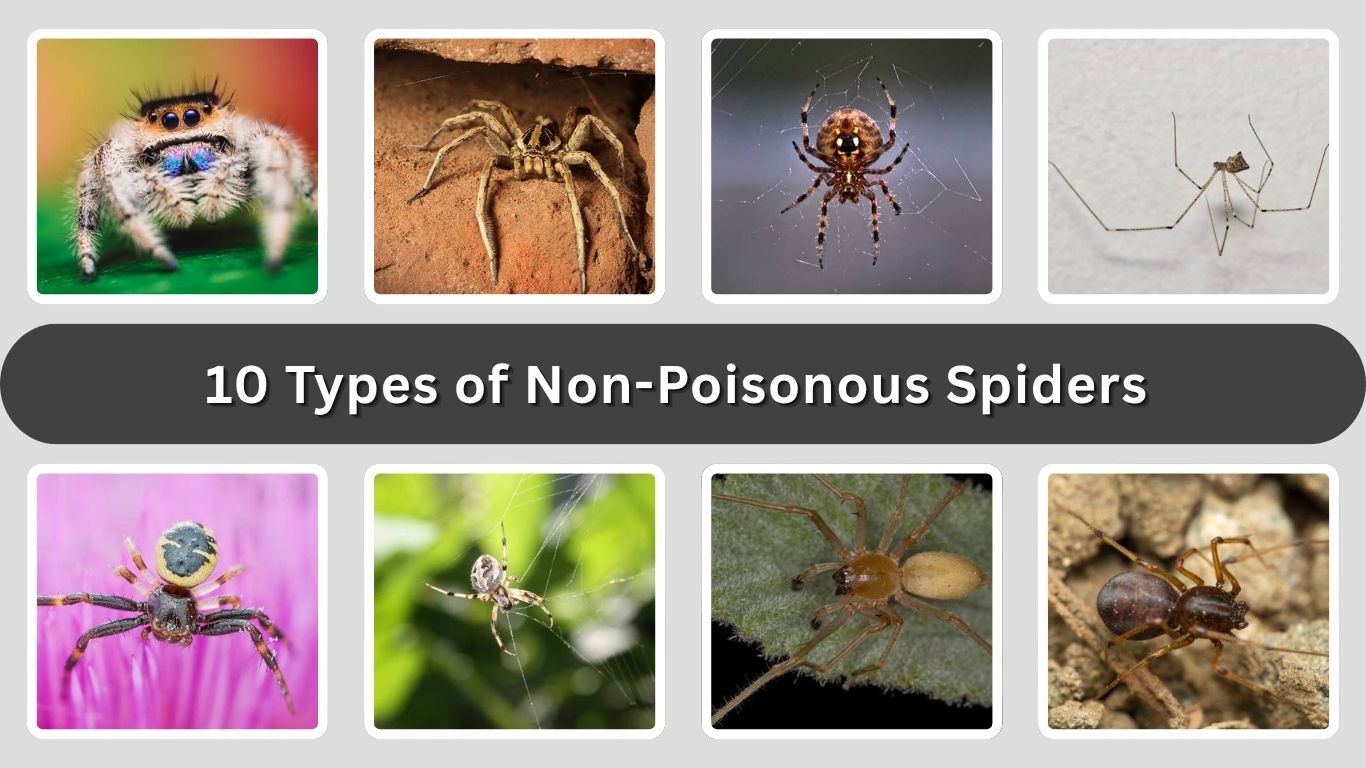
Spiders are often misunderstood and feared, but the vast majority of them are completely harmless to humans. In fact, many spiders play an important role in maintaining balance in nature by controlling insect populations. From tiny indoor dwellers to larger outdoor hunters, these non-poisonous spiders are safe to have around and can even be beneficial in homes and gardens.
In this list, you’ll discover 10 common types of harmless spiders, along with their identifying features, behavior, habitats, and why they pose no threat to humans.
1. Jumping Spider

Jumping spiders are small, active hunters known for their excellent vision and curious behavior. They are completely harmless to humans and are often considered beneficial because they help control insect populations. Unlike many other spiders, they rely on their eyesight rather than webs to catch prey, making them fascinating to observe.
Identification
- Compact, hairy body
- Large front-facing eyes (very noticeable)
- Usually small in size (about 1–2 cm)
- Often black, brown, or brightly colored depending on species
- Short legs with strong jumping ability
Behavior
Jumping spiders are active during the day and do not rely on webs to capture food. Instead, they stalk their prey slowly and then leap onto it with precision. Their movements are quick and alert, and they often appear curious, sometimes even turning to observe humans. They use a silk dragline as a safety tether when jumping.
Habitat
These spiders are commonly found in gardens, on walls, window sills, and sometimes inside homes. They prefer sunny environments where they can easily spot and hunt insects. Their adaptability allows them to live in both natural and urban areas.
Harmlessness to Humans
Jumping spiders are non-aggressive and rarely bite humans. Even in rare cases where a bite occurs, it is generally harmless and causes only mild irritation. They are considered safe and even helpful due to their role in controlling pests.
2. Wolf Spider

Wolf spiders are fast-moving ground hunters known for their speed and excellent camouflage. Despite their somewhat intimidating appearance, they are harmless to humans and play an important role in controlling insect populations.
Identification
- Medium to large size (up to 3–4 cm including legs)
- Hairy body with brown, gray, or black coloration
- Distinct stripe patterns on the back
- Long, strong legs adapted for running
- Eyes arranged in three rows (two large central eyes visible)
Behavior
Wolf spiders do not spin webs to catch prey. Instead, they actively hunt insects on the ground, especially at night. They are quick runners and rely on their speed and stealth to capture prey. Female wolf spiders are known for carrying their egg sacs attached to their abdomen and later carrying their spiderlings on their back, which is a unique behavior among spiders.
Habitat
These spiders are commonly found in grasslands, gardens, forests, and sometimes inside homes, especially in basements or garages. They prefer ground-level environments where they can easily hunt, such as leaf litter, under rocks, or in burrows.
Harmlessness to Humans
Wolf spiders are not aggressive and will usually run away when disturbed. Bites are rare and typically occur only if handled. Their bite is not dangerous and may cause mild redness or discomfort, similar to a bee sting, but they pose no serious threat to humans.
3. Orb-Weaver Spider

Orb-weaver spiders are well-known for their beautiful, circular webs that are often seen in gardens and forests. They are harmless to humans and are highly beneficial because they capture and reduce populations of flying insects like mosquitoes and flies.
Identification
- Rounded, often large abdomen
- Bright or patterned colors (yellow, orange, brown, or black)
- Long legs with spines
- Typically medium to large in size
- Found sitting in the center of a circular web
Behavior
Orb-weavers are mostly nocturnal and build intricate spiral-shaped webs to catch prey. They usually rebuild their webs daily, often consuming the old silk to recycle nutrients. These spiders wait patiently at the center or edge of their web until an insect gets trapped, then quickly immobilize it with silk.
Habitat
They are commonly found in gardens, forests, fields, and around homes where there is enough space to build large webs. Orb-weavers prefer areas between plants, trees, or structures where insects frequently pass.
Harmlessness to Humans
Orb-weaver spiders are non-aggressive and rarely bite humans. Even if they do, their bite is mild and not medically significant. They are considered completely safe and are helpful in maintaining ecological balance by controlling insect populations.
4. Cellar Spider (Daddy Longlegs)

Cellar spiders, commonly known as daddy longlegs, are delicate-looking spiders often found in corners of homes. They are harmless to humans and are actually helpful because they prey on other insects and even other spiders.
Identification
- Very long, thin legs
- Small, pale or light brown body
- Body appears fragile and elongated
- Often found hanging upside down in webs
- Legs may vibrate rapidly when disturbed
Behavior
Cellar spiders build loose, irregular webs rather than neat patterns. When threatened, they often shake or vibrate in their web to confuse predators. They are opportunistic feeders and will eat insects, small bugs, and even other spiders caught in their web. They are slow-moving but effective hunters within their web space.
Habitat
These spiders are commonly found indoors in dark, damp areas such as basements, cellars, garages, and corners of ceilings. They prefer quiet, undisturbed environments where they can build their webs and remain hidden.
Harmlessness to Humans
Cellar spiders are completely harmless to humans. They are not aggressive and rarely bite. Even if a bite were to occur, it would not cause any significant harm. They are often considered beneficial because they help reduce other pest populations inside homes.
5. Garden Spider

Garden spiders are large, colorful spiders often seen in outdoor spaces. They are harmless to humans and are highly beneficial because they help control flying insect populations such as flies, mosquitoes, and beetles.
Identification
- Large size with long legs
- Bright colors like yellow, black, or orange
- Distinct patterns on the abdomen
- Builds large, circular (orb-shaped) webs
- Often seen sitting in the center of the web
Behavior
Garden spiders are web-builders and rely on their strong, sticky webs to catch prey. They usually remain still in the center of the web, waiting for insects to get trapped. Once prey is caught, they quickly wrap it in silk. These spiders are mostly active during the daytime and may rebuild their webs regularly.
Habitat
They are commonly found in gardens, fields, farms, and around plants or shrubs. Garden spiders prefer areas with plenty of insect activity and structures where they can anchor their webs, such as between branches or tall grass.
Harmlessness to Humans
Garden spiders are non-aggressive and rarely bite unless provoked. Even if they do bite, it is harmless and causes only minor irritation. They are considered safe and are actually helpful for maintaining a healthy garden ecosystem.
6. Crab Spider

Crab spiders are unique-looking spiders known for their sideways movement and ability to blend into flowers. They are harmless to humans and play an important role in controlling pollinating insects like flies and bees, although they mainly target pests.
Identification
- Flat, wide body resembling a crab
- Front two pairs of legs are longer and held outward
- Can move sideways like a crab
- Usually small to medium in size
- Colors vary (white, yellow, green, or pink), often matching flowers
Behavior
Crab spiders are ambush predators rather than active hunters. They do not build webs to catch prey. Instead, they sit motionless on flowers or leaves and wait for insects to come close. Once an insect lands, they grab it quickly with their strong front legs. Some species can even change color over time to match their surroundings, improving their camouflage.
Habitat
They are commonly found on flowers, plants, shrubs, and garden vegetation. Crab spiders prefer places where insects frequently visit, especially flowering plants. Their ability to blend in makes them difficult to spot in natural environments.
Harmlessness to Humans
Crab spiders are non-aggressive and rarely interact with humans. Bites are extremely uncommon and not dangerous. Even if bitten, the effects are mild and short-lived. They are completely safe and beneficial for natural pest control.
7. Sac Spider

Sac spiders are small, pale-colored spiders that are often found wandering indoors at night. They are harmless to humans and are helpful because they hunt and reduce populations of small insects.
Identification
- Small to medium size (about 5–10 mm)
- Light-colored body (pale yellow, beige, or light green)
- Smooth, slightly translucent appearance
- Long, slender legs
- No distinctive markings, often plain-looking
Behavior
Sac spiders are active hunters and do not rely on webs to catch prey. They roam around at night in search of insects, using speed and stealth to capture them. During the day, they rest inside small silk sacs or retreats, which they build in corners, under leaves, or along walls—this is where they get their name.
Habitat
They are commonly found both indoors and outdoors. Inside homes, they may be seen on walls, ceilings, or near windows. Outdoors, they live in gardens, under leaves, or within vegetation. They prefer quiet places where they can hide during the day and hunt at night.
Harmlessness to Humans
Sac spiders are not aggressive and usually avoid human contact. While bites can occasionally happen if they are trapped against the skin, they are not dangerous. A bite may cause mild redness or irritation but does not pose any serious health risk.
8. Fishing Spider

Fishing spiders are large, semi-aquatic spiders known for their ability to walk on water and catch prey near aquatic environments. Despite their size and appearance, they are harmless to humans and are beneficial for controlling insects and small aquatic creatures.
Identification
- Large body with long legs (can span up to 7–8 cm)
- Brown, gray, or tan coloration with stripe patterns
- Long legs adapted for moving across water surfaces
- Hairy body with subtle markings
- Often confused with wolf spiders due to similar appearance
Behavior
Fishing spiders are skilled hunters and do not rely on webs to catch prey. They can walk on water using surface tension and may even dive underwater to escape predators or catch prey. Their diet includes insects, small fish, tadpoles, and other aquatic organisms. They detect vibrations on the water surface to locate prey.
Habitat
These spiders are commonly found near ponds, lakes, rivers, and wetlands. They prefer areas with vegetation along the water’s edge, such as reeds, rocks, or logs. Occasionally, they may wander into nearby buildings, but they primarily stay close to water sources.
Harmlessness to Humans
Fishing spiders are non-aggressive and typically avoid human contact. Bites are very rare and occur only when the spider feels threatened. Even then, the bite is not dangerous and may cause only minor discomfort. They are safe and play an important role in maintaining ecological balance.
9. House Spider

House spiders are common indoor spiders that quietly live alongside humans without causing harm. They are harmless and beneficial because they help reduce populations of flies, mosquitoes, and other household pests.
Identification
- Small to medium size
- Brown, gray, or dull-colored body
- Long, thin legs
- Oval-shaped abdomen
- Builds messy, irregular webs
Behavior
House spiders are generally sedentary and prefer to stay in one area where they build their webs. They wait patiently for insects to get trapped rather than actively hunting. These spiders are more active at night and may occasionally wander to find better locations for web-building. They tend to avoid light and human activity.
Habitat
They are most commonly found indoors, especially in corners of rooms, ceilings, basements, attics, and behind furniture. House spiders prefer quiet, undisturbed areas where their webs are less likely to be destroyed. They may also be found in garages and storage spaces.
Harmlessness to Humans
House spiders are non-aggressive and rarely bite. Even if a bite occurs, it is harmless and causes little to no reaction. They pose no threat to humans and are actually helpful in keeping indoor insect populations under control.
10. Spitting Spider

Spitting spiders are small, unusual spiders known for their unique hunting technique of “spitting” a sticky silk to capture prey. They are harmless to humans and help control small insect populations indoors.
Identification
- Small size (about 3–6 mm)
- Pale yellow or light brown body with dark markings
- Long, thin legs
- Dome-shaped (high, rounded) head region
- Slow-moving compared to other spiders
Behavior
Spitting spiders have a fascinating hunting method. Instead of chasing or trapping prey in webs, they spit a sticky, venomous silk in a zigzag pattern to immobilize insects. After trapping the prey, they move in slowly to bite and consume it. They are nocturnal and prefer to hunt at night, moving carefully and deliberately.
Habitat
They are commonly found indoors in warm, quiet areas such as walls, ceilings, basements, and corners of rooms. Outdoors, they may live under rocks, bark, or in sheltered spaces. They prefer environments where small insects are available.
Harmlessness to Humans
Spitting spiders are non-aggressive and rarely come into contact with humans. Bites are extremely rare and not dangerous. Even if a bite occurs, it results in only mild irritation. They are completely safe and beneficial for controlling pests inside homes.
FAQs
Are all non-poisonous spiders completely safe for humans?
Yes, non-poisonous (harmless) spiders are generally safe for humans. They are not aggressive and rarely bite. Even if a bite happens, it usually causes only mild irritation and no serious health issues.
Do harmless spiders still bite?
Harmless spiders can bite, but it is very rare and usually happens only if they feel threatened or are accidentally pressed against the skin. Most species prefer to run away rather than bite.
Why are spiders considered beneficial?
Spiders help control insect populations by feeding on pests like mosquitoes, flies, and other bugs. This makes them useful for maintaining a balanced ecosystem both indoors and outdoors.
Can harmless spiders live inside homes?
Yes, many harmless spiders such as house spiders and cellar spiders commonly live indoors. They prefer quiet corners, ceilings, and undisturbed areas where they can find insects to eat.
Should I remove harmless spiders from my home?
It is not necessary to remove harmless spiders unless they bother you. They actually help reduce pests. If needed, they can be safely relocated outside without harming them.
