
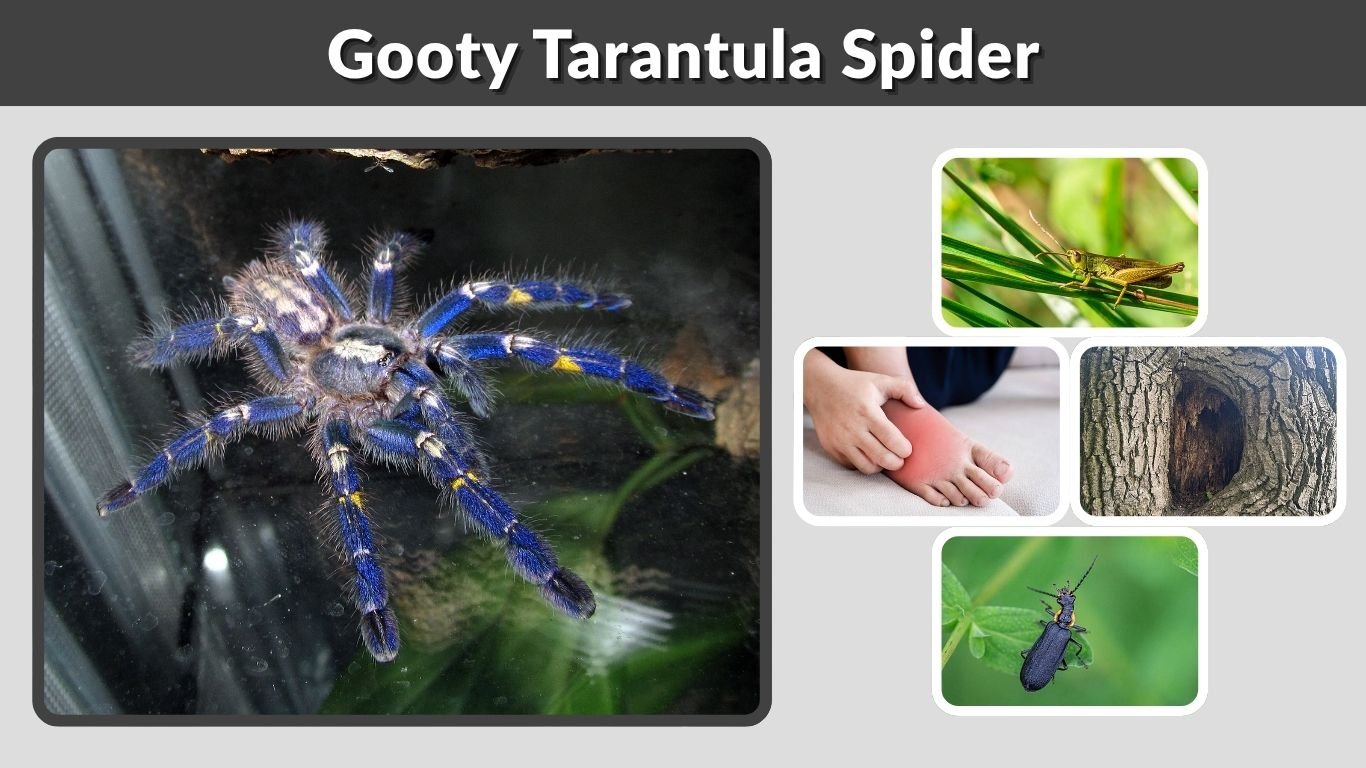
The Gooty tarantula spider is one of the most colorful and visually striking tarantulas in the world. Famous for its metallic-blue body and intricate markings, this rare Indian species attracts considerable attention from spider enthusiasts. However, its speed, defensive behavior, and medically significant venom make it unsuitable for inexperienced keepers. It is also threatened in the wild, so responsible ownership and conservation are extremely important.
What Is a Gooty Tarantula?
The Gooty tarantula (Poecilotheria metallica) is an arboreal, or tree-dwelling, tarantula native to India. It belongs to the Theraphosidae family and is commonly known by several names, including:
- Gooty sapphire ornamental tarantula
- Peacock tarantula
- Peacock parachute spider
- Metallic tarantula
- Gooty ornamental tree spider
The accepted scientific name is Poecilotheria metallica. The species was described by British zoologist Reginald Innes Pocock in 1899 and remains a recognized member of the ornamental tarantula genus Poecilotheria.
Although it is commonly associated with Gooty, its original specimen may have been transported there in timber. Confirmed wild populations have been recorded elsewhere in the Eastern Ghats of southern India.
Gooty Tarantula Identification
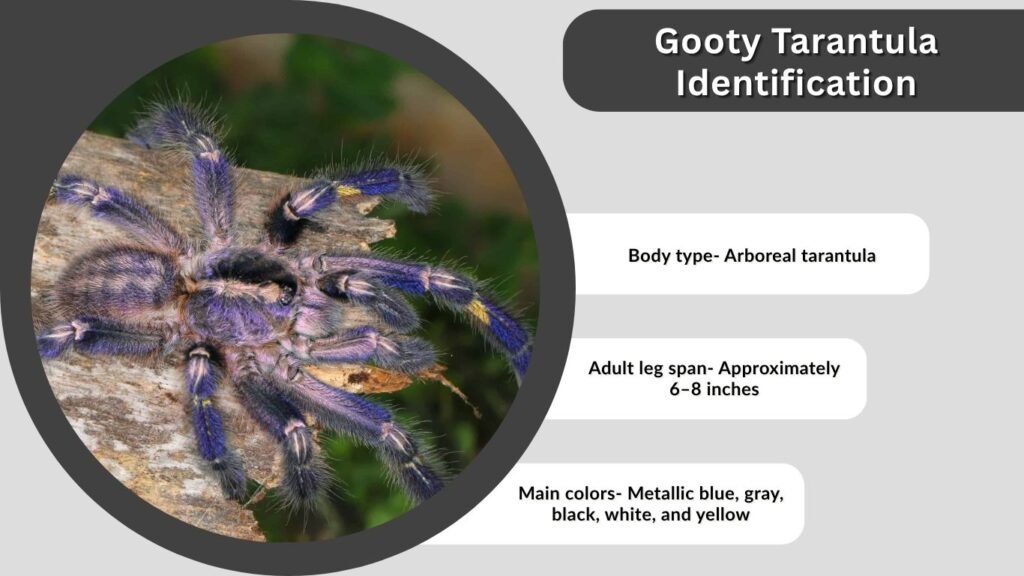
Adult Gooty tarantulas possess a combination of colors and patterns that distinguishes them from most other tarantulas.
Color and Markings
The spider’s most recognizable feature is its brilliant metallic-blue coloration. The legs and body may appear blue, grayish-blue, or even violet depending on the lighting and viewing angle. This effect is produced by microscopic structures on its hairs rather than ordinary blue pigment.
The abdomen carries a complicated pale pattern resembling leaves, lace, or a geometric design. Yellow bands are visible underneath the legs, while darker markings create strong contrast across the body.
Young spiderlings are usually less colorful. Their blue coloration becomes brighter and more noticeable as they grow and pass through additional molts.
Size
An adult Gooty tarantula commonly reaches a diagonal leg span of approximately 6–8 inches, although individual size varies. Females are generally heavier and more robust than males.
Mature males often have longer, thinner legs and a smaller abdomen. Females retain a thicker body and typically live much longer.
| Characteristic | Typical description |
|---|---|
| Scientific name | Poecilotheria metallica |
| Body type | Arboreal tarantula |
| Adult leg span | Approximately 6–8 inches |
| Main colors | Metallic blue, gray, black, white, and yellow |
| Temperament | Fast, nervous, and potentially defensive |
| Native country | India |
| Conservation status | Critically Endangered on the IUCN Red List |
Natural Habitat and Distribution
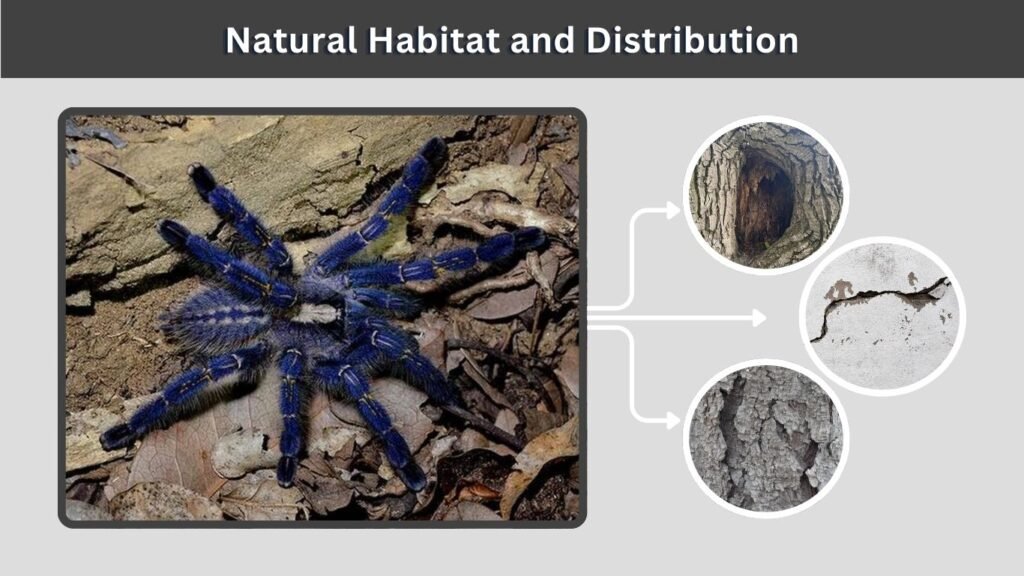
The Gooty tarantula is endemic to India, meaning it does not naturally occur anywhere else. Its best-known habitat lies within dry deciduous forest in the Eastern Ghats, particularly in Andhra Pradesh.
A 2019 field report documented the species farther south in Tamil Nadu, extending its recorded distribution by roughly 370 kilometers. This discovery suggests that its total range may be broader than previously understood, although it is still considered highly restricted. Journal of Threatened Taxa
Life in Trees
Gooty tarantulas spend much of their time in tree holes, cracks, and spaces beneath loose bark. They cover their retreats with silk, creating a secure place in which to hide during the day.
Their flattened bodies allow them to enter narrow crevices. If disturbed, they generally try to escape deeper into their shelter. They may run extremely quickly when no safe retreat is available.
These spiders become more active after dark. At night, they may wait near the entrance to their shelter for insects to approach.
Diet and Hunting Behavior
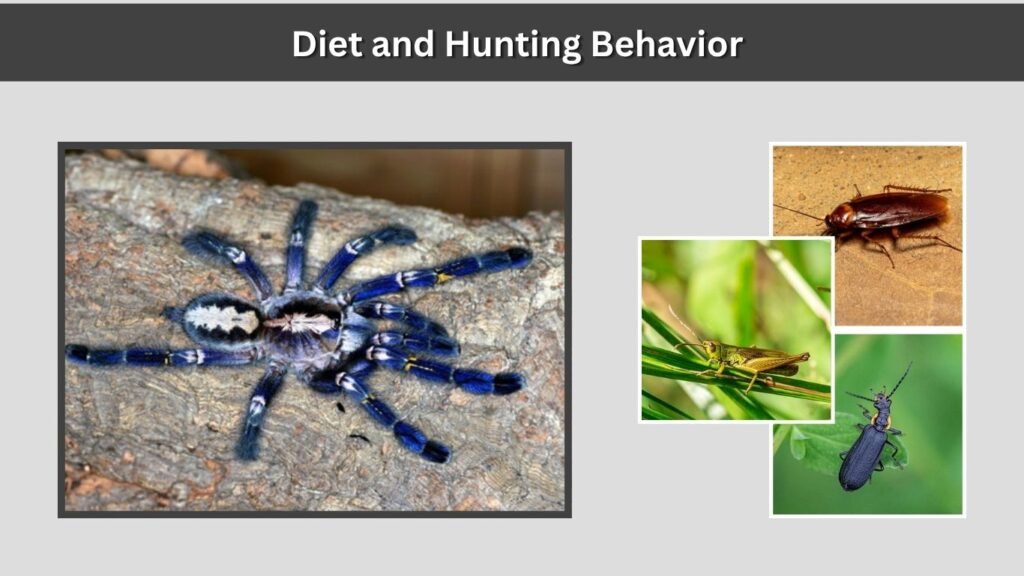
The Gooty tarantula is a carnivorous ambush predator. Its natural diet consists primarily of insects and other small invertebrates found around trees.
Potential prey includes:
- Crickets
- Cockroaches
- Moths
- Grasshoppers
- Beetles
- Other suitable arthropods
Unlike an orb-weaving spider, the Gooty tarantula does not construct a large sticky web to capture food. It detects movement and vibrations before rushing forward and grabbing its prey. Venom delivered through the fangs immobilizes the victim, while digestive fluids break down its internal tissues.
Tarantulas consume the resulting liquid meal and leave behind a compact mass of indigestible material.
Behavior and Temperament
A Gooty tarantula is normally reclusive, but it can be unpredictable when threatened. It is remarkably fast and capable of making sudden movements across vertical surfaces.
Its first response is usually to retreat. When escape is impossible, however, it may raise its front legs, expose its fangs, or strike defensively.
Unlike many New World tarantulas from the Americas, this species does not rely on clouds of irritating urticating hairs for protection. Instead, it depends on speed, camouflage, its threat display, and its venomous bite.
These characteristics make the Gooty tarantula fascinating to observe but dangerous to handle. Even an apparently calm individual can react instantly to vibrations, airflow, or unexpected contact.
Is the Gooty Tarantula Venomous?
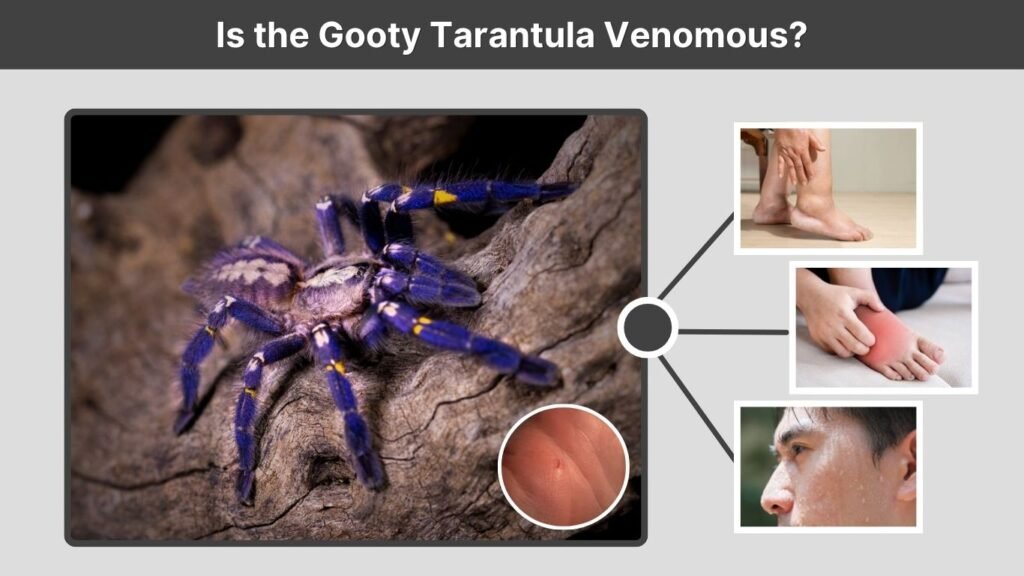
Yes, the Gooty tarantula is venomous. All tarantulas possess venom for subduing prey, but species in the genus Poecilotheria are associated with more serious symptoms than many commonly kept tarantulas.
A bite may cause:
- Immediate pain
- Swelling around the bite
- Redness
- Muscle cramping or spasms
- Nausea
- Sweating
- Weakness
- An increased heart rate
Published medical literature documents painful muscle spasms following bites from Old World tarantulas, including Poecilotheria species. Symptoms can occasionally be delayed and may continue for several days. PubMed
Anyone bitten should wash the area, remain calm, and seek medical attention. Difficulty breathing, spreading swelling, severe pain, chest discomfort, or muscle spasms require urgent care. The spider should never be handled directly.
Gooty Tarantula as a Pet
This species is sometimes maintained in captivity, but it is appropriate only for advanced tarantula keepers. Its combination of speed, climbing ability, defensive potential, and potent venom creates a serious escape and bite risk.
Enclosure Requirements
A secure, vertically oriented enclosure is necessary because this is a tree-dwelling species. The habitat should provide:
- Cross-ventilation
- A tightly secured door or lid
- Upright cork bark
- A dark vertical retreat
- A shallow water dish
- Moisture-retaining substrate
- Enough space for safe molting
The enclosure should not be continually wet. Good airflow is essential because stagnant, overly damp conditions encourage mold and other problems. A partially moist substrate and access to clean water are safer than attempting to maintain excessive humidity.
The enclosure must be positioned away from children and pets. Every opening should be checked carefully because juveniles can pass through surprisingly small gaps.
Feeding
Captive Gooty tarantulas can be offered appropriately sized crickets, roaches, or similar captive-raised feeder insects. Spiderlings require smaller prey than adults.
Uneaten insects should be removed, particularly when the tarantula is preparing to molt. Live prey can disturb or injure a vulnerable tarantula during this period. A spider that refuses food but appears plump may simply be approaching a molt.
Handling and Maintenance
Handling is strongly discouraged. The Gooty tarantula is an observation-only animal. Routine maintenance should be performed with long tools while carefully monitoring the spider’s location.
Rehousing requires planning, escape-proof containers, and experience with fast arboreal species. A person who is new to tarantulas should gain experience with calmer species before considering any Poecilotheria.
Lifespan and Growth
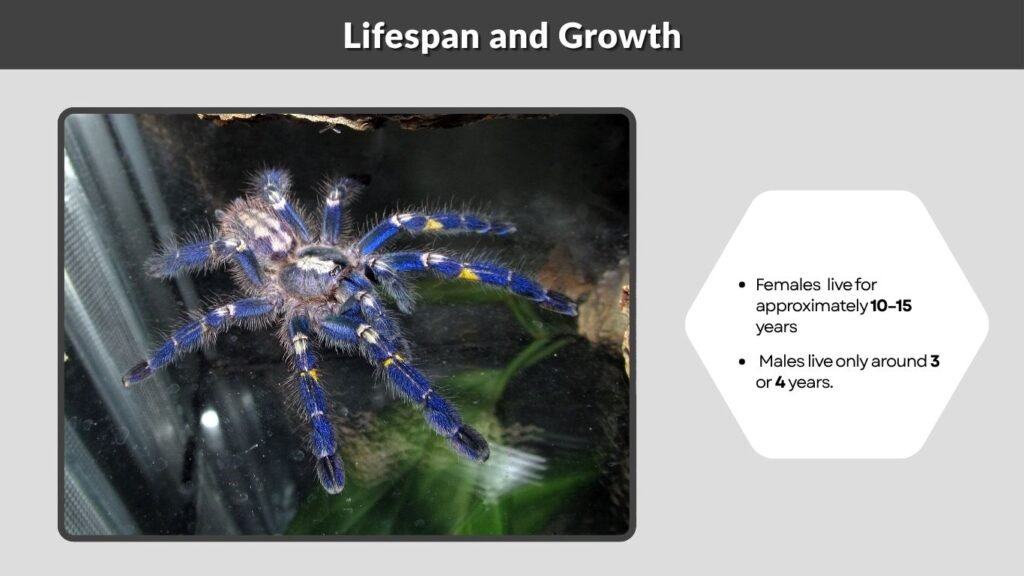
Female Gooty tarantulas may live for approximately 10–15 years under suitable captive conditions. Males mature sooner and often live only around three or four years.
Like other spiders, they grow by molting their exoskeleton. Before a molt, the tarantula may refuse food, become inactive, and develop a darker appearance. It commonly lies on its back while shedding, which is normal and should not be mistaken for death.
The spider must not be touched or fed immediately after molting. Its new exoskeleton and fangs need time to harden.
Conservation Status
The Gooty tarantula is listed as Critically Endangered on the IUCN Red List. Habitat degradation, timber collection, firewood harvesting, and removal for the exotic-pet trade have all been identified as threats.
The entire Poecilotheria genus has been included in CITES Appendix II since 2019. International trade is therefore controlled and requires appropriate documentation. CITES
Prospective owners should check national and local laws and purchase only documented, captive-bred spiders from reputable breeders. Wild-caught animals should never be purchased because their collection can damage already vulnerable populations.
FAQs
Is the Gooty tarantula dangerous to humans?
It can deliver a medically significant bite that causes severe pain, swelling, and muscle spasms. Bites are not considered harmless, even though the spider normally prefers to retreat. Direct handling should always be avoided.
Why is the Gooty tarantula blue?
Its blue appearance comes mainly from microscopic structures in its hairs that reflect light. Because the color is structural, its brightness and shade may change depending on the lighting and the angle from which it is viewed.
Can beginners keep a Gooty tarantula?
No. Its exceptional speed, arboreal movement, defensive potential, and potent venom make it an advanced species. Beginners should start with a slower, calmer tarantula that carries a lower risk during feeding, cleaning, and rehousing.
Does a Gooty tarantula make a web?
It produces silk but does not create a large prey-catching web like an orb weaver. Instead, it lines tree hollows, bark crevices, and captive retreats with silk, sometimes forming a funnel-shaped entrance around its shelter.
Is it legal to own a Gooty tarantula?
Ownership rules vary by country and region. Because Poecilotheria species are protected under CITES Appendix II, international movement and trade require documentation. Buyers should verify local laws and choose only legally obtained, captive-bred specimens.
