
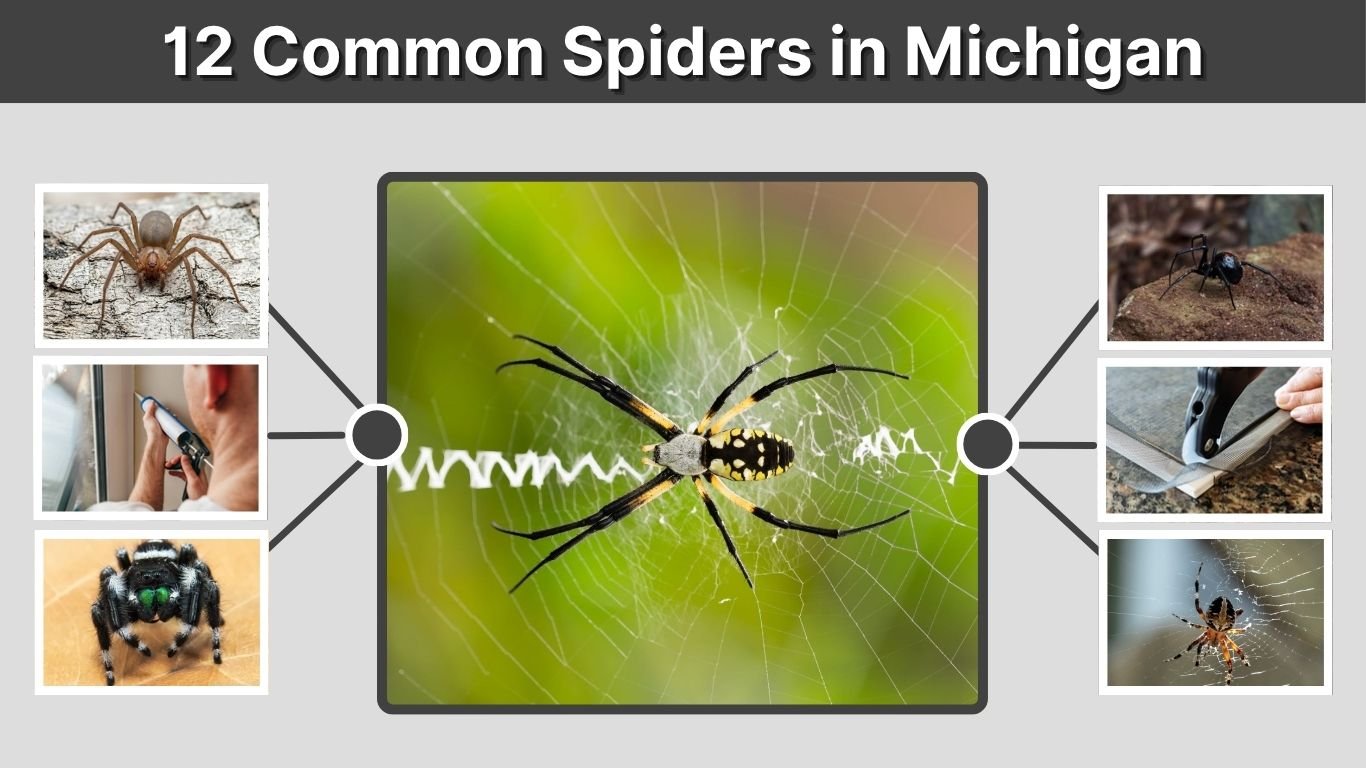
Michigan is home to many spider species, from tiny jumping spiders to large wolf spiders and colorful garden orb-weavers. Some live in basements, garages, and bedrooms, while others prefer gardens, forests, and grassy areas. Although their appearance can be frightening, most common spiders in Michigan are harmless to humans and help control insect populations. Learning their colors, markings, body shapes, and habitats makes identification easier. This guide explores 12 common spiders found in Michigan, where they live, how to identify them, and which species require extra caution.
12 Most Common Spiders in Michigan
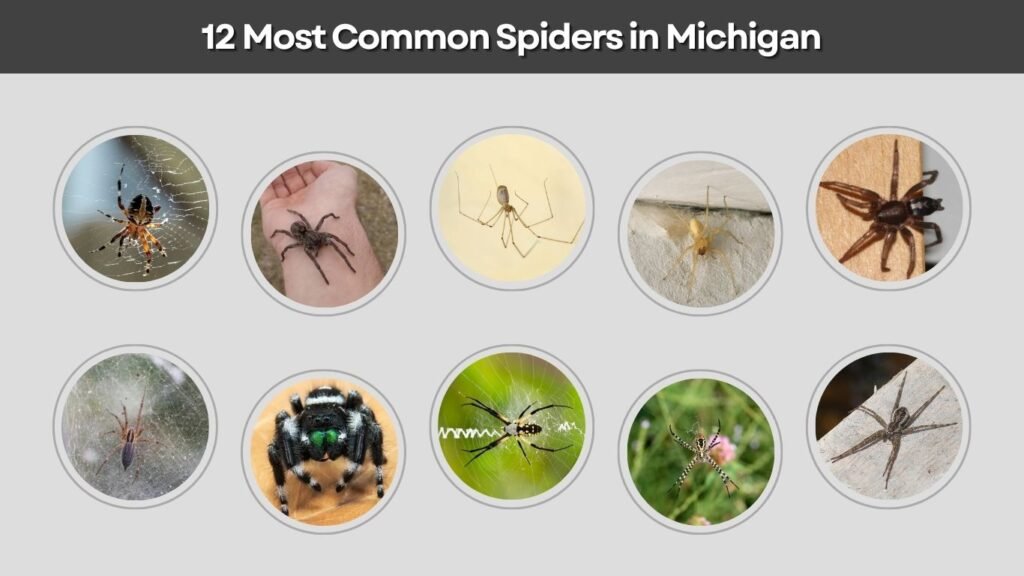
Michigan’s spider populations include web-building species and active hunters. Some prefer warm indoor environments, while others thrive in gardens, woodlands, and near water. Understanding their physical characteristics, behavior, and preferred hiding places can help you distinguish harmless household spiders from potentially dangerous species.
1. American House Spider
The American house spider (Parasteatoda tepidariorum) is one of the common household spiders in Michigan.
It has a small, rounded abdomen with brown, gray, or cream markings. Its slender legs are usually slightly banded.
These spiders construct irregular cobwebs in basements, garages, window corners, and storage rooms. They remain near their webs and capture flies, mosquitoes, and other small insects.
American house spiders are generally harmless and rarely bite people unless trapped against the skin.
2. Wolf Spider
Wolf spiders belong to the family Lycosidae and are among the most recognizable large spiders in Michigan.
They usually have brown, gray, or dark markings, hairy bodies, and strong legs. Unlike many household spiders, wolf spiders actively hunt insects instead of building capture webs.
They commonly inhabit gardens, grassy areas, basements, and crawl spaces.
Their fast movements and large size can seem intimidating, but wolf spiders are not aggressive. Their bites are usually not medically significant.
3. Long-Bodied Cellar Spider
The long-bodied cellar spider (Pholcus phalangioides) is frequently encountered in Michigan homes.
It has a small, elongated body supported by exceptionally long, thin legs. Its coloring generally ranges from pale tan to light gray.
Cellar spiders prefer dark, undisturbed environments such as basements, garages, and ceiling corners.
They construct loose, irregular webs and sometimes vibrate rapidly when disturbed. Despite their delicate appearance, these spiders capture various insects and other spiders.
They are not considered dangerous to humans.
4. Yellow Sac Spider
Yellow sac spiders (Cheiracanthium species) are common pale-colored spiders found in Michigan homes and gardens.
They have light yellow, cream, or greenish bodies with relatively long front legs.
Unlike web-building spiders, yellow sac spiders hunt insects at night. During the day, they hide inside small silk shelters near ceiling corners, windows, or folded leaves.
Their bites can cause localized pain, redness, and swelling, but serious complications are uncommon.
Avoid handling these spiders directly.
5. Eastern Parson Spider
The eastern parson spider (Herpyllus ecclesiasticus) is a common dark-colored hunting spider in Michigan.
Its most recognizable feature is a distinctive white marking along its dark abdomen, resembling a clerical necktie.
These spiders have elongated bodies and moderately long legs. They hunt at night and hide beneath stones, loose bark, furniture, and household objects during the day.
Parson spiders occasionally enter basements and ground-level rooms.
Although they may bite defensively when handled, they are not considered medically dangerous.
6. Grass Spider
Grass spiders (Agelenopsis species) are common brown spiders found throughout Michigan lawns and gardens.
They have elongated bodies with dark longitudinal stripes, long legs, and noticeably extended spinnerets at the rear of the abdomen.
Grass spiders build sheet-like webs with funnel-shaped retreats among grass, shrubs, and low vegetation.
When insects land on their webs, they rush forward to capture them.
These spiders may occasionally enter buildings, but they generally prefer outdoor habitats. They are not considered dangerous to people.
7. Bold Jumping Spider
The bold jumping spider (Phidippus audax) is one of Michigan’s recognizable black jumping spiders.
It has a compact, hairy black body with three pale spots on its abdomen. Its mouthparts often appear metallic green or blue.
Bold jumping spiders have large forward-facing eyes and excellent vision.
They frequently appear on fences, exterior walls, gardens, and sunny windowsills.
Instead of building capture webs, they stalk and jump onto prey.
These spiders are generally harmless and usually retreat when approached.
8. Zebra Jumping Spider
The zebra jumping spider (Salticus scenicus) is a small black-and-white spider commonly found on sunny outdoor surfaces.
Its striped body pattern resembles a zebra, making identification relatively easy.
These spiders are particularly noticeable on walls, fences, rocks, and window frames.
Zebra jumping spiders actively hunt small insects using their excellent eyesight and powerful jumping abilities.
They occasionally enter homes through open windows or doors.
Their small size and nonaggressive behavior make them a low-risk spider species for humans.
9. Black-and-Yellow Garden Spider
The black-and-yellow garden spider (Argiope aurantia) is one of Michigan’s most distinctive garden spiders.
Adult females have large abdomens featuring bright yellow, black, and sometimes white markings.
They construct impressive circular webs between plants, shrubs, and garden structures. Their webs often contain a noticeable zigzag silk decoration.
These spiders feed on flies, grasshoppers, and other insects.
Although their size can seem alarming, black-and-yellow garden spiders are generally harmless when left undisturbed.
10. Banded Garden Spider
The banded garden spider (Argiope trifasciata) is another colorful orb-weaver found in Michigan.
Its elongated abdomen displays alternating pale, yellowish, and dark horizontal bands. Its long legs often show contrasting markings.
Banded garden spiders build circular webs in gardens, meadows, and grassy fields.
They frequently remain suspended in the center of their webs while waiting for flying insects.
Females are considerably larger than males.
Despite their noticeable appearance, these spiders rarely bite and are not considered dangerous to humans.
11. Dark Fishing Spider
The dark fishing spider (Dolomedes tenebrosus) is one of the larger spiders encountered in Michigan.
It has a broad, flattened body with brown, gray, and dark mottled markings. Its long legs can make it appear particularly large.
Dark fishing spiders inhabit wooded areas, tree trunks, and buildings. Unlike some other fishing spiders, they are not restricted to locations beside water.
They hunt insects and other small animals without using capture webs.
Although they may occasionally wander indoors, they usually avoid humans.
12. Triangulate Cobweb Spider
The triangulate cobweb spider (Steatoda triangulosa) is a small household spider with distinctive abdominal markings.
It generally has a brownish body with pale triangular or zigzag patterns on its rounded abdomen.
These spiders construct irregular webs in basements, storage areas, garages, and quiet corners.
They feed on ants, flies, and other small arthropods.
Triangulate cobweb spiders belong to the same family as black widows, but they are not considered medically dangerous.
Their small size and preference for hidden spaces often make them difficult to notice.
Are There Dangerous Spiders in Michigan?
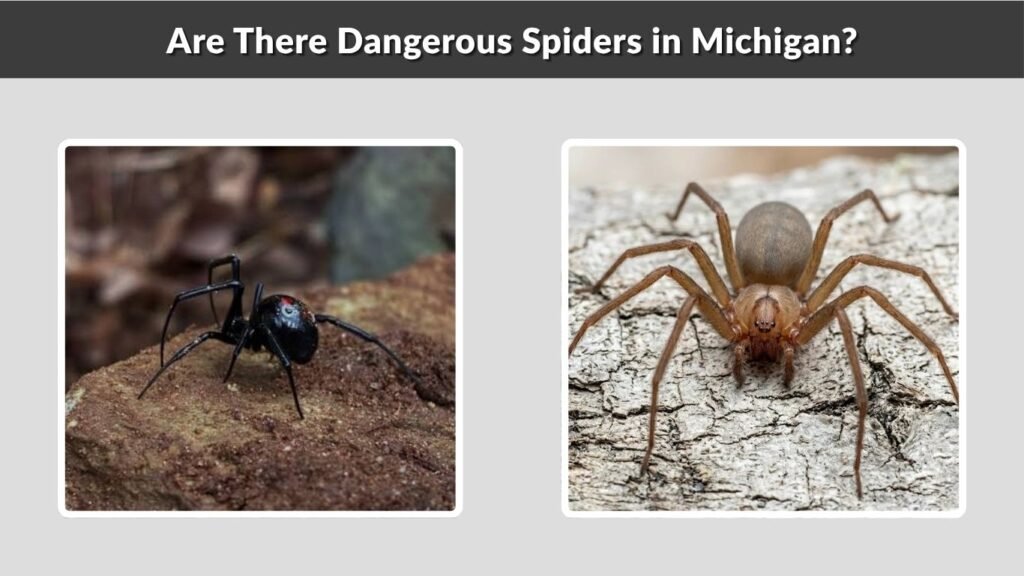
Most Michigan spiders pose little risk to humans. However, northern black widows occur naturally in the state, and brown recluse spiders have been documented in a few isolated populations. These species deserve additional caution because their venom can cause medically significant symptoms.
Northern Black Widow Spider
The northern black widow (Latrodectus variolus) is found in Michigan, particularly in parts of the western Lower Peninsula.
Adult females usually have shiny black bodies with red markings. The hourglass-shaped marking beneath the abdomen may be divided into two sections.
They prefer undisturbed areas such as woodpiles, hollow logs, sheds, and outdoor structures.
Black widow bites are uncommon, but their venom can cause severe pain, muscle cramps, and other systemic symptoms. Suspected bites require prompt medical attention.
Brown Recluse Spider
Brown recluse spiders (Loxosceles reclusa) are not native to Michigan, although isolated populations have been confirmed.
They have tan or brown bodies, six eyes arranged in three pairs, and a characteristic violin-shaped marking behind the eyes.
However, the violin marking alone is insufficient for reliable identification.
Brown recluse spiders often hide in boxes, stored clothing, and undisturbed spaces.
Their bites are uncommon but occasionally cause significant tissue damage.
Michigan State University recommends professional identification when a brown recluse is suspected.
How to Identify Common House Spiders in Michigan
Correct spider identification requires examining several characteristics rather than relying on color alone.
Look at the spider’s body shape, leg length, markings, behavior, and web structure.
For example, wolf spiders have sturdy, hairy bodies and run across floors, while cellar spiders have extremely long, delicate legs and remain in irregular webs.
Jumping spiders have compact bodies and prominent front eyes. Grass spiders build funnel-shaped sheet webs, while orb-weavers construct circular webs.
Taking a clear photograph from a safe distance can help with identification.
How to Keep Spiders Out of Your Michigan Home
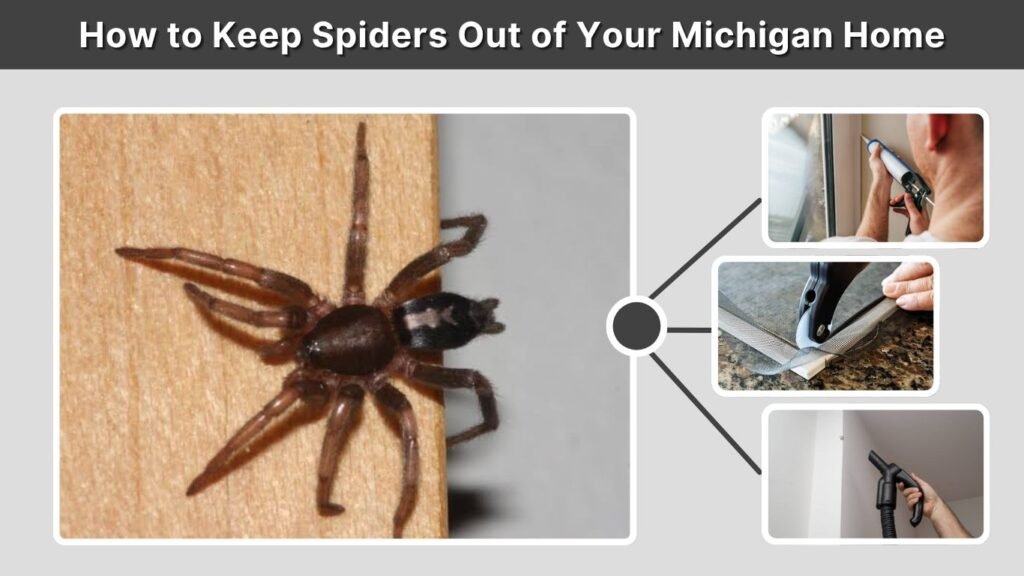
Most household spiders enter buildings while searching for prey, shelter, or suitable temperatures.
Preventing their entry involves reducing insects and eliminating accessible hiding places.
- Seal cracks around windows, doors, and foundations.
- Repair damaged window screens.
- Remove unused boxes and excessive storage clutter.
- Vacuum existing webs and egg sacs.
- Reduce insects around outdoor lighting.
- Keep firewood and debris away from exterior walls.
These measures can reduce spider encounters without unnecessary pesticide applications.
FAQs
1. What are the most common house spiders in Michigan?
Common indoor spiders include American house spiders, cellar spiders, yellow sac spiders, and triangulate cobweb spiders. Wolf spiders, eastern parson spiders, and jumping spiders may also wander indoors, especially when seeking shelter or hunting insects.
2. Are wolf spiders common in Michigan?
Yes. Wolf spiders are widespread throughout Michigan and inhabit gardens, lawns, forests, and occasionally homes. They are active hunters rather than web builders. Although some grow relatively large, they are generally harmless unless handled roughly.
3. Are brown recluse spiders common in Michigan?
No. Michigan is outside their native range. Michigan State University has confirmed a few small, isolated populations, but encounters remain uncommon. Most brown spiders found in Michigan homes belong to other species.
4. What are the most common big spiders in Michigan?
Wolf spiders, dark fishing spiders, and large garden orb-weavers are among the biggest spiders residents commonly notice. Their long legs and substantial body sizes can make them appear intimidating, but most are not dangerous to humans.
5. Are black widow spiders common in Michigan?
Northern black widow spiders occur in Michigan but are not among the most frequently encountered household spiders. They typically prefer sheltered, undisturbed outdoor locations. Their bites can be medically significant, so avoid handling suspected black widows.
