
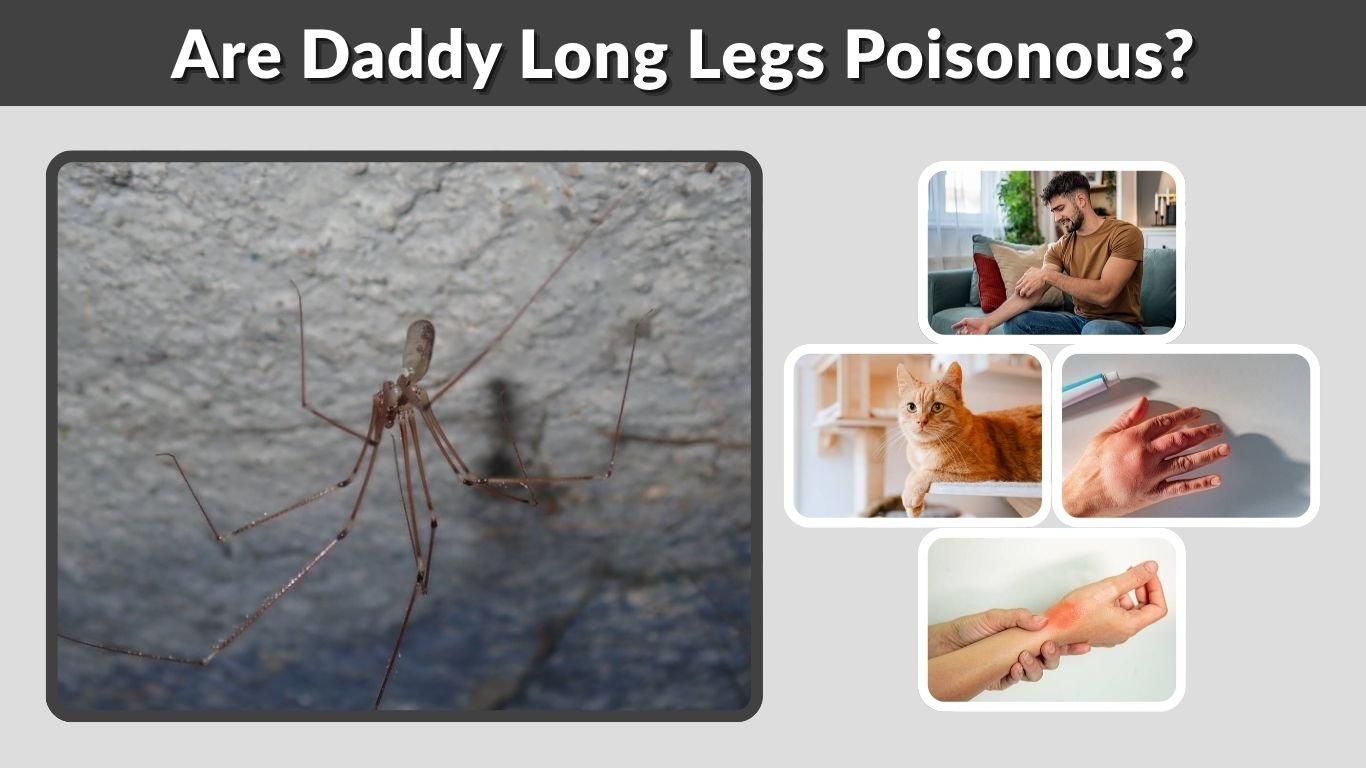
Are daddy long legs poisonous? In most cases, no. The name “daddy long legs” can refer to several different creatures, including harvestmen, cellar spiders, and crane flies. Harvestmen—the animals most commonly called daddy long legs in North America—do not have venom glands or venom-injecting fangs. Cellar spiders do have venom for subduing prey, but they are not considered dangerous to people. The popular claim that daddy long legs are the world’s most poisonous spiders but cannot bite humans is a myth. Here is what you should actually know.
What Are Daddy Long Legs?
“Daddy long legs” is a common name rather than one specific species. This causes much of the confusion about whether these animals are poisonous. Depending on where you live, the name may describe harvestmen, long-legged cellar spiders, or even crane flies.
Animals Called Daddy Long Legs
The name may refer to:
- Harvestmen: Arachnids in the order Opiliones
- Cellar spiders: True spiders in the family Pholcidae
- Crane flies: Long-legged flying insects sometimes called daddy long legs in the UK
- Several regional long-legged arachnids with similar appearances
These animals are biologically different, so questions about venom or biting depend on which one is being discussed.
Harvestmen vs. Daddy Long Legs Spiders
Harvestmen are arachnids but not true spiders.
A harvestman typically has a compact, oval body that appears to be one continuous section. True spiders have two obvious main body sections: the cephalothorax and abdomen.
Harvestmen also lack the venom glands and fangs used by true spiders to inject venom into prey.
Are Daddy Long Legs Poisonous to Humans?
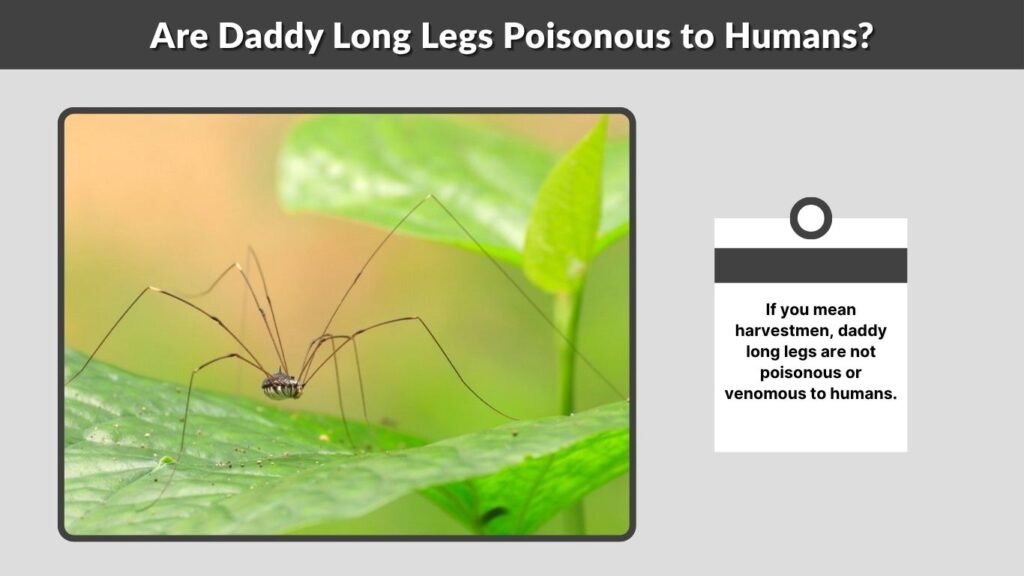
If you mean harvestmen, daddy long legs are not poisonous or venomous to humans. They do not possess venom glands and cannot inject venom.
They may produce defensive chemicals that help discourage predators, but this does not make them dangerous to people during ordinary contact.
Can Daddy Long Legs Bite Humans?
Harvestmen have small mouthparts called chelicerae, but they are not designed like a spider’s venom-injecting fangs.
They generally feed on small invertebrates, decaying organic material, fungi, and other available foods.
They are not aggressive toward humans, and normal handling does not present a significant bite hazard.
Cellar spiders are different because they are true spiders. They possess fangs and venom, although bites to humans are uncommon and are not regarded as medically significant.
Are Daddy Long Legs Poisonous or Venomous?
The words poisonous and venomous describe different things.
A poisonous animal causes harm when it is eaten or touched in a way that exposes someone to toxins. A venomous animal actively delivers venom through a bite, sting, or similar structure.
Harvestmen are neither dangerously poisonous nor venomous to humans.
Cellar spiders are technically venomous because they use venom on their prey, but their venom is not considered dangerous to healthy humans under normal circumstances.
Are Daddy Long Legs the Most Poisonous Spider?
No. The claim that daddy long legs are the most poisonous spiders in the world is a long-running myth.
One version of the story says they possess extraordinarily powerful venom but have fangs too short to penetrate human skin. There is no scientific basis for this claim.
Why Did the Myth Start?
The myth may have developed from several sources.
Cellar spiders sometimes capture and eat other spiders, including species people consider dangerous. Observing a delicate-looking cellar spider killing another spider may have encouraged the idea that its venom must be exceptionally powerful.
However, successfully capturing another spider does not prove that an animal possesses extraordinarily toxic venom.
Their long legs and unusual appearance may also contribute to exaggerated stories.
Can Their Fangs Penetrate Human Skin?
Cellar spiders can potentially penetrate human skin with their fangs.
The idea that their fangs are physically incapable of biting humans is therefore also incorrect.
Even so, cellar spider bites are rare, and available evidence does not indicate that their venom produces dangerous effects in humans.
Harvestmen, meanwhile, do not have spider-like venomous fangs in the first place.
How Poisonous Are Daddy Long Legs?
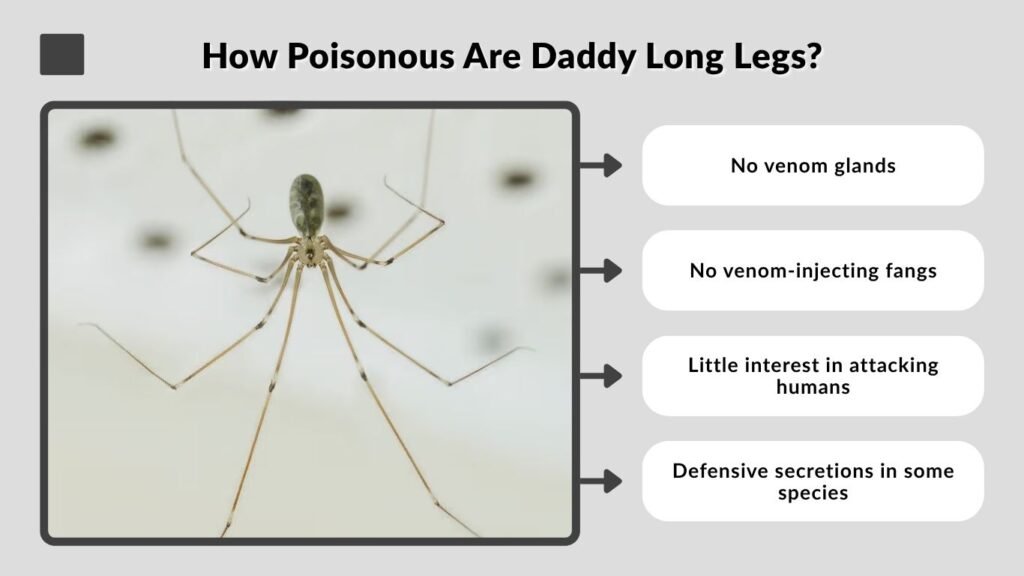
For humans, the practical answer is that daddy long legs are not considered dangerously poisonous.
The degree of risk depends primarily on which animal is being called a daddy long legs.
Harvestmen
Harvestmen have:
- No venom glands
- No venom-injecting fangs
- Little interest in attacking humans
- Defensive secretions in some species
- Extremely low risk to people
Their chemical defenses are primarily intended to discourage natural predators.
Cellar Spiders
Cellar spiders have:
- Functional venom glands
- Small fangs
- Venom used against prey
- The ability to bite under unusual circumstances
- No reputation for medically serious human bites
Their venom is useful for capturing small arthropods rather than defending themselves against humans.
Crane Flies
Crane flies are insects with extremely long legs that are sometimes called daddy long legs, especially in Britain.
Adult crane flies do not possess a venomous sting and are not dangerous to humans. Despite another common myth, they are also not giant mosquitoes that feed on human blood.
What Happens If a Daddy Long Legs Bites You?
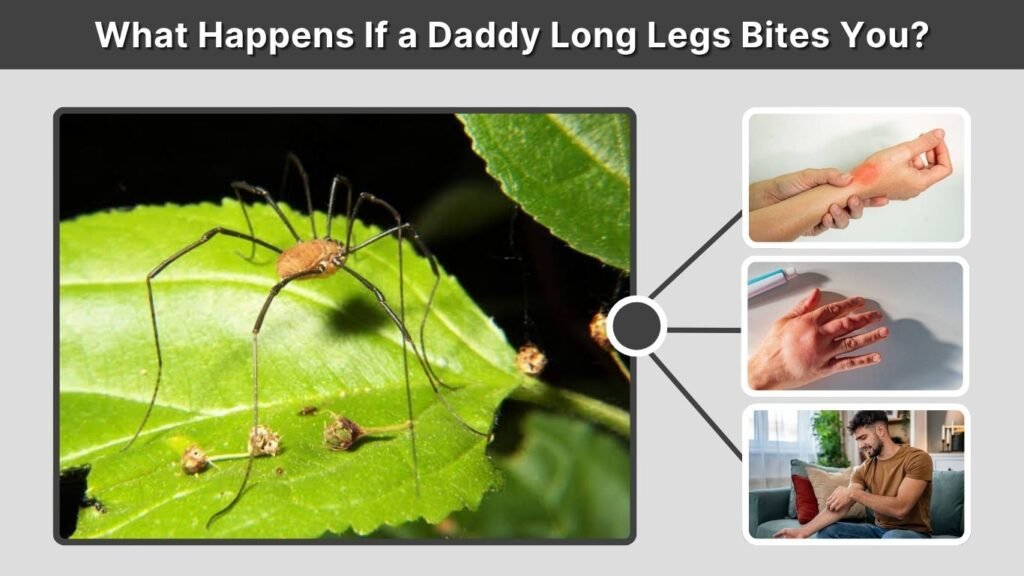
A true harvestman is extremely unlikely to produce anything resembling a dangerous spider bite.
If a cellar spider were to bite, any reaction would generally be expected to remain mild and localized.
Possible Minor Symptoms
A minor arthropod bite could cause:
- Brief pinching sensation
- Mild redness
- Slight swelling
- Local tenderness
- Temporary itching or irritation
These symptoms are not unique to daddy long legs and can result from numerous insects and spiders.
If severe pain, extensive swelling, difficulty breathing, dizziness, or rapidly worsening symptoms occur after an unidentified bite, seek medical attention rather than assuming a daddy long legs caused it.
Are Red Daddy Long Legs Poisonous?
A red, orange, brown, black, or pale daddy long legs is not automatically more dangerous because of its color.
Harvestmen occur in many colors and patterns. Some have reddish or orange markings, while others are brown, gray, or black.
Does Color Indicate Venom?
No.
Color alone cannot determine whether an arachnid has venom or whether it is dangerous.
If the animal is a harvestman, unusual red coloration does not change the basic fact that harvestmen lack venom glands.
A photograph or closer examination of body shape is much more useful for identification than color by itself.
Are Daddy Long Legs Poisonous to Cats?
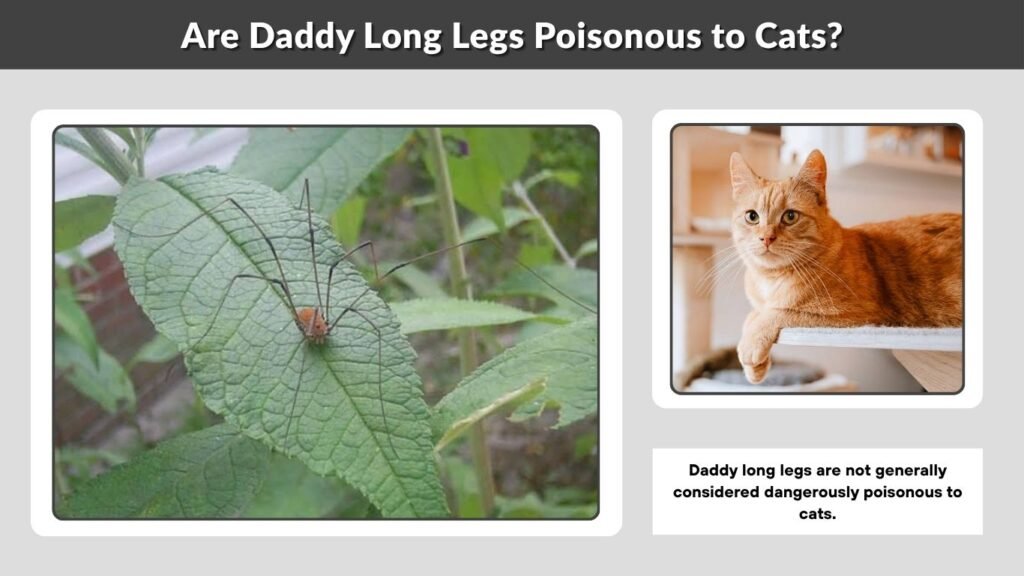
Daddy long legs are not generally considered dangerously poisonous to cats.
A cat may occasionally chase or eat a harvestman or cellar spider. In most cases, swallowing one is unlikely to cause serious poisoning.
What If a Cat Eats One?
Possible outcomes include:
- No noticeable reaction
- Mild temporary stomach upset
- Drooling from an unpleasant taste
- Vomiting after eating an unfamiliar arthropod
A larger concern can arise if the animal has been exposed to pesticides or another chemical before the cat eats it.
Contact a veterinarian if a cat develops repeated vomiting, tremors, unusual weakness, breathing problems, or other significant symptoms.
Are Daddy Long Legs Poisonous to Dogs?
Daddy long legs are also not generally considered poisonous to dogs.
Dogs sometimes eat insects and arachnids while exploring outdoors. Consuming a harvestman or cellar spider is unlikely to cause serious toxicity by itself.
If a Dog Eats Daddy Long Legs
Monitor the dog for unusual symptoms, especially:
- Repeated vomiting
- Excessive drooling
- Diarrhea
- Weakness
- Tremors
- Breathing difficulty
Again, pesticide contamination or eating several unknown organisms may present a greater risk than the daddy long legs itself.
Are Female or Baby Daddy Long Legs Poisonous?
Neither sex nor age suddenly makes a harvestman venomous.
Female Daddy Long Legs
Female harvestmen do not possess venom glands any more than males do. Their reproductive anatomy differs, but their danger to humans does not.
Female cellar spiders have venom because both sexes of true spiders use venom to capture prey. However, females are still not considered medically dangerous to people.
Baby Daddy Long Legs
Young harvestmen are also harmless to humans.
Juvenile cellar spiders possess the normal feeding structures of spiders, but their small size makes meaningful interaction with humans even less likely.
Are Daddy Long Legs Dangerous If Eaten?
Daddy long legs are not generally considered poisonous if accidentally swallowed, but deliberately eating wild arthropods is not recommended.
Wild animals can carry contaminants, microorganisms, parasites, or pesticide residues that are unrelated to their natural biology.
Accidental Ingestion
Accidentally swallowing one would not normally be expected to cause poisoning from harvestman venom because harvestmen have no venom.
However, anyone experiencing persistent vomiting, allergic symptoms, severe abdominal pain, or breathing difficulty after ingesting an unidentified animal should seek medical advice.
Why Do Daddy Long Legs Have Such Long Legs?
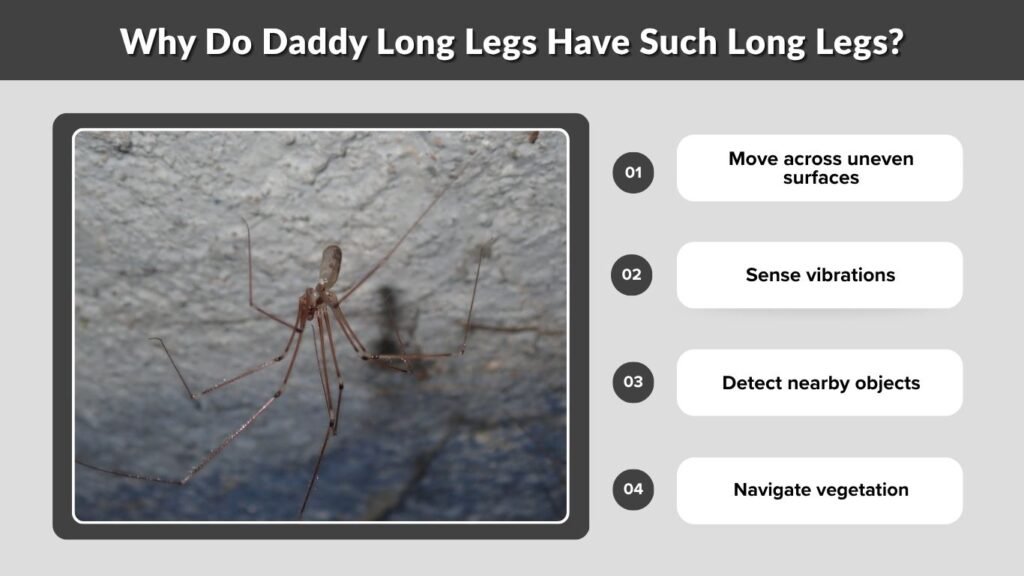
Their extremely long legs provide several advantages.
They contain sensory structures that help the animal explore its surroundings, detect vibrations, navigate vegetation, and locate food.
Benefits of Long Legs
Long legs can help daddy long legs:
- Move across uneven surfaces
- Sense vibrations
- Detect nearby objects
- Navigate vegetation
- Escape predators
- Search for food
- Keep the body elevated above the ground
Some harvestmen can even lose a leg while escaping a predator and survive, although the lost limb generally does not regenerate in adults.
Should You Kill Daddy Long Legs?
There is usually no need.
Harvestmen are harmless scavengers and predators that may consume small insects and decompose organic material. Cellar spiders can also help control flies, mosquitoes, moths, and other small arthropods around buildings.
If you do not want one indoors, gently moving it outside is generally sufficient.
FAQs
The biggest misunderstanding about daddy long legs comes from treating several completely different animals as if they were one species. Identifying whether you are looking at a harvestman, cellar spider, or crane fly resolves most questions about their supposed toxicity.
Are daddy long legs poisonous?
Harvestmen are not poisonous or venomous to humans. Cellar spiders possess venom for capturing prey but are not considered dangerously venomous to people.
Are daddy long legs the most poisonous spiders?
No. This is a myth. Harvestmen are not even true spiders and lack venom glands, while cellar spiders have not been shown to possess exceptionally dangerous venom.
Can daddy long legs bite you?
Harvestmen do not have the venomous fangs of true spiders. Cellar spiders technically can bite, but human bites are rare and generally not medically significant.
Are daddy long legs poisonous to cats and dogs?
They are not generally considered poisonous to cats or dogs. However, pets should be monitored if they eat unidentified arthropods, particularly when pesticides may be involved.
Are daddy long legs dangerous?
For most people, daddy long legs are essentially harmless. Harvestmen lack venom, cellar spiders pose little threat to humans, and crane flies neither sting nor feed on human blood.
