
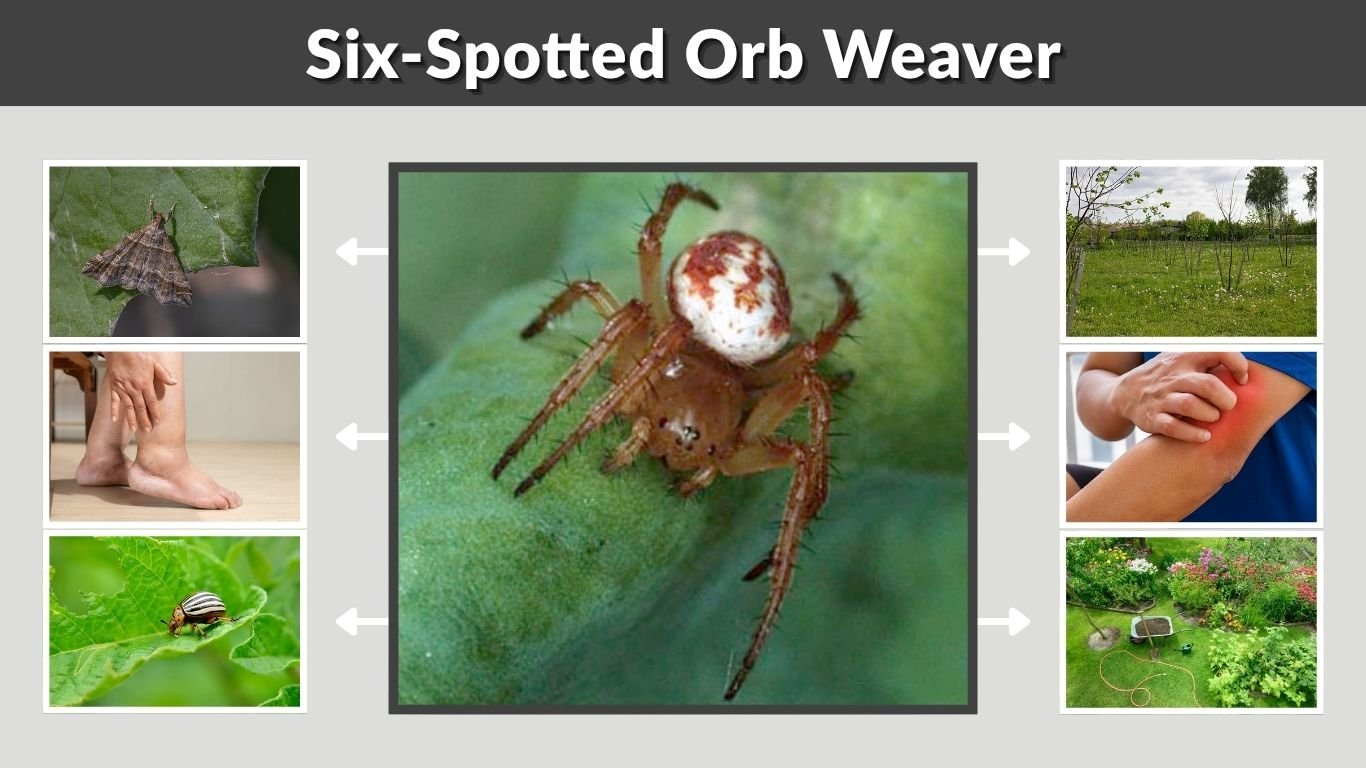
The six-spotted orb weaver is a tiny, colorful spider often discovered on leaves, shrubs, and low tree branches. Scientifically known as Araniella displicata, it belongs to the orb-weaver family Araneidae. Despite its bright appearance and ability to produce venom, this spider is not considered dangerous to people. Its rounded abdomen, dark spots, small circular web, and changing colors make it an interesting—but sometimes difficult—species to identify.
What Is a Six-Spotted Orb Weaver?
The six-spotted orb weaver is a small web-building spider found across a broad area of the Northern Hemisphere. It is sometimes grouped with “cucumber spiders” because many individuals have a pale green or yellow-green abdomen that helps them blend into leaves.
| Feature | Description |
|---|---|
| Scientific name | Araniella displicata |
| Family | Araneidae |
| Common name | Six-spotted orb weaver |
| Female body size | Approximately 4–8 mm |
| Male body size | Approximately 4–6 mm |
| Typical habitat | Trees, shrubs, gardens and woodland edges |
| Diet | Small flying and plant-dwelling insects |
| Risk to humans | Very low |
This species occurs in North America, Europe and parts of Asia, including Russia, Kazakhstan, China, Korea and Japan. In North America, published records extend from Alaska and Canada into parts of the eastern and western United States.
Six-Spotted Orb Weaver Identification
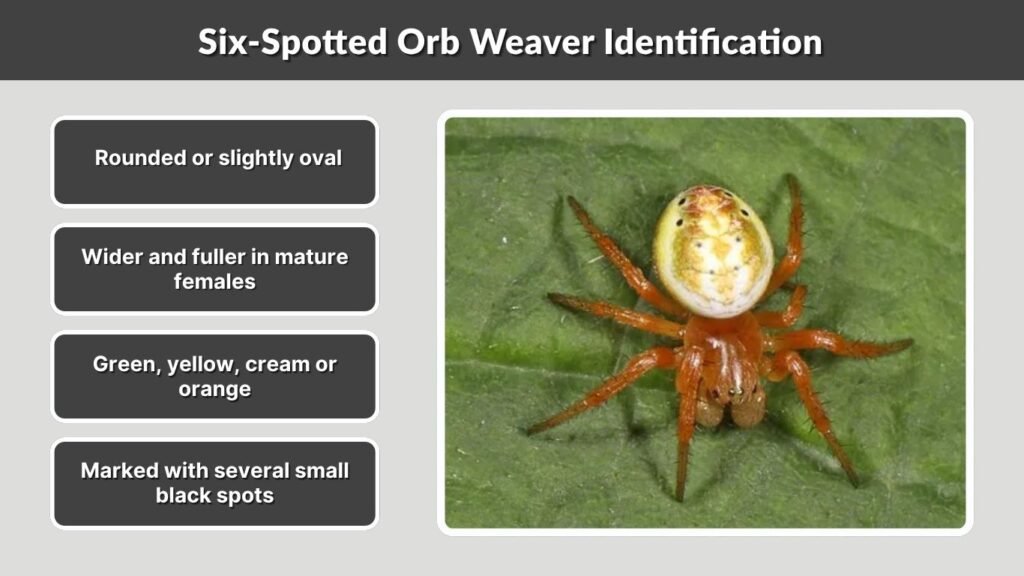
Color alone is not always reliable when identifying this spider. Individuals may appear green, yellow, cream, orange, reddish, tan or nearly white. Their appearance can also change as they mature.
Abdomen and Spots
The abdomen is usually:
- Rounded or slightly oval
- Wider and fuller in mature females
- Green, yellow, cream or orange
- Marked with several small black spots
- Sometimes decorated with pale, reddish or leaf-like markings
The common name refers to the characteristic dark spots on the abdomen. However, some individuals show more than six visible marks, while others have spots that are faint or difficult to see.
Legs and Head
The cephalothorax—the front body section—is generally reddish-brown, orange or tan. Its legs are slender, lightly covered with hairs or spines and often darker near the joints or tips.
Because the spider is so small, these features may require a close photograph or magnifying lens to see clearly. Similar Araniella species can be difficult to distinguish without examining reproductive structures under magnification.
Six-Spotted Orb Weaver Size
Six-spotted orb weavers are much smaller than many familiar garden orb weavers. Their size is measured by body length and does not include the legs.
Adult females generally measure about 4–8 millimeters long, while males are approximately 4–6 millimeters. A large female may therefore be only about one-quarter of an inch in body length.
Their tiny size causes them to be mistaken for juvenile spiders. However, even fully grown adults can remain small enough to hide beneath a single leaf.
Six-Spotted Orb Weaver Male vs Female
Male and female six-spotted orb weavers have the same basic coloring, but their body shapes and behavior can be different.
| Characteristic | Female | Male |
| Body length | About 4–8 mm | About 4–6 mm |
| Abdomen | Larger and rounder | Smaller and slimmer |
| Legs | Proportionally shorter | Often appear longer |
| Web use | Frequently remains near a web | May wander while seeking females |
| Reproductive feature | Epigyne beneath abdomen | Enlarged pedipalps near mouth |
Mature females are usually easier to notice because their abdomen expands as eggs develop. Adult males tend to have a narrower body and enlarged, club-shaped pedipalps that resemble tiny boxing gloves.
Six-Spotted Orb Weaver Habitat and Distribution
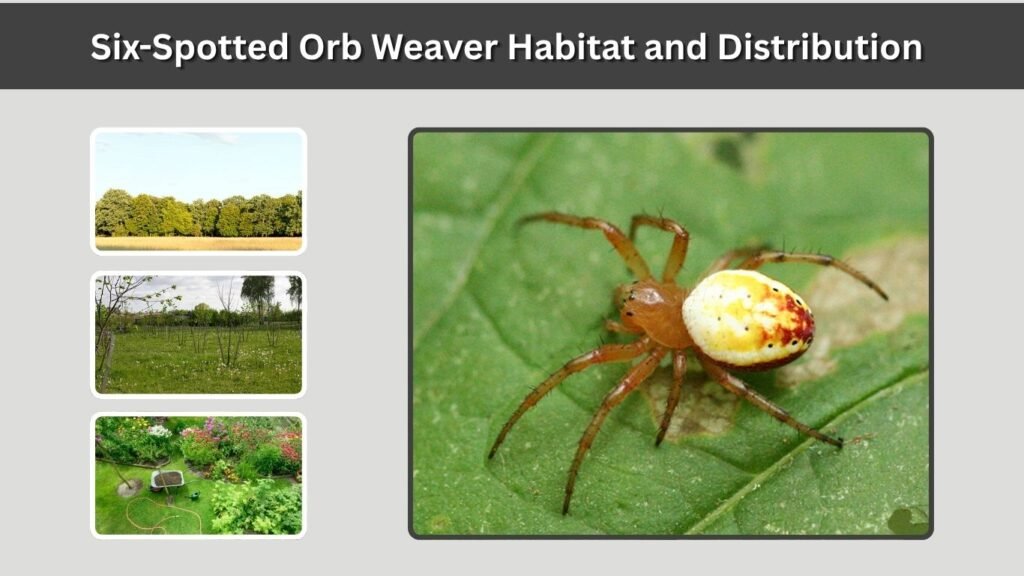
Six-spotted orb weavers prefer vegetation where leaves provide support, camouflage and access to flying insects. They may be found in:
- Woodland edges
- Open forests
- Meadows bordering trees
- Gardens and yards
- Shrubs and hedges
- Young trees
- Vegetation near fences
In North America, the species is widespread across northern regions and parts of both the eastern and western United States. It appears to be less common through much of the southern Great Plains and some Gulf Coast areas.
Is the Six-Spotted Orb Weaver Found in Hawaii?
The standard distribution sources reviewed for Araniella displicata list North America, Europe and extensive parts of Asia but do not specifically confirm an established population in Hawaii. Hawaii has numerous native and introduced orb-weaver species, so a small green or spotted spider photographed there should not automatically be identified as A. displicata. Expert examination may be required for confirmation.
Six-Spotted Orb Weaver Web and Hunting Behavior
Unlike larger garden orb weavers, this species usually builds a compact web. An adult web may measure only three or four inches across and can be positioned several feet above the ground.
The web may be:
- Stretched across part of a large leaf
- Built between two nearby leaves
- Attached to small branches or stems
- Horizontal, angled or vertical
- Hidden beneath vegetation
The spider often waits at the center of the web or stays nearby in a sheltered retreat. When a fly or another small insect strikes the sticky spiral, the spider approaches, bites the prey and may wrap it in silk.
What Does a Six-Spotted Orb Weaver Eat?
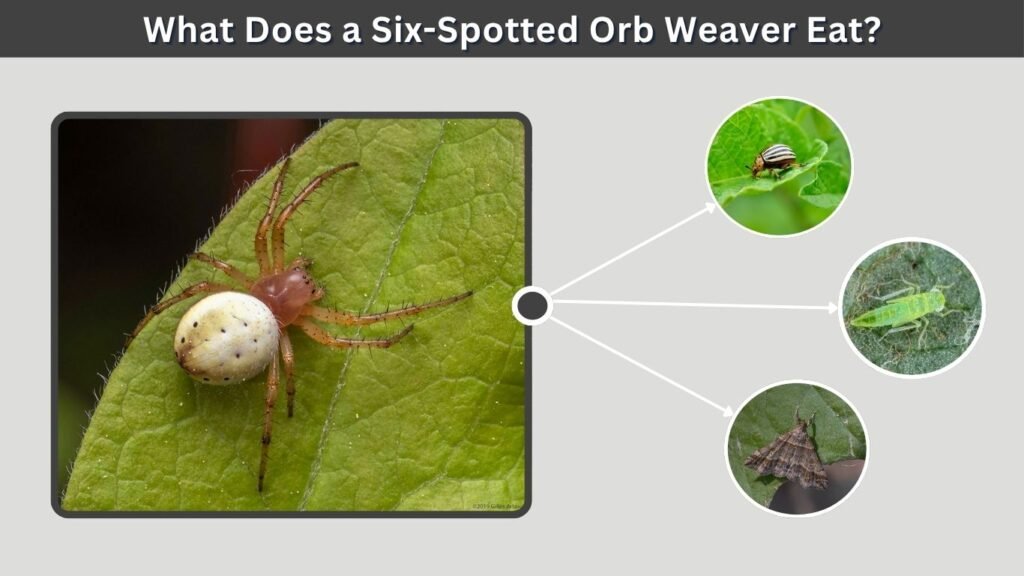
The six-spotted orb weaver feeds mainly on small insects that move through foliage or fly into its web. Common prey may include:
- Small flies
- Gnats
- Plant bugs
- Leafhoppers
- Tiny beetles
- Moths
- Other soft-bodied insects
By catching these animals, the spider contributes to natural insect control in gardens, forests and shrub habitats. It does not eat leaves, damage plants or create an infestation inside vegetation.
Is the Six-Spotted Orb Weaver Poisonous?
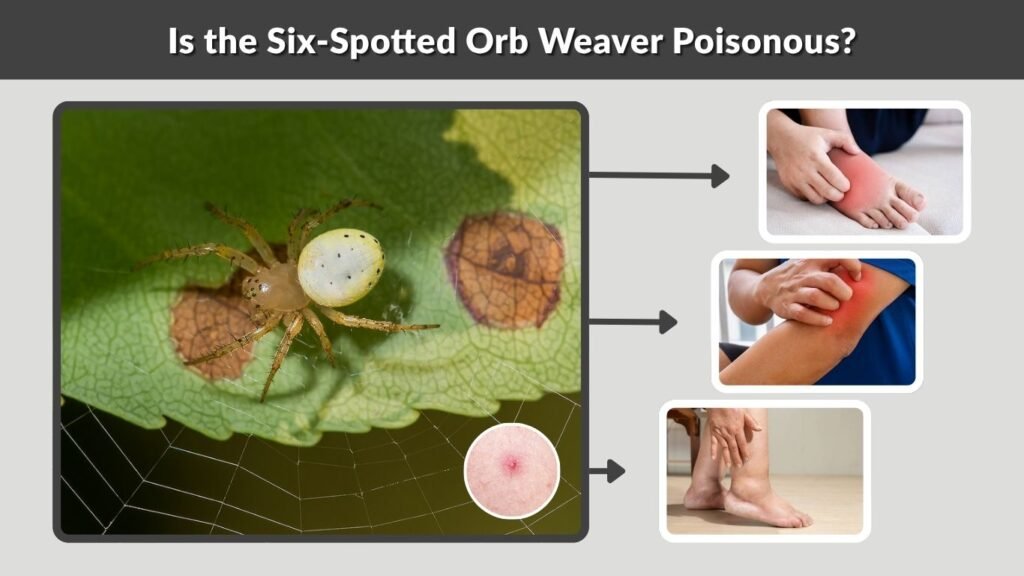
The six-spotted orb weaver is venomous, not poisonous. Venom is injected through fangs, while poison must normally be eaten, touched or absorbed.
Its venom helps immobilize small insect prey. However, six-spotted orb weavers are not considered medically dangerous to humans. Orb weavers generally avoid confrontation and are more likely to hide, remain still or drop from their web than bite.
Can a Six-Spotted Orb Weaver Bite?
A bite is possible if the spider is squeezed, trapped against the skin or handled roughly. Because the spider is small and nonaggressive, documented bites appear to be uncommon.
A minor spider bite may produce temporary:
- Redness
- Mild pain
- Itching
- Localized swelling
Wash the area with soap and water and apply a cold compress. Seek medical help if severe swelling, breathing difficulty, spreading pain, dizziness or other serious symptoms develop.
Reproduction and Life Cycle
Adults are most often noticed during late spring and early summer. After mating, females produce eggs that may be enclosed in silk and protected within a curled or sheltered leaf.
Spiderlings emerge as tiny versions of adults. They disperse into nearby vegetation, where they begin catching very small prey and constructing miniature webs. As they grow, they molt several times before reaching maturity.
Six-Spotted Orb Weaver Facts
- It can complete much of its web across a single leaf.
- A mature female may still be less than one-quarter inch long.
- Its body color can range from green to orange or nearly white.
- Females generally have rounder abdomens than males.
- It catches prey rather than actively chasing insects.
- It is beneficial in gardens because it consumes small insects.
- It is not known to damage plants, buildings or stored food.
FAQs
Are six-spotted orb weavers dangerous?
No. They possess venom for subduing insect prey, but they are not regarded as dangerous to people. They are shy spiders that normally remain on vegetation and attempt to escape when disturbed.
Why does the spider have six spots?
The dark abdominal markings inspired its common name. The precise number and visibility can vary between individuals, so some spiders may appear to have additional dots or fewer clearly defined spots.
Do six-spotted orb weavers live inside houses?
They normally live outdoors on trees, shrubs and other leafy vegetation. An individual might accidentally enter a home on a plant, clothing or another object, but it is unlikely to establish an indoor infestation.
What should I do if I find one in my garden?
Leave it undisturbed whenever practical. It is a beneficial predator that catches flies, plant bugs and other small insects without harming flowers, vegetables or ornamental plants.
How can I tell a male from a female?
Females usually have a larger, rounder abdomen. Males tend to be slimmer, with proportionally longer-looking legs and enlarged pedipalps near the mouth. Precise identification may require close examination by a spider expert.
