
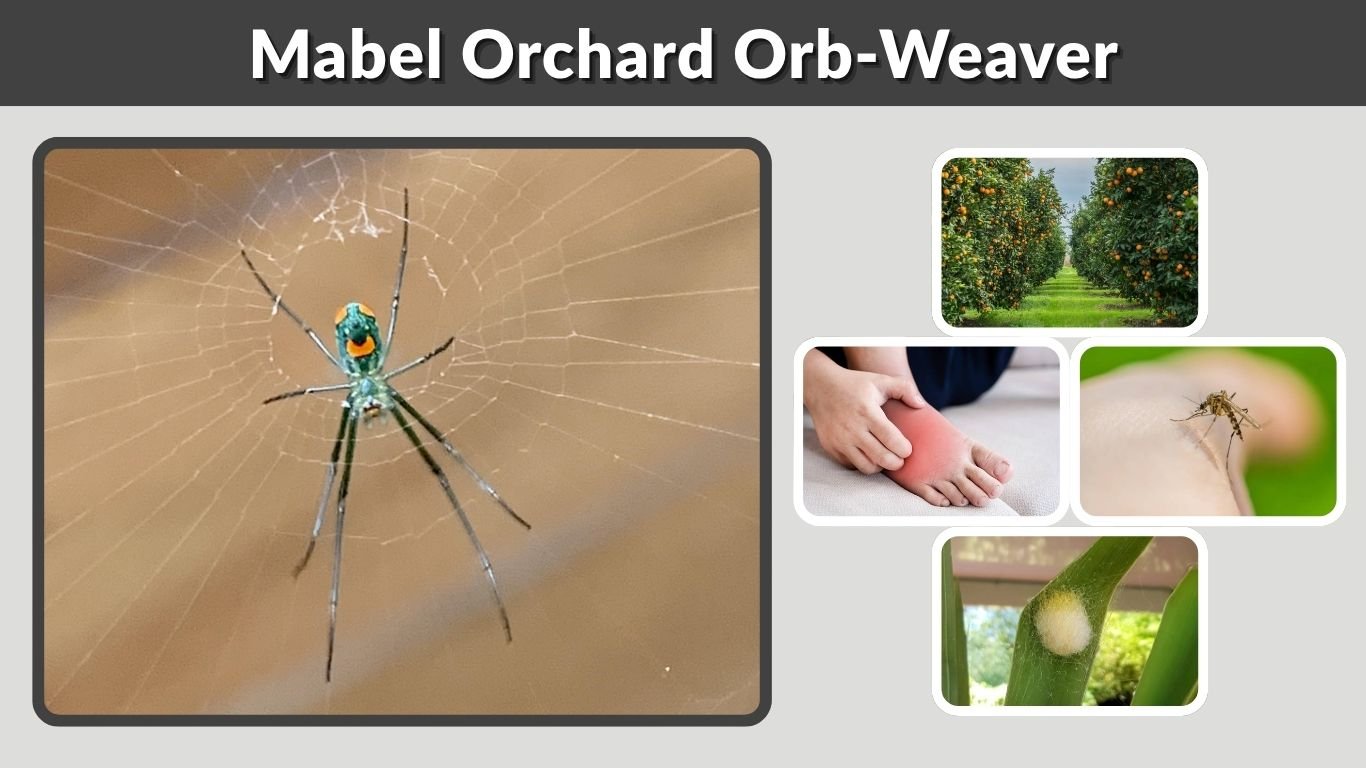
The Mabel orchard orb-weaver (Leucauge argyrobapta) is a small, colorful spider recognized by its reflective silver abdomen, green legs, dark stripes, and bright orange markings. It commonly builds delicate circular webs in gardens, orchards, woodland edges, and other areas with dense vegetation. Although its unusual colors sometimes cause concern, this spider is shy, beneficial, and not considered dangerous to people. It primarily spends its life catching mosquitoes, flies, and other small insects in its web.
What Is a Mabel Orchard Orb-Weaver?
The Mabel orchard orb-weaver is a long-jawed orb-weaving spider belonging to the family Tetragnathidae. Its accepted scientific name is Leucauge argyrobapta, although older references may place it under names such as Leucauge mabelae or treat it as the same species as Leucauge venusta. Modern research recognizes L. argyrobapta as a separate southern species.
| Feature | Description |
| Scientific name | Leucauge argyrobapta |
| Family | Tetragnathidae |
| Common name | Mabel orchard orb-weaver |
| Female body length | About 5.5–7.5 mm |
| Male body length | About 3.5–4 mm |
| Main colors | Silver, green, black, yellow and orange |
| Diet | Mosquitoes, flies and other small insects |
| Risk to humans | Very low |
| Primary range | Florida southward through tropical regions to Brazil |
The name Leucauge refers to the spider’s bright gleam, while argyrobapta can be interpreted as “dipped in silver.” Both names describe the reflective appearance of its abdomen.
Mabel Orchard Orb-Weaver Identification
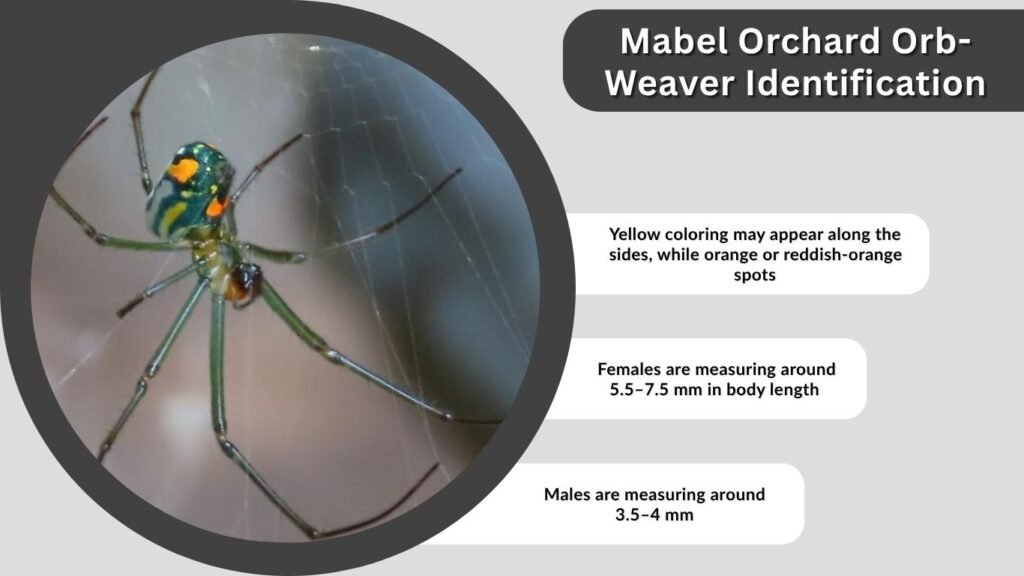
This spider may look striking in close-up photographs, but it is quite small. Its long legs make it appear larger than its actual body size.
Color and Markings
The abdomen is oval and usually appears silvery white or mirror-like. Several thin, dark lines run lengthwise along its upper surface. Yellow coloring may appear along the sides, while orange or reddish-orange spots are visible near the rear and underneath the abdomen.
Its legs are normally green or greenish black, with darker bands around the joints. The front body section, known as the cephalothorax, is generally light brown or tan. The silver appearance is produced by tiny guanine crystals that reflect light beneath the spider’s outer covering.
Male vs. Female
Female Mabel orchard orb-weavers measure approximately 5.5–7.5 mm in body length. Males are smaller, measuring around 3.5–4 mm, but they often have proportionally longer legs.
Adult males also have noticeably enlarged, bulb-shaped pedipalps near the mouth. These structures are involved in reproduction and can help distinguish mature males from females.
Orange Markings Under the Abdomen
The underside of a female often has two reddish-orange triangular areas. A male may have a more band-shaped orange marking.
These orange patches sometimes cause people to mistake an orchard orb-weaver for a widow spider. However, their body shape, coloration and web design are quite different. Widow spiders generally have rounded, dark bodies and build irregular cobwebs, while Mabel orchard orb-weavers build organized circular webs.
Where Do Mabel Orchard Orb-Weavers Live?
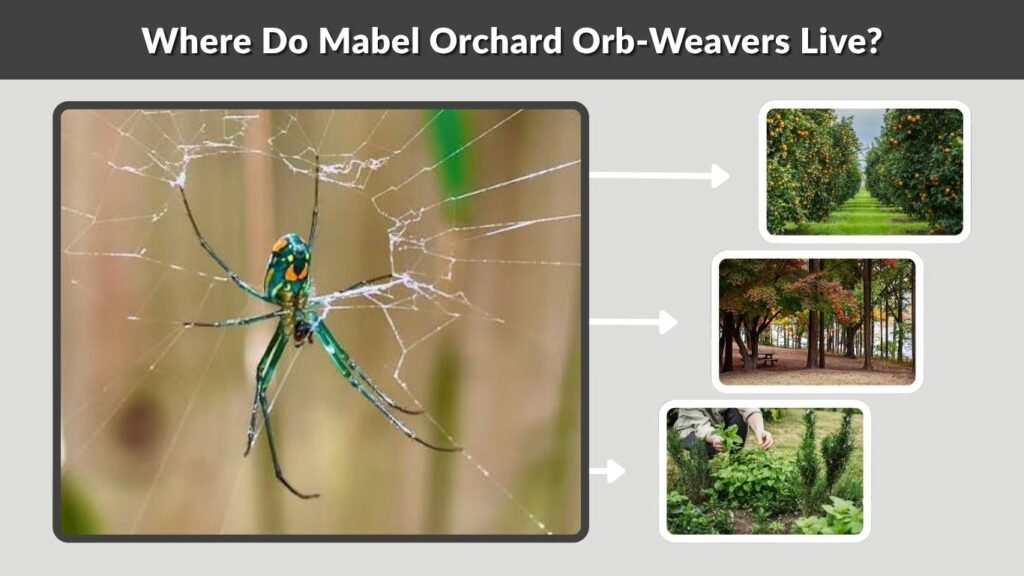
The confirmed range of Leucauge argyrobapta extends from Florida southward through tropical areas to Brazil. Records also occur in Mexico, while the precise boundaries and possible overlap with closely related orchard orb-weavers remain uncertain.
Common habitats include:
- Citrus groves and fruit orchards
- Shrubby meadows
- Woodland borders
- Tropical and subtropical forests
- Gardens with dense plants
- Hedges and shaded yards
- Areas beneath overhanging roofs
- Vegetation near houses
The spider does not need an actual orchard to survive. It mainly requires plants or structures that provide several attachment points for its web. Multiple spiders may build connected webs in the same area when insects are abundant.
Mabel Orchard Orb-Weaver Web
The web is one of the easiest ways to recognize this spider. Unlike many familiar orb webs that stand vertically, its web is usually horizontal or only slightly angled.
Web Structure
A typical web contains a central hub surrounded by supporting lines and numerous sticky spirals. There may be more than 30 radial threads and over 60 sticky spiral sections. A loose barrier of irregular silk may also be constructed underneath the main web.
The spider normally hangs beneath the center with its underside facing upward. This position allows it to detect vibrations and quickly reach trapped prey.
What Happens When It Is Disturbed?
The Mabel orchard orb-weaver is more likely to escape than defend itself. When frightened, it may run toward the edge of the web or drop toward the ground while remaining attached to a safety line of silk. It can later climb back to its web along that thread.
What Does a Mabel Orchard Orb-Weaver Eat?
Mabel orchard orb-weavers are insect predators. Their webs are designed to capture small flying insects moving through low vegetation.
Common prey may include:
- Mosquitoes
- Gnats
- Small flies
- Midges
- Tiny moths
- Leafhoppers
- Other soft-bodied insects
Small flies and related insects are among the most frequently captured prey, and mosquitoes have been directly documented in orchard orb-weaver webs.
Once an insect becomes trapped, the spider bites it and releases venom that helps immobilize it. Digestive fluids are then applied to break down the prey’s internal tissues. The spider consumes the resulting liquid rather than swallowing solid pieces.
Is the Mabel Orchard Orb-Weaver Poisonous?
No. The Mabel orchard orb-weaver is not poisonous. Poisonous animals cause harm when eaten or touched, while venomous animals deliver toxins through a bite or sting.
Like most spiders, the Mabel orchard orb-weaver is technically venomous because it uses venom to subdue insects. However, having venom does not automatically make a spider dangerous to people. Only a small number of spider species possess venom considered medically significant to humans.
Its orange abdominal markings should not be interpreted as proof that it is dangerous. They are simply part of the spider’s normal coloration.
Does the Mabel Orchard Orb-Weaver Bite?
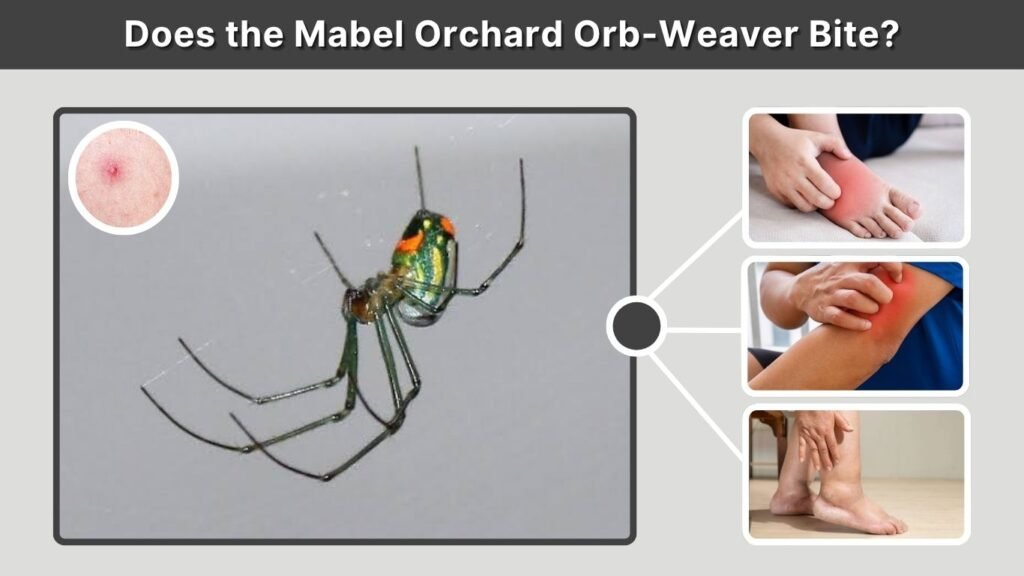
A bite is possible, but it is unlikely. These spiders are not aggressive and normally flee or drop from their webs when disturbed. A bite would most likely happen if someone trapped the spider against their skin, squeezed it or handled it roughly.
Possible minor reactions could include:
- Brief pain or stinging
- Mild redness
- Slight swelling
- Temporary itching or tenderness
Orb-weaving spiders are generally regarded as harmless to people, and bites from non-medically significant species usually do not require special treatment. Individual sensitivity can vary, however.
What to Do After a Bite
Wash the affected area with soap and water. Apply a cold pack wrapped in cloth for about 10 minutes at a time to reduce discomfort and swelling. Avoid scratching the skin.
Seek medical advice when pain or swelling continues to worsen, the skin becomes infected, or symptoms such as breathing difficulty, widespread hives, dizziness or facial swelling develop. Severe symptoms may represent an allergic reaction or a bite from a different animal.
Life Cycle and Egg Sacs
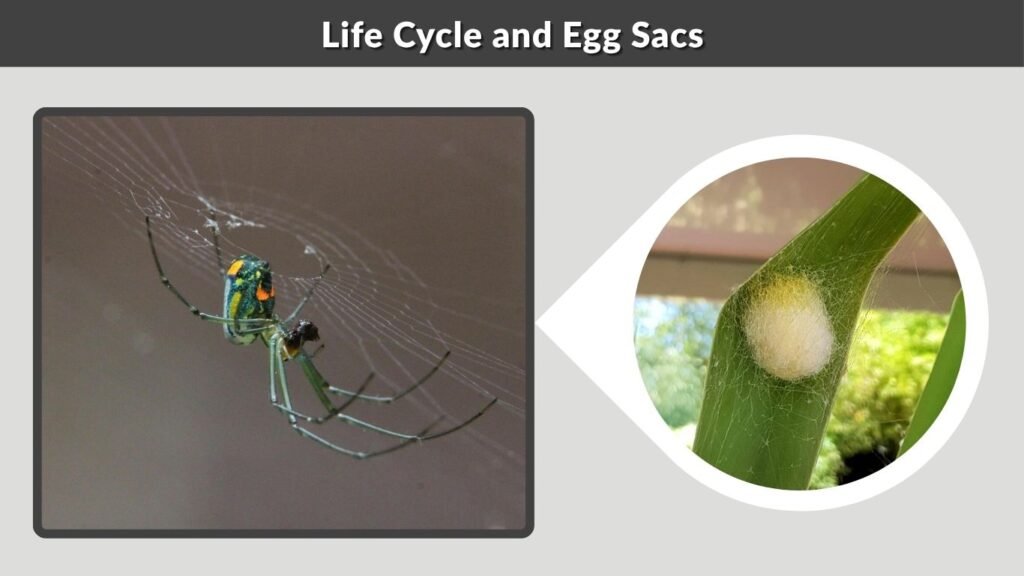
Detailed life-cycle information specifically separating L. argyrobapta from its close relatives remains limited. Like other orchard orb-weavers, it develops through egg, spiderling and adult stages.
A related orchard orb-weaver egg sac has been described as a fluffy, orange-white silk structure attached to a leaf or twig near the web. It measured roughly 8–9 mm across and contained several hundred tiny reddish-orange eggs. Young spiderlings eventually disperse and begin constructing small webs of their own.
As the spider grows, it must shed its outer covering. Orchard orb-weavers often molt while hanging beneath the web’s central hub, and the empty shed skin may remain nearby afterward.
Are Mabel Orchard Orb-Weavers Beneficial?
Mabel orchard orb-weavers are beneficial predators that help reduce populations of mosquitoes, gnats, flies and other small insects. Their presence usually indicates that the surrounding area provides enough vegetation and insect life to support web-building spiders.
They do not damage plants, eat fruit or infest wood. There is normally no reason to kill one found in a garden or orchard.
When a web blocks a walkway, gently remove a few supporting strands with a long stick and allow the spider to relocate. Reducing bright outdoor lighting near doors can also discourage insects—and therefore spiders—from gathering close to entrances.
FAQs
Can a Mabel orchard orb-weaver kill a human?
No verified evidence indicates that the Mabel orchard orb-weaver can kill a person. It is a small, nonaggressive spider whose venom is adapted for tiny insect prey. It is not regarded as a medically significant spider.
Is the Mabel orchard orb-weaver dangerous to dogs?
It is not considered dangerous to dogs under ordinary circumstances. A curious dog might experience mild irritation if bitten, but such encounters are unlikely. Contact a veterinarian when a pet develops significant swelling, weakness, vomiting or breathing problems.
Why is its abdomen silver?
The shiny surface is produced by microscopic, platelet-like guanine crystals beneath the outer covering. These crystals reflect light and create the spider’s bright silver or mirror-like appearance.
Is it the same as the orchard orb-weaver?
The names are closely connected, but taxonomy separates Leucauge argyrobapta from the northern orchard orb-weaver, Leucauge venusta. They look extremely similar, and females can be difficult to distinguish without considering geographic location or examining specialized structures.
Should I remove Mabel orchard orb-weavers from my yard?
Removal is usually unnecessary. They control small flying insects and do not harm plants or buildings. Relocation may be helpful only when webs repeatedly cross doors, paths, play areas or other frequently used spaces.
