
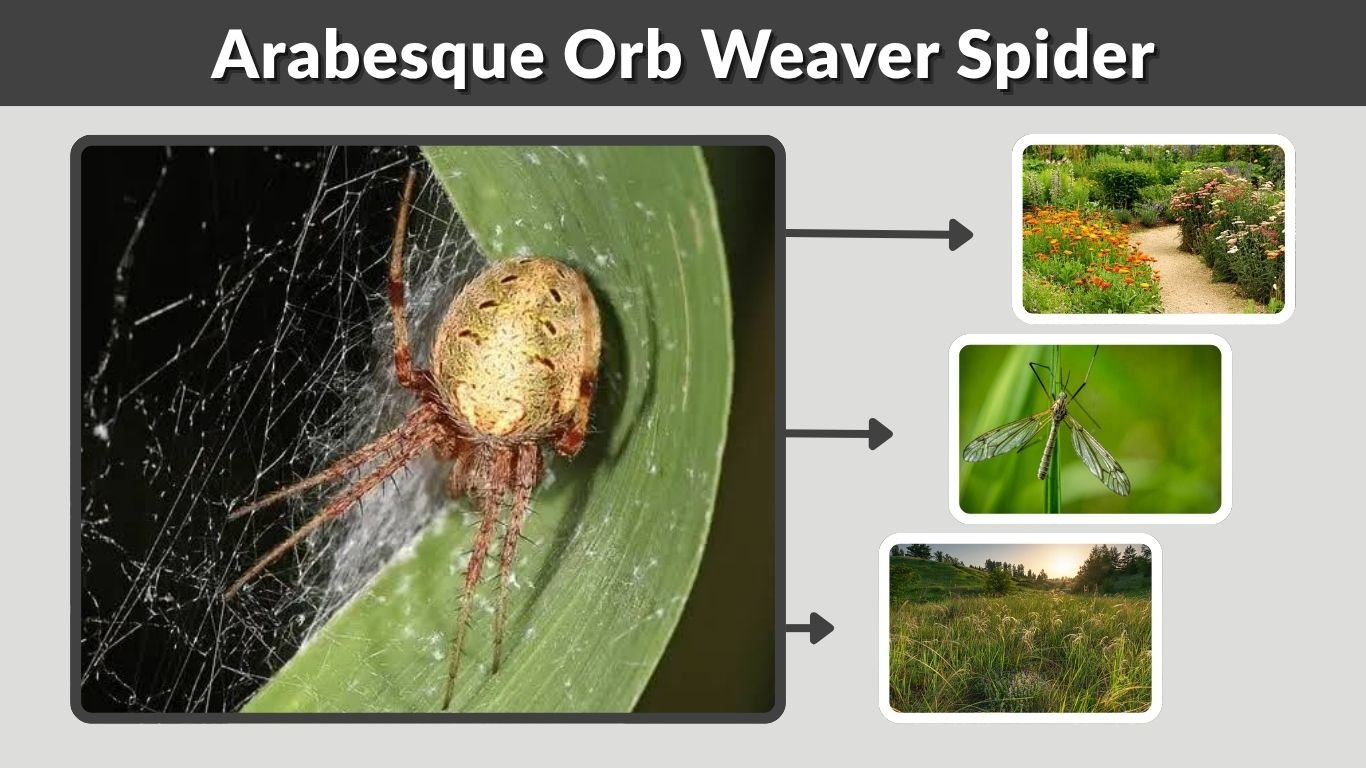
The arabesque orb weaver spider is a small North American species recognized by the decorative, swirling pattern covering its rounded abdomen. Scientifically named Neoscona arabesca, it builds circular webs in gardens, grassy fields, woodland edges and around buildings. Although its intricate markings and hairy legs may look intimidating, this spider is shy, beneficial and not considered dangerous to humans. It spends the night catching flying insects and usually hides in a folded leaf during daylight hours.
What Is an Arabesque Orb Weaver?
The arabesque orb weaver belongs to the family Araneidae, a large family of spiders known for constructing wheel-shaped orb webs. Its accepted scientific name is Neoscona arabesca, and it is the type species of the genus Neoscona.
The name “arabesque” refers to the ornate pattern on the upper side of the abdomen. These curved, interlacing markings resemble the decorative designs seen in traditional arabesque artwork.
| Feature | Description |
| Scientific name | Neoscona arabesca |
| Family | Araneidae |
| Female size | Approximately 5.5–7 mm |
| Male size | Approximately 5–6 mm |
| Web type | Circular vertical orb web |
| Main food | Moths, flies and other flying insects |
| Activity | Mainly nocturnal |
| Risk to humans | Very low |
| General range | United States and Canada |
Arabesque Orb Weaver Identification
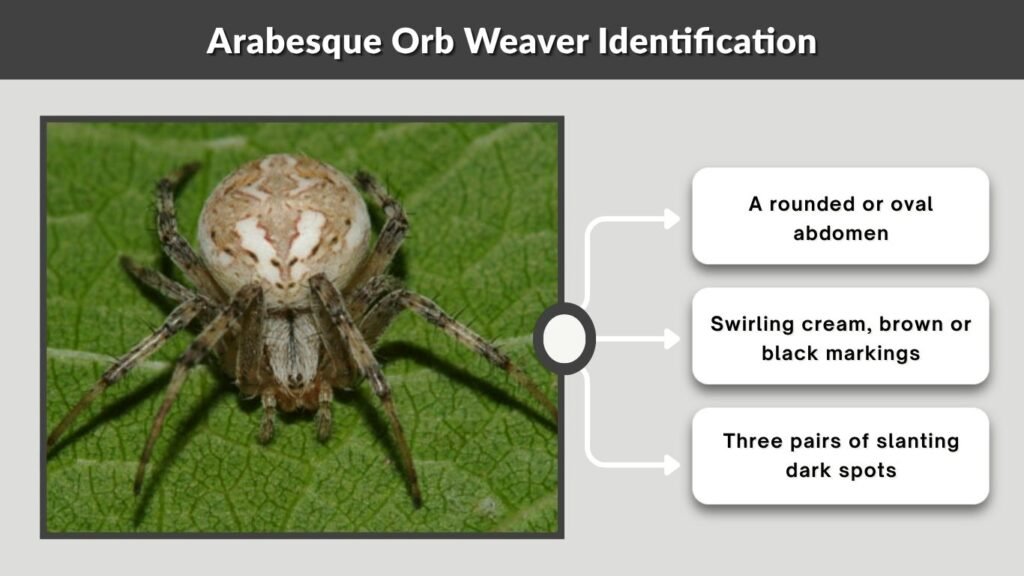
Arabesque orb weavers vary considerably in color. Depending on the individual, they may be cream, tan, gray, brown, orange or nearly black. This variation can make identification difficult, especially when comparing them with other spotted orb weavers.
Abdomen and Pattern
The spider has a rounded to slightly triangular abdomen decorated with an intricate central pattern. The most useful field marks are usually three pairs of dark, slanting spots or comma-shaped markings along the top of the abdomen. These marks help separate N. arabesca from the similar western spotted orb weaver, Neoscona oaxacensis.
Common identification features include:
- A rounded or oval abdomen
- Swirling cream, brown or black markings
- Three pairs of slanting dark spots
- Hairy legs with visible spines
- Brown or gray bands around the legs
- A smaller body than many common garden orb weavers
Color and pattern alone may not always provide a certain identification. Some Neoscona species are so similar that specialists examine small anatomical structures to confirm the species.
Arabesque Orb Weaver Size
The arabesque orb weaver is relatively small when body length is measured without the legs. Females generally measure about 5.5–7 millimeters long, while males usually measure approximately 5–6 millimeters. Mature females normally look larger because their abdomen becomes rounder and heavier.
The total span appears much greater when the legs are fully extended. This can make an adult spider look surprisingly large when it is sitting in the center of a web.
Male vs Female
Female arabesque orb weavers have a fuller, more rounded abdomen and spend more time building and occupying webs. Males are usually slimmer and have proportionally longer-looking legs.
Mature males can also be recognized by their enlarged pedipalps. These small structures near the mouth look similar to tiny boxing gloves. Adult males frequently leave permanent webs and wander through vegetation while searching for females.
Arabesque Orb Weaver Spider Habitat and Distribution
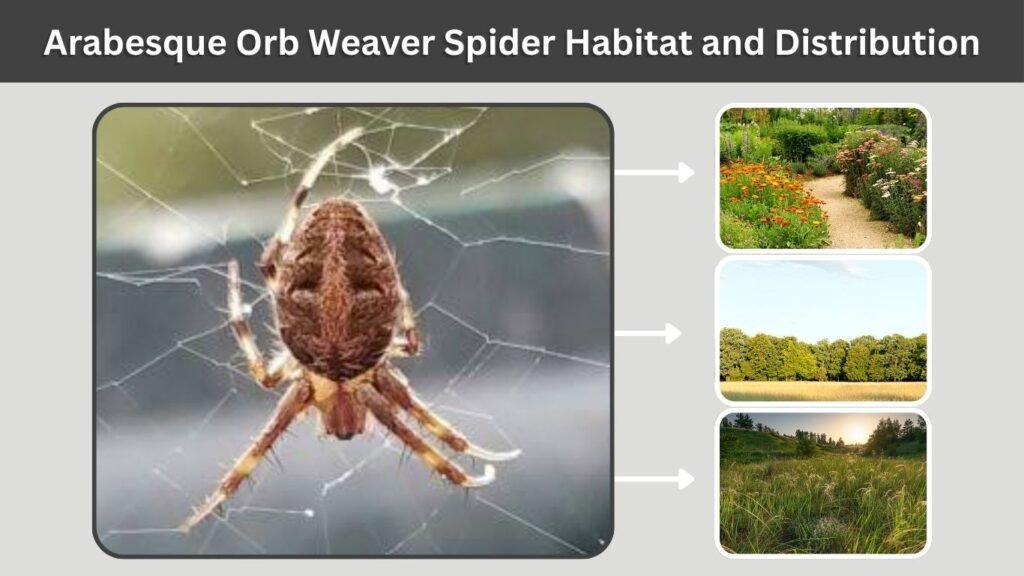
The arabesque orb weaver is widely distributed across the United States and Canada. It also occurs farther south into Central America and parts of the Caribbean. Its broad range allows it to live in many natural and human-modified habitats.
Typical habitats include:
- Open woodlands
- Brushy fields
- Tall grass
- Forest edges
- Flower gardens
- Shrubs and hedges
- Fence lines
- Barns, sheds and house exteriors
The spider chooses locations that provide strong attachment points for its web and regular movement of flying insects. It may construct a web between plant stems, across a gap in vegetation or beneath the eaves of a building.
Arabesque Orb Weaver in New Mexico
The arabesque orb weaver is documented in New Mexico. BugGuide’s published range for the species specifically includes NM along with Arizona, Colorado, Texas and many other states. New Mexico residents may encounter it in gardens, irrigated landscapes, grassy areas and vegetation near buildings.
New Mexico also supports other Neoscona species, so photographs should be checked carefully. The three pairs of slanting dark marks on the abdomen are particularly useful for distinguishing the arabesque orb weaver from similar western species.
Web and Hunting Behavior
Female arabesque orb weavers build vertical, wheel-shaped webs. Their webs may measure approximately 6–18 inches across, depending on the spider and available space. The center contains an open hub crossed by only a small number of silk threads.
The spider is primarily active at night. After darkness falls, the female sits near the center of the web with her head pointing downward, waiting for vibrations caused by trapped prey.
During the day, she normally leaves the exposed center and hides in a nearby retreat. This shelter is often a curled leaf held together with silk. A signal thread connecting the retreat to the web can alert the spider when prey becomes trapped.
Some individuals consume worn web silk in the morning and reuse its nutrients when constructing a fresh web later.
What Does an Arabesque Orb Weaver Eat?
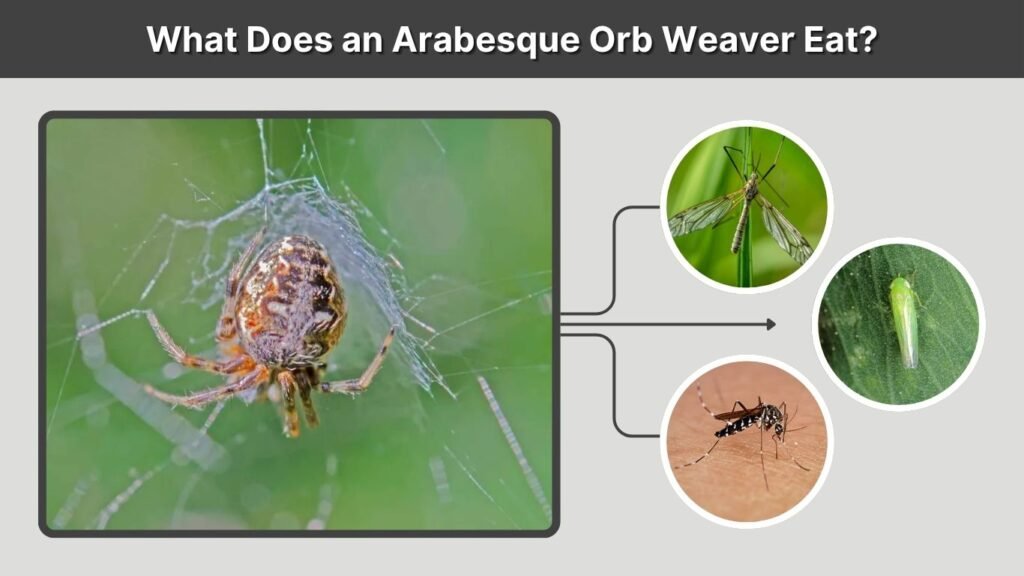
Arabesque orb weavers mainly capture flying insects. Sticky spiral threads stop the insect, while radial lines transmit vibrations to the waiting spider.
Common prey includes:
- Moths
- Flies
- Crane flies
- Gnats
- Mosquitoes
- Small beetles
- Leafhoppers
- Other small flying insects
After detecting prey, the spider approaches, bites it and may wrap it in silk. The venom immobilizes the insect before the spider begins feeding. By capturing numerous insects, arabesque orb weavers provide natural pest control in yards, gardens and agricultural areas.
Is the Arabesque Orb Weaver Poisonous?
The arabesque orb weaver is venomous but not poisonous. It injects venom through its fangs to overpower small insects. However, its venom is not considered medically dangerous to humans.
These spiders are nonaggressive and generally try to escape or hide when disturbed. A bite would be most likely if someone squeezed the spider, trapped it against the skin or handled it roughly. The Missouri Department of Conservation notes that orb weavers typically do not bite unless molested and that their bites are not dangerous.
Arabesque Orb Weaver Lifespan
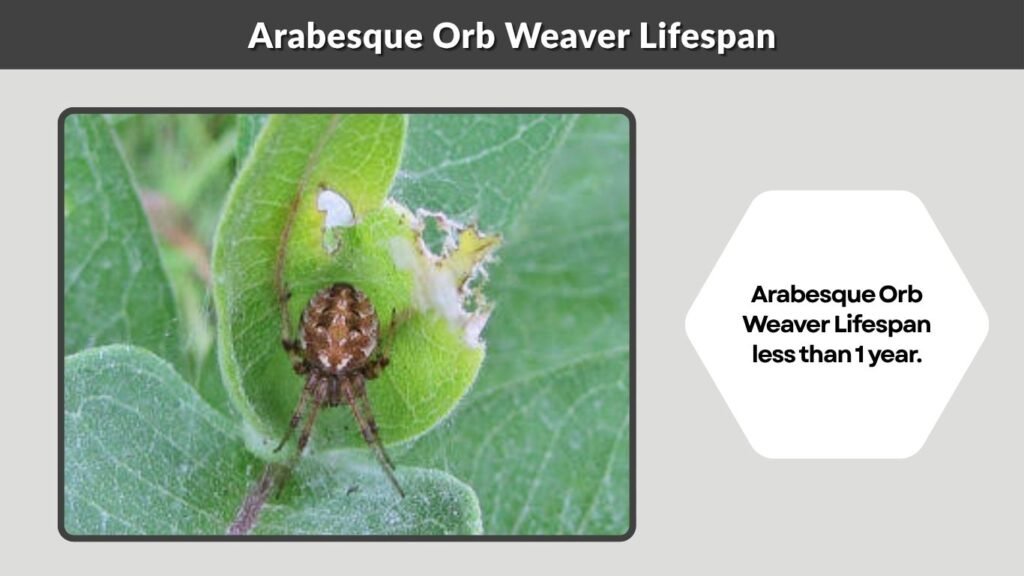
There is no precise lifespan that applies to every arabesque orb weaver, but in seasonal parts of its range, it generally follows an annual life cycle.
Young spiders emerge from egg sacs early in the growing season and spend spring and summer feeding and molting. They reach maturity during late summer or early fall. After mating, females produce protected egg sacs containing the next generation.
The adult spiders become sluggish as temperatures fall and usually die after freezing weather arrives. The offspring survive winter inside their egg sacs and emerge when conditions become warmer. Therefore, most individuals live for less than one year, although the exact timing depends on climate and when the spider hatches.
Arabesque Orb Weaver Facts
- Its decorative abdominal pattern inspired the name “arabesque.”
- It is active mainly after sunset.
- Females hide inside curled leaves during the day.
- It is recorded throughout the United States and Canada.
- New Mexico is included within its documented range.
- Females are generally larger and rounder than males.
- Its web may stretch 6–18 inches across.
- It controls flies, moths and other insects naturally.
- It does not damage plants, wood, clothing or stored food.
- It rarely bites and is not considered dangerous to people.
FAQs
Are arabesque orb weavers dangerous?
No. Arabesque orb weavers possess venom for capturing insects, but they are not considered medically dangerous to humans. They are shy spiders that normally remain in their webs or hide in vegetation when disturbed.
Where do arabesque orb weavers live?
They live throughout much of the United States and Canada, including New Mexico. Common habitats include grasslands, woodland edges, gardens, shrubs, fences and the exteriors of houses, sheds and barns.
How big does an arabesque orb weaver get?
An adult female generally measures about 5.5–7 millimeters in body length. Males are approximately 5–6 millimeters long. Their extended legs make them look considerably larger than the body measurement suggests.
Why does the spider disappear during the day?
Females usually leave the center of the web after sunrise and hide in a curled leaf or another protected retreat beside it. This behavior helps conceal the spider from birds and other daytime predators.
Should I remove an arabesque orb weaver from my garden?
Removal is usually unnecessary. The spider does not harm plants and helps reduce populations of moths, flies and other flying insects. A web crossing a walkway can be gently moved without killing the spider.
