
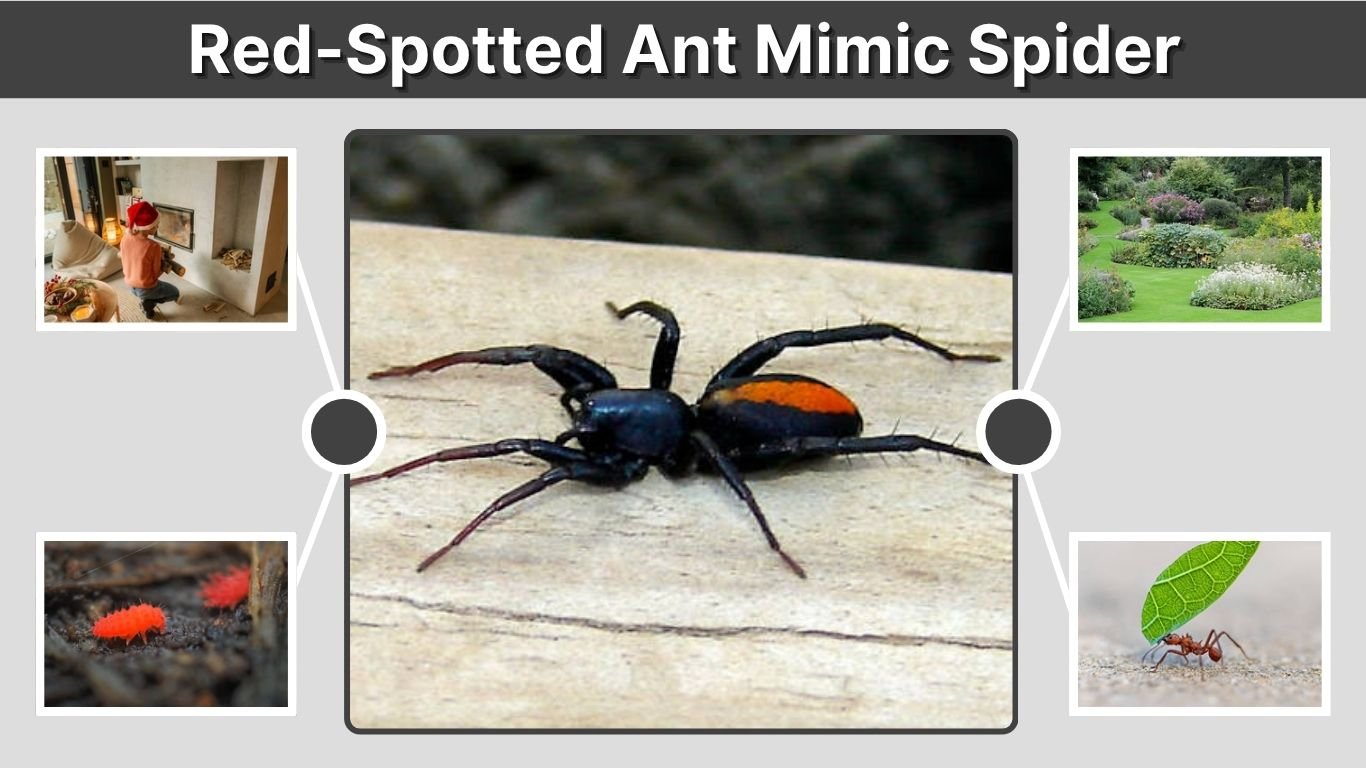
The red-spotted ant mimic spider is a small, fast-moving spider recognized by its black body and bright red or orange abdominal marking. Its ant-like shape and movements help protect it from predators that avoid aggressive or bad-tasting ants. Despite its dramatic coloring, this spider is not considered dangerous to humans. It is a beneficial hunter that feeds on insects and other small arthropods found in grasslands, gardens, forests, and leaf litter.
What Is a Red-Spotted Ant Mimic Spider?
The species commonly called the red-spotted ant mimic spider is Castianeira descripta. It belongs to the family Corinnidae, a group known as ant-mimicking and ground sac spiders.
It is also called the:
- Redspotted antmimic
- Red-spotted ant mimic sac spider
- Red-spotted ant-mimic spider
- Ant-mimic ground spider
This spider does not build a large web to catch prey. Instead, it moves across the ground and low vegetation while searching for small insects. It may construct a small silk shelter for resting, molting, or protecting its eggs.
| Feature | Description |
| Scientific name | Castianeira descripta |
| Family | Corinnidae |
| Body length | Approximately 5–10 mm |
| Main colors | Black with red or orange markings |
| Hunting method | Active ground hunting |
| Main habitat | Grasslands, forests, gardens, and leaf litter |
| Risk to humans | Not considered medically significant |
Red-Spotted Ant Mimic Spider Identification
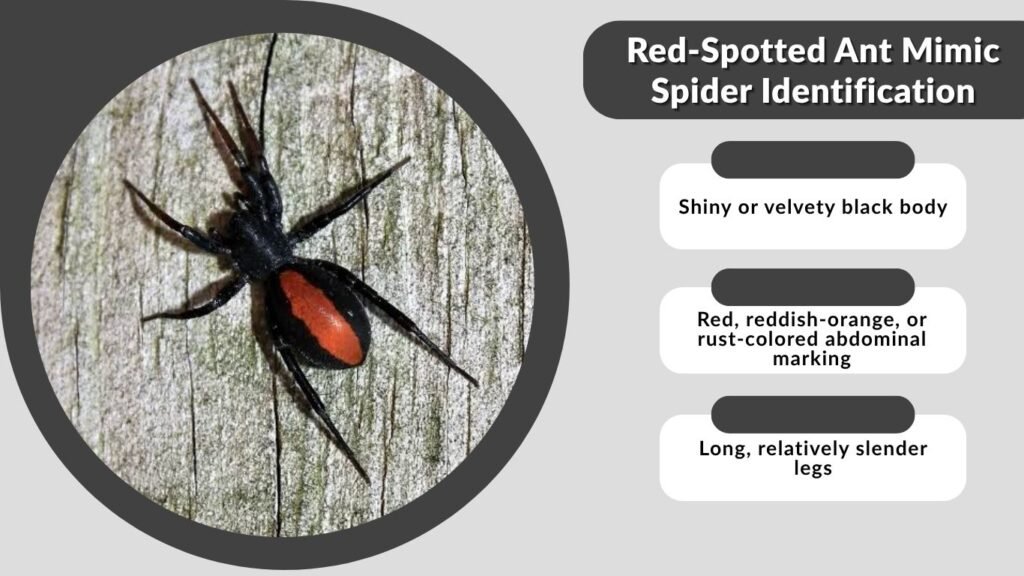
The spider’s contrasting colors make it relatively noticeable, but the exact shape and size of the red marking can vary. Some individuals have a broad red patch covering much of the abdomen, while others have a narrower stripe or smaller spot.
Identification Features
- Shiny or velvety black body
- Red, reddish-orange, or rust-colored abdominal marking
- Elongated rather than round abdomen
- Long, relatively slender legs
- Fast, ant-like walking pattern
- Front legs sometimes raised like antennae
- Eight legs instead of an ant’s six
- No large prey-catching web
The amount of red on the abdomen is particularly variable among females. The marking generally becomes larger in populations occurring farther south and west within the species’ range.
How Large Is It?
Most adults measure approximately 5–10 millimeters in body length, excluding the legs. Females are often larger and more robust than males. Documented specimens include males around 5.5 millimeters and females approaching 10 millimeters.
The spider can appear larger when its legs are fully extended, but its body is generally shorter than half an inch.
Why Does It Mimic an Ant?
Red-spotted ant mimic spiders resemble ants in both appearance and behavior. Their narrow bodies create an ant-like outline, while their quick, irregular movements imitate the walking pattern of ants.
The spider may raise its first pair of legs and wave them in front of its body. This creates the appearance of two antennae while the spider walks on its remaining six legs.
This form of imitation may discourage predators. Many birds, reptiles, and other insect-eating animals avoid ants because ants can bite, sting, release defensive chemicals, or defend themselves in groups. Looking like an ant may therefore make the spider appear less appealing as prey.
Red-Spotted Ant Mimic Spider Habitat
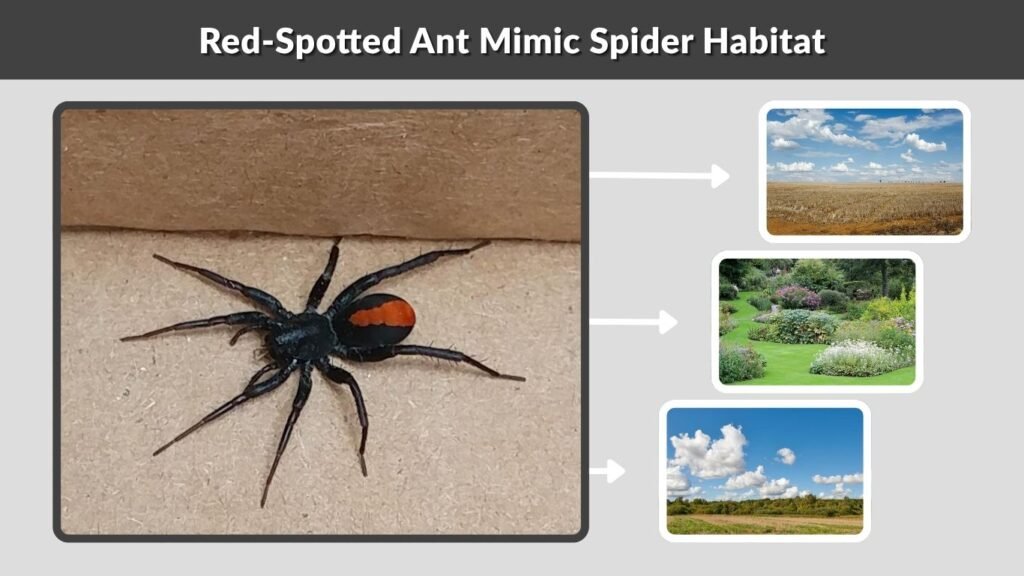
The red-spotted ant mimic spider is most common in open environments, although it can also inhabit wooded areas.
Typical habitats include:
- Dry grasslands
- Prairies and meadows
- Gardens and parks
- Open forests
- Sandy shorelines
- Leaf litter
- Areas beneath logs and stones
- Low-growing vegetation
The spider usually runs across the ground or vegetation instead of remaining in one permanent web. It may occasionally enter houses, sheds, garages, or other buildings while searching for prey or shelter.
Geographic Range
Castianeira descripta occurs in the United States and Canada. Its documented range extends from Maine westward toward Minnesota and south through parts of Oklahoma, Texas, and Florida. It can also be found in states such as Michigan, North Carolina, and other areas containing suitable open or wooded habitats.
Red-spotted ant mimics reported outside North America may be different Castianeira species or unrelated spiders with similar black-and-red patterns.
What Does a Red-Spotted Ant Mimic Spider Eat?
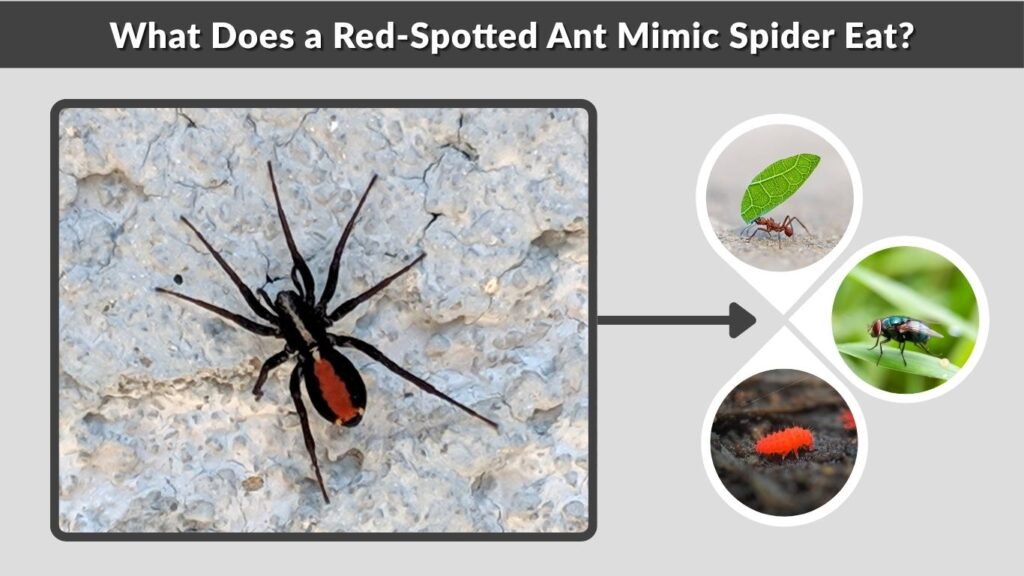
This spider is an active predator of small arthropods. It searches along the ground and through vegetation instead of waiting inside a capture web.
Its possible prey includes:
- Small ants
- Flies
- Gnats
- Springtails
- Beetles
- Insect nymphs
- Other small spiders
- Soft-bodied arthropods
The spider catches prey with its legs, bites it, and uses venom to immobilize it. Although it resembles an ant, its mimicry is not necessarily used only to hunt ants. The disguise may primarily provide protection from predators.
Is the Red-Spotted Ant Mimic Spider Poisonous?
The red-spotted ant mimic spider is not poisonous. Poisonous animals cause harm when eaten or touched, while venomous animals inject venom through fangs or stingers.
Like most spiders, Castianeira descripta is technically venomous because it uses venom to subdue prey. However, it is not considered harmful or medically significant to humans.
Its venom is designed for small insects rather than large animals. The spider normally attempts to escape when disturbed and has no reason to attack people.
Red-Spotted Ant Mimic Spider Bite
A red-spotted ant mimic spider can probably bite when trapped against the skin or handled roughly, but confirmed bites appear to be uncommon. Its small size and nonaggressive nature make accidental contact unlikely.
A possible bite could cause:
- A brief pinching sensation
- Mild localized pain
- Temporary redness
- Minor swelling
- Itching or tenderness
Symptoms attributed to spiders are frequently diagnosed without the spider being captured or positively identified. Redness, swelling, skin infections, insect bites, and other conditions can easily be mistaken for spider bites.
Wash a suspected bite with soap and water and avoid scratching it. Medical attention is appropriate when pain or swelling becomes severe, redness continues spreading, infection develops, or symptoms such as breathing difficulty, dizziness, facial swelling, or widespread hives occur.
Red-Spotted Ant Mimic Spider vs. Black Widow
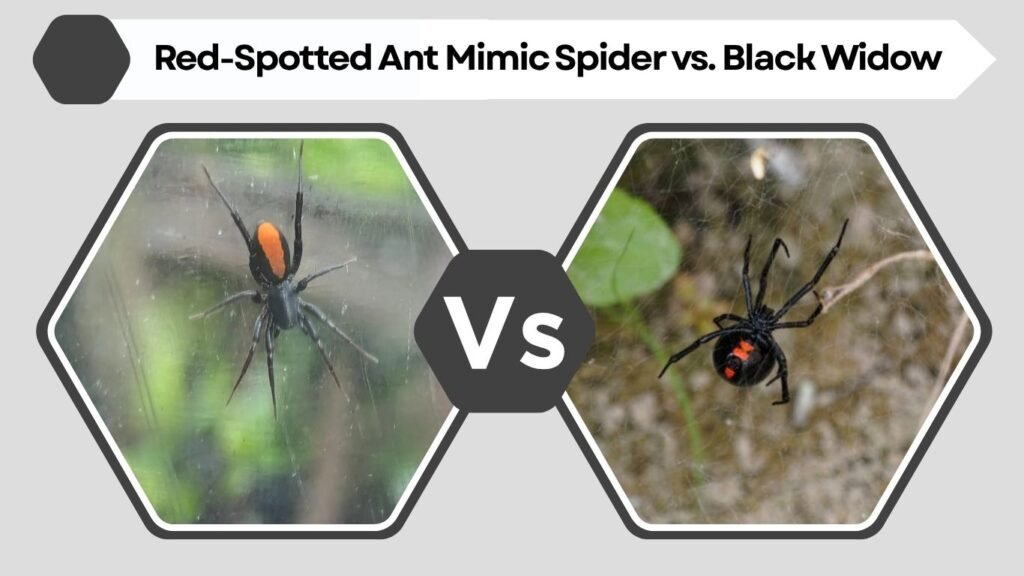
The red marking on this spider sometimes leads people to mistake it for a black widow. However, their body shape, behavior, web use, and markings are different.
| Feature | Red-spotted ant mimic | Black widow |
| Abdomen | Long or oval | Large, smooth, and rounded |
| Red marking | Usually on top of abdomen | Classic hourglass usually underneath |
| Body posture | Runs actively across surfaces | Often remains near a tangled web |
| Web | No large capture web | Strong, irregular cobweb |
| Legs | Ant-like and suited for running | Long, slender legs around a round body |
| Human risk | Not considered harmful | Bite can be medically significant |
A mature female black widow normally has a noticeably rounded abdomen. The red-spotted ant mimic is more elongated and often has a red stripe or broad patch visible across the upper surface of its abdomen.
Young or male widow spiders can have additional markings, so identification should consider body shape, web type, behavior, and location—not color alone.
Similar Red-Spotted Ant Mimic Species
The similar Castianeira crocata can be difficult to distinguish from C. descripta through photographs alone. Both may have black bodies with red markings.
Castianeira crocata is generally associated with more southern areas, while C. descripta extends farther into northern states and Canada. Because their markings overlap, examination of reproductive structures may be necessary for a certain species-level identification.
Other spiders, including parson spiders, jumping spiders, and juvenile widows, may also have black bodies with pale, red, or orange markings.
Red-Spotted Ant Mimic Spider in the House
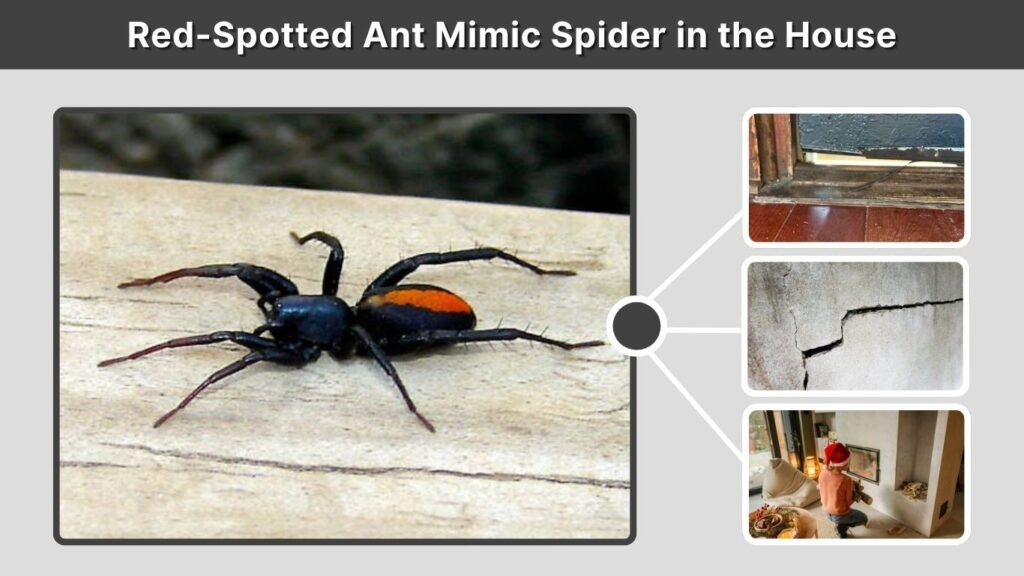
Finding one inside does not usually indicate an infestation. These spiders are solitary hunters and do not create colonies like ants.
An individual may enter through:
- Gaps beneath doors
- Window-screen openings
- Foundation cracks
- Firewood carried indoors
- Potted plants
- Boxes stored outside
The spider can be captured using a cup and a piece of stiff paper and released outdoors. Sealing openings, reducing clutter, and controlling indoor insect prey can help prevent repeated appearances.
FAQs
Is the red-spotted ant mimic spider dangerous?
No. It is not considered harmful or medically significant to humans. It is a small, shy ground hunter that usually runs away when disturbed.
Is a red-spotted ant mimic spider venomous?
Yes, but only in the technical sense that it uses venom to immobilize small prey. Its venom is not known to pose a serious risk to people.
Can a red-spotted ant mimic spider bite?
It may bite when squeezed or handled, but bites are uncommon. A possible bite would generally be expected to cause mild, temporary local discomfort.
Does the red-spotted ant mimic spider eat ants?
It may capture ants, but it also eats other small insects and arthropods. Its ant-like appearance may be more important for avoiding predators than for hunting ants.
Is a red-spotted ant mimic spider a black widow?
No. It has a narrower abdomen, actively runs along the ground, and does not occupy the strong tangled web associated with black widows.
