
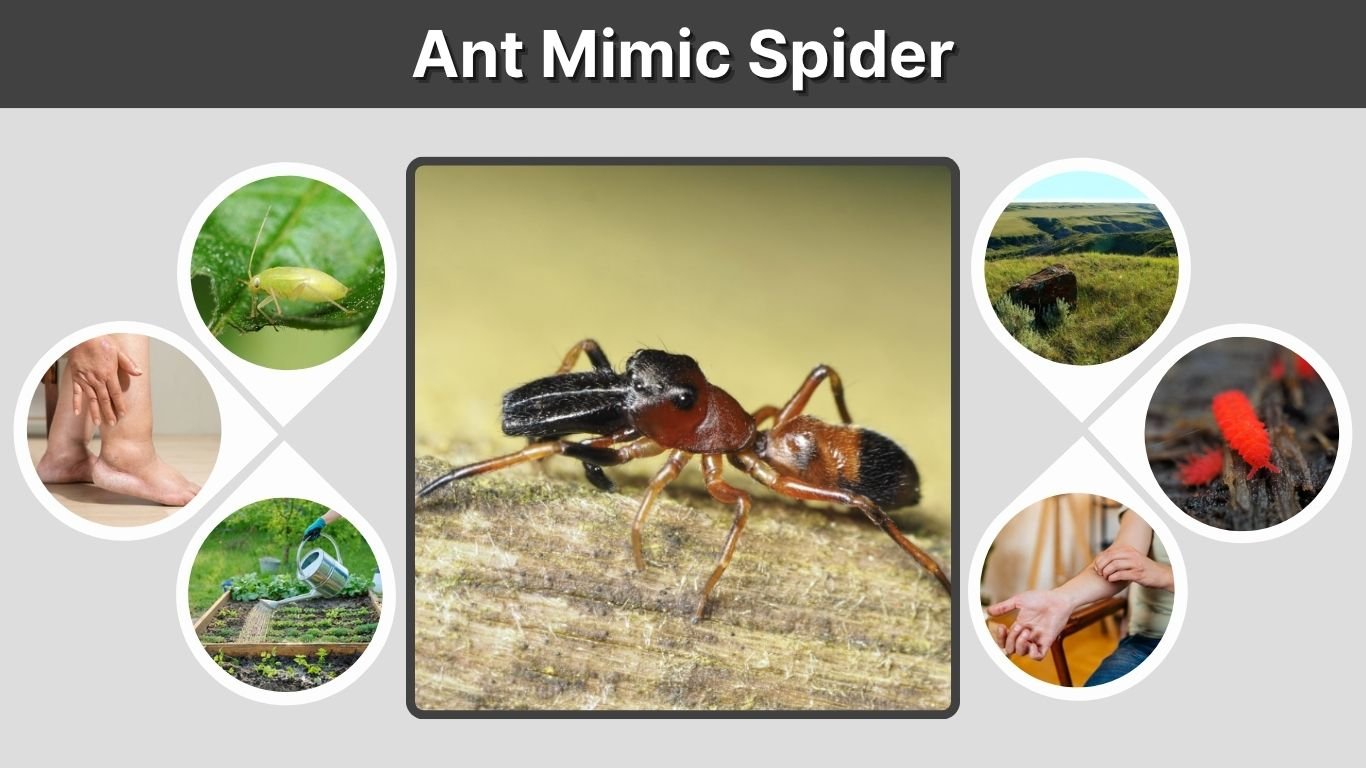
An ant mimic spider is any spider that resembles an ant in its appearance, movement, or behavior. These remarkable spiders may have narrow bodies, dark red or black coloring, and front legs that they wave like antennae. Common examples include red-spotted ant mimic sac spiders and ant-mimicking jumping spiders. Although their unusual appearance can cause concern, ant mimic spiders are generally shy, beneficial predators and are not considered dangerous to humans.
What Is an Ant Mimic Spider?
“Ant mimic spider” does not refer to a single species. It describes spiders from several families that have evolved to resemble ants. Ant mimicry has appeared independently in jumping spiders, sac spiders, ground spiders, crab spiders, and other groups.
Well-known examples include:
- Castianeira ant mimic sac spiders
- Myrmarachne ant mimic jumping spiders
- Synemosyna jumping spiders
- Micaria ground spiders
- Ant-mimicking crab spiders
More than 100 spider species are known to imitate ants through body shape, coloration, movement, or even chemical signals.
Classification
| Group | Common example |
| Order | Araneae |
| Ant mimic sac spider family | Corinnidae |
| Ant mimic jumping spider family | Salticidae |
| Common sac spider genus | Castianeira |
| Common jumping spider genus | Myrmarachne |
| Diet | Small insects and other arthropods |
| Risk to humans | Generally low |
Ant Mimic Spider Identification
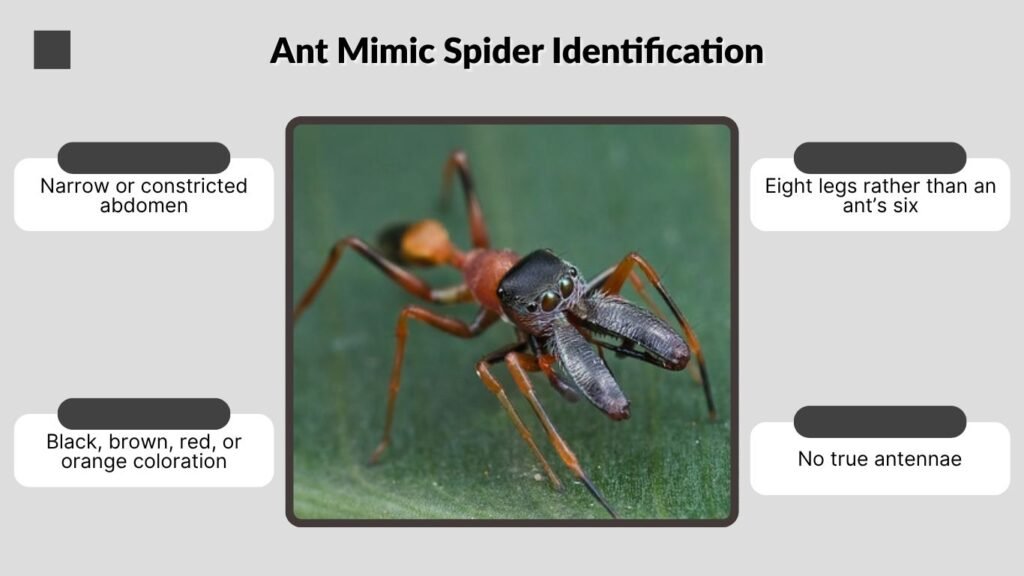
Ant mimic spiders are usually small, slender, and fast-moving. Their bodies often appear divided into three sections, helping them resemble insects even though spiders naturally have only two main body sections.
Identification Features
- Eight legs rather than an ant’s six
- No true antennae
- Narrow or constricted abdomen
- Black, brown, red, or orange coloration
- One or more red, white, or silver markings
- Front legs frequently raised like antennae
- Quick, ant-like walking movements
- Eight eyes, although some may be difficult to see
- No large prey-catching web
Watch the animal carefully when identification is difficult. An ant uses six legs and moves its jointed antennae from the head. An ant mimic spider has eight legs but may walk on six while holding its first pair in the air.
Why Does It Look Like an Ant?
Many predators avoid ants because ants can bite, sting, release defensive chemicals, or attack in groups. By looking and moving like an ant, the spider may appear less desirable to birds, wasps, and other spider-eating animals.
Research on ant-mimicking jumping spiders has shown that they do more than copy an ant’s shape. They alter their walking pattern and raise their front legs to imitate moving antennae, making the disguise more convincing.
Mimicry may also help some species approach insects without immediately alarming them. However, protection from predators is believed to be one of its primary advantages.
Red-Spotted Ant Mimic Spider
The red-spotted ant mimic spider commonly refers to species in the genus Castianeira, especially Castianeira descripta and Castianeira crocata. These active sac spiders belong to the family Corinnidae.
They typically have a shiny or velvety black body with a bright red or orange patch on the abdomen. Some have a central stripe, while others have a broad spot extending across much of the abdomen.
Appearance
A red-spotted ant mimic usually has:
- A dark black or charcoal body
- A red-orange abdominal spot or stripe
- Long, narrow legs
- Pale or translucent sections on some legs
- An elongated body resembling a large ant
- Short hairs that create a velvety appearance
Color patterns vary between species, individuals, sexes, and life stages. A photograph alone may not always separate C. descripta from similar Castianeira species.
Red-Spotted Ant Mimic vs. Black Widow
A red marking can cause people to mistake this harmless hunter for a black widow. However, their shapes and behavior are noticeably different.
| Feature | Red-spotted ant mimic | Black widow |
| Abdomen | Long or oval | Large and rounded |
| Red marking | Usually on top | Often an hourglass underneath |
| Legs | Slender and ant-like | Longer around a rounded body |
| Web | Hunts without a capture web | Builds a tangled web |
| Movement | Runs actively | Usually stays near its web |
| Medical concern | Low | Bite can be medically significant |
Black widows typically have a glossy, rounded abdomen and live in strong, irregular webs. Red-spotted ant mimics have narrower bodies and actively run across the ground, vegetation, or walls.
Ant Mimic Jumping Spider
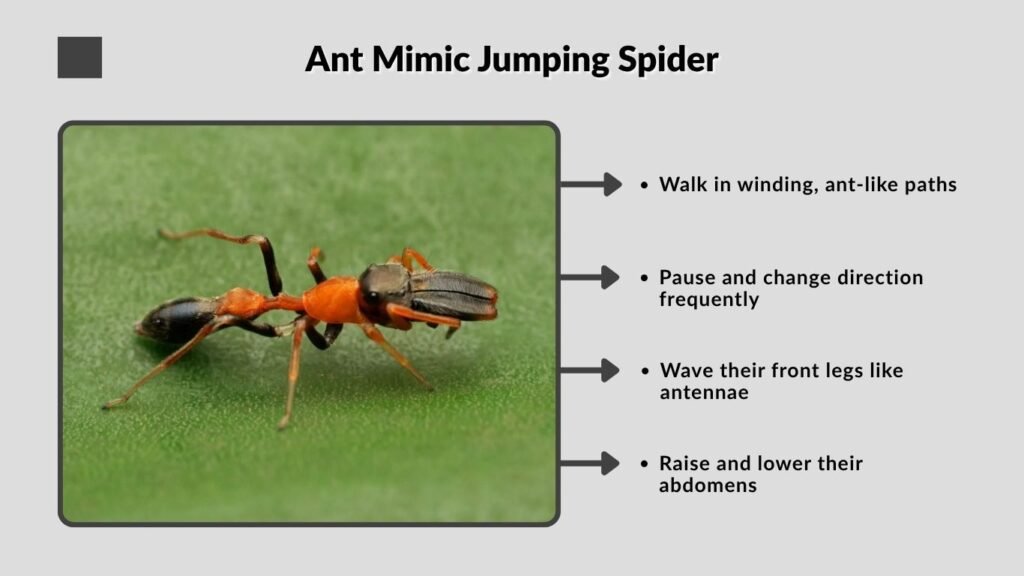
Ant mimic jumping spiders belong to the family Salticidae. Many species historically placed in Myrmarachne are famous for their extremely convincing ant-like appearance.
They may be black, brown, reddish, orange, or patterned with pale bands. Males of some species possess enlarged jaws that make their heads appear longer than those of females.
Behavior
Like other jumping spiders, ant mimics hunt visually instead of trapping insects in webs. They approach prey on foot and leap when close enough to capture it.
Their movements can differ from those of typical jumping spiders. They may:
- Walk in winding, ant-like paths
- Pause and change direction frequently
- Wave their front legs like antennae
- Raise and lower their abdomens
- Remain close to real ants
Some jumping spider species prey on ants, but ant mimicry does not mean every species primarily eats ants. Many capture flies, small insects, and other soft-bodied arthropods.
Orange, Red, and Black Ant Mimic Spiders
Color descriptions such as “orange ant mimic spider” or “black ant mimic spider” can refer to several unrelated species.
Orange Ant Mimic Sac Spider
Orange or reddish ant mimic sac spiders are often young Castianeira spiders or naturally reddish species. Their coloration may imitate red ants or velvet ants.
A velvet ant is actually a wingless female wasp with a powerful sting. Some spiders may gain protection by copying its bright warning colors and quick movements.
Black Ant Mimic Spider
Black ant mimics frequently resemble carpenter ants or other dark ant species. They may have glossy bodies, silver hairs, white bands, or reddish leg segments.
Body shape, eye arrangement, markings, and location are more useful than color alone when identifying one.
Ant Mimic Spiders Habitat and Distribution
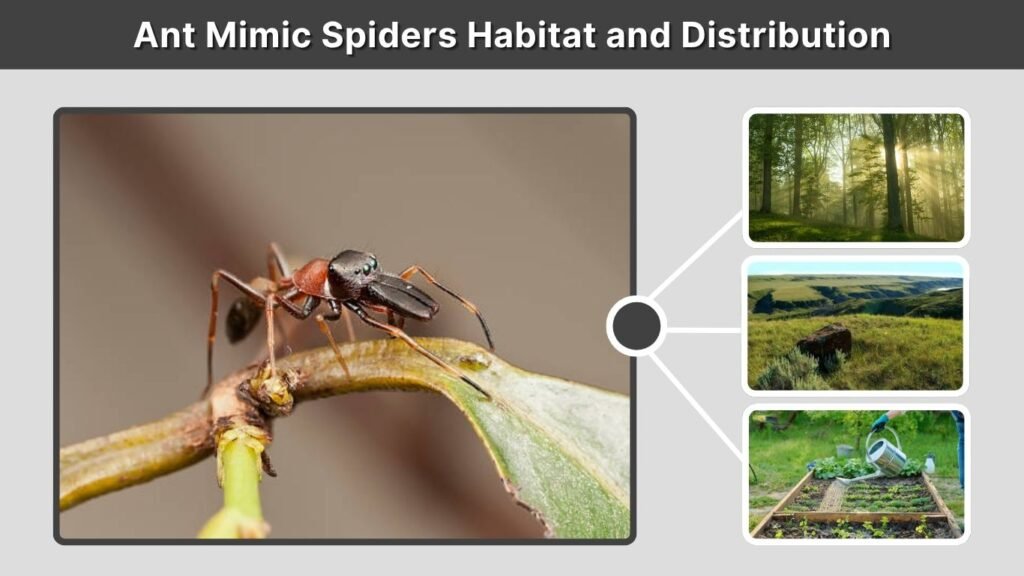
Ant mimic spiders live in many warm and temperate regions worldwide. They can be found in forests, grasslands, gardens, fields, wetlands, and around buildings. Different groups occur across North America, Europe, Asia, Africa, and Australia.
Typical hiding and hunting locations include:
- Beneath leaves and plant debris
- Around tree bark and fallen logs
- Among grasses and low vegetation
- Under stones and garden objects
- Near ant trails and colonies
- Inside sheds, garages, and basements
Castianeira species occur across much of the Americas and in parts of Eurasia and Africa, while Australia has its own ant-mimicking spiders from other genera.
Ant mimics may therefore occur in Texas, Florida, California, Colorado, Ohio, New York, Pennsylvania, Michigan, North Carolina, and other states. Similar spiders are also recorded in Canada, the UK, India, Japan, and Australia, although the exact species varies by region.
What Do Ant Mimic Spiders Eat?
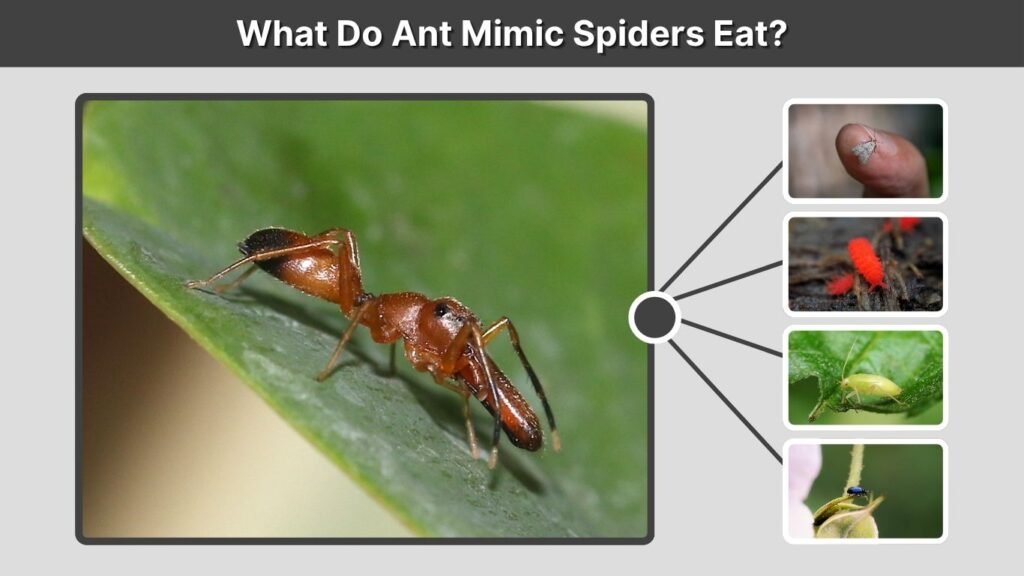
Ant mimic spiders are predators that help control small arthropods. Depending on the species, their diet may include:
- Small flies
- Gnats
- Springtails
- Moths
- Aphids
- Small beetles
- Other spiders
- Ants and ant larvae
- Insect eggs and nymphs
Most hunt actively rather than relying on a web. They use silk for safety lines, resting shelters, molting chambers, and egg sacs.
Are Ant Mimic Spiders Poisonous?
Ant mimic spiders are not poisonous. Like most spiders, they are technically venomous because they inject venom into small prey. However, ant mimic spider venom is not known to pose a serious threat to humans.
They prefer escaping or hiding rather than confronting people. Their small fangs may also have difficulty penetrating human skin unless the spider is squeezed or handled roughly.
Ant Mimic Spider Bite
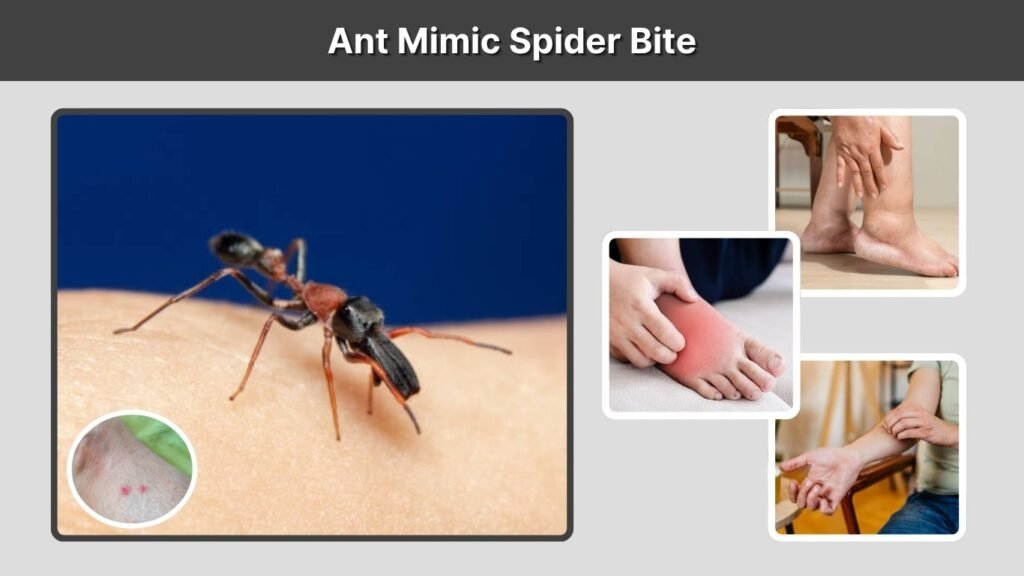
Bites are uncommon and normally occur when a spider becomes trapped against the skin. A red-spotted ant mimic may bite if provoked, but it is not considered a significant human health threat. One university identification guide compares a possible bite to a bee sting rather than a dangerous spider envenomation.
Possible symptoms include:
- Brief pain or stinging
- Mild redness
- Local swelling
- Itching
- Tenderness near the puncture
Wash the area with soap and water and apply a cloth-wrapped cold pack. Seek medical care for spreading redness, increasing pain, signs of infection, breathing difficulty, severe swelling, dizziness, or widespread hives.
Ant Mimic Spider in the House
An ant mimic spider may accidentally enter through an open door, window, foundation gap, or object carried indoors. Finding one does not usually indicate an infestation or colony.
Spiders do not form ant-like colonies simply because they imitate ants. Most live and hunt independently.
Capture the spider with a cup and stiff paper, then release it outdoors. Seal gaps and reduce indoor insect prey when ant mimic spiders appear repeatedly.
FAQs
Are ant mimic spiders dangerous?
Ant mimic spiders are not considered dangerous to humans. They are small, nonaggressive hunters that usually run away when disturbed. Bites are uncommon and are expected to produce only temporary local discomfort.
Is the red-spotted ant mimic spider venomous?
Yes, it possesses venom for subduing small prey, as most spiders do. However, its venom is not considered medically significant to humans, and the spider bites only when trapped or seriously provoked.
Do ant mimic spiders eat ants?
Some species eat ants, but others consume flies, springtails, small beetles, insect eggs, and different arthropods. Looking like an ant is often a defensive strategy rather than proof of an ant-based diet.
Why does an ant mimic spider wave its front legs?
The spider raises its first pair of legs to imitate an ant’s antennae. It may walk using the other six legs, making its outline and movement appear more like those of a true ant.
Can ant mimic spiders jump?
Ant mimic jumping spiders can jump because they belong to the jumping spider family. Ant mimic sac spiders such as Castianeira generally rely on fast running and do not make the controlled hunting leaps associated with jumping spiders.
