
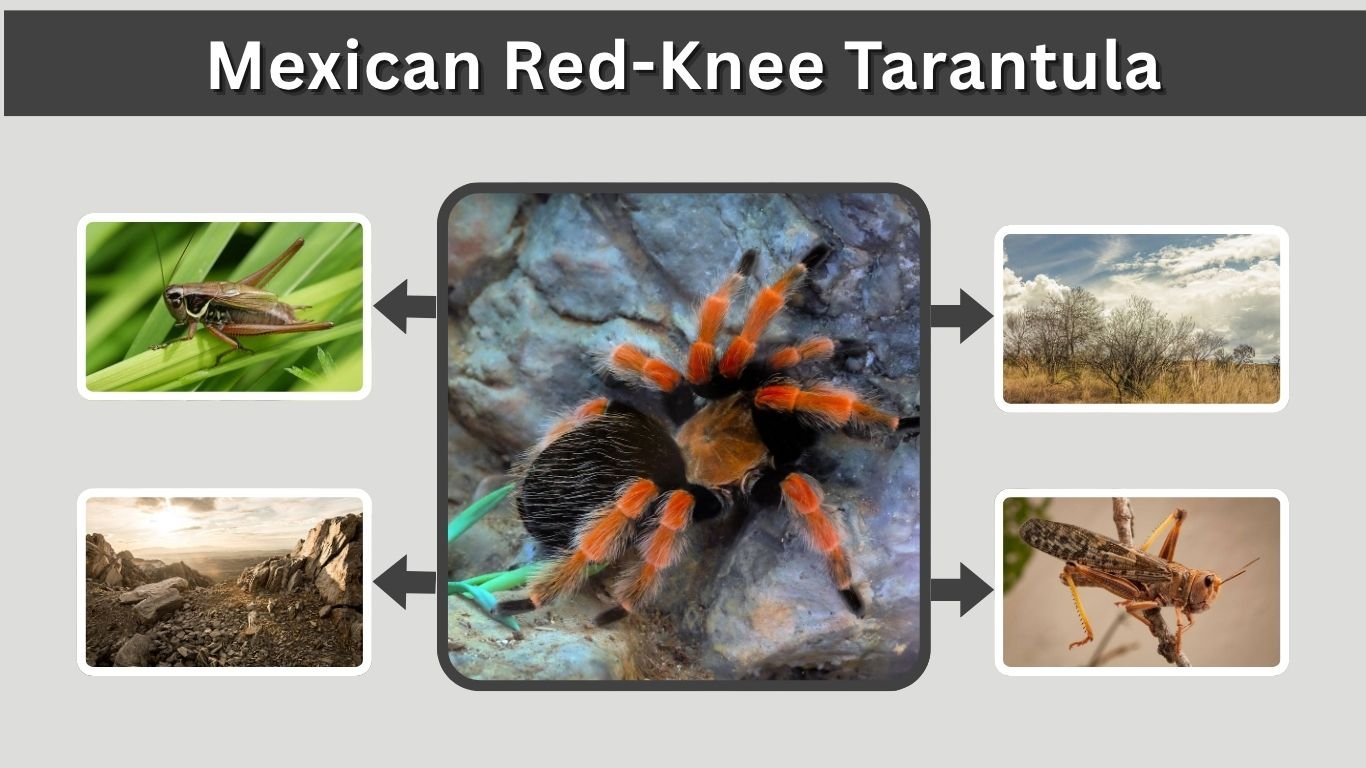
The Mexican red-knee tarantula is a large, slow-growing terrestrial spider admired for its black body and vivid orange leg markings. This article focuses primarily on Brachypelma hamorii, although the similar Brachypelma smithi is also commonly sold under the Mexican red-knee name. Its generally calm behavior and straightforward housing needs make it popular with beginners, but it remains a venomous display animal that can release irritating defensive hairs and should rarely be handled.
| Quick fact | Details |
| Scientific name | Brachypelma hamorii |
| Type | Terrestrial, opportunistic burrower |
| Average body length | Males 48 mm; females 55 mm |
| Native range | Western Mexico |
| Female lifespan | Up to approximately 30 years |
| Male lifespan | Around five years |
| Conservation status | Vulnerable; CITES Appendix II |
The common name can also refer to Brachypelma smithi, so buyers should confirm the scientific name when purchasing one.
Identification and Full-Grown Size
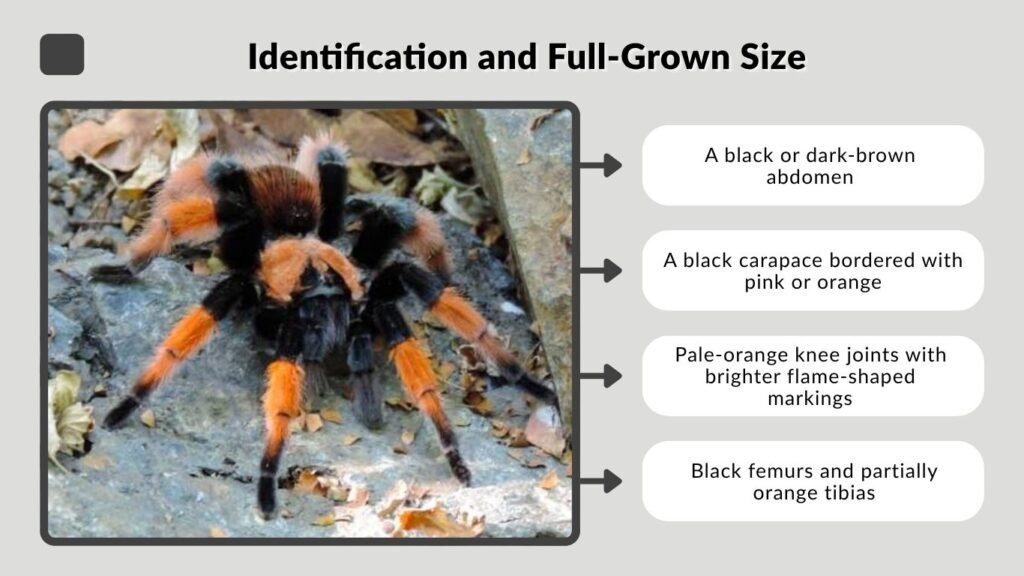
Mexican red-knee tarantulas are recognized by the striking contrast between their dark bodies and orange or reddish leg joints. Their heavy build, slow movement and ground-dwelling lifestyle distinguish them from slimmer arboreal tarantulas. Adults are moderately large rather than gigantic, and females usually develop heavier bodies while mature males become leggier and more slender.
Key Identification Features
A typical Brachypelma hamorii has:
- A black or dark-brown abdomen
- A black carapace bordered with pink or orange
- Pale-orange knee joints with brighter flame-shaped markings
- Black femurs and partially orange tibias
- Pale rings near some leg joints
- Long grayish hairs on the legs
- Scattered reddish hairs over the abdomen
Freshly molted spiders display their strongest colors. The markings can gradually appear duller as the next molt approaches.
Mexican Red-Knee Tarantula Size
The CITES identification guide reports average body lengths of approximately 48 millimetres for males and 55 millimetres for females. Leg span is considerably greater than body length, with many full-grown specimens reaching roughly five to six inches across, depending on sex and individual development.
This species grows slowly. A sling may take several years to become a recognizable juvenile and considerably longer to reach maturity. Feeding, temperature, sex and individual genetics influence its growth rate.
Brachypelma hamorii vs Brachypelma smithi
These species were confused in the pet trade for many years. B. hamorii is primarily associated with Jalisco, Colima and Michoacán, whereas B. smithi occurs farther south in Guerrero. B. smithi generally has brighter red-orange knees, while the sides of the knee joints are usually darker in B. hamorii.
Natural Habitat and Behavior
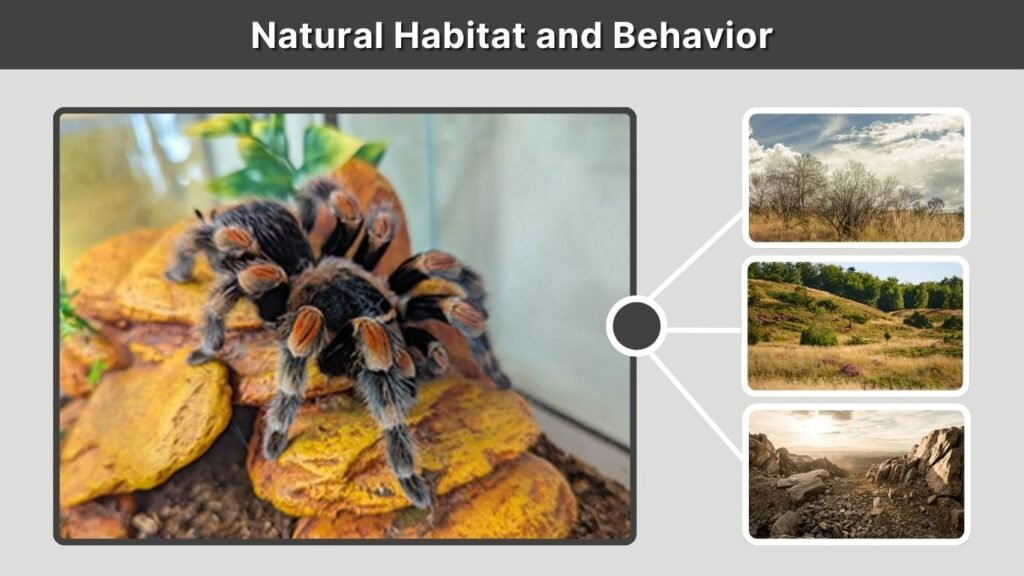
In the wild, Mexican red-knee tarantulas occupy seasonally dry areas of western Mexico rather than permanently wet rainforest. They spend much of their time inside protected retreats and emerge to hunt or find mates. Captive conditions should reflect this terrestrial lifestyle by providing broad floor space, shelter and substrate instead of a tall climbing enclosure.
Range and Natural Habitat
Brachypelma hamorii is endemic to Mexico. Its documented range extends from southeastern Jalisco through coastal Colima to northwestern coastal Michoacán. Mexican red-knee tarantulas use burrows and sheltered spaces in dry forest, scrubland and rocky environments where underground retreats offer protection from predators and extreme weather.
Habitat loss, roads and illegal collection have affected wild populations. The species is categorized as Vulnerable and is included in CITES Appendix II, which regulates international commercial trade.
Temperament and Defensive Behaviors
Mexican red-knees are often calm, but individual behavior varies. When threatened, one may:
- Retreat into its hide
- Raise its front legs
- Display its fangs
- Kick urticating hairs from its abdomen
- Deliver a defensive bite when cornered
The microscopic hairs can irritate skin, eyes and airways. Frequent hair-kicking may leave a visible bald patch on the abdomen and can indicate that the spider is being disturbed too often.
Burrowing and Webbing
This is a terrestrial, opportunistic burrower. Some individuals excavate extensively, while others adopt a ready-made hide and make only minor changes to it. A cork-bark shelter or partly buried plant pot can provide a secure starting retreat.
It produces silk but does not construct an aerial prey-catching web. Silk may be spread around the entrance, over the substrate and beneath resting areas to detect vibrations.
Mexican Red-Knee Tarantula Care
The species is commonly recommended to responsible beginners because it does not need specialized lighting or a complicated enclosure. However, correct housing remains essential. Falls, overheating, dehydration and excessive moisture can all cause problems. The enclosure should prioritize security, usable ground area, suitable substrate and a protected hide instead of elaborate decorations.
Enclosure Checklist
A proper Mexican red-knee tarantula enclosure should contain:
- An escape-proof glass or plastic container
- More horizontal space than vertical height
- A secure lid with ventilation
- Several inches of diggable substrate
- A cork-bark hide or artificial burrow
- A clean, shallow water dish
- A digital thermometer
- Moderate ventilation
- No sharp rocks, cacti or heavy decorations
Terrestrial tarantulas can rupture their abdomens after falling. Keep the distance between the substrate and lid relatively low, and avoid mesh tops that may trap the spider’s feet. Each tarantula must be housed alone because cohabitation can lead to cannibalism.
Temperature, Humidity and Lighting
A stable room temperature of approximately 23–30°C, or 74–88°F, is suitable for many commonly kept tarantulas. Extreme fluctuations should be avoided. Heat lamps and unregulated heating pads may dry the enclosure and dehydrate the spider, so ordinary room heating is usually safer.
Moderate humidity of around 60–65% generally suits this species. Keep a shallow water dish available and allow adequate airflow. The enclosure should not remain swampy or continuously wet. Normal room lighting is sufficient; ultraviolet lighting is unnecessary.
Best Substrate
Fertilizer-free topsoil, a suitable commercial tarantula substrate or an appropriate soil-and-coir mixture can support digging. Pack it firmly enough that shallow burrows will not immediately collapse.
Avoid gravel, sharp sand and aromatic wood shavings. Gravel can injure the spider during a fall, while loose bark and wood products may encourage mites and prevent normal burrowing.
Diet, Feeding and Molting
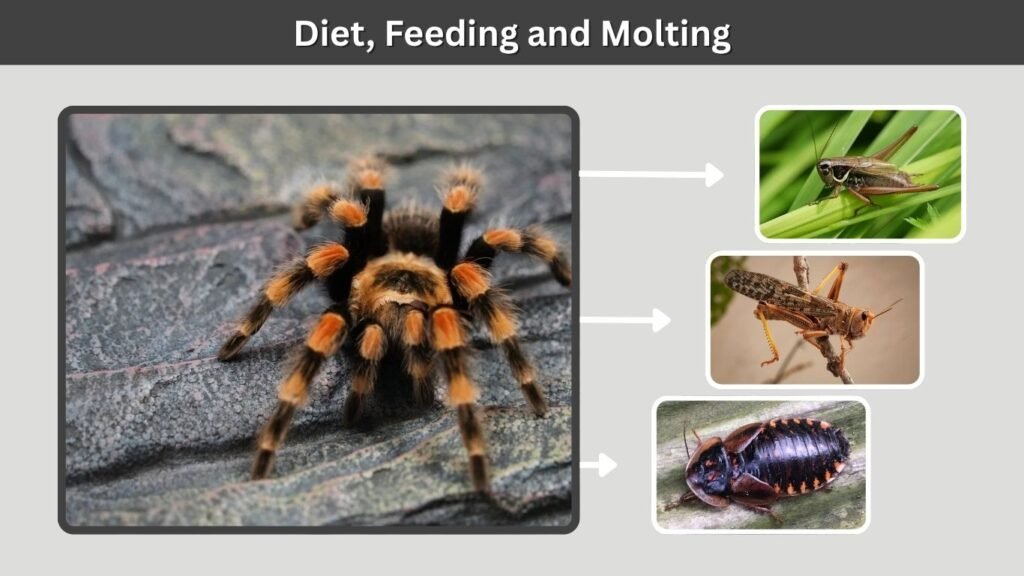
Mexican red-knee tarantulas are ambush predators that primarily consume invertebrates. Captive feeding is uncomplicated, but portion size and frequency should match the spider’s age and abdominal condition. A tarantula may refuse food for weeks before molting, and this normal fasting period should not be mistaken for starvation or illness.
Suitable Foods
Offer captive-bred prey such as:
- Crickets
- Locusts
- Dubia or other feeder roaches
- Small flies for spiderlings
- Occasional waxworms
- Appropriately sized alternative feeder insects
Prey should be smaller than, or reasonably proportioned to, the tarantula’s body. Vertebrate foods such as mice are unnecessary and may contribute to obesity or leave difficult-to-clean remains.
Feeding Schedule
Spiderlings can receive small prey more frequently because they are growing rapidly. Juveniles may be fed once or twice weekly, while healthy adults often need less frequent meals.
Use the abdomen as a guide rather than feeding on a rigid schedule. Remove uneaten prey within approximately 24 hours, especially when the spider becomes inactive or refuses food.
Molting Care
Before molting, a Mexican red-knee may stop eating, darken in color, seal its retreat or lie on its back. Do not turn over a tarantula lying on its back, as this is a normal molting position.
Remove all live feeder insects because they can injure the soft, defenseless spider. Wait until the new exoskeleton and fangs have hardened before offering another meal.
Lifespan, Sex and Buying Advice
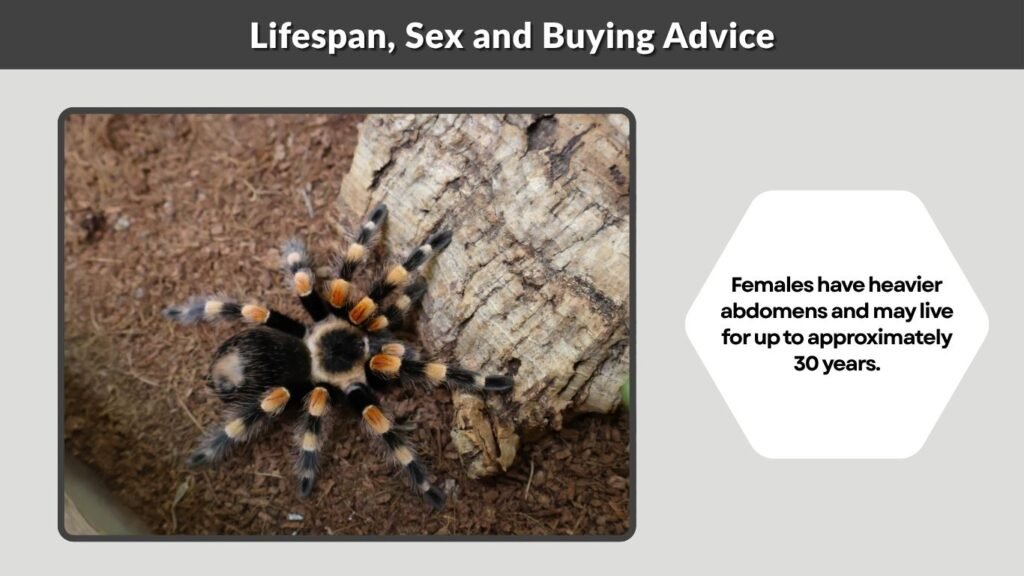
Choosing a Mexican red-knee tarantula involves a potentially long commitment. Sex greatly affects lifespan, adult appearance and purchase price. Buyers should also consider the conservation consequences of the pet trade. A captive-bred animal with clear identification and legal documentation is preferable to a cheap spider of uncertain or potentially wild-caught origin.
Female vs Male
Females have heavier abdomens and may live for up to approximately 30 years. Males usually mature more quickly and commonly survive only around five years. Mature males become leggier and develop reproductive structures, including emboli on the pedipalps and hooks on the front legs.
Accurate sexing normally requires examination of a well-preserved molt. External body shape alone is not always reliable, particularly with slings and small juveniles.
Price and Purchasing
The cost varies according to country, age, size, sex and whether the spider has been confirmed female. Slings are usually cheaper, while mature females command higher prices because of their long lifespan.
Ask the seller for the scientific name, captive-breeding history, feeding record and legal origin. Since Brachypelma tarantulas are regulated under CITES Appendix II, international movement may require permits or documentation.
Is It Good for Beginners?
The Mexican red-knee can be a good first tarantula for someone comfortable feeding live insects and maintaining a secure enclosure. It is generally slow-moving and tolerant of moderately dry conditions.
However, it should be viewed rather than held. Minimal handling reduces stress, prevents irritating-hair exposure and protects the spider from potentially fatal falls.
FAQs
These frequently asked questions address handling, venom, enclosure type, heating and lifespan. Although Mexican red-knees have a reputation for being manageable pets, they are still solitary predators with individual temperaments. Owners should avoid assuming that a calm spider enjoys contact or cannot defend itself when frightened, restrained or exposed to unsuitable conditions.
Are Mexican red-knee tarantulas aggressive?
They are generally considered docile and more likely to retreat or kick irritating hairs than attack. However, temperament varies between individuals, and any tarantula may bite when trapped or provoked. Slow movements and minimal disturbance make defensive reactions less likely.
Are Mexican red-knee tarantulas poisonous?
They are venomous rather than poisonous. Venom is delivered through the fangs during prey capture or defense. A bite can cause pain and local symptoms, while the urticating hairs may irritate the skin, eyes and respiratory system. Medical advice is appropriate after a serious reaction.
Can you hold a Mexican red-knee tarantula?
Handling is not recommended. The spider gains no benefit from being held, and a short fall can cause severe or fatal abdominal injury. Handling also increases the chance of a bite or exposure to defensive hairs. Use a catch container when relocation is necessary.
Does a Mexican red-knee need a heat lamp?
Usually not. A consistently warm room is generally safer than direct heating. Heat lamps and poorly controlled pads can dry the substrate and cause dehydration. Monitor temperatures with a digital thermometer and provide additional controlled room heating only when the surrounding environment becomes too cold.
How long do Mexican red-knee tarantulas live?
Females may live for up to approximately 30 years, making them a very long-term pet. Males mature earlier and commonly live for around five years. Exact lifespan depends on sex, development, environmental stability, nutrition and general care.
