
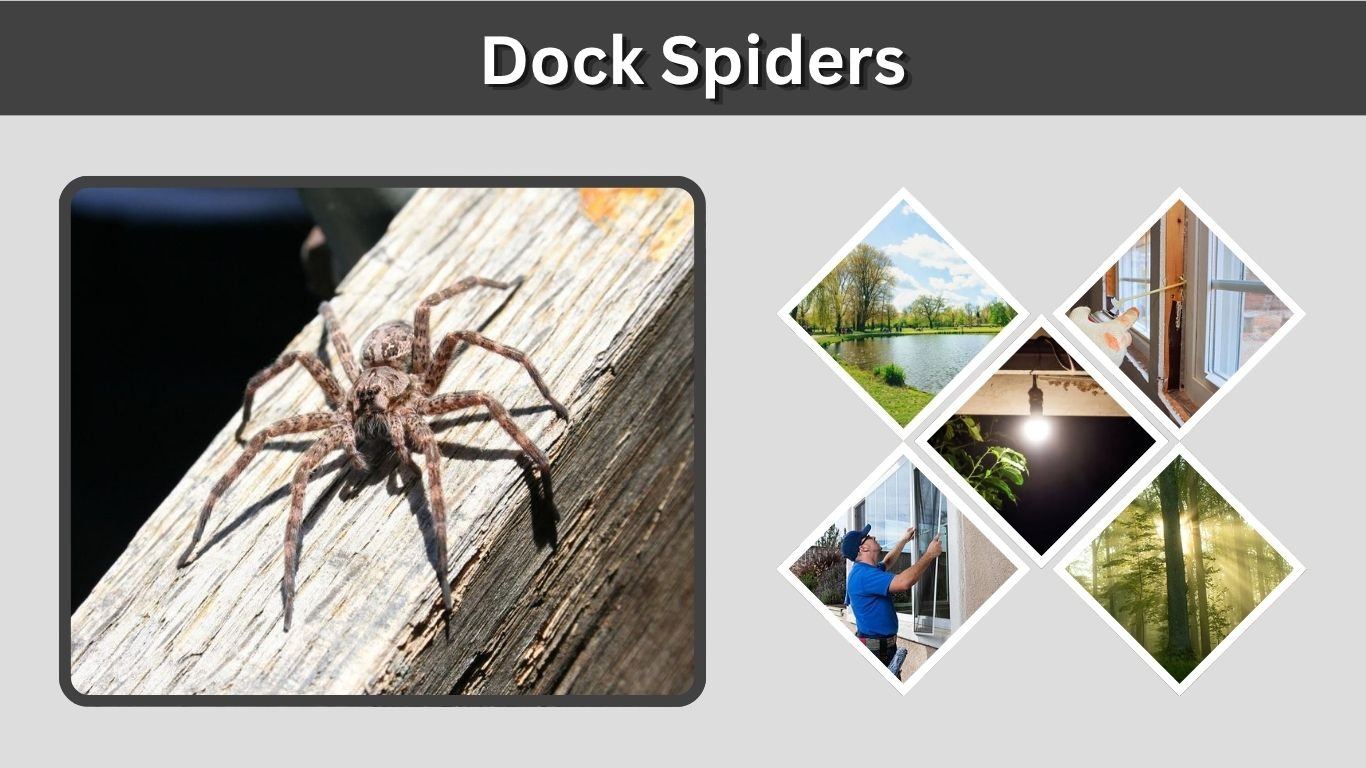
Dock spiders are large fishing spiders commonly seen around lakes, ponds, cabins, docks, and other damp environments in North America. The name usually refers to species in the genus Dolomedes, including the dark fishing spider (Dolomedes tenebrosus). Their impressive size and fast movements can make them look dangerous, but they rarely bite people and are generally harmless. Dock spiders are skilled predators that can move across water, dive beneath the surface, and capture insects, tadpoles, and occasionally small fish.
What Are Dock Spiders?
“Dock spider” is an informal name commonly used for large fishing spiders in the genus Dolomedes. They belong to a group of hunting spiders adapted to living around water, although some species are regularly found in forests and buildings far from lakes or streams. The dark fishing spider is among the species commonly given this name.
Dock Spider Identification
Typical dock spider characteristics include:
- Large, flattened body
- Long, powerful legs
- Brown, gray, or dark brown coloration
- Dark and light markings across the body
- Banded legs
- Several chevron-like markings on the abdomen
- Eight eyes arranged differently from wolf spiders
- Ability to rest with the legs spread widely across a surface
Their mottled coloration provides excellent camouflage on weathered wooden docks, tree bark, rocks, and shoreline debris.
Dock Spider Species
There is no single species scientifically named the “dock spider.” Several Dolomedes fishing spiders may receive that common name.
The dark fishing spider (Dolomedes tenebrosus) is particularly large and widespread. It ranges from Canada and New England south into Florida and Texas. Other fishing spiders are more strongly associated with ponds, streams, wetlands, and lake edges.
How Big Are Dock Spiders?
Their large leg span is one reason dock spiders attract so much attention. The body itself is considerably smaller than the spider appears when its legs are fully extended. Female fishing spiders are normally larger than males, and mature females can rank among the largest spiders commonly encountered around homes and cottages in eastern North America.
Dock Spider Size
University of Minnesota Extension reports that a large fishing spider can measure about 1 1⁄4 inches in body length and up to approximately 3 1⁄2 inches across, including its legs.
For D. tenebrosus, Penn State reports female body lengths of about 15–26 mm, compared with approximately 7–13 mm for males.
Why Do They Look So Large?
Their long legs dramatically increase their overall span. When a dock spider stretches across a board or wall, the spider may therefore look much larger than its actual body measurements suggest.
Large females can appear particularly intimidating when carrying an egg sac, even though their size does not indicate that they are especially dangerous.
Where Do Dock Spiders Live?
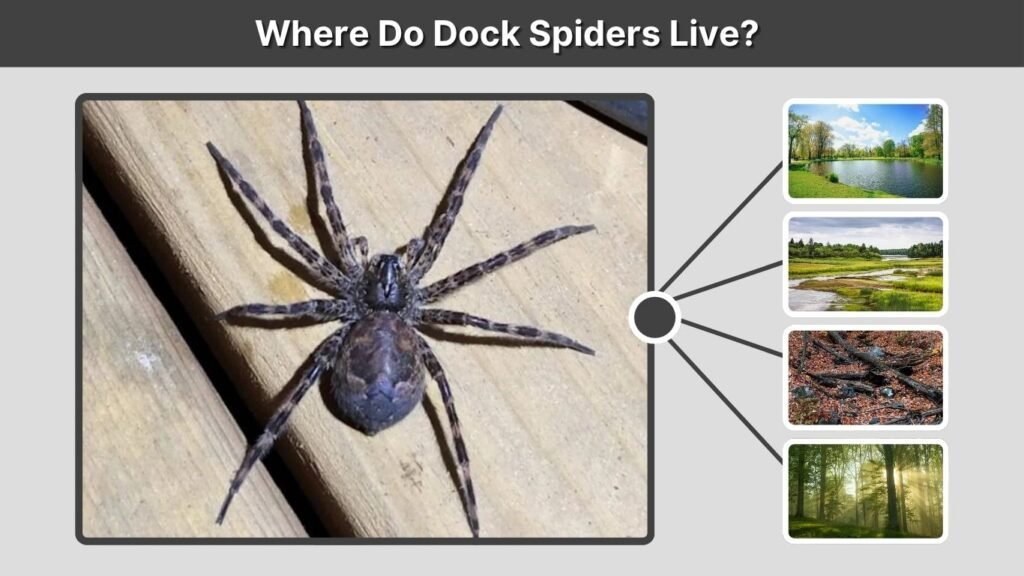
Dock spiders are strongly associated with damp habitats because many Dolomedes species hunt at the water’s edge. They are often noticed around cottages and lake properties because docks provide protected cracks, abundant insects, and immediate access to water. However, the dark fishing spider is also commonly encountered in wooded environments considerably farther from water.
Common Dock Spider Habitats
They may be found around:
- Lakes and ponds
- Slow-moving streams
- Marshes and swamps
- Boat docks
- Boathouses and cabins
- Rocks along shorelines
- Trees and fallen logs
- Wooded areas
- Buildings near forests or water
Dock spiders occur in areas such as Maine, New Hampshire, Ontario, and other parts of Canada and the United States where suitable species of Dolomedes are present.
Why Are They Common on Boat Docks?
A dock gives these spiders almost everything they need. Cracks between boards provide hiding places, lights around docks attract insects at night, and the nearby water supports abundant aquatic prey.
They are hunting spiders, so seeing one repeatedly on a dock does not necessarily mean there is a large web or nest beneath it.
Can Dock Spiders Swim?
Yes. Fishing spiders are remarkably well adapted to water. They can move across the surface using their long legs and detect vibrations produced by struggling insects or other small prey. Some can also submerge themselves when hunting or escaping danger. Maine’s pest guidance describes fishing spiders as amphibious spiders capable of skating across water and diving below its surface.
Can Dock Spiders Go Underwater?
Yes. Fishing spiders may dive beneath the surface and remain submerged for periods while avoiding predators or pursuing prey.
Their water-associated lifestyle distinguishes them from many other large spiders people encounter around houses. However, not every dock spider spends all of its time beside water, particularly D. tenebrosus.
Do Dock Spiders Eat Fish?
Occasionally. Their name “fishing spider” comes partly from observations of Dolomedes capturing small fish and aquatic animals.
Their diet may include:
- Aquatic insects
- Terrestrial insects
- Tadpoles
- Small fish
- Other small arthropods
Most prey is considerably smaller than the spider. Fish are an occasional food source rather than the only thing dock spiders eat.
Are Dock Spiders Dangerous?
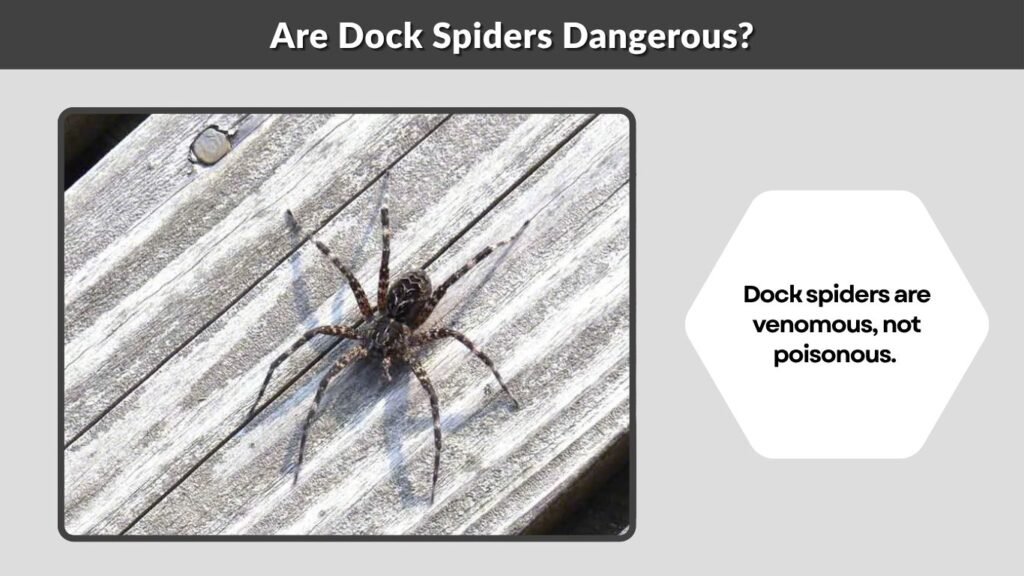
Despite their intimidating appearance, dock spiders are not considered dangerous to people. They generally attempt to escape instead of confronting humans. Penn State Extension notes that fishing spiders rarely bite even when handled. Their large size therefore creates considerably more fear than their actual medical significance warrants.
Do Dock Spiders Bite Humans?
They are capable of biting because, like other spiders, they possess fangs used to subdue prey. However, bites are uncommon and generally occur only when a spider is trapped, squeezed, or deliberately handled.
Leaving the spider alone almost always prevents an encounter.
Are Dock Spiders Poisonous or Venomous?
Dock spiders are venomous, not poisonous. Their venom is injected through their fangs into prey.
Most spiders possess venom, but only a small number have venom considered medically important to people. Maine’s pesticide-control guidance notes that relatively few spiders can cause significant health effects in humans.
Can a Dock Spider Kill You?
For healthy people, dock spiders are not regarded as life-threatening spiders. Their bites are rare and are not comparable to medically significant species such as certain widows or recluses.
Any unusual or severe reaction following a suspected spider bite should nevertheless receive appropriate medical evaluation.
Dock Spiders vs Wolf Spiders
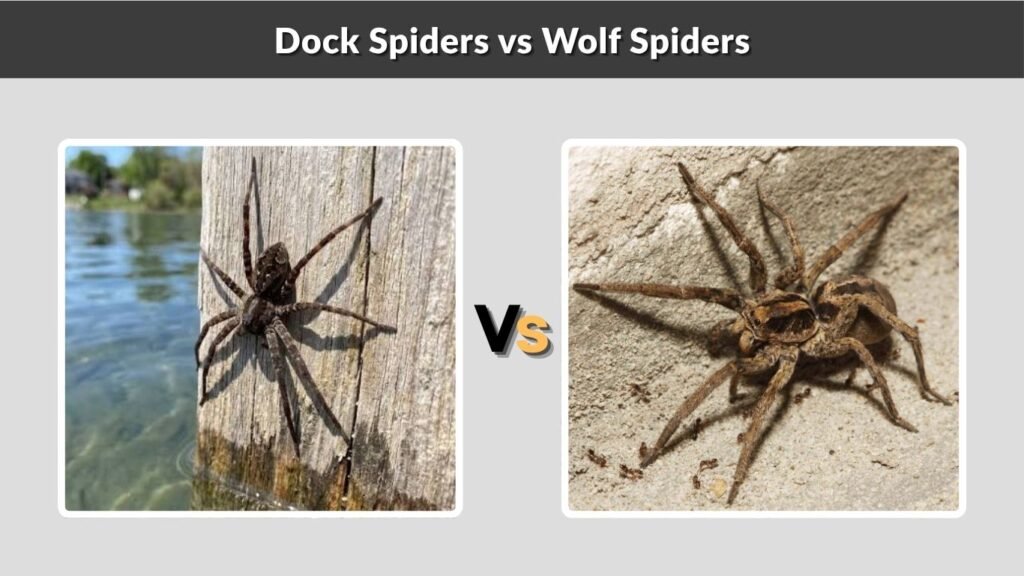
Dock spiders and wolf spiders are frequently confused because both are large, brown, fast-moving hunters. Neither depends on a large prey-catching web, and both may wander into buildings. However, they belong to different spider families and have identifiable differences in their eyes, reproductive behavior, and typical habitat.
Are Dock Spiders Wolf Spiders?
No. Dock or fishing spiders belong to Dolomedes, while wolf spiders belong to the family Lycosidae.
One useful difference involves the eyes. Wolf spiders have two particularly prominent eyes, whereas the eyes of fishing spiders are more similar in size.
Females also handle their egg sacs differently. Fishing spiders carry egg sacs with their jaws and pedipalps, whereas female wolf spiders attach their sacs to their spinnerets behind the abdomen.
Do Dock Spiders Make Webs?
Dock spiders produce silk, but they normally do not construct traditional prey-catching webs like orb-weaving spiders. They actively hunt instead. Silk becomes particularly important during reproduction, when females make egg sacs and later construct protective nursery webs for newly emerging spiderlings.
Dock Spider Egg Sac and Nursery Web
Female fishing spiders carry their round egg sacs near their mouthparts until the young are close to hatching.
The female then places the sac within a silk nursery web and guards it. A single female D. tenebrosus may produce an egg sac containing a very large number of spiderlings—Penn State notes that broods can number 1,000 or more.
Dock Spider Life Cycle
Dock spiders develop from eggs into spiderlings and pass through repeated molts before reaching adulthood. Their development is seasonal in colder parts of their range. Young dark fishing spiders can overwinter beneath bark, stones, tree cavities, or protected structures before reaching maturity the following season.
How Long Do Dock Spiders Live?
The exact lifespan varies according to species, sex, and climate. For Dolomedes tenebrosus, available observations indicate a life span of roughly one to two years, with females generally taking longer to mature than males.
Females deposit egg sacs during warmer months and protect the young in nursery webs until the spiderlings disperse.
How to Keep Dock Spiders Away
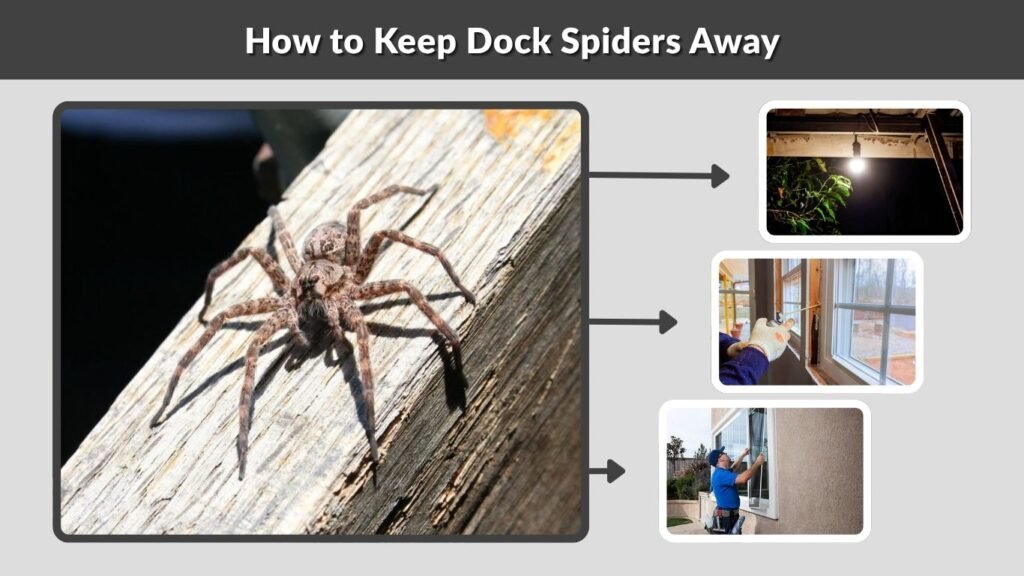
Dock spiders are beneficial predators, so complete elimination around a lake is usually unrealistic and unnecessary. A dock naturally attracts insects and provides excellent spider habitat. If numbers become uncomfortable around a boat, cottage, or seating area, reducing hiding places and insect activity is generally preferable to repeatedly killing individual spiders.
Ways to Reduce Dock Spiders
- Remove excessive webs and old egg sacs when unoccupied.
- Clean cracks and spaces around dock furniture.
- Reduce unnecessary nighttime lighting that attracts insects.
- Keep stored equipment organized rather than piled in corners.
- Repair gaps around cabin doors and windows.
- Install screens where spiders repeatedly enter buildings.
- Remove spiders with a container rather than handling them directly.
- Reduce insect populations that provide abundant prey.
Avoid applying pesticides directly to lakes or other water unless the product is specifically approved for that use.
FAQs
Dock spiders look intimidating because of their long legs and large body size, but their behavior is quite different from what their appearance might suggest. Most are shy predators that provide natural insect control around lakes, forests, and cottages.
1. Are dock spiders dangerous to humans?
No. Dock spiders are generally harmless and rarely bite people. They usually retreat when disturbed rather than attacking.
2. How big can dock spiders get?
Large fishing spiders can reach an overall leg span of about 3½ inches, although their actual body is much smaller.
3. Can dock spiders swim?
Yes. Many fishing spiders can walk across water and dive beneath the surface to escape or hunt aquatic prey.
4. Do dock spiders make webs?
They produce silk but generally do not use large webs to capture prey. Females use silk to create egg sacs and nursery webs for their spiderlings.
5. Are dock spiders and wolf spiders the same?
No. They belong to different spider families. Fishing spiders are often associated with water and carry their egg sacs near their mouthparts, while wolf spiders attach egg sacs to their spinnerets.
