
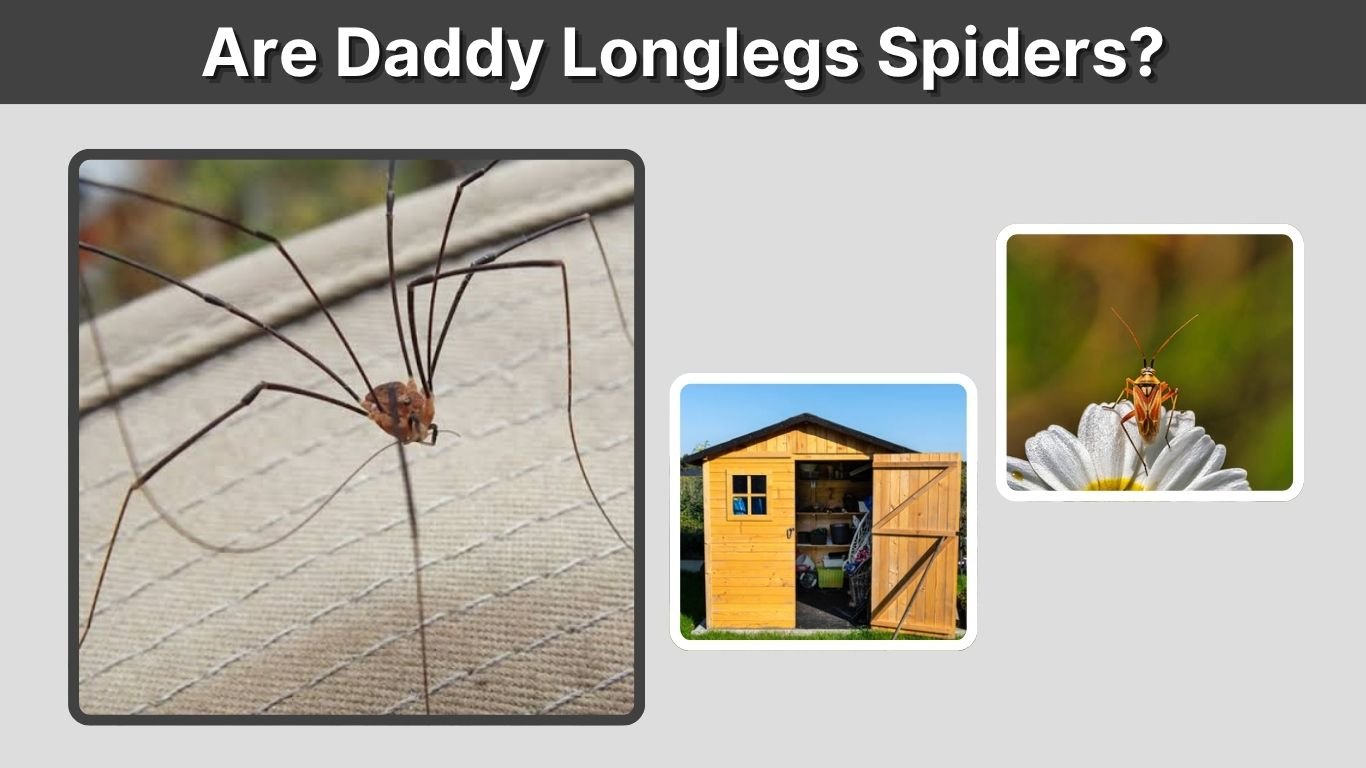
Are daddy longlegs spiders? Usually, no. The creatures most commonly called daddy longlegs are harvestmen, arachnids in the order Opiliones, and they are not true spiders. However, the same nickname is also used for cellar spiders, which really are spiders. This shared common name causes much of the confusion. Harvestmen have one compact body, do not make silk, and lack venom glands, while cellar spiders have two main body regions, produce webs, and use venom to capture prey.
Are Daddy Longlegs Actually Spiders?
The answer depends on which animal someone is calling a daddy longlegs. In North America, the name commonly refers to harvestmen, which are close relatives of spiders but belong to a different arachnid order. Cellar spiders are also called daddy longlegs in many regions, and these animals are genuine spiders belonging to the family Pholcidae.
True Daddy Longlegs: Harvestmen
Harvestmen belong to the order Opiliones. Like spiders, they are arachnids and normally have eight legs, but several characteristics separate them from true spiders.
Important features include:
- One oval-looking body without an obvious narrow waist
- Eight usually long, slender legs
- Typically two eyes
- No silk-producing spinnerets
- No webs for capturing prey
- No venom glands
- Ability to eat both solid and liquid food
University of Minnesota Extension describes harvestmen as harmless animals that do not possess venom.
Why Do They Look Like Spiders?
Harvestmen and spiders are both arachnids, so their general body plan has similarities. Eight legs make harvestmen especially easy to mistake for spiders.
The key difference is body structure. True spiders have a cephalothorax and abdomen connected by a narrow waist. A harvestman’s main body regions appear broadly joined, producing the characteristic single oval shape.
Are Cellar Spiders Daddy Longlegs?
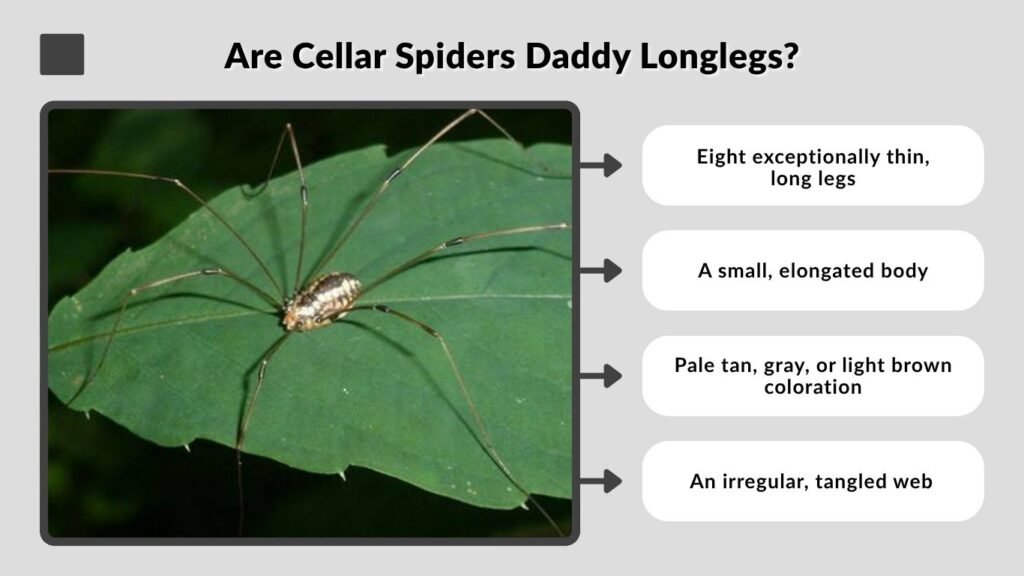
Yes, depending on regional usage. Cellar spiders are frequently called daddy longlegs spiders, particularly the long-bodied cellar spider, Pholcus phalangioides. Unlike harvestmen, cellar spiders belong to the order Araneae and are genuine spiders. They commonly live in basements, garages, sheds, caves, and quiet corners of buildings.
How to Identify a Cellar Spider
A cellar spider typically has:
- Eight exceptionally thin, long legs
- A small, elongated body
- Two clearly distinguishable main body regions
- Pale tan, gray, or light brown coloration
- An irregular, tangled web
- A habit of hanging upside down
- Rapid vibrating behavior when disturbed
The long-bodied cellar spider generally has a body only several millimeters long, although its legs make it appear much larger.
Cellar Spider vs Harvestman
The quickest clue is the web. If the long-legged animal is hanging in an irregular web in a basement or ceiling corner, it is probably a cellar spider.
Harvestmen cannot produce silk and therefore do not build webs. They usually walk freely over vegetation, tree trunks, walls, soil, and leaf litter instead.
Are Daddy Longlegs Venomous?
One of the most persistent myths claims that daddy longlegs have extremely powerful venom but cannot bite humans because their fangs are too short. This story incorrectly mixes characteristics of harvestmen and cellar spiders. Scientific information does not support the myth for either group.
Are Harvestmen Venomous?
No. Harvestmen do not possess venom glands.
They also lack the fangs used by spiders to inject venom. Instead, harvestmen possess small mouthparts known as chelicerae that help them handle food.
They may feed on small arthropods as well as dead animal material and plant juices, but they present essentially no venom risk to humans.
Are Cellar Spiders Venomous?
Cellar spiders are true spiders and use venom when capturing prey. However, they are not considered dangerous to people.
Colorado State University Extension specifically notes that the story about deadly cellar-spider venom and supposedly ineffective fangs is a myth. Rare bites have been reported, but effects are generally limited to little or mild irritation.
Are Daddy Longlegs Dangerous to Humans?
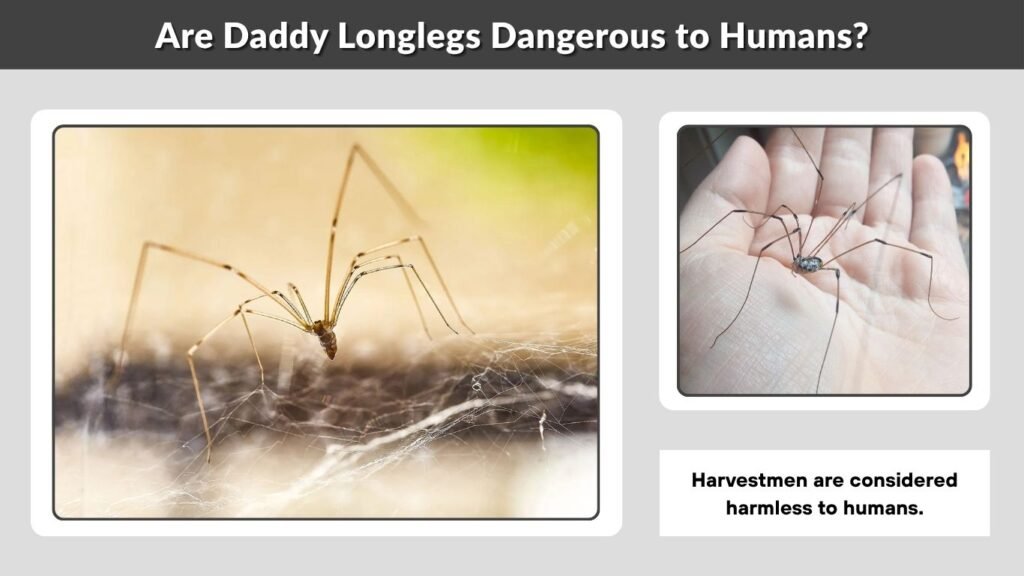
Harvestmen are considered harmless to humans. They do not sting, lack venom glands, and are not known for medically significant bites. Cellar spiders are similarly regarded as low-risk household spiders. Their frightening reputation largely comes from misinformation rather than their actual biology.
Can Daddy Longlegs Bite?
For harvestmen, human bites are not considered a normal concern. Their mouthparts are designed for handling small prey and food rather than delivering venomous bites.
Cellar spiders technically have spider mouthparts and can bite under unusual circumstances, but bites are rare. Colorado State University reports that their venom rarely causes more than mild irritation, if symptoms occur at all.
Are Daddy Longlegs Poisonous?
“Poisonous” is also inaccurate for ordinary harvesters. They are not regarded as poisonous animals dangerous to humans.
Some harvestmen release defensive secretions that discourage predators, but this is very different from having venom injected through fangs.
Cellar spiders use venom against prey, making “venomous” biologically more appropriate than “poisonous,” although their venom is not considered medically important to people.
How Can You Tell a Harvestman From a Spider?
The easiest way to distinguish a harvestman from a true spider is to look at body shape and web production. Both animals have eight legs, so simply counting legs cannot answer the question. Their anatomy, eyes, silk production, feeding behavior, and preferred habitats provide much better clues.
Harvestman vs True Spider
Key differences include:
- Body: Harvestmen appear to have one fused oval body; spiders have two obvious body regions.
- Silk: Harvestmen cannot produce silk; many spiders can.
- Venom: Harvestmen lack venom glands; most spiders use venom to subdue prey.
- Eyes: Harvestmen commonly have two; spiders usually have several.
- Webs: Harvestmen do not build prey-catching webs.
- Feeding: Harvestmen can consume pieces of solid material, while spiders generally liquefy prey before feeding.
These differences show why eight legs alone do not make an arachnid a spider.
Where Do Daddy Longlegs Live?
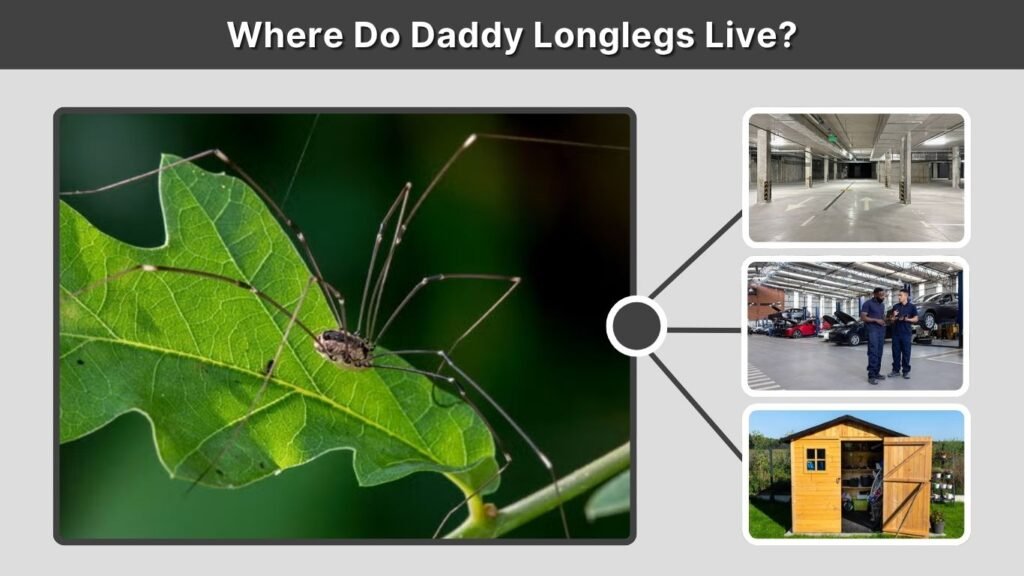
Harvestmen inhabit a wide variety of environments, including forests, fields, gardens, urban landscapes, leaf litter, logs, rocks, and vegetation. They frequently favor moist or sheltered locations. University of Minnesota Extension notes that harvestmen can occur in forests, fields, and urban areas and are commonly active from spring through fall.
Where Are Cellar Spiders Found?
Cellar spiders are strongly associated with protected spaces in buildings. Common locations include basements, garages, crawl spaces, sheds, warehouses, and ceiling corners.
They build irregular cobwebs where they wait for insects and other arthropods. When disturbed, many cellar spiders rapidly vibrate their bodies and webs, making the spider appear blurred.
What Do Daddy Longlegs Eat?
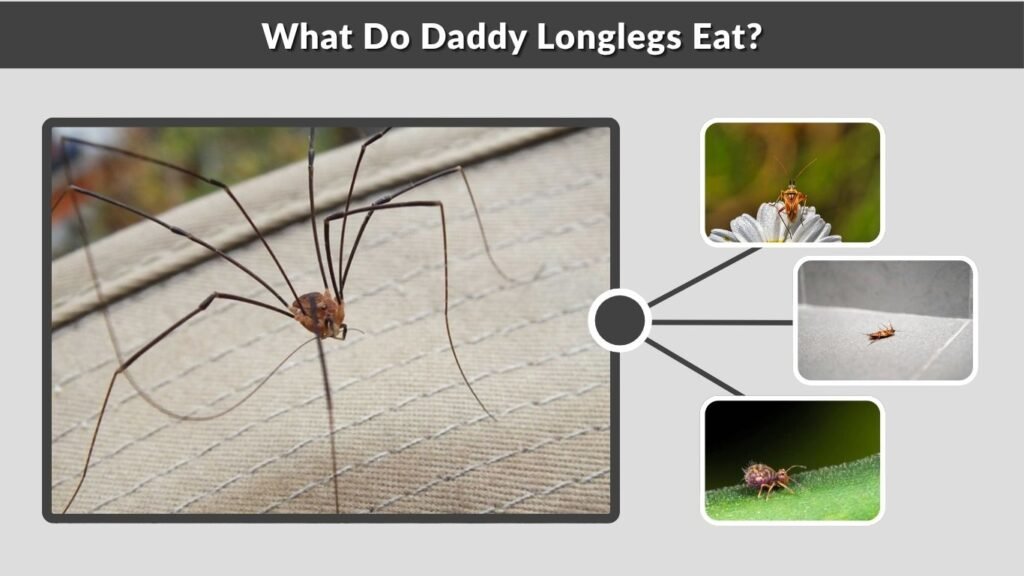
Harvestmen are useful scavengers and predators rather than household pests. Their varied diet allows them to consume food that many true spiders do not. They may hunt small arthropods but can also feed on dead organisms and other organic material, helping recycle nutrients in natural habitats.
Common Foods of Harvestmen
Their diet can include:
- Small insects
- Other tiny arthropods
- Dead insects
- Decaying animal material
- Plant juices
- Other organic matter
This flexible feeding behavior is one of the biological differences between harvestmen and typical predatory spiders.
What Do Cellar Spiders Eat?
Cellar spiders primarily capture insects and other arachnids in their loose webs.
They can consume flies, mosquitoes, moths, and other spiders. Their predatory behavior makes them beneficial indoors even though accumulated cobwebs may become a nuisance.
Why Are They Called Daddy Longlegs?
The exact origin of the common name is less important biologically than the confusion it creates. Several unrelated long-legged animals have acquired the nickname because their legs appear extremely long compared with their bodies.
Three Animals Called Daddy Longlegs
The term may refer to:
- Harvestmen — arachnids in the order Opiliones
- Cellar spiders — true spiders in the family Pholcidae
- Crane flies — long-legged flying insects
Therefore, hearing “daddy longlegs” does not automatically tell you what animal someone has found. Identification should rely on body structure, wings, and whether it produces a web rather than the nickname alone.
FAQs
The nickname daddy longlegs has generated numerous myths because it refers to more than one animal. The most important distinction is that harvestmen are arachnids but not spiders, whereas cellar spiders truly belong to the spider order. Understanding that difference also clears up most questions about venom and danger.
1. Are daddy longlegs actually spiders?
Harvestmen, the animals most commonly called daddy longlegs, are not spiders. They belong to the arachnid order Opiliones. Cellar spiders, however, are true spiders that are also sometimes called daddy longlegs.
2. Are daddy longlegs poisonous?
Harvestmen are not considered poisonous and do not have venom glands. The common story that they possess extremely toxic venom is a myth.
3. Are daddy longlegs spiders dangerous to humans?
Neither harvestmen nor common cellar spiders are considered dangerous to humans. Harvestmen lack venom, while cellar spiders are not regarded as medically significant.
4. Can daddy longlegs bite humans?
Harvestmen are not a meaningful biting threat to people. Cellar spiders can potentially bite, but bites are uncommon and generally cause little or mild irritation.
5. How do I know whether a daddy longlegs is a spider?
Look for two distinct body regions and a web. A long-legged animal hanging in an irregular silk web is probably a cellar spider. A free-roaming animal with one oval-looking body and no web is more likely a harvestman.
