
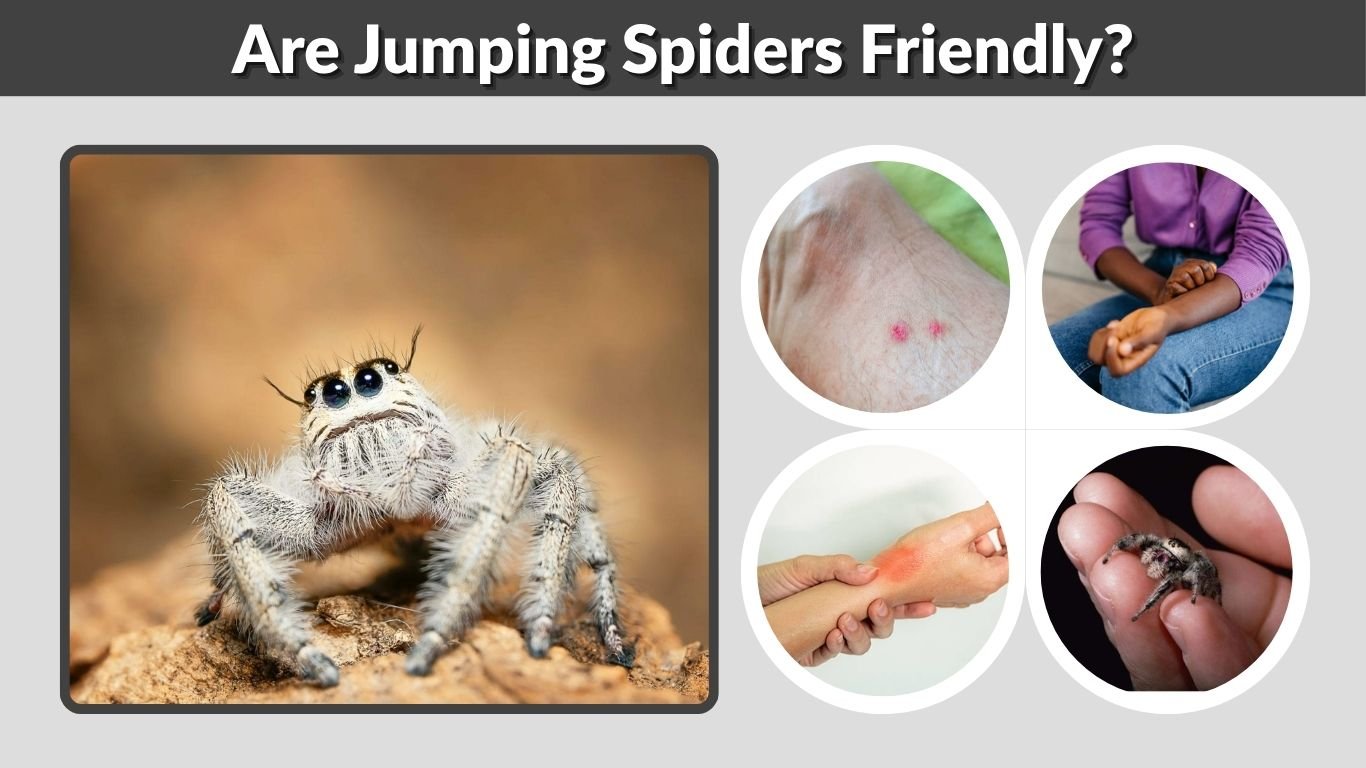
Are jumping spiders friendly? They can certainly appear that way, but “friendly” is a human description rather than a scientific behavior. Jumping spiders are usually curious, alert, and reluctant to bite people. Their large forward-facing eyes allow them to visually track nearby objects, including humans, which can make them seem unusually interactive. Most would rather jump or retreat than defend themselves. Species such as bold, regal, zebra, and tan jumping spiders are generally considered low-risk when left undisturbed.
Are Jumping Spiders Actually Friendly?
Jumping spiders belong to the family Salticidae, a diverse group of active hunting spiders famous for excellent eyesight and precise jumping ability. They do not recognize friendship in the way people do, but their natural behavior is usually cautious rather than aggressive. Their visual attention toward humans often creates the impression that they are curious or even socially interested.
Why Do Jumping Spiders Seem Friendly?
Several behaviors contribute to their friendly reputation:
- They often turn and look directly at people.
- Their large front eyes make their gaze easy to notice.
- They may follow movement with their body or eyes.
- They often investigate nearby objects rather than immediately hiding.
- They usually retreat instead of attacking when approached.
- Some individuals will calmly walk across a hand if allowed to do so voluntarily.
Their behavior is better described as visual investigation and cautious curiosity than affection.
Do Jumping Spiders Recognize Humans?
There is no good evidence that ordinary jumping spiders recognize individual people as friends in the human sense.
However, their vision is exceptionally advanced for spiders. Jumping spiders have particularly large central eyes and use vision for hunting, navigation, courtship, and detecting threats. Some species can even perceive ultraviolet wavelengths that humans cannot see.
Why Are Jumping Spiders So Curious Around Humans?
Jumping spiders are visual hunters. Unlike web-building spiders that wait for prey to become trapped, they actively search their surroundings, locate potential prey with their eyes, stalk it, and jump. Because examining movement is central to their survival, they frequently orient themselves toward a moving hand, face, camera, or other nearby object.
Why Do They Look Directly at You?
Those prominent forward-facing eyes provide excellent visual information. When you move near a jumping spider, it may rotate its body and continue watching you.
This behavior can look surprisingly intentional. The spider is most likely determining whether you represent danger, a surface to explore, or simply another moving object in its environment.
It is not preparing to attack just because it is looking at you.
Why Do They Jump Toward People?
A jumping spider occasionally jumps onto a person, but this usually should not be interpreted as aggression.
Your hand, clothing, or arm may simply provide a convenient landing surface. Jumping spiders naturally leap between leaves, branches, walls, and other objects as they explore.
They also produce a silk safety line while moving, helping prevent dangerous falls.
Are Jumping Spiders Friendly to Humans?
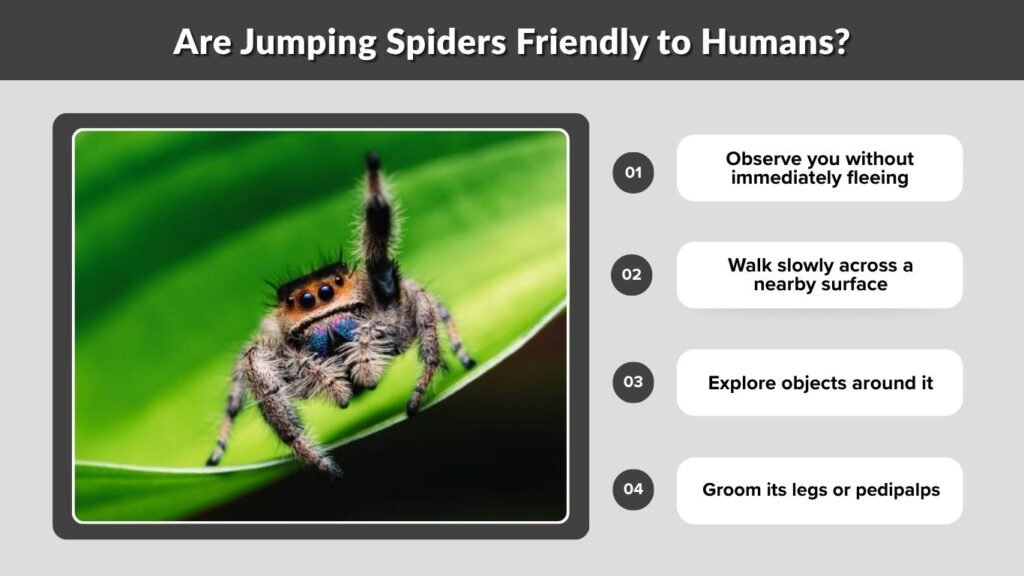
For practical purposes, jumping spiders are among the less threatening spiders people commonly encounter. They typically avoid confrontation and are unlikely to bite unless trapped, squeezed, or repeatedly handled. Penn State describes the bold jumping spider as shy and notes that it generally retreats when approached.
Signs a Jumping Spider Is Comfortable or Calm
A spider that is not highly disturbed may:
- Observe you without immediately fleeing
- Walk slowly across a nearby surface
- Explore objects around it
- Groom its legs or pedipalps
- Turn to follow movement
- Jump away rather than assume defensive behavior
Remember that these behaviors do not necessarily mean the spider likes being touched. Allowing it to choose where it moves is less stressful than restraining it.
Should You Pick Up a Wild Jumping Spider?
Handling is usually unnecessary. Even relatively harmless animals may defend themselves when squeezed or frightened.
If you want to move one, offering a container, piece of paper, or your stationary hand as a surface is preferable to grabbing it.
Wash your hands before handling captive spiders, particularly if you have recently used pesticides, lotions, cleaners, or other chemicals.
Do Jumping Spiders Bite?
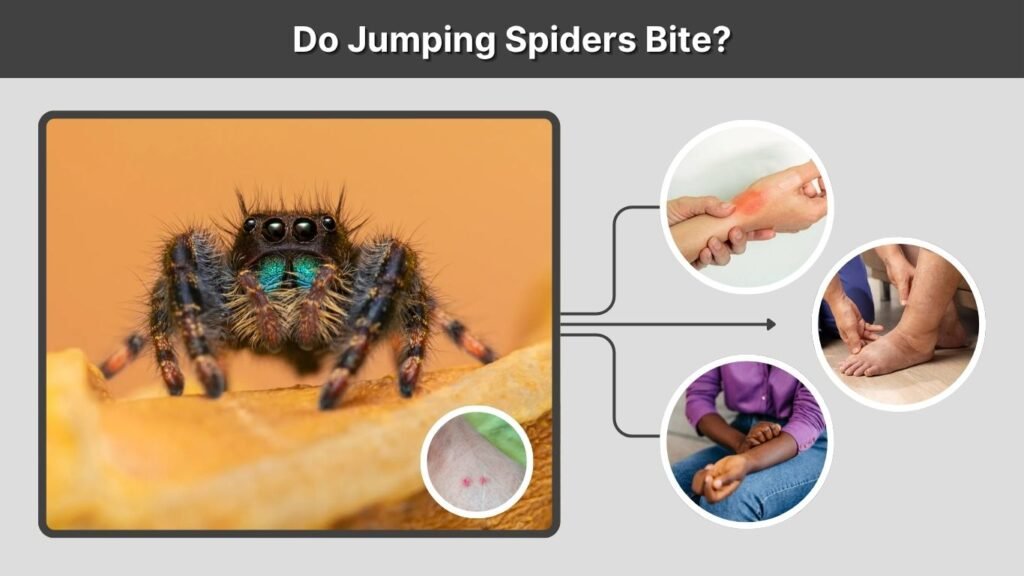
Jumping spiders have fangs and venom because they use them to capture small prey. However, bites to humans are uncommon. When a bold jumping spider does bite, Penn State reports that symptoms can include minor pain, redness, itching, and swelling that may persist for a day or two. Penn State Extension
Are Jumping Spider Bites Dangerous?
Most jumping spider species encountered around homes are not considered medically significant.
Typical minor bite symptoms may include:
- Brief pain
- Localized redness
- Mild swelling
- Itching
- Temporary tenderness
Serious symptoms after any suspected spider bite should receive medical attention, especially if difficulty breathing or a significant allergic reaction develops.
Will a Jumping Spider Bite If It Jumps on You?
Usually not.
Jumping is simply how these spiders move. A spider landing on your arm is not equivalent to a mosquito landing to feed. It may simply explore briefly before jumping away.
Avoid squeezing or trapping it against your skin, since defensive biting becomes more likely when a spider cannot escape.
Are Bold Jumping Spiders Friendly?
The bold jumping spider (Phidippus audax) is one of the best-known jumping spiders in North America. Its large eyes, black body, white or orange abdominal markings, and often metallic green chelicerae make it easy to recognize. It is also one of the species commonly kept by spider enthusiasts.
Bold Jumping Spider Behavior
Bold jumpers are active daytime hunters rather than aggressive spiders. They may stop and watch people, cameras, or nearby movement before deciding whether to approach or retreat.
Penn State specifically describes them as shy spiders that retreat when humans approach and generally do not bite when handled.
What About Regal Jumping Spiders?
Regal jumping spiders (Phidippus regius) are also popular among people who keep jumping spiders because of their size, appearance, and active visual behavior.
Like other jumping spiders, however, individuals have different tolerance levels. One may readily explore a hand while another repeatedly moves away. Respecting that behavior is better than assuming every spider wants interaction.
Are Zebra and Other Jumping Spiders Friendly?
The family Salticidae contains thousands of species, so behavior differs somewhat among them. Still, familiar household and garden species such as zebra jumpers generally pose little risk to people. Penn State describes the zebra jumper (Salticus scenicus) as harmless and beneficial around homes because it hunts insects.
Are All Jumping Spiders Friendly?
Not necessarily. Individual spiders vary, and “friendly” does not mean domesticated.
A wild jumping spider may:
- Immediately run away
- Hide beneath an object
- Jump away repeatedly
- Turn and observe you
- Approach cautiously
- Become defensive if restrained
These are normal survival responses. A spider that retreats should simply be allowed to leave.
Are Jumping Spiders Friendly to Each Other?
Jumping spiders are generally solitary animals, not social pets that need companions. They interact during courtship and reproduction, but encounters between individuals can also involve territorial behavior, predation, or cannibalism.
Should Two Pet Jumping Spiders Live Together?
Generally, no. Keeping two jumping spiders together can result in one attacking or eating the other.
Males perform elaborate visual courtship displays when approaching females, but mating interactions require careful signaling. Outside reproductive situations, separate enclosures are the safer choice for captive jumping spiders.
Are Jumping Spiders Friendly Pets?
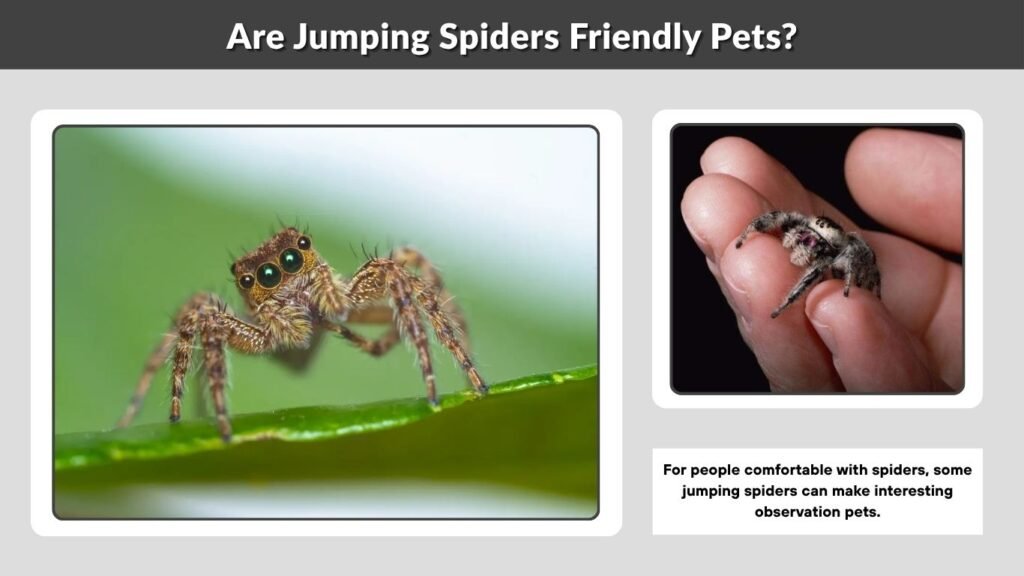
For people comfortable with spiders, some jumping spiders can make interesting observation pets. Their excellent eyesight, daytime activity, hunting behavior, and tendency to visually inspect their surroundings make them more interactive to watch than many web-dwelling species.
What Makes Them Popular Pets?
Common reasons include:
- Small enclosure requirements
- Interesting hunting behavior
- Excellent eyesight
- Active daytime behavior
- Distinctive colors and markings
- Relatively low risk to humans
- Fascinating courtship displays
They are still delicate animals rather than pets designed for frequent physical handling. Watching their natural behavior is often better than repeatedly picking them up.
FAQs
Jumping spiders behave differently from many spiders people encounter around homes. Their large eyes and visual hunting style make their behavior particularly noticeable, which explains why so many people describe them as curious or friendly.
1. Why are jumping spiders so friendly?
They are not friendly in the human emotional sense. Their apparent friendliness comes mainly from curiosity-like visual investigation, excellent eyesight, and their tendency to observe rather than immediately flee.
2. Are jumping spiders friendly to humans?
Generally, they are non-aggressive toward humans. Most prefer retreating or jumping away instead of biting.
3. Are bold jumping spiders friendly?
Bold jumping spiders are usually shy and reluctant to bite. They may calmly observe people and sometimes tolerate gentle interaction.
4. Are wild jumping spiders safe to handle?
Most common species pose little danger, but handling is unnecessary. Let a spider voluntarily walk onto a surface rather than grabbing or squeezing it.
5. Are jumping spiders friendly with other jumping spiders?
Usually not. Most are solitary, and placing two together can lead to aggression or cannibalism. Captive jumping spiders are generally better housed separately.
