
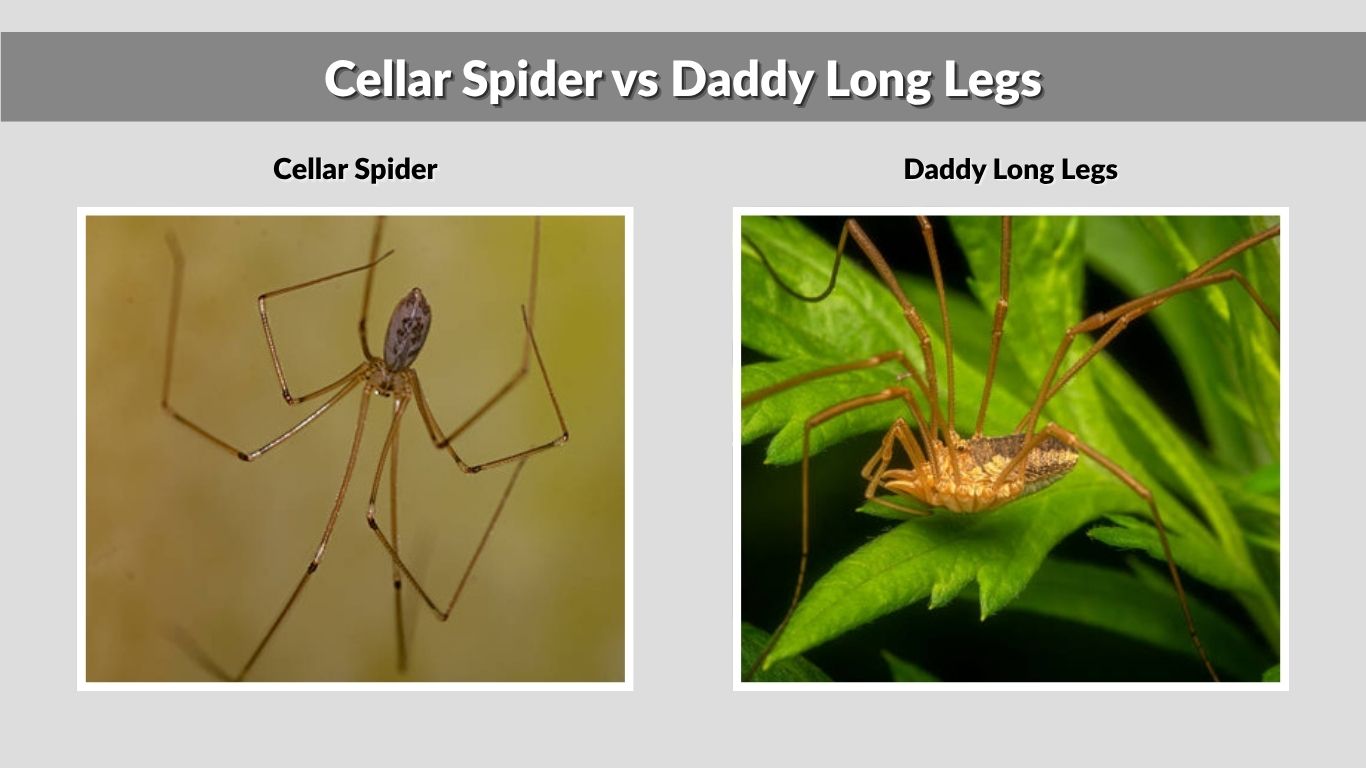
Many people confuse cellar spiders with daddy long legs because they both have long, thin legs and are commonly found around homes. However, they are not the same creature. This confusion has led to myths about danger, venom, and behavior. Understanding their differences helps you identify them correctly and know whether they are harmful or beneficial.
Cellar Spider vs Daddy Long Legs
| Feature | Cellar Spider | Daddy Long Legs |
| Type | True spider (Pholcidae) | Often harvestmen (not true spiders) |
| Body Structure | Two distinct body parts | Single fused body |
| Web | Builds messy webs | Does not build webs |
| Venom | Has mild venom | No venom (harvestmen) |
| Bite | Rare, harmless | Cannot bite (most cases) |
| Habitat | Indoors (ceilings, corners) | Outdoors (gardens, grass) |
| Movement | Stays in web, hangs upside down | Walks or runs freely |
| Diet | Traps insects in webs | Eats small insects, sometimes scavenges |
What Is a Cellar Spider?

Cellar spiders are true spiders commonly found inside homes. They are often seen in corners of ceilings, basements, and quiet indoor areas.
Key Characteristics:
- Long, thin legs with a small body
- Two clearly separated body parts
- Builds loose, irregular webs
- Usually hangs upside down in its web
They rely on their webs to catch prey and rarely leave them unless disturbed.
What Is a Daddy Long Legs?

Daddy long legs usually refers to harvestmen, which are not true spiders. They are often found outdoors in gardens, grass, and damp areas.
Key Characteristics:
- Long legs with a single rounded body
- No silk production or web-building
- Moves freely instead of staying in one place
- Commonly seen walking on surfaces
Unlike cellar spiders, they do not depend on webs to survive.
Body Structure Differences
One of the easiest ways to tell them apart is by looking at their body shape.
Cellar Spider:
- Two separate body sections
- Clear division between head and abdomen
Daddy Long Legs:
- Single, fused body
- No visible separation
This difference is one of the most reliable ways to identify them.
Legs and Appearance Differences
Although both have long legs, their appearance is slightly different.
Cellar Spider:
- Very thin and delicate legs
- Often seen hanging upside down
- Body appears smaller compared to legs
Daddy Long Legs:
- Legs may appear slightly thicker
- Stands upright while walking
- Body looks more rounded
These visual cues can help quickly identify which one you are seeing.
Do Cellar Spiders and Daddy Long Legs Bite?
Biting ability is another major difference between the two.
Cellar Spider:
- Can bite, but it is very rare
- Bites are harmless to humans
Daddy Long Legs:
- Most cannot bite at all
- Do not have venom (in the case of harvestmen)
Neither of them poses any real threat, even if contact occurs.
Venom and Danger Comparison
There is a lot of confusion about how dangerous these creatures are, especially due to online myths.
Key Points:
- Neither cellar spiders nor daddy long legs are dangerous to humans
- Cellar spiders have venom, but it is extremely mild and harmless
- Daddy long legs (harvestmen) do not have venom at all
Despite common myths, neither of them can cause harm, and both are considered safe to have around.
Habitat and Where They Live
Their living environments are quite different, which also helps in identifying them.
Cellar Spider:
- Found indoors
- Common in ceilings, basements, and corners
- Prefers quiet, undisturbed areas
- Builds webs to stay and hunt
Daddy Long Legs:

- Mostly found outdoors
- Lives in gardens, grass, and damp areas
- Does not build webs
- Moves around freely
This difference in habitat is one of the easiest ways to tell them apart in daily life.
Behavior and Movement Differences
Their behavior is another clear distinction.
Cellar Spider:
- Stays in its web most of the time
- Vibrates its web rapidly when disturbed
- Relies on passive hunting
Daddy Long Legs:
- Constantly moving and exploring
- Walks or runs instead of staying in one spot
- Does not depend on webs
These movement patterns make them easy to distinguish even from a distance.
Diet Differences
Cellar Spider:
- Feeds on insects caught in its web
- Eats mosquitoes, flies, and other spiders
- Relies on trapping prey
Daddy Long Legs:

- Eats small insects and tiny bugs
- Can also scavenge dead insects
- Does not rely on webs to feed
Both are helpful in reducing pests, but their feeding methods are different.
Which One Is More Useful?
Both creatures are beneficial, but in slightly different ways.
Cellar Spider:
- Excellent for indoor pest control
- Reduces flies, mosquitoes, and other spiders
Daddy Long Legs:
- Helps control small insects outdoors
- Plays a role in the natural ecosystem
Neither should be considered a pest, as both contribute positively to their environments.
Common Myths About Cellar Spiders and Daddy Long Legs
There are several myths that cause confusion between these two.
Common Misconceptions:
- “They are the same creature” — false
- “They are the most poisonous spiders” — false
- “They can kill humans” — completely untrue
These myths usually come from misidentification and misinformation rather than scientific facts.
How to Tell the Difference Quickly
You can easily identify which one you are seeing with a few simple checks:
- Look for a web → If yes, it’s a cellar spider
- Check the body → One piece = daddy long legs, two parts = cellar spider
- Observe movement → Walking freely = daddy long legs
These quick observations are enough for accurate identification.
Are Cellar Spiders and Daddy Long Legs the Same?
No, cellar spiders and daddy long legs are not the same.
They differ in:
- Body structure
- Behavior
- Habitat
- Venom and feeding methods
The confusion mainly comes from their similar leg appearance and shared nickname. Once you know the key differences, it becomes easy to tell them apart.
FAQ
Are cellar spiders and daddy long legs the same?
No, they are completely different creatures. Cellar spiders are true spiders with two body segments and web-building behavior, while daddy long legs (harvestmen) have a single body and do not build webs. The confusion comes from their similar long-legged appearance.
Which is more dangerous, cellar spider or daddy long legs?
Neither is dangerous. Cellar spiders have mild venom that does not harm humans, and daddy long legs usually have no venom at all. Both are harmless and pose no threat to people or pets.
Can cellar spiders bite humans?
Yes, cellar spiders can bite, but it is extremely rare. Even if a bite happens, it is harmless and may only cause mild irritation. They are not aggressive and usually avoid human contact.
Why are they both called daddy long legs?
The name “daddy long legs” is used in different regions to describe various long-legged creatures. This includes harvestmen and sometimes even cellar spiders, which leads to confusion and misidentification.
Which one is better to have in your house?
Cellar spiders are generally more useful indoors because they build webs and actively catch insects like flies and mosquitoes. They help reduce pests naturally and are safe to have around.
