
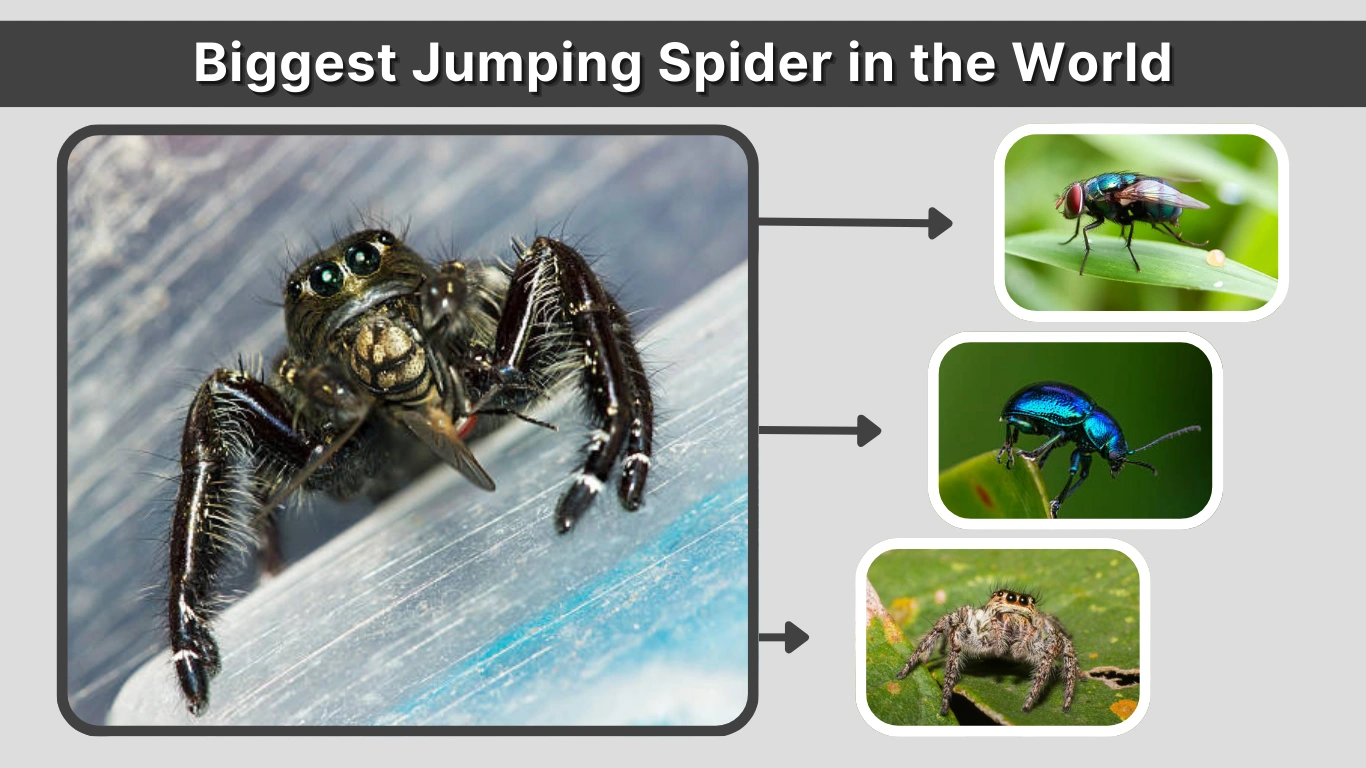
Jumping spiders are known for their excellent eyesight, quick movements, and impressive jumping ability. Among the more than 6,000 known species, some stand out for their unusually large size. This has led many people to search for the biggest jumping spider in the world and wonder how big a jumping spider can actually get. From rainforest giants to thick-bodied tree dwellers, the world’s biggest jumping spider species challenge the idea that all jumping spiders are tiny. Understanding their size, appearance, and behavior reveals how remarkable these spiders truly are.
Identification of the Biggest Jumping Spider

The biggest jumping spiders belong to the family Salticidae, a group defined by strong bodies and highly developed vision.
- Family: Salticidae (jumping spiders)
- Common reference: Giant jumping spiders, largest jumping spider species
- Eye structure: Large forward-facing central eyes with excellent depth perception
- Body build: Thick cephalothorax, powerful hind legs, compact abdomen
- Key feature: Ability to jump many times their own body length
- What makes them “biggest”: Exceptional body length and heavier build compared to other jumpers
What Is the Biggest Jumping Spider in the World?
There is no single officially titled “largest jumping spider,” but most arachnologists agree that a small group of tropical species hold the record for size. Among them, spiders from the genera Hyllus and Phidippus are often cited as containing the biggest jumping spider species in the world.
Species such as Hyllus giganteus and Hyllus diardi are frequently mentioned as the world’s biggest jumping spiders. These spiders are noticeably larger and bulkier than the small wall-dwelling jumping spiders people commonly see around homes. Their thick legs, broad heads, and muscular bodies give them a heavy, powerful appearance.
When people ask “what is the biggest jumping spider,” the answer usually refers to these giant Hyllus species. They are not only long in body length but also impressive in leg span, which makes them appear even larger when moving or hunting.
Biggest Jumping Spider Species Ever Recorded

The largest confirmed jumping spiders ever recorded come primarily from Southeast Asia and nearby tropical regions. Forests in Malaysia, Indonesia, Thailand, and surrounding countries are home to some of the biggest members of the Salticidae family.
Hyllus giganteus is often described as the biggest jumping spider species currently known. Adult females are especially massive, with thick abdomens and strong legs adapted for capturing relatively large prey. Another giant species, Hyllus diardi, is slightly smaller but still enormous by jumping spider standards.
These spiders were identified and classified through specimen collections and field observations. Their size immediately distinguished them from typical jumping spiders, leading researchers to study them more closely. Their heavy build, slow but deliberate movements, and ability to overpower larger insects make them stand out as true giants among jumpers.
How Big Is the Biggest Jumping Spider?
The biggest jumping spider can reach body lengths of around 18 to 25 millimeters, which is massive for a jumping spider. When the legs are included, their full span can appear much larger, sometimes approaching the size of a small tarantula spiderling.
Females are generally the largest. A full-grown female giant jumping spider has a thick, rounded abdomen and powerful hind legs built for both jumping and wrestling with prey. Males are usually slimmer but still far larger than common house-dwelling jumping spiders.
To put this into perspective, most common jumping spiders measure only 4 to 8 millimeters long. This means the biggest jumping spider species can be three to four times longer and many times heavier, giving them a very different look and presence.
Biggest Jumping Spider vs Common Jumping Spiders

Size Comparison
Typical jumping spiders are tiny and delicate, often smaller than a fingernail. The biggest jumping spider, by contrast, can cover a large coin with its body and extend well beyond it with its legs. This dramatic difference in size is what makes giant jumping spiders so fascinating.
Strength and Jumping Ability
Larger jumping spiders are capable of tackling much bigger prey. Their jumps are powerful rather than quick flicks, and they rely on strength as much as precision. Despite their heavier bodies, they can still leap several times their own length with accuracy.
Appearance Differences
Common jumping spiders often appear cute or delicate. Giant jumping spiders look muscular, thick-legged, and more imposing. Their faces are broader, their legs hairier, and their overall structure much closer to that of a small tarantula than a typical tiny jumper.
Habitat and Natural Range of the World’s Biggest Jumping Spider
The world’s biggest jumping spiders live almost exclusively in tropical environments. Dense rainforests, humid lowland forests, and warm jungle ecosystems provide the conditions they need to thrive.
They are commonly found on tree trunks, large leaves, and forest vegetation where large insects are plentiful. Some species prefer higher forest layers, while others hunt closer to the ground. Warm temperatures and high humidity are essential, as these spiders are rarely found in cold or dry climates.
Their natural range is concentrated in Southeast Asia and nearby islands, although other large jumping spider species exist in parts of Australia and Africa. These regions offer rich biodiversity and stable climates, allowing giant jumping spiders to grow to their impressive sizes.
Behavior and Hunting Style
The biggest jumping spiders are active daytime hunters that rely more on vision than vibration. Their large forward-facing eyes give them excellent depth perception, allowing them to carefully stalk prey before attacking. Unlike web-building spiders, they do not wait for insects to become trapped. Instead, they slowly approach, pause to calculate distance, and then launch a controlled leap.
Despite their large size, these spiders are precise jumpers. They anchor themselves with a thin silk safety line before jumping, which prevents serious falls if they miss. Their hunting strategy combines patience, stealth, and power. Once contact is made, the spider uses its strong front legs to secure the prey and deliver a venomous bite.
Large jumping spiders are generally solitary and territorial. They may display threat postures if another spider approaches, raising their front legs and spreading their bodies to appear larger.
Diet of the Biggest Jumping Spider

The biggest jumping spider species feed on a wider range of prey than smaller jumpers. Their diet commonly includes flies, beetles, moths, grasshoppers, and large mosquitoes. Because of their strength, some have even been observed capturing other spiders.
After a successful jump, the spider injects venom that quickly immobilizes its prey. Digestive enzymes are then released to liquefy the internal tissues, which are slowly consumed. Large jumping spiders tend to eat less frequently than small species, but each meal provides much more nutrition.
In their natural environment, giant jumping spiders help control insect populations and maintain balance in forest ecosystems. Their presence benefits the surrounding plant life by reducing herbivorous insect numbers.
Life Cycle and Lifespan of the Biggest Jumping Spider
Like all jumping spiders, the biggest species follow a clear life cycle.
- Egg stage: Females lay eggs inside thick silk retreats attached to bark or leaves.
- Spiderling stage: Newly hatched spiderlings remain near the nest before dispersing.
- Juvenile growth: Several molts occur as the spider increases in size and strength.
- Adult phase: Full size is reached, and mating behaviors appear.
- Breeding behavior: Males perform visual courtship displays.
- Average lifespan: Most live one to two years, depending on climate and food availability.
Is the Biggest Jumping Spider Dangerous?
Even the biggest jumping spider in the world is not considered dangerous to humans. Although their size can appear intimidating, they are not aggressive and usually avoid confrontation. Their venom is adapted for insects, not people.
A bite is rare and usually only happens if the spider is trapped or mishandled. When it does occur, symptoms are generally mild, such as slight pain, redness, or swelling at the bite site.
There are no known medically significant cases linked to jumping spider venom. Compared to many other large spiders, giant jumping spiders are among the least threatening.
Biggest Jumping Spider Bite: What to Expect
If a biggest jumping spider bite occurs, it is typically minor. Most people describe it as similar to a mild bee sting or pinprick. The discomfort usually fades within a short time.
Basic first aid is enough in most cases. Washing the area with soap and water and applying a cold compress helps reduce irritation. Antihistamine cream may relieve itching if present.
Medical attention is only necessary if unusual symptoms appear, such as spreading redness, intense pain, or signs of infection, which are extremely uncommon.
Biggest Jumping Spider as a Pet
Some spider enthusiasts are interested in keeping large jumping spiders as exotic pets. While possible, it requires specialized care. These spiders need spacious enclosures, vertical climbing surfaces, and stable warmth and humidity.
Feeding involves live insects such as crickets, flies, and small roaches. Because of their size, they should not be overfed. Gentle misting provides drinking water, as jumping spiders prefer to drink droplets.
Handling is not recommended. While not dangerous, they are delicate and can be injured easily. Most keepers prefer observation rather than interaction.
Interesting Facts About the Biggest Jumping Spider
Despite their size, giant jumping spiders share the intelligence and agility of their smaller relatives.
- They have some of the best eyesight among all spiders.
- They can jump many times their own body length.
- They perform complex courtship dances.
- They are capable of learning and adapting hunting strategies.
- They are among the largest visually hunting spiders in the world.
Common Myths and Misidentifications
Many photos online label large wolf spiders or small tarantulas as “giant jumping spiders.” In reality, true jumping spiders can be identified by their eye arrangement and alert behavior.
A common myth is that large jumping spiders are highly venomous. Scientifically, this is false. Their venom is weak toward humans and primarily affects insects.
Another misconception is that all big spiders are aggressive. Giant jumping spiders are typically shy and retreat when approached.
FAQs
What is the biggest jumping spider in the world?
The biggest jumping spider in the world is widely believed to belong to the genus Hyllus, especially Hyllus giganteus. These spiders are much larger and heavier than common jumping spiders and are found mainly in Southeast Asian rainforests.
How big is the biggest jumping spider ever recorded?
The biggest jumping spiders can reach about 18 to 25 millimeters in body length, with a much larger leg span. This makes them several times larger than most jumping spider species.
What is the biggest jumping spider species?
Hyllus giganteus is commonly considered the biggest jumping spider species. It is known for its thick body, strong legs, and powerful hunting ability compared to other jumpers.
Is the biggest jumping spider dangerous to humans?
No, even the biggest jumping spider is not dangerous. Bites are rare and mild, and their venom is not medically significant to humans.
Can the biggest jumping spider be kept as a pet?
Yes, some people keep large jumping spiders as pets, but they require warm, humid enclosures, live insect diets, and minimal handling. They are better suited for observation than interaction.
