
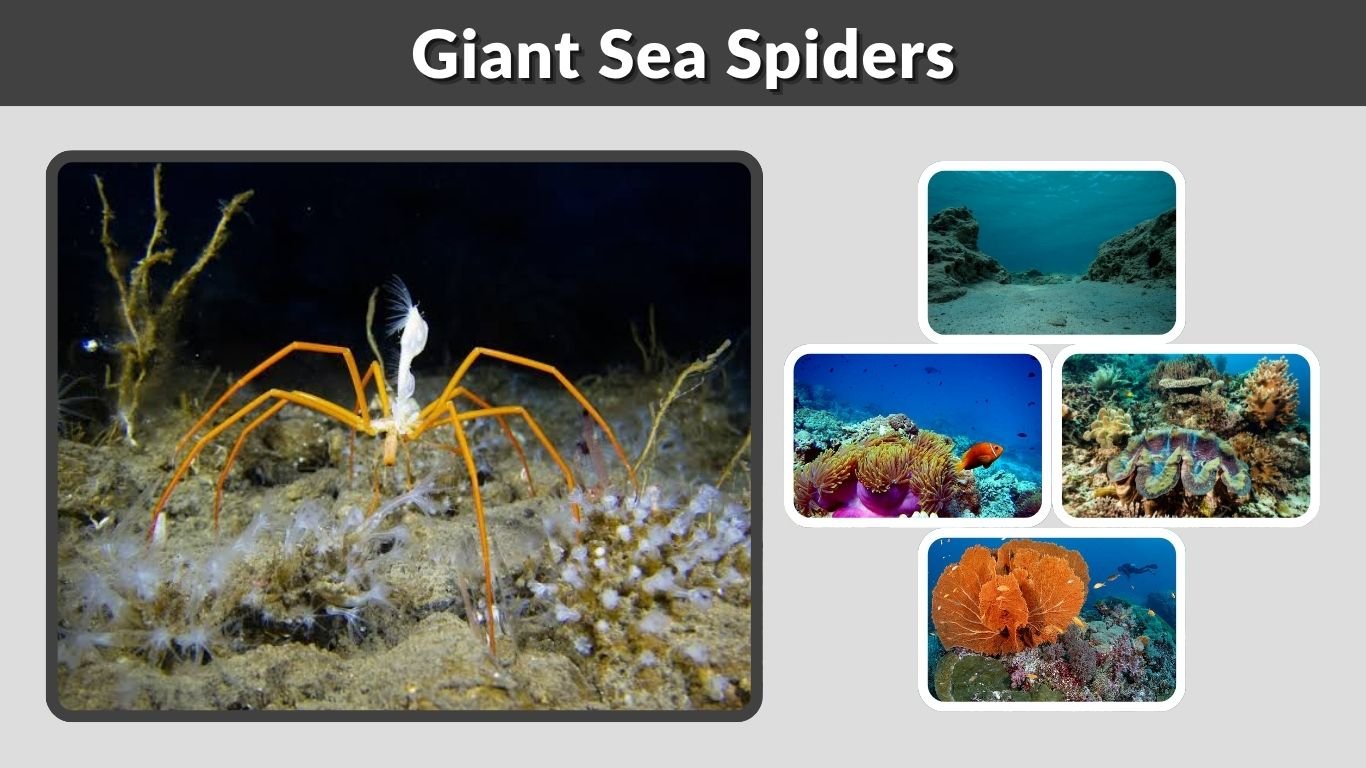
Giant sea spiders are among the ocean’s strangest-looking creatures, with extremely long legs surrounding a remarkably small body. These marine arthropods are especially famous in Antarctica, where some species grow much larger than relatives living in warmer waters. Despite their spider-like appearance and impressive leg span, they are not giant versions of ordinary land spiders and pose little threat to people. From their unusual breathing system to their specialized feeding habits, giant sea spiders demonstrate some extraordinary adaptations for surviving cold and deep marine environments.
What Are Giant Sea Spiders?
Giant sea spiders are unusually large members of Pycnogonida, a group of marine arthropods commonly called sea spiders. They occur exclusively in marine environments and are related to other chelicerate arthropods, although they are not true spiders. Their tiny central bodies, exceptionally long legs, and unusual internal anatomy give them an appearance unlike almost any familiar terrestrial animal.
Giant Sea Spider Identification
Common characteristics include:
- Very long and slender jointed legs
- A relatively tiny central body
- Usually four pairs of walking legs
- A tube-like proboscis used for feeding
- Internal organs extending partly into the legs
- No lungs or conventional gills
- Colors ranging from pale to orange, red, or brown
- Large leg span in certain polar and deep-sea species
Their long-legged body design provides considerable surface area, which is important because their legs play a major role in gas exchange.
Are Giant Sea Spiders Real?
Yes. Giant sea spiders are completely real animals and have been repeatedly collected, photographed, and studied by marine scientists.
They are not fictional oversized spiders living beneath Antarctica. Sea spiders occur throughout the world’s oceans, and some deep-sea species can reach nearly 3 feet (about 1 meter) across, according to Smithsonian Ocean.
How Big Are Giant Sea Spiders?
The phrase “giant sea spider” refers mainly to exceptionally large pycnogonids found in cold or deep water. Most sea spiders are considerably smaller. Their impressive measurements also come primarily from the spread of their legs rather than a massive body, which remains remarkably compact even in large individuals.
Giant Sea Spider Size
Some of the largest sea spiders can approach three feet from leg tip to leg tip, although many Antarctic giants are closer to dinner-plate size. Their extremely long, narrow legs account for most of this width.
This unusual proportion makes photographs deceptive. A giant sea spider may cover a large area of seabed while possessing only a small central trunk.
Why Are Antarctic Sea Spiders So Big?
The large size of some Antarctic marine animals is known as polar gigantism. Scientists have investigated several possible explanations, particularly the interaction between cold temperatures, metabolism, and oxygen availability.
Cold water contains more dissolved oxygen than warm water, while cold-adapted animals often have relatively slow metabolisms. These conditions have been proposed as factors allowing some polar invertebrates to attain unusually large sizes. However, research indicates that the relationship between temperature, oxygen, and giant body size is more complicated than a single explanation.
Where Do Giant Sea Spiders Live?
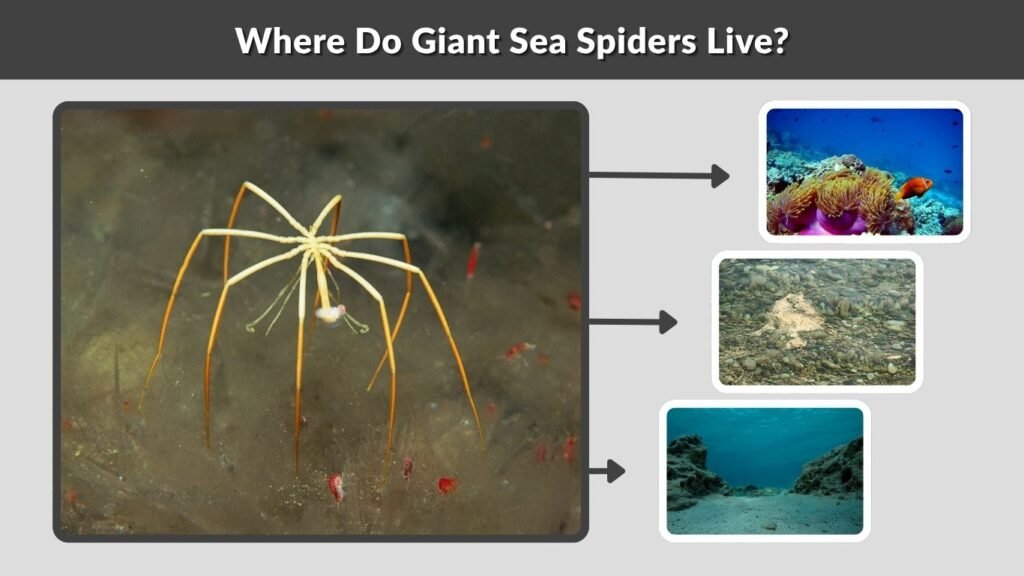
Giant sea spiders are strongly associated with cold polar regions and the deep ocean, where conditions remain cold throughout the year. Sea spiders as a broader group occur worldwide, but Antarctica supports particularly remarkable diversity. Scientists have documented hundreds of pycnogonid species across Southern Ocean sampling locations.
Giant Sea Spiders in Antarctica
Antarctic giant sea spiders may occur around:
- Continental-shelf seabeds
- Rocky bottom habitats
- Sponge communities
- Coral communities
- Areas beneath Antarctic ice
- Deep continental slopes
- Cold benthic ecosystems
Researchers exploring the Bellingshausen Sea have observed giant sea spiders living among rich communities of corals, sponges, fish, and other marine animals. In 2025, scientists also documented giant sea spiders in previously hidden ecosystems exposed after an Antarctic iceberg detached.
Giant Sea Spiders in Africa and South Africa
Sea spiders are not restricted to Antarctica. Numerous pycnogonid species occur around Africa, including South African waters.
Scientific records document deep-sea species of Colossendeis, a genus known for large, long-legged sea spiders, from South African marine environments. However, “giant African sea spider” is not the name of one particular species.
Giant Deep-Sea Spiders
Deep water provides another important habitat. Giant sea spiders have been observed thousands of feet below the ocean surface, crawling over the bottom and among deep-sea corals.
Unlike terrestrial spiders, they do not construct webs. Their long legs allow them to move across complex seafloor habitats while searching for suitable prey.
What Do Giant Sea Spiders Eat?
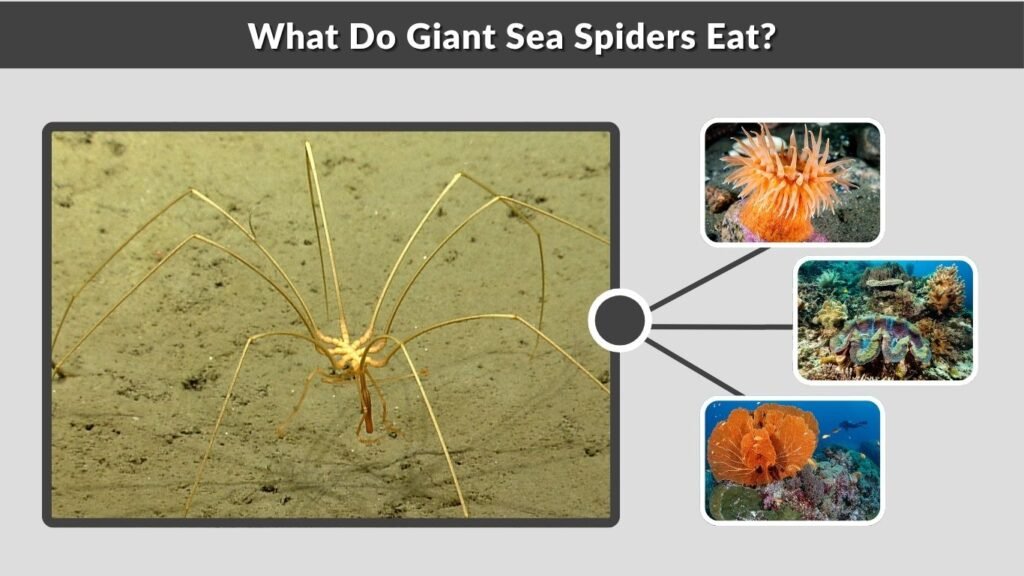
Giant sea spiders are predators or specialized feeders that consume soft-bodied marine organisms. Instead of chewing food with jaws like many familiar animals, they possess a long proboscis that allows them to pierce or access prey and draw out soft tissues and nutrients.
Common Foods of Giant Sea Spiders
Depending on the species, prey can include:
- Sea anemones
- Hydroids
- Soft corals
- Other cnidarians
- Sponges
- Bryozoans
- Small soft-bodied marine invertebrates
Smithsonian observations show giant deep-sea sea spiders feeding on corals with their long tube-like mouthparts.
Giant Anemone-Sucking Sea Spiders
The description “anemone-sucking sea spider” comes from this unusual feeding style. A sea spider can position its proboscis against soft-bodied prey and extract nutritious material.
Their delicate appearance therefore should not be mistaken for helplessness. Giant sea spiders are well adapted to locating and feeding on suitable prey across cold and deep seafloor habitats.
How Do Giant Sea Spiders Breathe?
One of the most remarkable things about giant sea spiders is that they lack the familiar lungs or gills used by many other animals. Oxygen instead passes directly across their outer surfaces. Their long, thin legs are especially important because they provide enormous surface area relative to the animal’s volume.
They Essentially Breathe Through Their Legs
Research on Antarctic sea spiders found that pores in their exoskeleton help oxygen diffuse into their bodies. Larger sea spiders also develop proportionally greater pore volume, potentially helping them obtain sufficient oxygen despite their increased size.
Their thin legs therefore function somewhat like enormous respiratory surfaces.
This adaptation helps explain how such surprisingly large animals can survive despite lacking conventional respiratory organs.
Their Guts Help Move Oxygen
Getting oxygen through the body surface is only the first problem. It must then be transported through extraordinarily long legs.
Researchers discovered that sea spiders use rhythmic contractions of their digestive system to help move internal fluids and distribute oxygen. Their branching gut extends into the legs, and its contractions supplement their relatively weak heart.
In simple terms, their legs help them breathe, while their guts help circulate oxygen.
Are Giant Sea Spiders Dangerous?
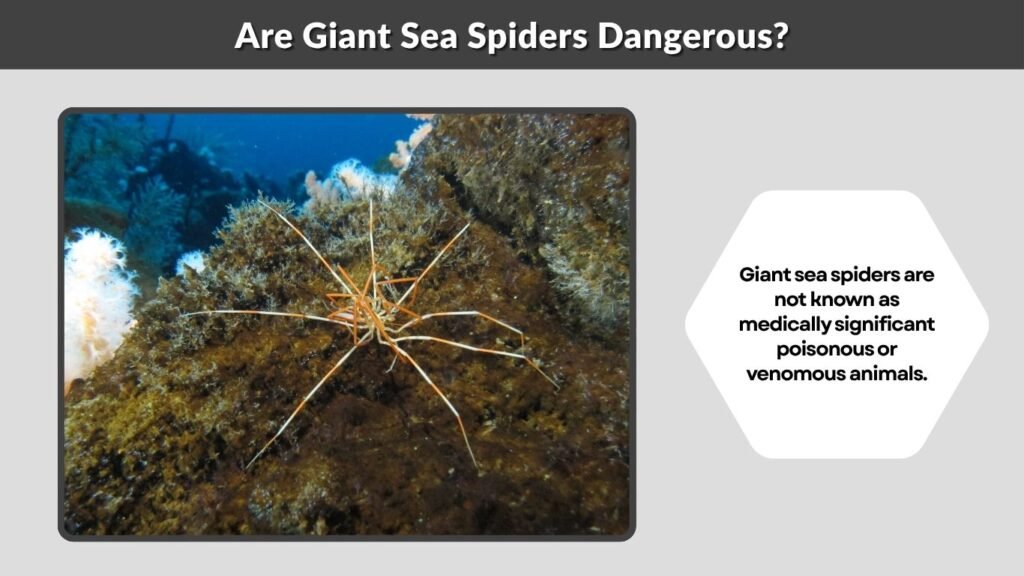
Their appearance may suggest an aggressive monster, but giant sea spiders are not considered dangerous to humans. Their feeding structures are adapted for relatively small, soft marine prey, and people are not part of their natural feeding behavior. Even particularly large Antarctic specimens are primarily a curiosity for researchers rather than a threat.
Are Giant Sea Spiders Poisonous or Venomous?
Giant sea spiders are not known as medically significant poisonous or venomous animals.
They do not possess the venom-delivering fangs characteristic of many true spiders. Instead, their prominent proboscis is specialized for obtaining nutrients from marine prey.
Divers and researchers therefore do not generally regard giant pycnogonids as dangerous animals.
Can Giant Sea Spiders Live on Land?
No. Giant sea spiders are marine animals physiologically adapted to life underwater.
Their respiratory system depends on gas exchange with surrounding seawater, and their entire lifestyle—including feeding and reproduction—is associated with marine habitats. A giant sea spider cannot crawl onto land and establish itself like a terrestrial spider.
Can Giant Sea Spiders Survive Warming Oceans?
Because giant Antarctic sea spiders evolved in consistently cold water, scientists have questioned whether warming oceans could create serious physiological challenges. Surprisingly, experiments suggest that large body size alone may not make them more vulnerable than smaller individuals, although long-term environmental changes remain uncertain.
A Surprisingly Porous Exoskeleton
Researchers studying Antarctic species found that larger individuals develop increasingly porous exoskeletons. Those pores help oxygen diffuse into the animal.
In short-term temperature experiments, large individuals did not perform worse merely because of their size. Researchers suggested that increasing cuticle porosity may help compensate for the oxygen demands associated with becoming larger.
Their Future Is Still Uncertain
That does not mean warming poses no risk. Ocean warming changes temperature, oxygen availability, prey communities, competition, and entire Antarctic ecosystems.
Researchers specifically caution that short-term experiments cannot predict every long-term consequence. Antarctic pycnogonids also have exceptionally high levels of regional diversity and endemism, potentially making ecological change particularly important for the group.
Interesting Facts About Giant Sea Spiders
Giant sea spiders combine an intimidating appearance with biological features rarely encountered in other animals. Studying them gives scientists insights into polar gigantism, respiration, circulation, and the evolution of marine arthropods.
Giant Sea Spider Facts
- Giant sea spiders are pycnogonids, not true spiders.
- Some species can approach three feet across.
- Antarctica is particularly rich in sea spider diversity.
- Their central bodies remain tiny compared with their legs.
- Their digestive system extends into their legs.
- Oxygen can diffuse through pores in their exoskeleton.
- Gut contractions help circulate oxygen-containing fluids.
- They feed using a tube-like proboscis.
- Some giant species prey on corals and anemones.
- They cannot live permanently on land.
These unusual adaptations make giant sea spiders some of the most distinctive arthropods living beneath the ocean.
FAQs
Are giant sea spiders real?
Yes. Giant sea spiders are real marine arthropods belonging to Pycnogonida. Scientists have collected and photographed them in Antarctica and other oceans. While most sea spiders are relatively small, some deep-sea species can approach three feet across when their extremely long legs are fully extended.
How big are giant sea spiders?
The largest sea spiders can approach approximately three feet, or nearly one meter, across. Their central bodies are much smaller than this measurement suggests because most of their overall width comes from their extraordinarily long legs. Many Antarctic forms are closer to dinner-plate size.
Are giant sea spiders dangerous?
Giant sea spiders are not considered dangerous to humans. They are marine predators adapted to feeding on soft-bodied organisms such as corals and anemones rather than large animals. They are not known for attacking divers and do not possess the venomous fang system associated with many terrestrial spiders.
What do giant sea spiders eat?
Giant sea spiders feed on soft-bodied marine organisms. Depending on species and habitat, their diet can include sea anemones, hydroids, corals, sponges, and other small invertebrates. They use an elongated proboscis to access and suck nutrient-rich tissues from their prey.
Where do giant sea spiders live?
Giant sea spiders are best known from cold Antarctic and deep-sea habitats, although sea spiders occur throughout the world’s oceans. They typically live on or near the seafloor among rocks, corals, sponges, and other benthic organisms rather than swimming through open water or living on land.
