
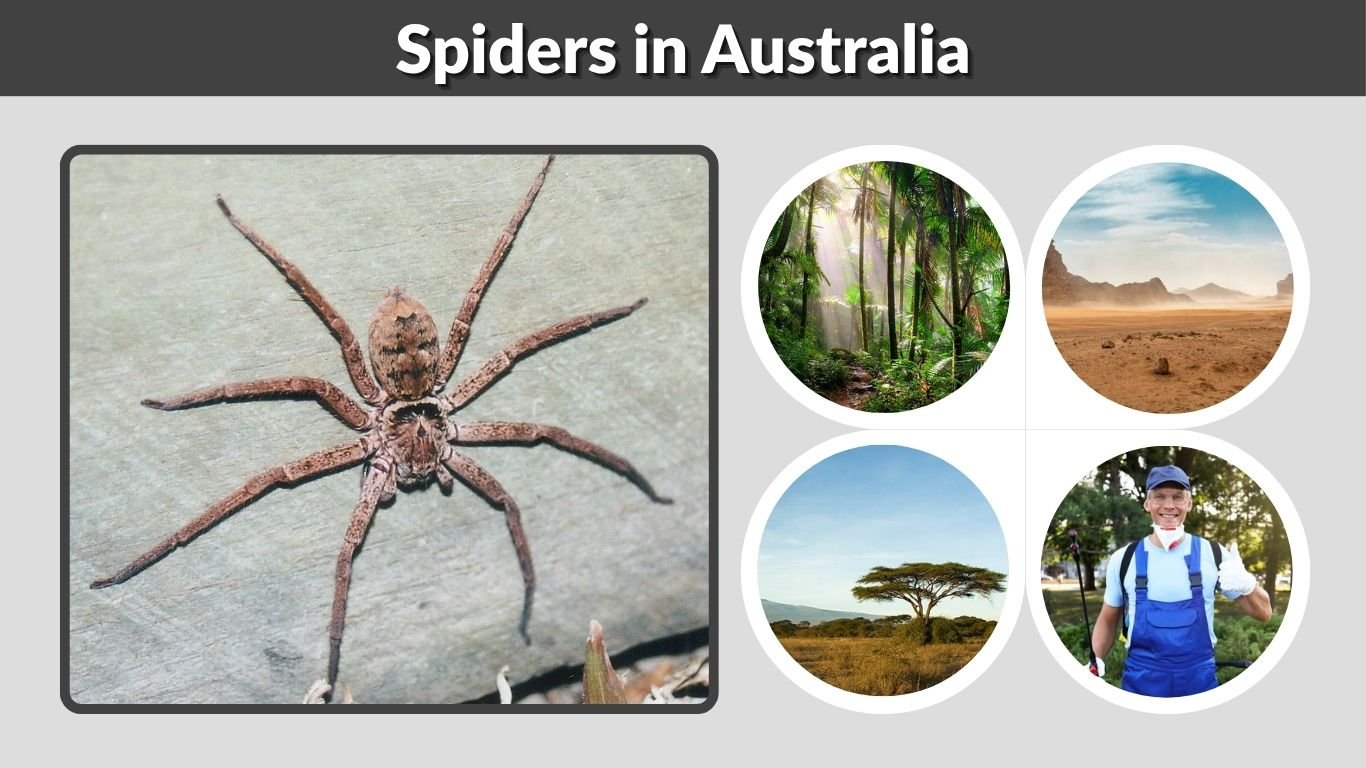
Australia spiders have a worldwide reputation for being unusually large, dangerous, and sometimes downright frightening. In reality, spiders in Australia are extremely diverse, ranging from tiny garden species to large huntsman and whistling spiders. Only a small proportion present a serious medical risk to humans. Australia’s varied climates—from tropical forests to deserts and temperate suburbs—provide habitats for thousands of species. Below, you’ll learn about giant spiders of Australia, venomous species, house spiders, spider season, and even the famous phenomenon of “raining spiders.”
How Many Types of Spiders Are in Australia?
Australia supports an enormous variety of spiders because the continent contains deserts, rainforests, woodlands, wetlands, grasslands, coastal habitats, and cities. The Australian Museum estimates that about 3,600 spider species occur in the country, with new species continuing to be described. Most are harmless predators that spend their lives hunting insects and other small invertebrates.
Common Spiders in Australia
Some well-known Australian spider groups include:
- Huntsman spiders – large, flat-bodied wandering hunters.
- Funnel-web spiders – robust spiders that include medically significant species.
- Redback spiders – small black spiders with characteristic red markings.
- Whistling spiders – Australia’s large native tarantulas.
- Garden orb weavers – web-building spiders common around vegetation.
- Golden orb weavers – large spiders known for strong golden-colored webs.
- Wolf spiders – ground hunters that do not rely on capture webs.
- Trapdoor spiders – burrowing spiders that spend much of their lives underground.
- Black house spiders – common around windows and structures.
- White-tailed spiders – wandering hunters frequently encountered around homes.
Most of these spiders pose little danger when left undisturbed. Spiders also play an important ecological role by controlling insects.
Why Australia Has Such Diverse Spiders
Australia has been geographically isolated for millions of years and contains an extraordinary variety of environmental conditions. Different spiders have adapted to dry deserts, wet tropical forests, mountains, temperate woodland, urban gardens, and coastal environments.
That diversity allows many species with very different lifestyles to coexist across the continent.
How Big Are Spiders in Australia?
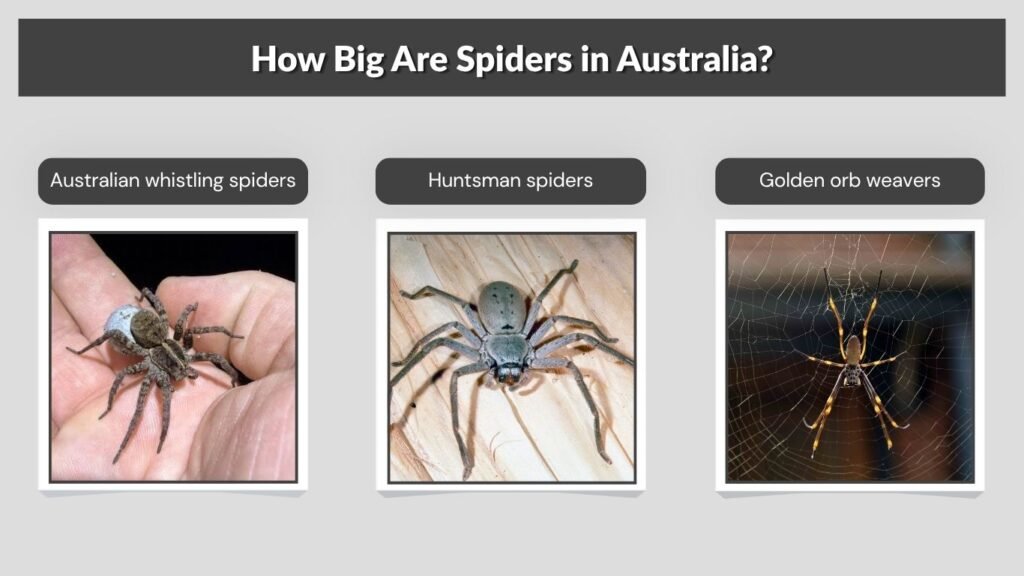
Stories about giant spiders in Australia are partly based on reality, although photographs can exaggerate their size. Australia’s largest spiders are impressive mainly because of their long legs. Huntsman spiders can spread widely across a wall, while native tarantulas have thicker bodies and powerful legs. Neither should be confused with fictional human-sized spiders.
Biggest Spiders in Australia
Some of Australia’s larger spiders include:
- Australian whistling spiders: among the country’s largest spiders.
- Huntsman spiders: some have leg spans approaching 15 cm.
- Golden orb weavers: females may have bodies several centimeters long.
- Large trapdoor spiders: heavy-bodied species that spend much of their time underground.
The Australian Museum identifies whistling spiders as Australia’s biggest spiders. The northern Selenocosmia crassipes can reach about 6 cm in body length with a 16 cm leg span. Australian tarantulas collectively include species reported with leg spans approaching 20 cm.
Are Huntsman Spiders Really Giant?
Huntsman spiders are responsible for many viral photographs of huge Australian spiders. Their flattened bodies and sideways-spreading legs make them appear particularly enormous.
Australian Museum information lists huntsman leg spans of up to about 15 cm for some species. Despite their intimidating size and speed, huntsman spiders are not considered dangerous to humans and generally prefer escaping rather than biting.
Are Spiders in Australia Dangerous?
Australia does have medically important spiders, but the idea that almost every Australian spider can kill a person is inaccurate. The majority are harmless or cause only minor effects if they bite. Funnel-web spiders and redbacks deserve particular attention because their venom can cause significant illness, and suspected serious bites require appropriate medical care.
Sydney Funnel-Web Spider
The Sydney funnel-web is one of Australia’s best-known dangerous spiders. It occurs around Sydney and surrounding regions and is typically found in moist, sheltered places.
Male Sydney funnel-web spiders possess highly potent venom. Suspected funnel-web bites should be treated as medical emergencies. Australian authorities recommend pressure immobilization and immediate emergency assistance. No deaths from Sydney funnel-web bites have occurred since effective antivenom became available in 1981.
Redback Spider
The redback is another famous Australian spider. Females are typically shiny black with a prominent red or orange marking on the abdomen.
They often establish tangled webs in dry, protected locations such as sheds, outdoor furniture, rubbish areas, and spaces beneath objects. Their bites can cause significant pain and other systemic symptoms, although modern medical treatment has greatly reduced serious outcomes.
Poisonous vs Venomous Spiders
People frequently search for poisonous spiders in Australia, but “venomous” is normally the correct term. Venom is actively delivered through a bite, whereas poison generally causes harm when an organism is eaten or touched.
Most Australian spiders possess venom for subduing prey, but very few have venom considered seriously dangerous to humans.
Why Does Australia Have So Many Spiders?
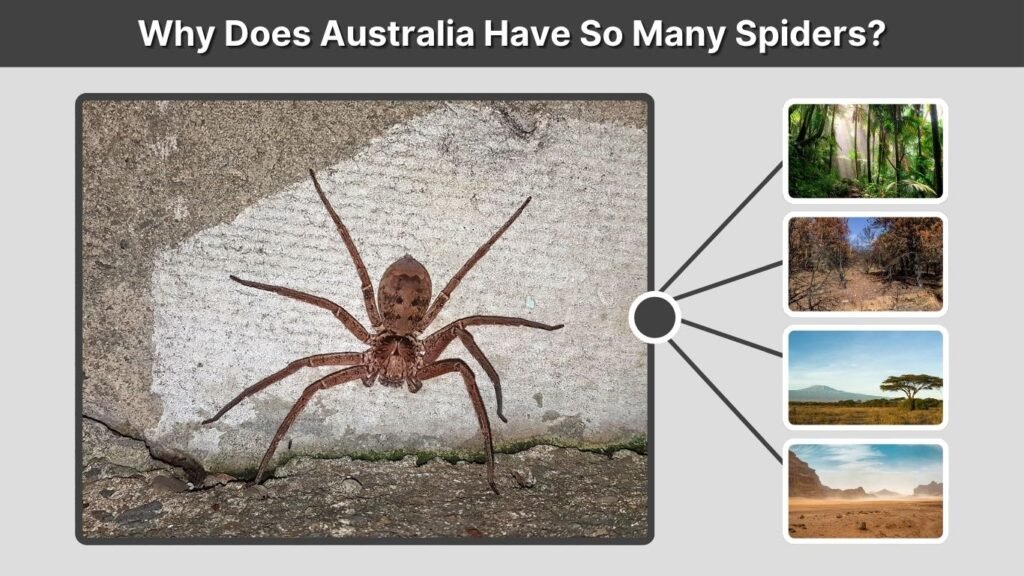
Australia appears particularly spider-rich because its climate, geography, and biodiversity create countless suitable habitats. Spiders can occupy almost any terrestrial environment containing prey and adequate shelter. Australia’s warm regions also support insect populations that provide plentiful food for predatory spiders.
Spiders Benefit From Different Habitats
Australian spiders can live in:
- Tropical rainforests
- Dry woodland
- Grasslands
- Deserts
- Coastal vegetation
- Underground burrows
- Gardens
- Sheds and garages
- Houses
- Trees and shrubs
Different hunting strategies help them exploit these environments. Huntsman spiders chase prey, orb weavers construct webs, and trapdoor spiders wait inside burrows.
Spiders Are Important Predators
Spiders consume enormous numbers of insects and other arthropods. Around Australian houses and gardens, many species effectively provide natural pest control.
The Australian Museum notes that spiders are ecologically important predators and that only a small number of Australian species are harmful to people.
Spiders in Australian Houses
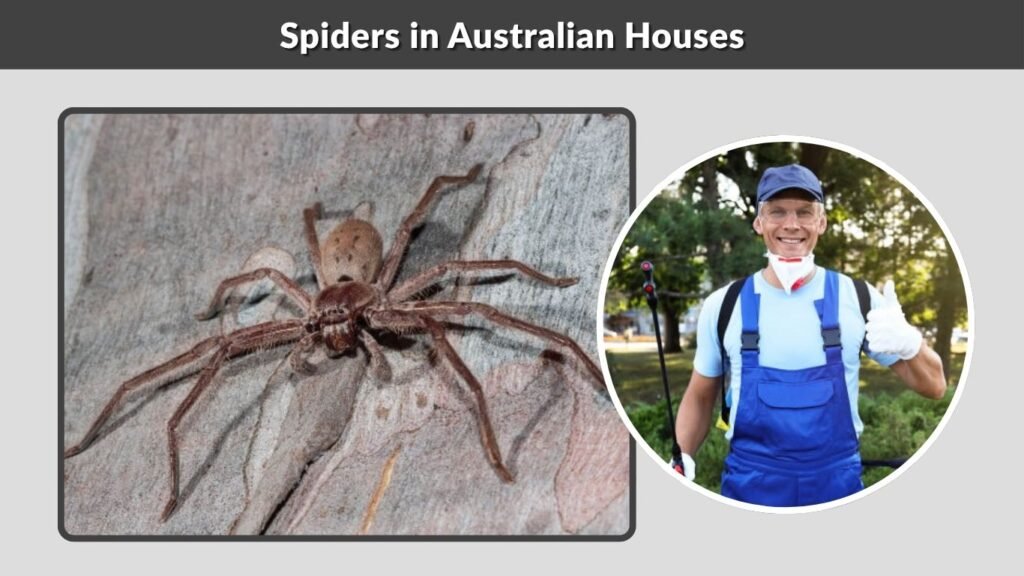
Finding a large spider on a wall can be alarming, but indoor encounters are common in parts of Australia. Houses offer sheltered spaces, and insects attracted indoors may provide food. Some spiders live around buildings permanently, while wandering species may enter accidentally while searching for prey, shelter, or mates.
Common House Visitors
Huntsman spiders are especially famous for appearing unexpectedly inside houses and even cars. Black house spiders commonly construct webs around windows and other protected areas, while daddy-long-legs spiders often occupy ceiling corners.
Huntsman spiders entering houses generally remain wandering hunters rather than establishing large webs. Australian Museum guidance describes them as fast-moving but normally non-aggressive.
What to Do When You Find a Spider
For spiders that appear harmless:
- Avoid handling them with bare hands.
- Keep children and pets away.
- Leave harmless outdoor spiders alone where practical.
- Relocate indoor spiders carefully if you can do so safely.
- Reduce clutter where spiders can hide.
- Repair gaps around doors and windows.
- Seek professional help when identification is uncertain.
Do not attempt close handling of a large unidentified black spider, particularly in areas where funnel-webs occur.
Does It Really Rain Spiders in Australia?
Reports of a rain of spiders in Australia sound fictional, but they describe a real behavior called ballooning. Spiders are not falling from clouds like ordinary rain. Instead, large numbers release silk strands that interact with air currents, allowing the spiders to travel away from their original location.
What Are Flying Spiders in Australia?
Australian “flying spiders” do not have wings. Many small spiders and spiderlings disperse through ballooning.
They climb to elevated locations, release silk strands, and can then be carried through the air. After flooding, mass ballooning events can become particularly noticeable because enormous numbers of ground-dwelling spiders may simultaneously move toward safer locations.
Why Everything Can Become Covered in Webs
During major ballooning events, thousands of individual silk strands can accumulate across grass, fences, trees, and fields.
This has happened after Australian floods, creating landscapes that appear covered in enormous sheets of webbing. It may look like millions of spiders suddenly appeared, but many were already living throughout the surrounding landscape before environmental conditions forced them to disperse.
When Is Spider Season in Australia?
There is no single spider season that applies equally across Australia. The country spans tropical, subtropical, desert, and temperate climates, so spider activity varies according to region, rainfall, temperature, prey availability, and species. However, particular spiders can become more noticeable during warmer or wetter periods when insects and spider activity increase.
Sydney Spiders
Sydney supports funnel-webs, huntsman spiders, orb weavers, redbacks, trapdoor spiders, and many smaller species. The Sydney funnel-web attracts particular attention because of its medical significance.
Garden orb weavers are also highly visible around vegetation because their large circular webs may stretch across paths and gardens.
Brisbane and Tropical Australia
Brisbane’s warmer subtropical conditions support numerous spiders throughout much of the year. Huntsman spiders, orb weavers, house-associated species, and tropical spiders may all occur around gardens and buildings.
Spider activity can change with rainfall and prey availability rather than following exactly the same seasonal pattern seen in southern Australia.
FAQs
Are spiders in Australia really that big?
Some Australian spiders are genuinely large, but online images can make them appear even bigger. Whistling spiders are among Australia’s largest, while huntsman spiders may reach around 15 cm across. Most Australian spiders are much smaller and are unlikely to resemble the giant specimens frequently shared online.
What is the biggest spider in Australia?
The Australian Museum identifies native whistling spiders, or Australian tarantulas, among the country’s largest spiders. The northern Selenocosmia crassipes can reach roughly 6 cm in body length and about 16 cm across the legs, making it considerably heavier-bodied than most familiar household spiders.
What are the most dangerous spiders in Australia?
Funnel-web spiders are among the most medically significant, particularly the Sydney funnel-web. Redback spiders can also cause painful and potentially serious envenomation. Most other Australian spiders are considered relatively harmless to people, although any bite producing severe or persistent symptoms should receive medical attention.
Why are there so many spiders in Australia?
Australia combines a huge land area with tropical, temperate, arid, forest, coastal, and urban environments. These habitats support diverse insects and other invertebrates that spiders eat. Geographic isolation has also contributed to Australia’s distinctive wildlife, allowing numerous spider groups to diversify across different ecological niches.
Does it really rain spiders in Australia?
Not literally. The phenomenon usually involves ballooning spiders releasing fine strands of silk and being carried through the air. When large numbers do this simultaneously—sometimes while escaping floods—the spiders and their silk can cover vegetation and fields, creating the dramatic impression that spiders have fallen from the sky.
