
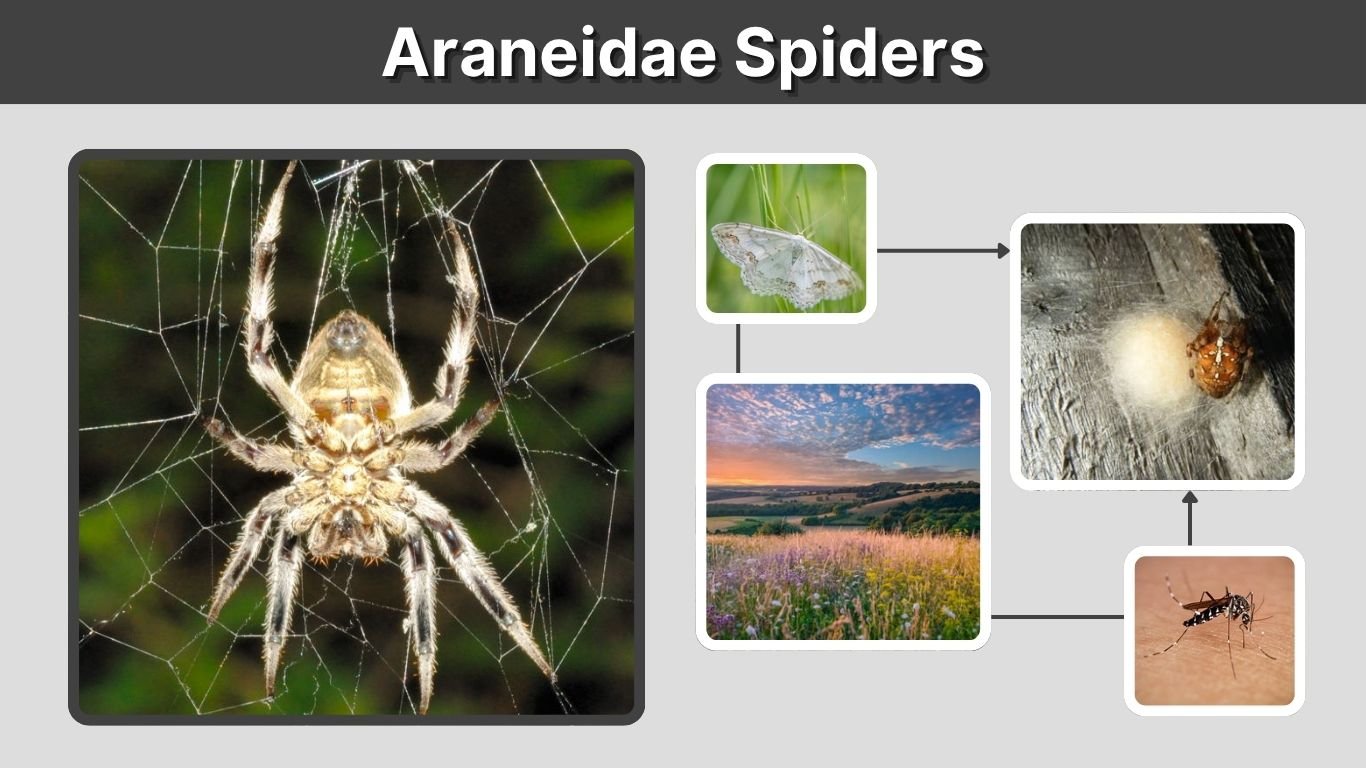
Araneidae spiders are among the most recognizable spiders in gardens, forests, fields, and backyards because of the impressive circular webs many species construct. Commonly called orb-weaver spiders, members of the Araneidae family vary dramatically in size, color, shape, and markings. Some have round abdomens, while others carry prominent spines or striking yellow patterns. Despite their sometimes intimidating appearance, these spiders are generally beneficial predators. This guide explains Araneidae spider identification, habitat, webs, diet, behavior, reproduction, lifespan, and their importance in natural ecosystems.
What Are Araneidae Spiders?
Araneidae is a large spider family commonly known as the orb-weaver family. Its members are famous for constructing the classic wheel-shaped web most people associate with spiders. The family occurs across much of the world and includes enormous diversity, ranging from tiny, inconspicuous species to colorful garden spiders with large bodies and elaborate webs.
Araneidae Family Classification
Araneidae belongs to the order Araneae within the class Arachnida. The World Spider Catalog currently recognizes about 3,181 accepted species in 200 genera in the family, making it one of the world’s largest spider families.
Some well-known groups and genera associated with Araneidae include Araneus, Argiope, Gasteracantha, Micrathena, and Cyclosa. Their appearances can be extremely different even though they share important anatomical and behavioral characteristics.
Why Are They Called Orb Weavers?
The term “orb” refers to the nearly circular shape of the web. A typical orb web contains radial threads extending outward like the spokes of a wheel and a spiral of sticky silk used to intercept flying insects.
However, not every member of Araneidae produces exactly the same web. Evolution has produced many modifications, reductions, and specialized designs within the family.
Araneidae Spider Identification
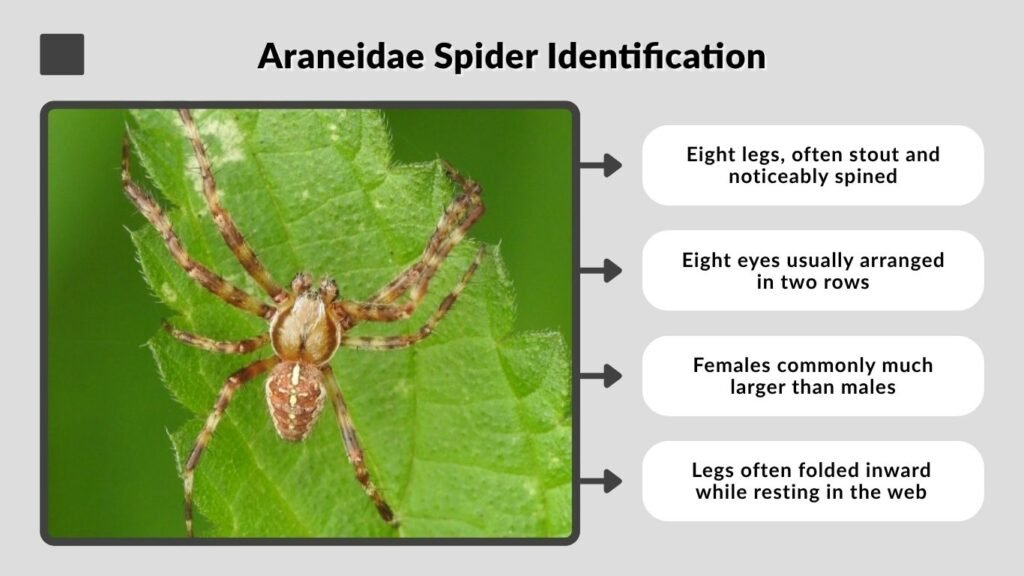
Identifying an Araneidae spider usually requires looking at body shape, leg arrangement, web structure, coloration, and sometimes microscopic anatomical features. Their diversity means there is no single color or body pattern that identifies every orb weaver. Nevertheless, several characteristics can help distinguish them from other common spiders.
Key Identification Features
- Eight legs, often stout and noticeably spined
- Eight eyes usually arranged in two rows
- Frequently large, rounded, oval, or unusually shaped abdomen
- Females commonly much larger than males
- Legs often folded inward while resting in the web
- Colors ranging from brown and gray to yellow, orange, red, white, and black
- Some species have hard abdominal spines or projections
- Many construct circular or wheel-shaped capture webs
- Spider often waits at the web’s center or in a nearby retreat
The Australasian Arachnological Society notes that Araneidae commonly have stout, strongly spined legs and characteristic arrangements of the lateral and median eyes.
Male vs. Female Araneidae Spiders
Sexual size differences can be obvious in many species. Adult females generally have larger abdomens because they produce eggs, while adult males are usually smaller and more slender.
Males also possess enlarged pedipalps near the mouth that function as reproductive organs. Mature males may spend more time searching for females and less time maintaining large prey-catching webs.
Araneidae Spider Webs and Hunting
Web building is the characteristic that made the Araneidae family famous. A large orb web can look delicate, but its architecture combines structural support with sticky capture silk. This allows the spider to intercept flying insects without actively chasing them through vegetation.
How Orb Webs Work
The spider first establishes supporting threads between branches, plants, fences, or other structures. Radial threads are then arranged around a central hub. Finally, sticky spiral silk is added across the web.
When an insect strikes the sticky spiral, vibrations travel through the web. Orb weavers generally rely heavily on these vibrations to detect and locate struggling prey rather than depending primarily on eyesight.
Some spiders sit directly at the hub. Others hide beneath a leaf or in a silk retreat connected to the web by a signal thread.
Why Do Orb Weavers Rebuild Their Webs?
Webs gradually become damaged by struggling prey, wind, rain, leaves, and debris. Many orb-weaving spiders therefore repair or reconstruct portions of their web regularly.
Web-building habits vary considerably by species. Some spiders remove and consume old silk before constructing another capture web, allowing valuable silk proteins to be reused.
Certain Argiope spiders also add conspicuous zigzag silk structures to their webs. These structures are commonly called stabilimenta, although scientists have proposed several possible functions for them.
Habitat and Distribution of Araneidae
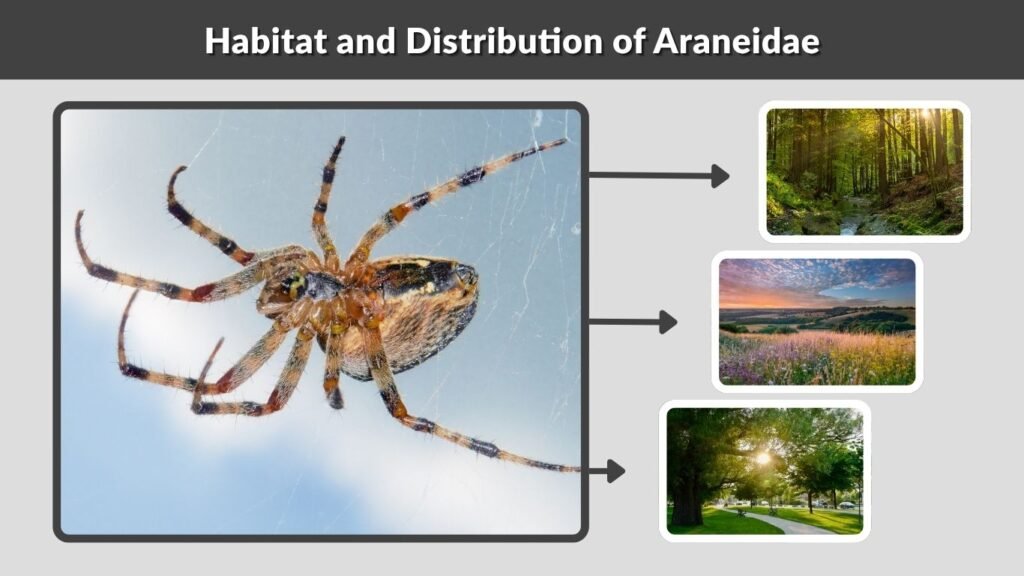
Araneidae spiders have a worldwide distribution and occupy an impressive variety of habitats. Their main requirement is usually an environment containing suitable anchor points for webs and enough insect prey to support them.
Where Do Araneidae Spiders Live?
Orb weavers are common in gardens, woodlands, meadows, farms, wetlands, parks, and forest edges. Around homes, they frequently attach webs between shrubs, fences, porch supports, deck railings, trees, and exterior structures.
Exterior lights can create particularly productive hunting sites because moths, flies, and other insects gather around artificial light at night. Utah State University notes that orb weavers are commonly noticed around buildings and ornamental vegetation, particularly during late summer and early fall.
Araneidae Spiders in Gardens
Gardens provide nearly ideal conditions for many species. Flowers and vegetation attract insects while stems, shrubs, and fences provide anchor points for large webs.
Finding an orb weaver in a garden usually indicates that a natural predator is helping control insects. Washington State University describes spiders, including orb weavers, as valuable contributors to natural pest control in gardens.
What Do Araneidae Spiders Eat?
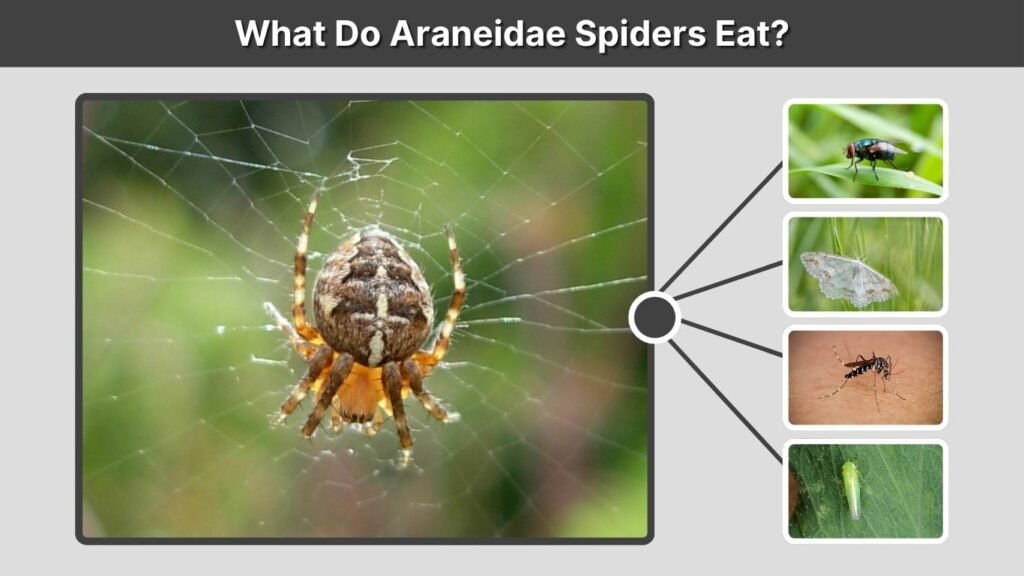
Araneidae spiders are carnivorous predators. Their diet depends on the spider’s size, habitat, web position, and whatever suitable prey becomes trapped. Because they catch numerous flying insects, they can influence local insect populations without damaging plants.
Common Prey
Flies, moths, mosquitoes, gnats, beetles, leafhoppers, small wasps, and various other insects may become caught in orb webs. Large species can occasionally subdue surprisingly substantial prey.
When an insect becomes entangled, the spider detects its vibrations, approaches, and may immobilize it with silk and venom. Digestive fluids help break down the prey before the spider consumes the liquefied material.
UC Integrated Pest Management notes that garden orb weavers mainly capture insects that fly, fall, or are blown into their webs.
Are Araneidae Spiders Beneficial?
Yes. Their predatory lifestyle means they naturally remove insects from gardens and landscapes without feeding on leaves, flowers, fruit, or other plant tissue.
They should therefore generally be considered beneficial rather than plant pests. North Carolina State Extension similarly notes that orb-weaving spiders feed on insects and can be beneficial around landscapes.
Are Araneidae Spiders Dangerous?
The large size and bright colors of some orb weavers can make them appear dangerous. However, appearance is a poor indicator of medical importance in spiders, and Araneidae are not generally regarded as a significant threat to people.
Are Araneidae Spiders Venomous?
Orb weavers use venom to immobilize prey. In that sense, they are venomous spiders rather than poisonous animals. Their venom evolved mainly to subdue insects.
Araneidae spiders are not known for medically significant bites to humans. Bites are uncommon because these spiders generally remain in or around their webs and tend to escape rather than attack people. Research reviewing orb-weaver bites describes the group as not known to cause medically significant effects in humans.
What Happens If an Orb Weaver Bites?
A bite may cause temporary localized discomfort, redness, or swelling. Individual reactions can vary, so unusual or severe symptoms should receive appropriate medical attention.
Even very large Araneidae species can be reluctant to bite. Penn State reports that Jorō spiders, for example, rarely bite and that documented effects are generally limited and short-lived.
Reproduction and Life Cycle
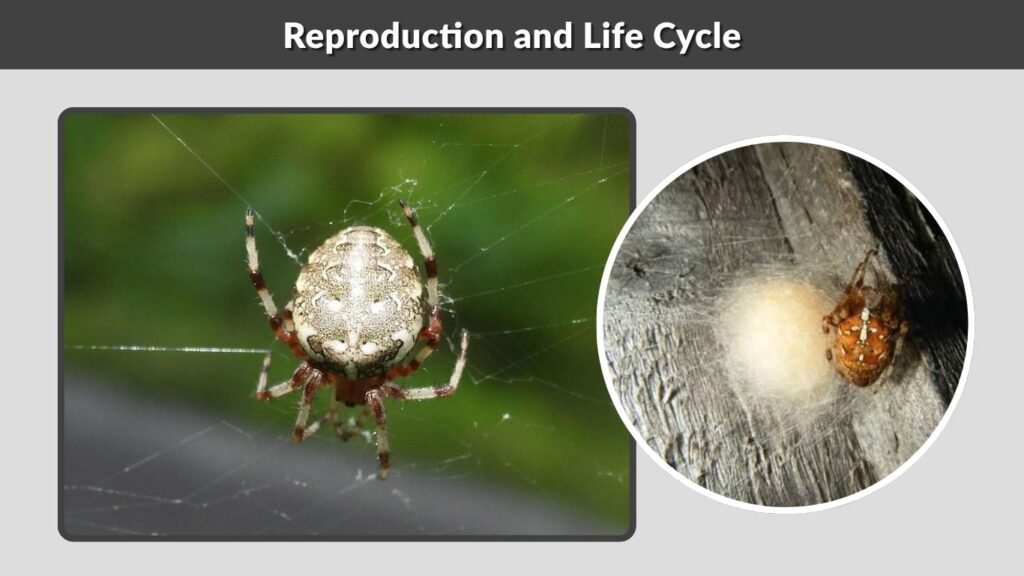
The Araneidae life cycle includes egg, spiderling, juvenile, and adult stages. Reproductive timing varies according to species and climate, but many temperate orb weavers become especially conspicuous toward the end of summer when females reach their mature size.
Mating and Egg Sacs
Adult males search for females and must approach their webs carefully because vibrations can resemble those produced by prey. Courtship signals help females distinguish potential mates.
After mating, females produce eggs and surround them with protective silk. Egg sacs may be attached to vegetation, hidden near the web, placed in sheltered crevices, or concealed among leaves, depending on the species.
From Spiderling to Adult
Young spiders emerge from their eggs and eventually disperse. Some spiderlings use silk for ballooning, allowing wind currents to carry them away from their birthplace. Spider silk can serve not only for prey-catching webs but also for egg cases, safety lines, shelters, and dispersal.
Spiderlings molt repeatedly as they grow. Their webs usually increase in size as they become capable of capturing larger prey.
In many temperate orb weavers, adults die when cold weather arrives while eggs survive inside protected sacs. The next generation emerges when favorable conditions return.
Common Types of Araneidae Spiders
The enormous diversity of the family produces some of the most distinctive spiders encountered worldwide. Familiar examples include yellow garden spiders in the genus Argiope, cross orb weavers and marbled orb weavers in Araneus, spiny-backed orb weavers in Gasteracantha, and spined species in Micrathena.
Why Their Appearance Varies So Much
Orb weavers can be tiny and brown, large and brightly colored, flattened, round, pointed, or covered with dramatic spines. Some resemble leaves or debris, while others display highly contrasting warning-like patterns.
This diversity reflects different habitats, camouflage strategies, predator defenses, reproductive strategies, and web-building lifestyles. Therefore, identifying an unfamiliar Araneidae spider by color alone is rarely reliable. Web style, body structure, geographic location, sex, and maturity should all be considered.
FAQs
Are Araneidae spiders the same as orb-weaver spiders?
Araneidae is commonly called the orb-weaver family because many members build circular orb webs. However, orb-web construction also occurs in some other spider families, so “orb weaver” does not always refer exclusively to Araneidae.
Are Araneidae spiders poisonous?
Araneidae spiders are better described as venomous rather than poisonous because they inject venom through their fangs to immobilize prey. Their bites are not generally considered medically significant to humans.
Where are Araneidae spiders commonly found?
They occur in many regions worldwide and commonly inhabit gardens, forests, meadows, parks, farmland, shrubs, and areas around buildings where there are suitable supports for webs.
What insects do Araneidae spiders eat?
Their prey includes moths, flies, mosquitoes, beetles, gnats, and many other small arthropods that become trapped in their webs. Their insect-eating behavior makes many orb weavers beneficial garden predators.
Should I remove an Araneidae spider from my garden?
Usually, there is no need. Orb weavers do not damage plants and help capture insects. If a web blocks a doorway or walkway, gently relocating the spider or removing the web may be preferable to killing a beneficial predator.
