
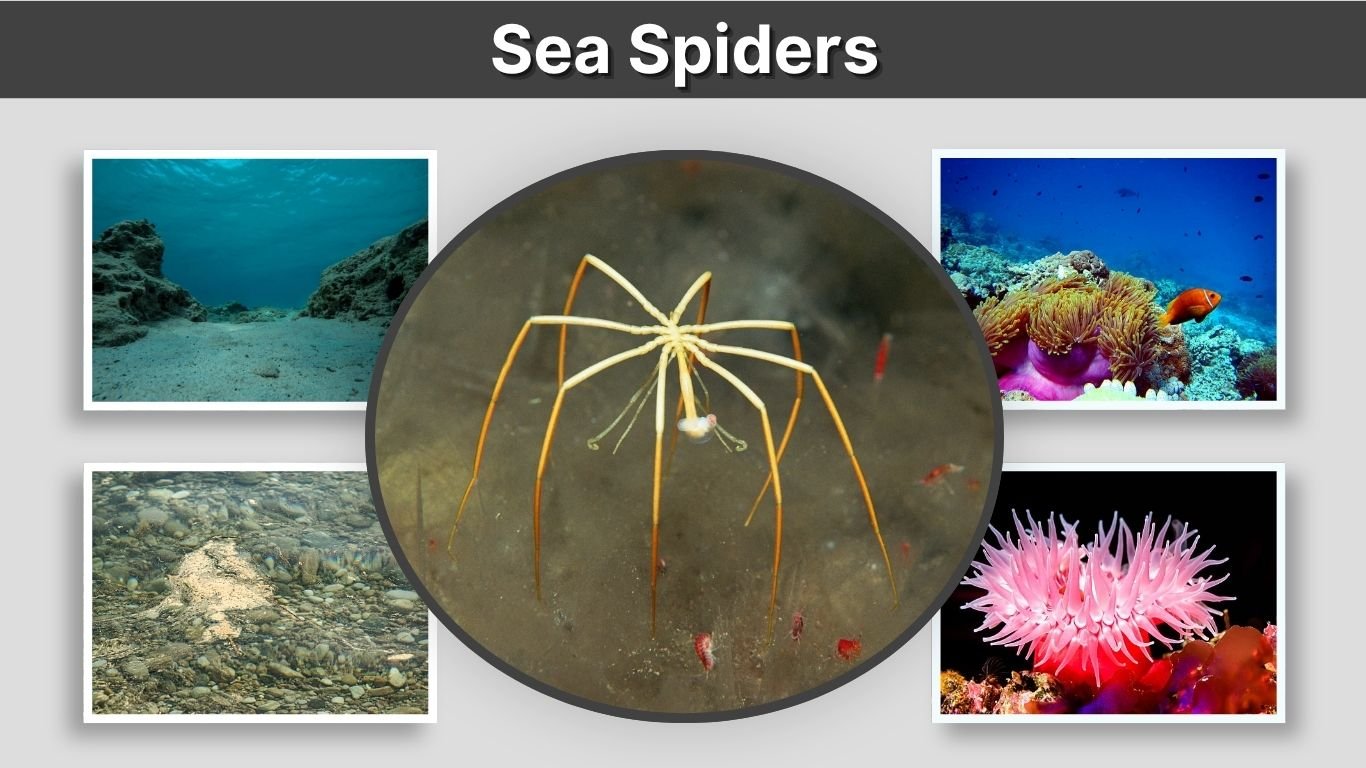
Sea spiders are strange marine animals known for extremely long legs, tiny bodies, and an appearance that resembles land spiders. Scientifically called pycnogonids, these ocean-dwelling arthropods occur from shallow coastal waters to the deep sea and polar oceans. Some are only a few millimeters across, while giant sea spiders can reach impressive leg spans. Despite their intimidating appearance, they are generally harmless to people. From Antarctic giants to newly studied methane-powered species, sea spiders have some of the most unusual adaptations found on the ocean floor.
What Are Sea Spiders?
Sea spiders are marine arthropods belonging to the class Pycnogonida. They resemble spiders because of their small central bodies and long jointed legs, but they are not true spiders of the order Araneae. They live entirely in marine environments and occur in oceans worldwide, including tropical coasts, deep-sea habitats, and the extremely cold waters surrounding Antarctica.
Quick Facts About Sea Spiders
- Scientific group: Pycnogonida
- Animal type: Marine arthropod
- Habitat: Oceans worldwide
- Typical legs: Usually four pairs of walking legs
- Diet: Mostly soft-bodied marine animals
- Body shape: Tiny central body with disproportionately long legs
- Human danger: Generally considered harmless
- Not true spiders: They are pycnogonids rather than members of Araneae
Their unusual anatomy is especially interesting because their bodies are so compact that portions of important internal systems extend into their legs.
Are Sea Spiders Actually Spiders?
The name can easily create confusion. Sea spiders certainly look spider-like, but they are a separate evolutionary group. Scientists classify them as Pycnogonida, while true spiders belong to the order Araneae. Sea spiders are marine animals and have evolved a distinctive body plan suited to living on or close to the seafloor.
Are Sea Spiders Arachnids?
Sea spiders are commonly discussed as relatives of arachnids within the larger chelicerate branch of arthropods, but they are not true arachnid spiders. The relationship and early evolutionary history of pycnogonids have long interested zoologists because their anatomy differs markedly from familiar spiders.
Calling them “sea spiders” is therefore useful as a common name, but it should not be interpreted as meaning that ordinary land spiders simply adapted to ocean life.
Are Crabs Sea Spiders?
No. Crabs are crustaceans, whereas sea spiders belong to Pycnogonida.
Although both are arthropods with jointed appendages and external skeletons, their evolutionary histories and body structures are quite different. The phrase “spiders of the sea” is sometimes casually applied to crabs because of their appearance, but it is not a scientific classification.
What Do Sea Spiders Look Like?
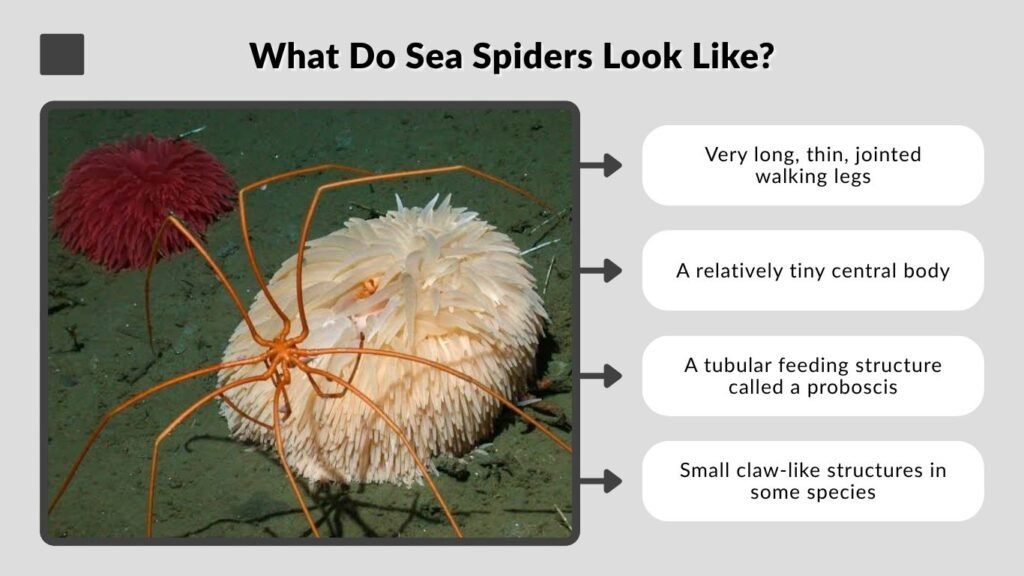
Sea spiders have one of the most recognizable body plans among marine invertebrates. Their central body can appear almost insignificant beside their legs. Depending on species, they may be pale, orange, red, yellowish, brown, or nearly transparent, helping some individuals blend into corals, sponges, and other seafloor organisms.
Sea Spider Identification
Typical features include:
- Very long, thin, jointed walking legs
- A relatively tiny central body
- A tubular feeding structure called a proboscis
- Small claw-like structures in some species
- Several pairs of walking legs
- Eyes in many species, although vision varies
- Pale or bright coloration depending on species and habitat
Most sea spiders have eight walking legs, although some groups possess additional pairs.
Their thin appearance is not simply cosmetic. Much of their anatomy extends into their legs because there is limited room inside the central body.
How Big Are Sea Spiders?
Sea spider size varies enormously. Many species are tiny and would never look frightening to a diver, while certain cold-water and deep-sea species develop exceptionally long legs. The result is an animal that can appear enormous even though its actual central body remains quite small.
Giant Sea Spiders
Some giant sea spiders can have remarkably broad leg spans. Smithsonian Ocean notes that certain deep-sea pycnogonids may grow as large as about three feet across. These animals use their long legs to move over corals and other seafloor habitats.
However, not every species becomes huge. Most sea spiders are much smaller, and the spectacular giants represent only part of the group.
Giant Sea Spiders in Antarctica
Antarctic waters are particularly famous for unusually large marine invertebrates. The British Antarctic Survey reports that the Antarctic sea spider Decolopoda australis can reach around 30 centimeters from tip to tip.
This phenomenon is often called polar gigantism. Researchers have explored several possible explanations, including cold temperatures, slow metabolism, and oxygen availability, though gigantism is not explained by one simple factor in every species.
Where Do Sea Spiders Live?
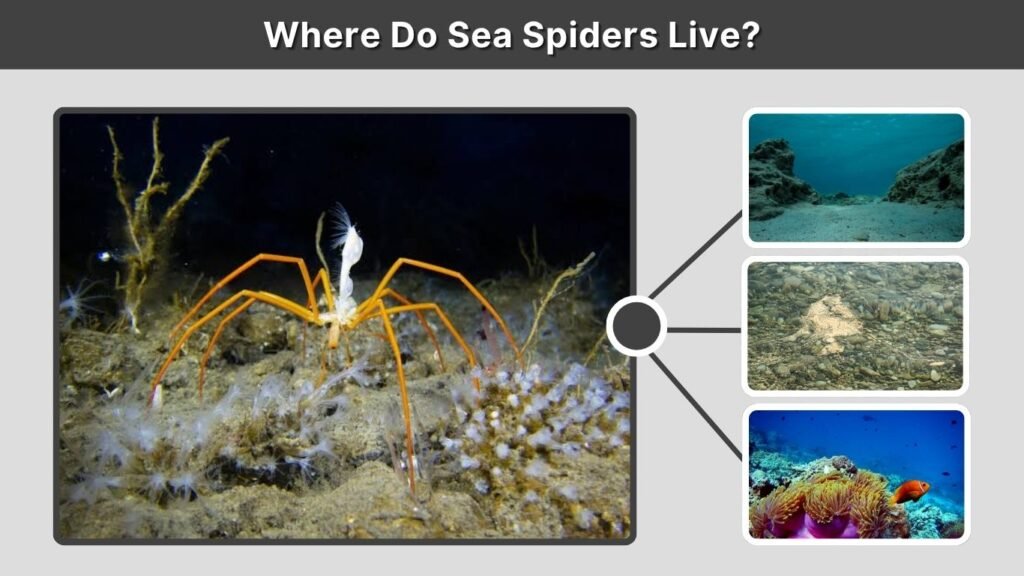
Sea spiders have an exceptionally broad distribution. They occur in marine environments around the world rather than being restricted to one ocean or climate. Different species have adapted to shallow coastal habitats, coral communities, polar seafloors, hydrothermal regions, and extreme deep-sea environments.
Common Sea Spider Habitats
Sea spiders can occur around:
- Rocky ocean floors
- Coral communities
- Sponges and hydroids
- Shallow coastal waters
- Deep-sea sediments
- Antarctic waters
- Arctic waters
- Australian coastal waters
- Methane seeps
- Hydrothermal environments
They usually crawl over the substrate or other marine organisms rather than swimming through open water.
Sea Spiders in Australia
Australian sea spiders are real and form part of the country’s diverse marine invertebrate fauna. Species occur in Australian waters from coastal environments to deeper habitats.
Seeing a sea spider does not mean beaches are suddenly becoming dangerous. These animals are marine invertebrates associated primarily with underwater habitats rather than terrestrial spiders that regularly come ashore.
Deep-Sea and Arctic Sea Spiders
Deep-sea species live under high pressure, low temperatures, and limited light. Some prey on organisms attached to deep-water corals. Smithsonian observations show giant pycnogonids feeding on deep-sea corals using their specialized mouthparts.
Sea spiders also occur in polar regions, including both Arctic and Antarctic ecosystems.
What Do Sea Spiders Eat?
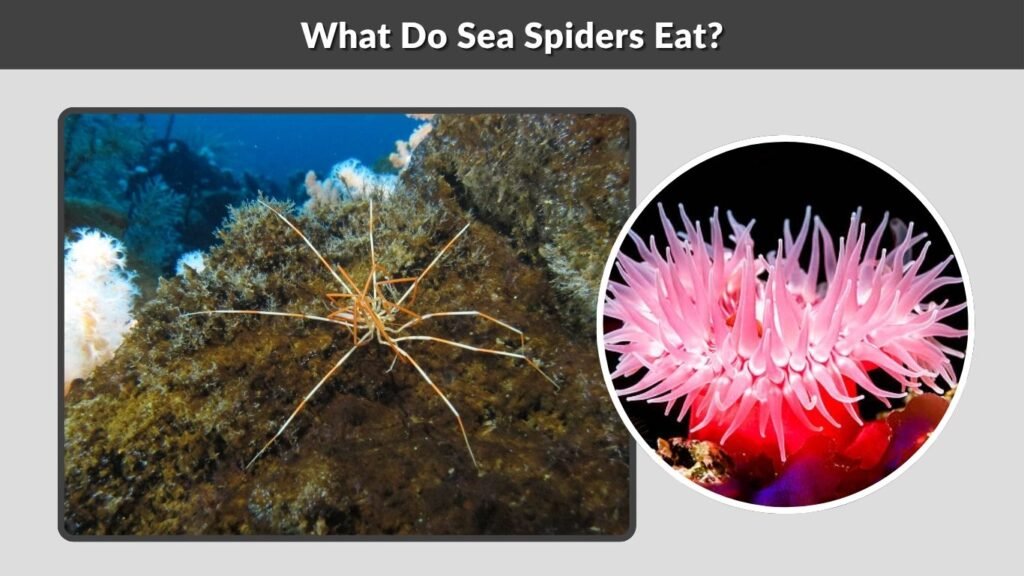
Most sea spiders feed on small or soft-bodied marine organisms. Their unusual mouthparts allow them to obtain food without chewing prey in the way many familiar terrestrial predators do. Diet varies among species, but hydroids, sea anemones, worms, sponges, bryozoans, and corals can all become food.
How Sea Spiders Feed
A sea spider generally uses its proboscis to pierce or suck material from suitable prey.
Smithsonian observations describe giant species using long, tube-like mouths to feed on soft tissues from deep-sea corals. Antarctic sea spiders may also eat soft-bodied animals such as worms and sea anemones.
This feeding behavior makes them small predators or grazers within marine ecosystems rather than web-building hunters like familiar spiders.
What Are Methane-Powered Sea Spiders?
One of the most fascinating sea spider discoveries involves species living around deep-sea methane seeps. A 2025 study investigated three undescribed species in the genus Sericosura from methane seeps along the eastern Pacific margin, including locations off California and Alaska. Researchers discovered an unusual relationship between these animals and methane-consuming microorganisms.
Do Sea Spiders Really Eat Methane?
Not directly.
Researchers found methane- and methanol-oxidizing bacteria growing on the sea spiders’ exoskeletons. Evidence indicated that the Sericosura sea spiders graze on these bacteria, allowing methane-derived carbon to ultimately enter their tissues.
In other words, the process works roughly like this:
- Methane escapes from the seafloor.
- Specialized bacteria use methane or related compounds.
- The bacteria grow on the sea spiders.
- The sea spiders consume those microorganisms.
- Methane-derived carbon becomes part of the animals’ nutrition.
The study even found similar microbes associated with egg sacs carried by males, suggesting the relationship may begin early in the animals’ lives.
How Do Sea Spiders Survive?
Sea spiders possess several remarkable adaptations for marine life. Their extremely thin bodies influence how they transport gases and nutrients, while their long legs provide considerable surface area relative to their size.
Breathing Through Their Legs
Sea spiders do not breathe using lungs like terrestrial spiders. Research on giant Antarctic forms has highlighted how oxygen can move across the surface of their legs and then be distributed through the body. Their high surface-area-to-volume ratio makes their slender limbs important to normal physiology.
Their digestive system is unusual as well, with portions extending into the legs—an adaptation highlighted in educational material from the U.S. Antarctic Program.
Male Sea Spiders Carry the Eggs
Sea spiders also have an unusual approach to reproduction. Males play an important role in caring for developing eggs, carrying them on specialized appendages after mating.
This paternal care occurs across pycnogonids and is one of their most distinctive behavioral traits. In the methane-associated Sericosura research, males were also observed carrying egg broods.
Are Sea Spiders Dangerous?
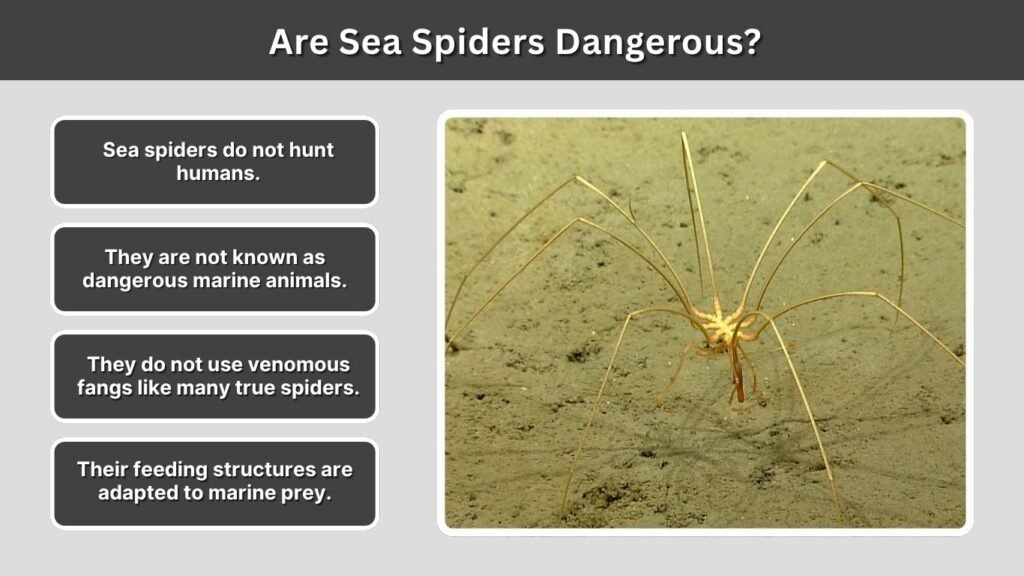
Despite their alien appearance, sea spiders are not considered a significant threat to people. They are marine animals specialized for feeding on relatively small or soft-bodied prey, and humans are far outside their normal diet.
Sea Spiders and Human Safety
Important facts include:
- Sea spiders do not hunt humans.
- They are not known as dangerous marine animals.
- They do not use venomous fangs like many true spiders.
- Their feeding structures are adapted to marine prey.
- They normally remain underwater.
- They cannot establish themselves inside houses.
- Encounters with swimmers are generally not a concern.
There is no reason to treat a sea spider like a medically significant terrestrial spider.
Do Sea Spiders Bite?
Sea spiders possess feeding structures rather than the typical fang arrangement people associate with true spiders. They use a proboscis to feed on marine organisms.
They are not known for biting swimmers or divers, and even giant sea spiders should not be viewed as human predators.
Interesting Facts About Sea Spiders
Sea spiders stand out even among the ocean’s many unusual invertebrates. Their strange anatomy, huge variation in size, unusual parenting behavior, and ability to occupy habitats from shallow seas to methane seeps make them valuable subjects for marine research.
Fascinating Sea Spider Facts
- Sea spiders belong to the class Pycnogonida.
- They are not true spiders.
- Most have extremely small bodies compared with their legs.
- Some giant forms reach extraordinary leg spans.
- Antarctic species demonstrate examples of polar gigantism.
- Their digestive system extends into their legs.
- Males commonly care for eggs.
- Some species prey on corals and other soft-bodied animals.
- They occur in oceans around the world.
- Some Sericosura species obtain nutrition indirectly from methane through bacteria.
Their appearance may resemble something from science fiction, but sea spiders are living members of real marine ecosystems.
FAQs
Are sea spiders real?
Yes. Sea spiders are real marine arthropods belonging to the class Pycnogonida. They occur in oceans worldwide, from shallow coastal habitats to deep and polar waters. Their tiny bodies and exceptionally long legs create the spider-like appearance responsible for their common name.
Are sea spiders poisonous or venomous?
Sea spiders are not known as venomous or poisonous animals that pose a significant danger to humans. Their feeding system is designed primarily for small, soft-bodied marine organisms. Unlike many true spiders, they do not depend on venomous fangs to capture prey.
How big do giant sea spiders get?
Size differs considerably between species. Many sea spiders are tiny, but some deep-sea forms develop enormous leg spans. Smithsonian Ocean reports that certain giant sea spiders can reach around three feet across, while the Antarctic Decolopoda australis reaches about 30 centimeters.
Can sea spiders live on land?
No. Sea spiders are marine animals adapted to underwater environments. Their physiology, feeding behavior, and respiration are suited to ocean life. They may occur from shallow coastal water to extreme deep-sea environments, but they are not terrestrial spiders and do not normally leave the sea to live on beaches or land.
What do sea spiders eat?
Sea spiders generally eat or extract nutrients from soft-bodied marine organisms such as hydroids, sea anemones, worms, sponges, bryozoans, and corals. Some Sericosura sea spiders have an even stranger diet: they graze on methane-consuming bacteria growing on their own bodies.
