
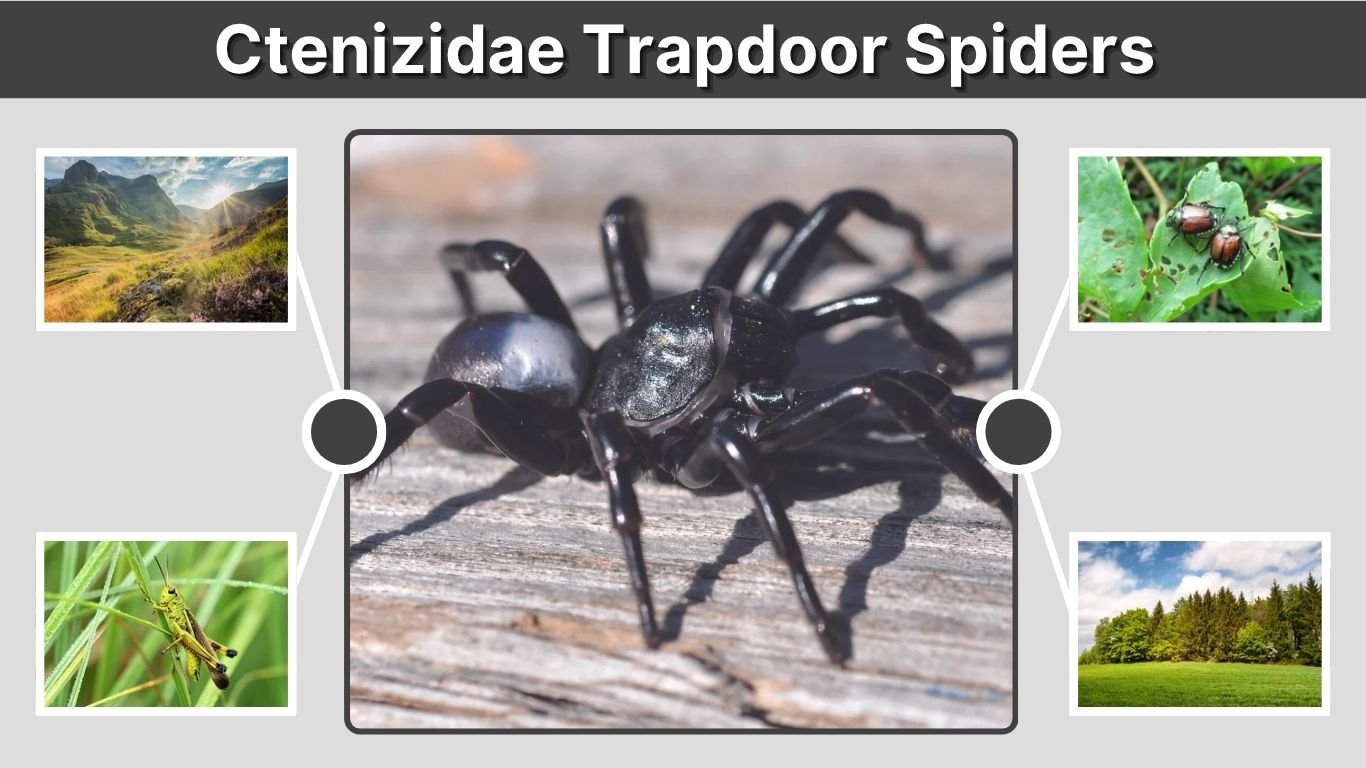
Ctenizidae trapdoor spiders are secretive, ground-dwelling spiders famous for constructing silk-lined burrows sealed with camouflaged, cork-like doors. Rather than building exposed webs to capture food, they remain hidden underground and rush out when prey approaches the entrance. Ctenizidae belongs to the mygalomorph spiders, a group that also includes tarantulas. Modern taxonomy has greatly narrowed this family compared with older classifications. This guide explains their identification, burrows, habitat, diet, hunting behavior, life cycle, venom, and other fascinating facts.
What Are Ctenizidae Trapdoor Spiders?
Ctenizidae is a family of mygalomorph spiders commonly associated with cork-lid trapdoor burrows. The family was historically much larger, so older books and websites may place many unrelated trapdoor spiders within Ctenizidae. Modern classifications recognize a much narrower group. The World Spider Catalog currently lists only two genera and six accepted species in the family.
Ctenizidae Classification
The basic classification includes:
- Kingdom: Animalia
- Phylum: Arthropoda
- Class: Arachnida
- Order: Araneae
- Infraorder: Mygalomorphae
- Family: Ctenizidae
- Main genera: Cteniza and Cyrtocarenum
The family was substantially reorganized after taxonomic research separated several former members into other families.
Are All Trapdoor Spiders Ctenizidae?
No. “Trapdoor spider” is a general name applied to spiders from several families that build burrows with doors or similar entrances.
Families containing trapdoor-building species include Halonoproctidae, Idiopidae, Euctenizidae, Antrodiaetidae, Cyrtaucheniidae, and others. Therefore, a spider that builds a trapdoor is not automatically a member of Ctenizidae.
What Do Ctenizidae Spiders Look Like?
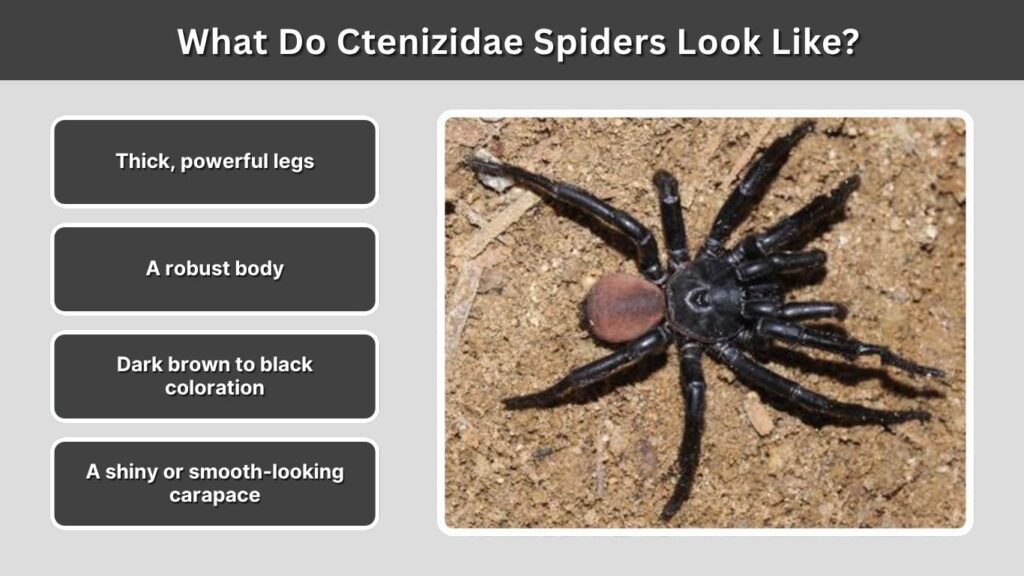
Ctenizidae spiders have the sturdy appearance typical of many mygalomorphs. Their bodies are compact and powerful, with strong legs designed for digging and holding prey. Coloration is usually dark brown, reddish brown, or nearly black, allowing them to blend easily with soil. Females typically spend most of their lives within burrows and are rarely seen above ground.
Key Identification Features
Ctenizidae trapdoor spiders generally have:
- Thick, powerful legs
- A robust body
- Dark brown to black coloration
- A shiny or smooth-looking carapace
- Strong downward-pointing fangs
- Compact mouthparts
- Digging adaptations on the legs
- Relatively small eyes compared with many hunting spiders
Male vs. Female Trapdoor Spiders
Females are generally heavier-bodied and strongly adapted to a life underground. Once they construct a suitable burrow, they may remain associated with it for long periods.
Adult males become more mobile after reaching maturity. Instead of permanently remaining in their original burrows, they may wander in search of receptive females, making males more likely to be encountered above ground.
How Do Ctenizidae Trapdoor Spiders Build Burrows?
The remarkable burrow is the feature that gives these spiders their common name. A spider excavates soil and lines the tunnel with silk, producing a sheltered retreat with stable walls. At the surface, it constructs a thick hinged door from silk, soil, and nearby natural material, helping the entrance blend almost perfectly with its surroundings.
Structure of a Trapdoor Burrow
A typical burrow may include:
- A vertical or slightly angled tunnel
- Silk covering the interior walls
- A strong hinged entrance
- Soil incorporated into the door
- Vegetation or debris used for camouflage
- Silk around the entrance that detects vibrations
The exact burrow design varies between species and local soil conditions.
How the Trapdoor Works
The door functions as both camouflage and protection. When closed, it may look almost identical to the surrounding soil.
The spider waits directly beneath it and senses vibrations produced by nearby animals. When suitable prey approaches, the spider rapidly pushes the door open, grabs the prey, and retreats underground. Cteniza sauvagesi is well known for this classic cork-lid hunting strategy.
Where Do Ctenizidae Trapdoor Spiders Live?
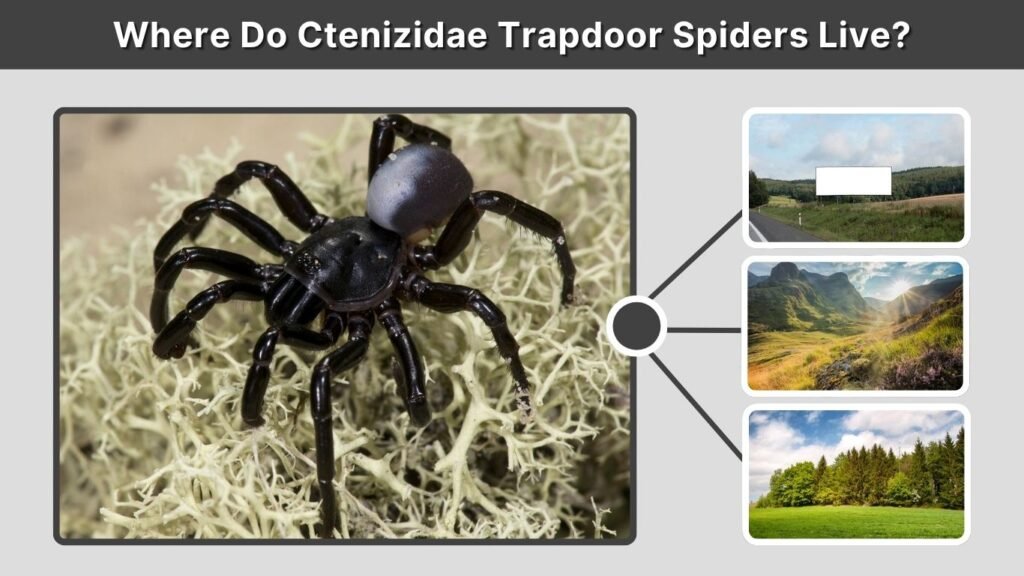
Modern Ctenizidae has a much more restricted distribution than older descriptions of the family might suggest. Current members occur primarily around parts of the Mediterranean region. Species inhabit areas where suitable soil allows permanent burrows to be constructed and where enough insects and other small animals occur near the ground to support ambush hunting.
Ctenizidae Distribution
Recognized species occur in areas including:
- Italy
- Corsica
- Greece
- Crete
- Rhodes
- Parts of Turkey
- Other localized Mediterranean areas
For example, Cteniza sauvagesi is recorded from Corsica and Italy, while Cyrtocarenum cunicularium occurs in Greece and Turkey.
Preferred Habitat
These spiders favor environments where soil remains stable enough for burrow construction. Roadside banks, slopes, scrubland, woodland edges, and other relatively undisturbed ground can provide suitable conditions.
Because females remain concealed, populations can exist in an area without being obvious to people walking nearby.
What Do Ctenizidae Trapdoor Spiders Eat?
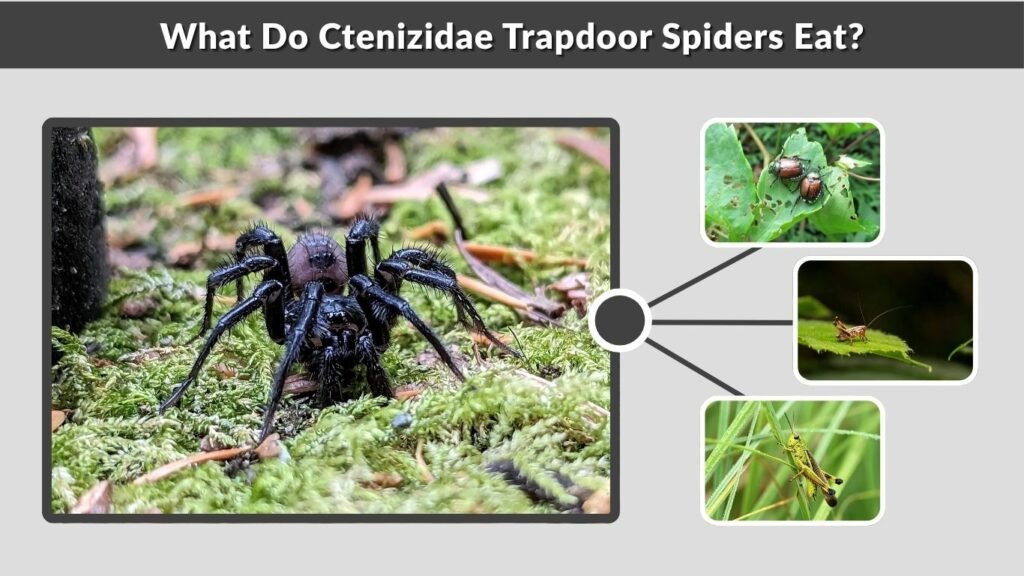
Ctenizidae spiders are ambush predators. They do not normally chase prey across large areas or construct sticky aerial webs. Instead, they exploit vibrations around their burrow entrance. This allows them to conserve energy while remaining protected underground, emerging only when potential food moves close enough to capture safely and quickly.
Common Prey
Potential prey includes:
- Beetles
- Crickets
- Cockroaches
- Grasshoppers
- Other spiders
- Caterpillars
- Small ground-dwelling arthropods
- Various insects passing the burrow
How Do They Hunt?
The spider positions itself beneath the closed or slightly raised trapdoor and monitors vibrations through its legs.
When prey comes within reach, it bursts from the entrance, seizes the animal with its powerful front legs and fangs, and pulls it into the burrow. The spider then feeds safely underground rather than remaining exposed to predators.
Are Ctenizidae Trapdoor Spiders Venomous?
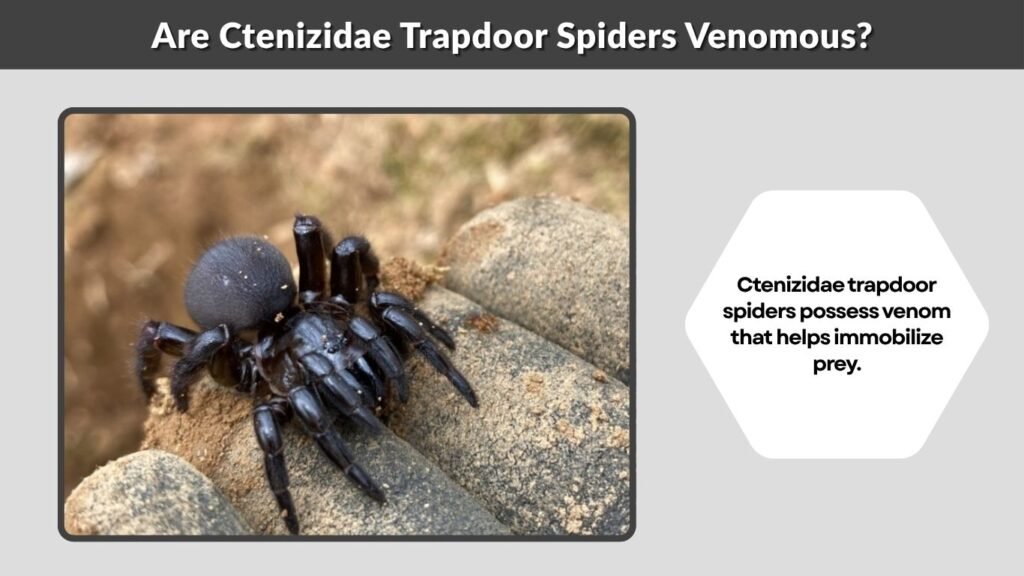
Like most spiders, Ctenizidae trapdoor spiders possess venom that helps immobilize prey. However, having venom does not automatically mean a spider is dangerously venomous to humans. These spiders spend most of their lives underground and normally have little reason to interact with people unless they are dug up, handled, or disturbed.
Do Ctenizidae Trapdoor Spiders Bite?
They are physically capable of biting, particularly if trapped or handled defensively. Their large fangs could also make a bite mechanically painful.
However, these spiders are secretive rather than actively aggressive toward humans. Avoid handling unidentified trapdoor spiders, and seek medical advice if any spider bite causes severe pain, spreading swelling, breathing difficulty, or other concerning symptoms.
Ctenizidae Life Cycle and Reproduction
The underground lifestyle continues through much of a Ctenizidae spider’s life. Females remain closely associated with their burrows, while mature males eventually leave their retreats to locate females. Reproduction therefore requires the wandering male to find a hidden female’s entrance and communicate without immediately being mistaken for prey.
Mating at the Trapdoor
When a male locates a female’s burrow, he may use vibrations or tapping movements to announce his presence.
In Cteniza sauvagesi, males have been observed signaling at the entrance before the female emerges. This behavior helps distinguish a potential mate from an ordinary insect moving near the burrow.
Young Trapdoor Spiders
After mating, females produce eggs within the protection of the burrow. Young spiders eventually disperse and must establish retreats of their own.
As juveniles grow, their burrows can be enlarged and reinforced, allowing them to remain protected while they pass through multiple molts on the way to adulthood.
Interesting Facts About Ctenizidae Spiders
Ctenizidae spiders demonstrate how successfully a predator can adapt to a largely stationary lifestyle. Their camouflage, silk engineering, vibration sensitivity, and explosive ambush strategy allow them to capture prey while spending remarkably little time exposed above ground. Their changing scientific classification is also a good example of how modern research continues to reshape spider taxonomy.
Quick Ctenizidae Facts
- Ctenizidae belongs to the infraorder Mygalomorphae.
- Members construct silk-lined underground burrows.
- Their doors can resemble cork-like plugs.
- Soil and vegetation help camouflage burrow entrances.
- They detect prey mainly through vibrations.
- Females spend much of their lives underground.
- Mature males wander in search of females.
- They use venom to subdue prey.
- Not every trapdoor spider belongs to Ctenizidae.
- Modern Ctenizidae is much smaller than the historically recognized family.
- The World Spider Catalog currently recognizes two genera in Ctenizidae.
FAQs
1. What are Ctenizidae trapdoor spiders?
Ctenizidae is a family of mygalomorph spiders best known for constructing silk-lined burrows covered by thick, camouflaged trapdoors. Modern taxonomy recognizes a much smaller Ctenizidae than older classifications did, with current members concentrated mainly in the Mediterranean region and placed in the genera Cteniza and Cyrtocarenum. wsc.nmbe.ch
2. Are Ctenizidae trapdoor spiders dangerous?
Ctenizidae spiders possess venom for capturing prey, but they are secretive animals that normally remain inside underground burrows. They do not actively seek interactions with people. A defensive bite may be painful because of their substantial fangs, so these spiders should be observed rather than handled.
3. What do Ctenizidae trapdoor spiders eat?
Ctenizidae trapdoor spiders primarily prey on insects and other small arthropods that move near their burrows. Beetles, crickets, cockroaches, caterpillars, and similar ground-dwelling animals can become prey. The spider detects vibrations, rapidly emerges through its trapdoor, captures the animal, and retreats underground to feed.
4. Where do Ctenizidae spiders live?
Under the current classification, Ctenizidae species are found mainly around the Mediterranean, including parts of Italy, Corsica, Greece, and Turkey. Individual species have restricted distributions. They typically occupy soils suitable for building stable silk-lined burrows and concealed trapdoors.
5. Do all trapdoor spiders belong to Ctenizidae?
No. Trapdoor-building behavior evolved in several spider families, so “trapdoor spider” is a broader ecological name rather than another name exclusively for Ctenizidae. Families such as Halonoproctidae, Idiopidae, Euctenizidae, and Antrodiaetidae also contain spiders that construct burrows with concealed entrances.
