
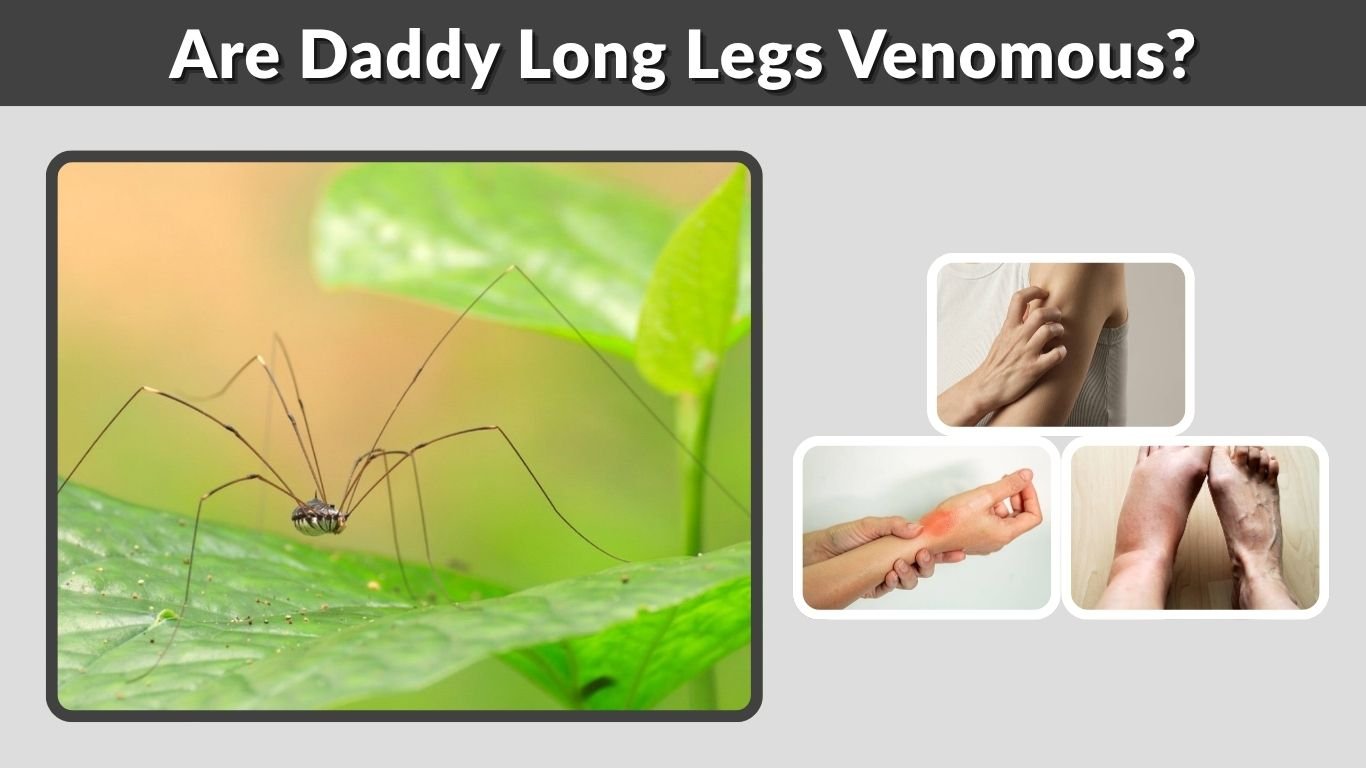
Daddy long legs are surrounded by one of the most persistent spider myths: that they are extremely venomous but cannot bite humans because their fangs are too small. In reality, the answer depends on which animal you call a “daddy long legs.” Harvestmen, cellar spiders, and even crane flies may share this nickname, yet they are very different creatures. So, are daddy long legs venomous? Most pose little or no danger to people, pets, or homes.
Are Daddy Long Legs Venomous?
The term daddy long legs does not refer to one single species. Depending on where you live, it may describe harvestmen, cellar spiders, or crane flies. This distinction matters because their ability to produce venom differs considerably. Despite frightening stories about their supposed toxicity, daddy long legs are generally considered harmless to people under normal circumstances.
Harvestmen Do Not Have Venom
Harvestmen belong to the order Opiliones. Although their long legs and small bodies make them look similar to spiders, they are not true spiders.
Important facts include:
- Harvestmen do not possess venom glands.
- They do not have spider-style fangs.
- Their bodies appear as one compact oval rather than two clearly separated sections.
- They mainly eat small insects, decaying organic material, fungi, and plant matter.
- They are not considered medically dangerous to humans.
Therefore, if the daddy long legs you see outdoors is a harvestman, the simple answer is no—it is not venomous.
Cellar Spiders Do Produce Venom
Cellar spiders are true spiders belonging to the family Pholcidae. These are often found hanging upside down in messy webs in basements, garages, ceilings, sheds, and quiet corners.
Unlike harvestmen, cellar spiders possess venom because they use it to capture small prey.
However, having venom does not automatically mean an animal is dangerous to humans. Cellar spider venom is primarily useful for subduing insects and other small arthropods.
Flying Daddy Long Legs Are Not Venomous
Crane flies are another animal commonly called daddy long legs, particularly in the United Kingdom and other regions.
Crane flies:
- Are insects rather than spiders.
- Have six legs and wings.
- Do not have venom glands.
- Do not sting people.
- Generally do not bite humans.
- Often appear around lights during warmer months.
Adult crane flies may look like enormous mosquitoes, but they are not giant venomous mosquitoes.
Are Daddy Long Legs the Most Venomous Spiders?
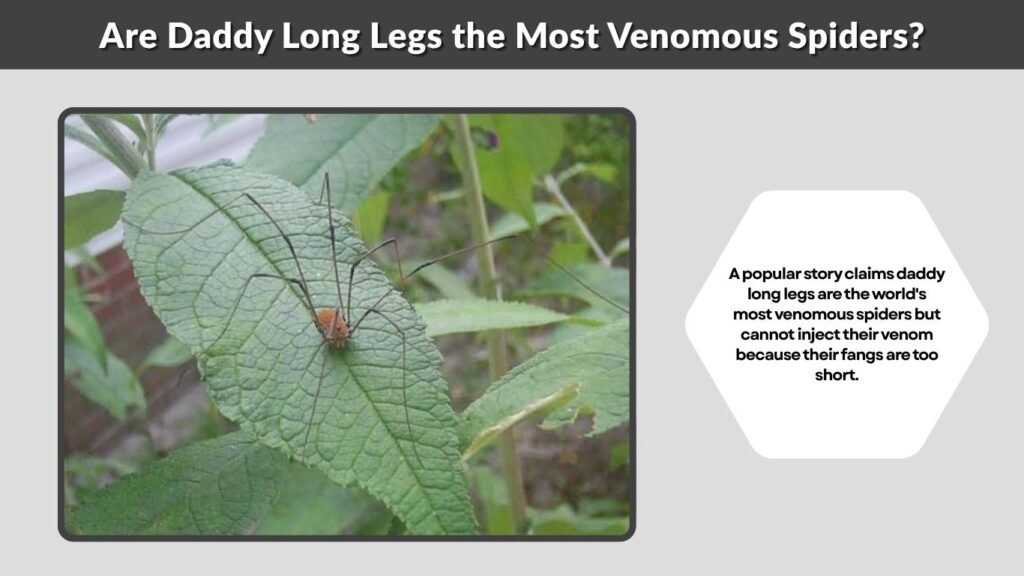
A popular story claims daddy long legs are the world’s most venomous spiders but cannot inject their venom because their fangs are too short. This claim has been repeated for decades, yet it combines several misunderstandings. Harvestmen have no venom at all, while cellar spiders have venom but are not known for causing dangerous bites in humans.
Where the Venom Myth Comes From
The exact origin of the myth is difficult to identify. It may have developed because cellar spiders successfully capture other spiders in their webs, sometimes including species that people consider more intimidating.
Seeing a thin, fragile-looking cellar spider overpower another spider can make its venom appear extraordinarily powerful.
However, effectiveness against another arthropod does not tell us how dangerous venom will be to humans. Venoms can have very different effects depending on the prey or animal involved.
Are They More Venomous Than Black Widows?
Daddy long legs should not be described as more venomous than black widow spiders.
Black widows possess medically significant venom capable of producing serious symptoms in people. The reputation of daddy long legs as an exceptionally venomous spider is not supported simply by the fact that cellar spiders can capture other spiders.
Comparisons should also consider:
- Venom composition
- Amount of venom delivered
- Bite mechanics
- Effects on humans
- Sensitivity of different animals
A spider’s ability to kill another arthropod does not automatically make its venom exceptionally dangerous to humans.
Can Daddy Long Legs Bite Humans?
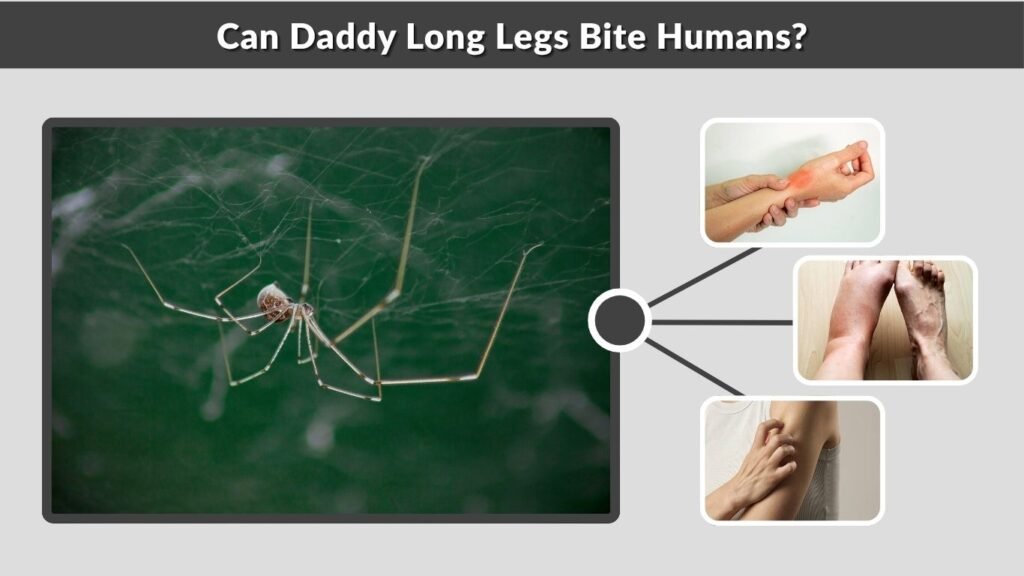
Whether daddy long legs can bite depends again on which animal is being discussed. Harvestmen lack the venom-delivering fang system of true spiders, while cellar spiders possess small fangs capable of interacting with prey. Nevertheless, encounters with humans rarely lead to meaningful medical problems, and these long-legged creatures usually prefer retreat over confrontation.
Can Cellar Spiders Bite?
Cellar spiders have mouthparts used to capture and feed on prey. Their fangs are not magically incapable of interacting with human skin, so the claim that their fangs are always “too short to bite” is misleading.
Even so, cellar spiders are not aggressive toward people.
They normally remain in their webs and may vibrate rapidly when disturbed rather than attempting to defend themselves by biting.
What Happens If One Bites?
A rare spider bite may cause mild, temporary irritation around the affected area.
Possible localized reactions can include:
- Mild redness
- Minor discomfort
- Slight swelling
- Temporary itching or irritation
Many skin marks blamed on spiders are never actually confirmed spider bites. Mosquito bites, flea bites, skin irritation, allergic reactions, and other causes can produce similar-looking marks.
Severe or rapidly worsening symptoms should receive medical attention regardless of what caused the suspected bite.
Are Daddy Long Legs Venomous to Pets?
Cats and dogs often investigate insects and spiders they encounter around the house. Fortunately, daddy long legs are not generally considered an important poisoning threat to household pets. Harvestmen lack venom, while cellar spiders possess venom intended for small prey rather than large mammals such as cats, dogs, or humans.
Are Daddy Long Legs Venomous to Cats?
A cat may chase, paw at, or occasionally eat a cellar spider or harvestman.
In most ordinary situations, encountering one is unlikely to create a serious venom problem.
Still, owners should monitor their cats whenever unusual symptoms appear after eating or interacting with an unidentified arthropod.
Are Daddy Long Legs Venomous to Dogs?
Dogs may also investigate or swallow small spiders and insects.
Watch for unusual symptoms such as:
- Persistent vomiting
- Significant facial swelling
- Excessive drooling
- Difficulty breathing
- Severe weakness
- Obvious pain
These symptoms are not typical of ordinary daddy long legs encounters and could indicate another problem. Veterinary advice is appropriate if significant symptoms appear.
How to Identify Different Daddy Long Legs
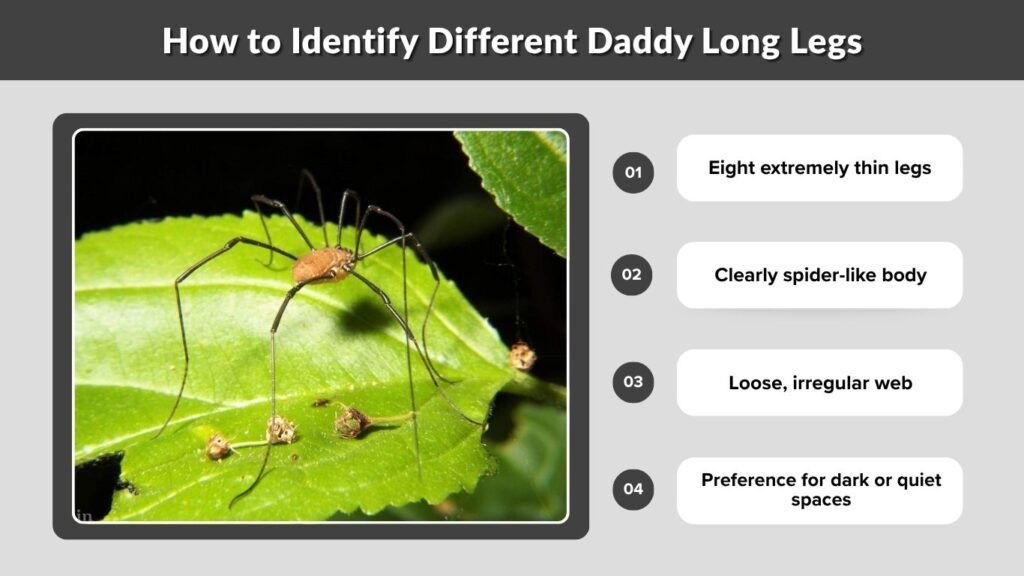
Because several unrelated creatures share the same common name, identification is the easiest way to understand whether the animal has venom. Examine its body shape, number of legs, presence of wings, and whether it lives in a web. Those characteristics can quickly separate harvestmen, cellar spiders, and crane flies.
Harvestman Identification
Harvestmen typically have extremely long legs surrounding a compact-looking body.
Look for:
- Eight legs
- One apparently fused body section
- No web used for capturing prey
- Frequent outdoor activity
- Small oval body
They commonly occur in gardens, wooded areas, under logs, around vegetation, and near buildings.
Cellar Spider Identification
Cellar spiders often look more delicate than harvestmen and usually stay around webs.
Common characteristics include:
- Eight extremely thin legs
- Clearly spider-like body
- Loose, irregular web
- Preference for dark or quiet spaces
- Rapid web vibration when disturbed
They frequently appear in basements, garages, storage areas, crawl spaces, and ceiling corners.
Crane Fly Identification
Crane flies are easy to distinguish because they have wings.
Typical characteristics include:
- Six long legs
- One pair of visible wings
- Slender insect body
- Ability to fly
- Attraction to lights
If the “daddy long legs” is flying around your room, it is probably a crane fly rather than a spider.
Are Daddy Long Legs Dangerous in the House?
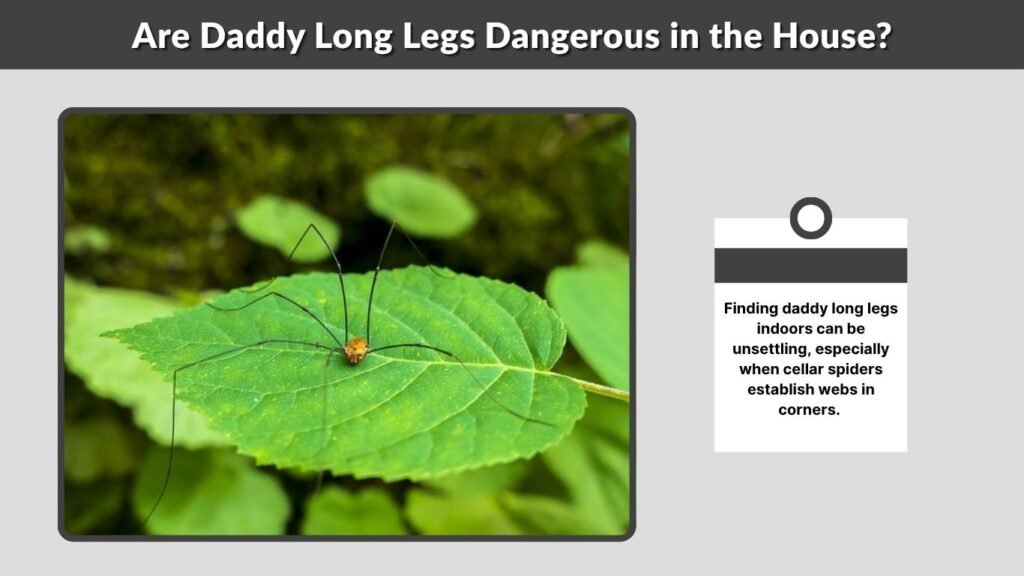
Finding daddy long legs indoors can be unsettling, especially when cellar spiders establish webs in corners. However, their presence normally represents more of a nuisance or housekeeping issue than a serious health threat. Cellar spiders may actually capture flies, mosquitoes, moths, and other small arthropods that enter the home.
Why Cellar Spiders Enter Homes
Cellar spiders prefer protected locations where they can build webs without frequent disturbance. Basements, closets, garages, attics, and corners often provide suitable conditions.
A large number of spiders may also indicate that sufficient insect prey is available nearby.
Reducing insect activity, removing unnecessary clutter, sealing openings, and periodically cleaning old webs can make indoor environments less attractive.
Should You Remove Them?
Removal is mainly a matter of personal preference.
Individual spiders can usually be captured with a container and released outside when appropriate. Regular vacuuming also removes abandoned webs and egg sacs.
Preventive measures include sealing gaps around windows and doors, repairing damaged screens, controlling moisture, and reducing insects attracted to indoor lights.
FAQs
1. Are daddy long legs actually venomous?
It depends on the animal. Harvestmen do not have venom glands, while cellar spiders do possess venom for capturing small prey. Crane flies, which are also sometimes called daddy long legs, are not venomous.
2. Are daddy long leg spiders venomous to humans?
Cellar spiders have venom, but they are not generally considered medically dangerous to humans. They are non-aggressive and rarely have problematic interactions with people.
3. Is it true that daddy long legs are the most venomous spiders?
No reliable evidence supports the popular claim that daddy long legs are the world’s most venomous spiders. Harvestmen are not venomous at all, while cellar spiders have venom primarily adapted for small arthropod prey.
4. Are daddy long legs poisonous or venomous?
“Venomous” describes an animal that delivers toxins through structures such as fangs or stingers, while “poisonous” generally refers to toxins that cause harm when touched or consumed. Cellar spiders have venom; harvestmen do not possess spider venom.
5. Are Australian daddy long legs venomous?
In Australia, “daddy long legs” often refers to cellar spiders. These spiders possess venom for capturing prey, but they are not generally regarded as a significant danger to humans during normal household encounters.
