
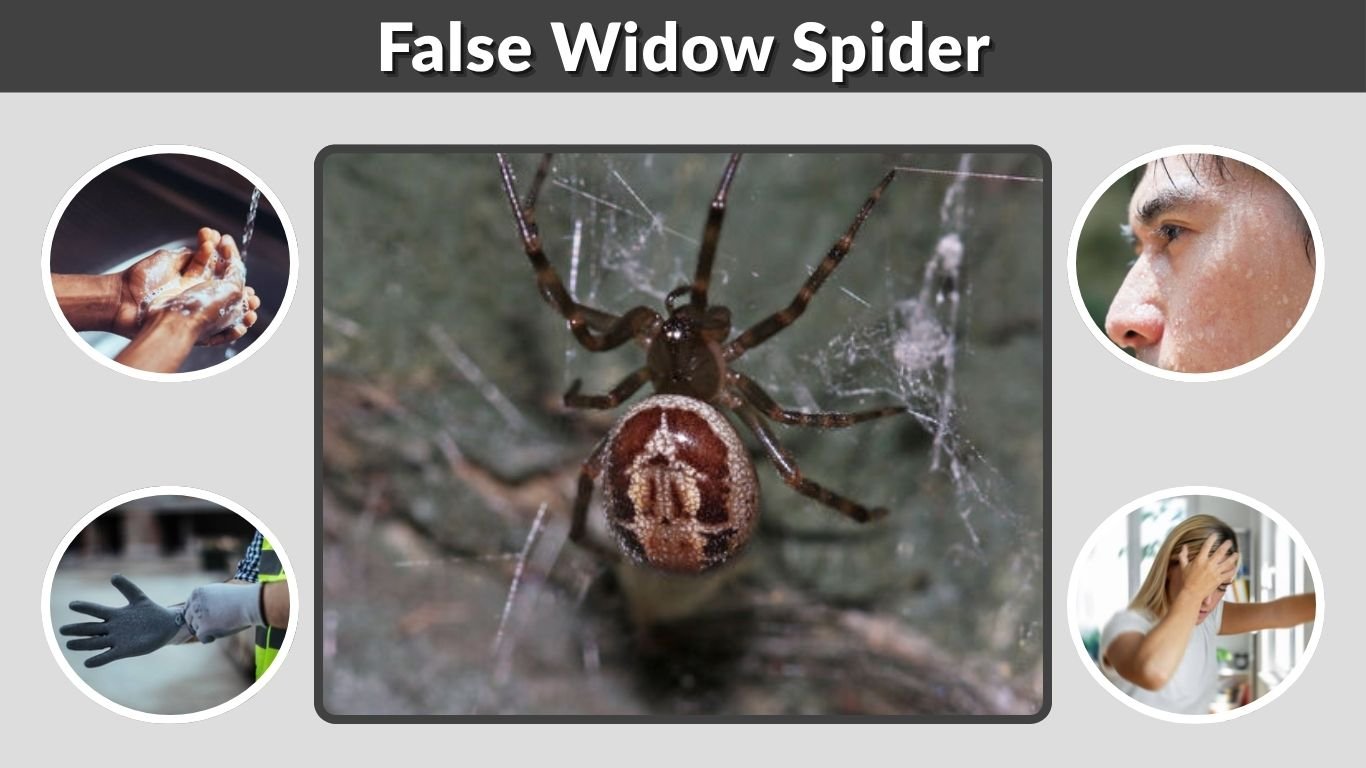
False widow spiders are dark, glossy cobweb spiders in the genus Steatoda that resemble true black widows but usually cause less serious bites. Several species live around buildings, including the noble false widow, cupboard spider, and rabbit hutch spider. Most bites cause temporary pain, redness, and swelling, but stronger reactions occasionally occur. Accurate identification matters because harmless spiders, skin infections, and true widows may be confused with them. This guide covers identification, symptoms, first aid, comparison, and safe removal from homes.
What Is a False Widow Spider?
“False widow” refers to several Steatoda species in the cobweb spider family, Theridiidae. They are related to black widows but belong to a different genus. False widows are venomous, meaning they inject venom when biting, but they are not poisonous to touch.
Common False Widow Species
- Noble false widow: Steatoda nobilis
- Cupboard spider: Steatoda grossa
- Rabbit hutch spider: Steatoda bipunctata
- Triangulate cobweb spider: Steatoda triangulosa
- False katipo: Steatoda capensis
The noble false widow receives the most attention because it is relatively large, lives around buildings, and can produce a medically significant bite. Even so, it normally retreats when disturbed and does not deliberately pursue people.
How to Identify a False Widow Spider
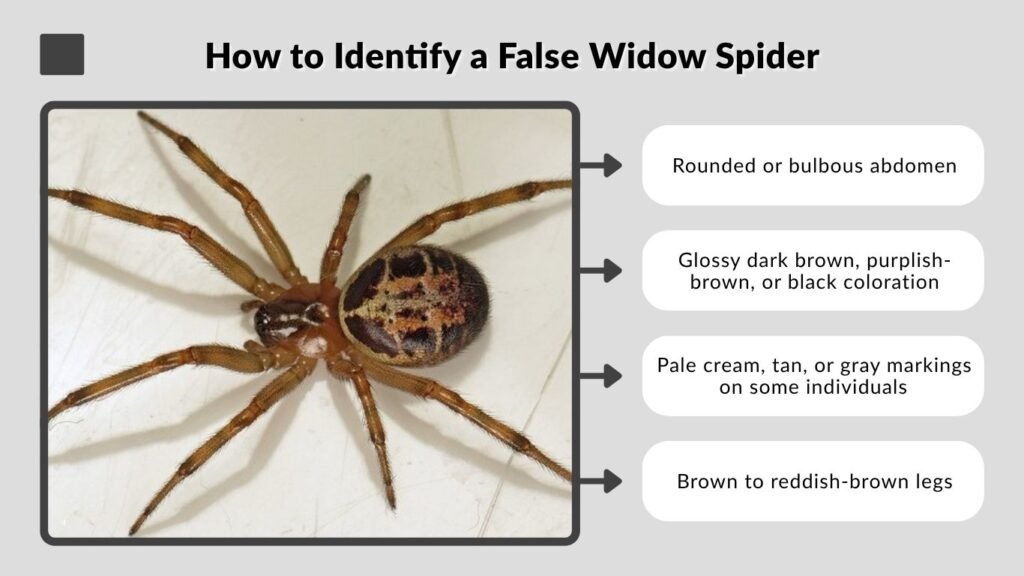
False widows have rounded abdomens, relatively slender legs, and glossy bodies. Color and markings vary with species, sex, age, and recent feeding, so identification should never depend on one feature or an online picture alone.
General Identification Features
- Rounded or bulbous abdomen
- Glossy dark brown, purplish-brown, or black coloration
- Pale cream, tan, or gray markings on some individuals
- Brown to reddish-brown legs
- Relatively small body compared with its leg span
- Irregular three-dimensional cobweb
- Habit of hanging upside down in the web
- No dependable red hourglass beneath the abdomen
Young true widows can also be brown and patterned. An experienced arachnologist, extension service, museum, or pest professional should confirm uncertain specimens.
Noble False Widow Identification
Adult female noble false widows have a body length of approximately 8.5 to 14 millimeters, excluding the legs. Males are usually 7 to 10 millimeters long and have slimmer abdomens.
The abdomen often displays a pale pentagon-shaped pattern sometimes described as a skull. However, the marking can fade or disappear in darker females. The legs are usually uniformly reddish-brown, and a pale band may cross the front of the abdomen.
Male False Widow Spider
Males are generally smaller and less rounded than mature females. Their legs appear longer relative to the body, and abdominal markings may be clearer.
Male false widows wander more frequently while searching for females, which makes them more likely to appear indoors. Their smaller size usually limits the amount of venom they can deliver, although they should still not be handled.
False Widow Spider Web and Egg Sac
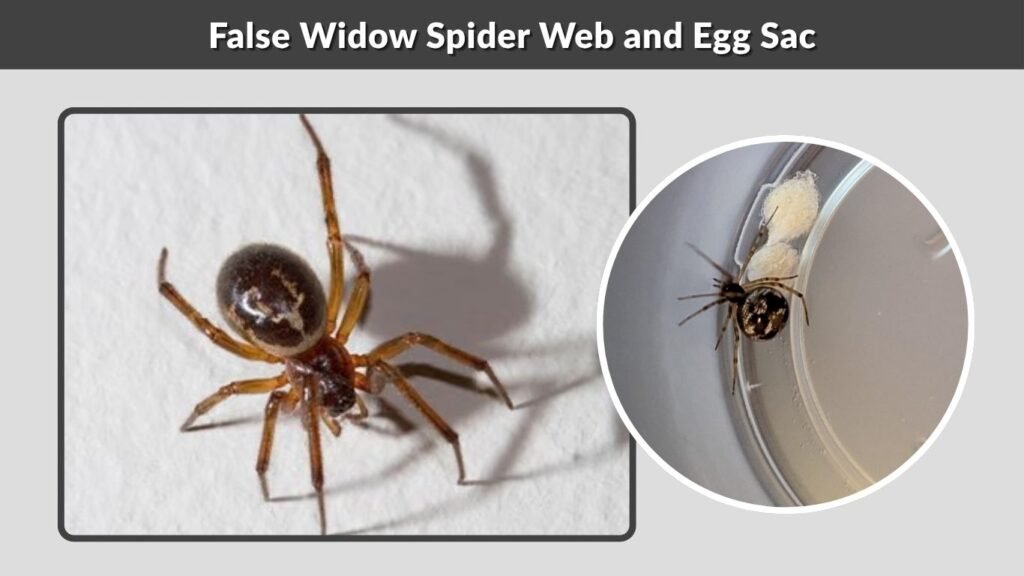
False widows construct messy-looking cobwebs rather than circular orb webs. The silk may appear disorganized, but it contains strong, sticky capture threads that restrain insects.
Where Webs Are Built
- Upper corners of rooms
- Conservatories
- Garages and sheds
- Cupboards and storage areas
- Window frames
- Beneath furniture
- Behind appliances
- Around garden fences
- Under stones
- Inside wall gaps
- Beneath outdoor railings
A noble false widow often hides inside a dense silk retreat during the day and enters its web after dark. The web is an irregular three-dimensional framework rather than a flat spiral.
What Do Egg Sacs Look Like?
False widow egg sacs are generally pale, rounded silk structures protected within the web or retreat. Appearance varies among species.
Do not confuse them with the distinctive spiky egg sacs of the brown widow, Latrodectus geometricus. A brown widow is a true widow species, not a false widow.
False Widow vs Black Widow
False widows acquired their name because their rounded, shiny abdomens resemble those of black widows. Close examination usually reveals important differences, although immature true widows remain challenging to identify.
Main Differences
| Feature | False Widow | Black Widow |
| Genus | Steatoda | Latrodectus |
| Typical color | Brown, purplish, or dark glossy | Mature female usually glossy black |
| Dorsal pattern | Pale cream or tan markings possible | Often plain black when mature |
| Underside | No dependable red hourglass | Usually red or orange hourglass |
| Typical bite | Local pain and swelling | Can cause severe muscle and nerve symptoms |
| Web | Irregular sticky cobweb | Irregular sticky cobweb |
| Medical risk | Usually mild to moderate | Potentially serious |
A true black widow bite can cause severe muscle cramps, abdominal or back pain, sweating, nausea, and changes in blood pressure. Seek urgent medical advice whenever a true widow bite is possible.
False Widow Spider Bite Symptoms
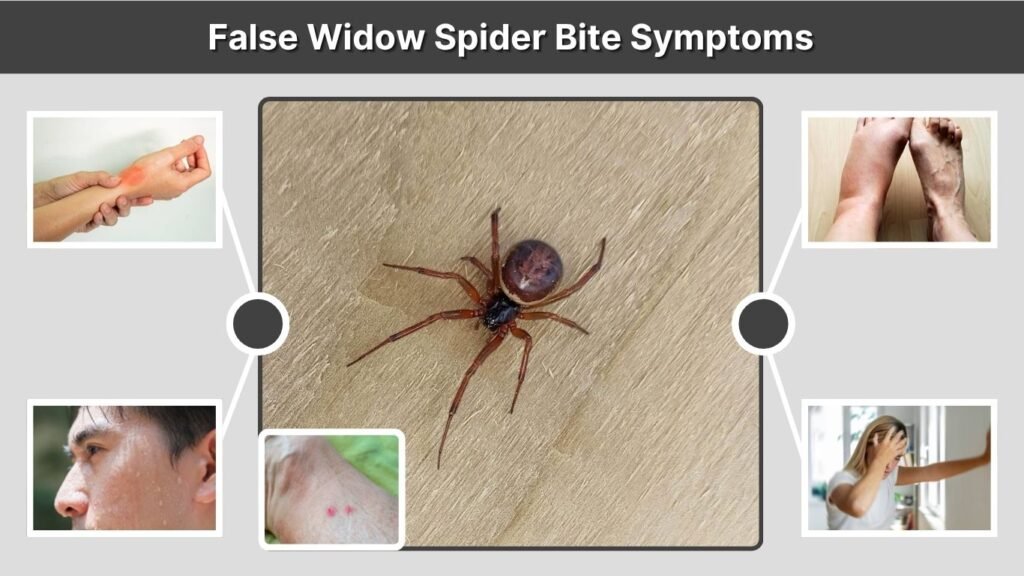
False widow bites usually occur when a spider is trapped against the skin inside clothing, bedding, gloves, or footwear. A person may also be bitten while squeezing or handling the spider.
Common Local Symptoms
- Immediate stinging or burning pain
- Redness around the bite
- Mild to moderate swelling
- Tenderness
- Itching
- Tingling
- Two tiny punctures, although these may not be visible
- A small blister in some cases
- Pain that radiates away from the bite
Pain commonly lasts between one and 12 hours and rarely continues beyond 24 hours. A noble false widow can occasionally produce more intense or prolonged effects.
Less Common Systemic Symptoms
More substantial envenomation, sometimes called steatodism, may produce:
- Nausea
- Headache
- Feverishness
- General weakness
- Trembling
- Sweating
- Facial flushing
- Muscle discomfort
- Reduced mobility
- Changes in blood pressure
These reactions are uncommon. Severe illness following an assumed spider bite may also result from an allergic reaction, bacterial infection, or another medical condition.
False Widow Bite Stages
During the first day, the bite may produce immediate pain followed by redness and swelling. A small blister can occasionally form.
Over the next one or two days, an uncomplicated bite should begin improving. Increasing heat, spreading redness, pus, worsening pain, red streaks, or fever may indicate infection and requires medical assessment.
Significant skin ulceration or a black wound is not a normal outcome of most false widow bites. Such lesions should be professionally examined because cellulitis, abscesses, and other skin diseases are frequently mistaken for spider bites.
Can Pictures Confirm a False Widow Bite?
A photograph cannot prove that a false widow caused a skin lesion. The appearance is not distinctive enough, and most people do not see the spider biting them.
Conditions That May Look Similar
- Mosquito, flea, or bedbug bites
- Bee or wasp stings
- Tick bites
- Contact dermatitis
- Folliculitis
- Cellulitis
- Staphylococcal abscesses
- Allergic reactions
- Ingrown hairs
- Chemical irritation
The most reliable confirmation requires witnessing the bite and having the spider identified. Capture it only when this can be done safely using a container; never use bare hands.
First Aid and Treatment
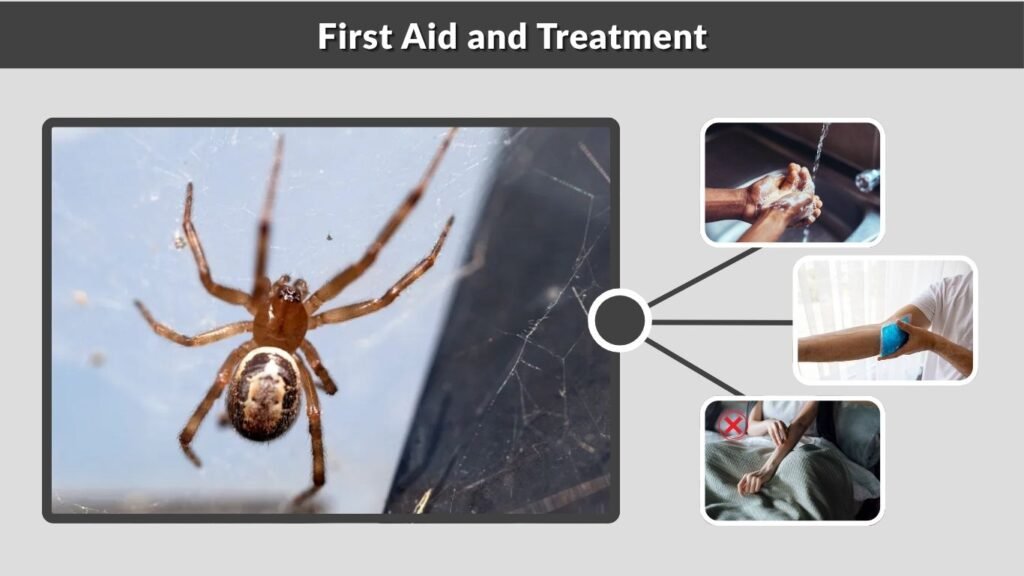
Most uncomplicated bites can be managed with basic first aid. Monitor the area because symptoms may change, and obtain medical guidance if pain or swelling becomes significant.
What to Do After a Bite
- Wash the area gently with soap and water.
- Apply a cold, damp cloth or wrapped ice pack for at least 20 minutes.
- Elevate the affected arm or leg when practical.
- Avoid scratching or squeezing the bite.
- Use an appropriate over-the-counter pain reliever if normally safe for you.
- Ask a pharmacist about an oral antihistamine or hydrocortisone cream for itching.
- Photograph the area and mark the edge of spreading redness.
- Keep any safely captured spider in a sealed container for identification.
Do not cut the bite, suck out venom, apply a tourniquet, or use caustic home remedies. Antibiotics treat bacterial infections, not spider venom, and should only be used when prescribed.
When to Get Medical Help
Contact a clinician, urgent-care service, or local medical advice line if:
- Symptoms are worsening rather than improving.
- Pain or swelling becomes severe.
- The bite is near the mouth, throat, or eyes.
- You develop abdominal pain or vomiting.
- You feel dizzy or lightheaded.
- You have a high temperature or swollen glands.
- Redness spreads or the skin becomes hot.
- Pus, fluid, or red streaks appear.
- A young child was bitten.
- You previously experienced a severe allergic reaction.
Call emergency services for breathing difficulty, swelling of the face or throat, fainting, confusion, blue or pale skin, or other signs of anaphylaxis.
Where Are False Widows Found?
Different Steatoda species occur in many parts of the world. Reports from a particular state or country do not automatically indicate the noble false widow because related species look similar.
United Kingdom
The noble false widow is established across southern Britain and continues spreading north. It commonly lives around houses, conservatories, fences, and other human-made structures.
Britain also supports the cupboard spider and rabbit hutch spider. False widows can occur in England, Wales, and other suitable locations, but their abundance varies with temperature and available shelter.
California and the United States
The cupboard spider, Steatoda grossa, is common inside buildings along the Pacific Coast from southern California into the Pacific Northwest. It is uniformly chocolate brown and lacks the black widow’s red hourglass.
The noble false widow has also become established in parts of coastal California, including the San Diego region, Monterey, and the San Francisco Bay area. Other false widow species occur in Texas, Utah, Colorado, Ohio, North Carolina, and additional states.
New Zealand
New Zealand has the false katipo, Steatoda capensis, an introduced false widow originally associated with southern Africa. It is different from the native katipo, which belongs to the true widow genus Latrodectus.
Should You Kill a False Widow Spider?
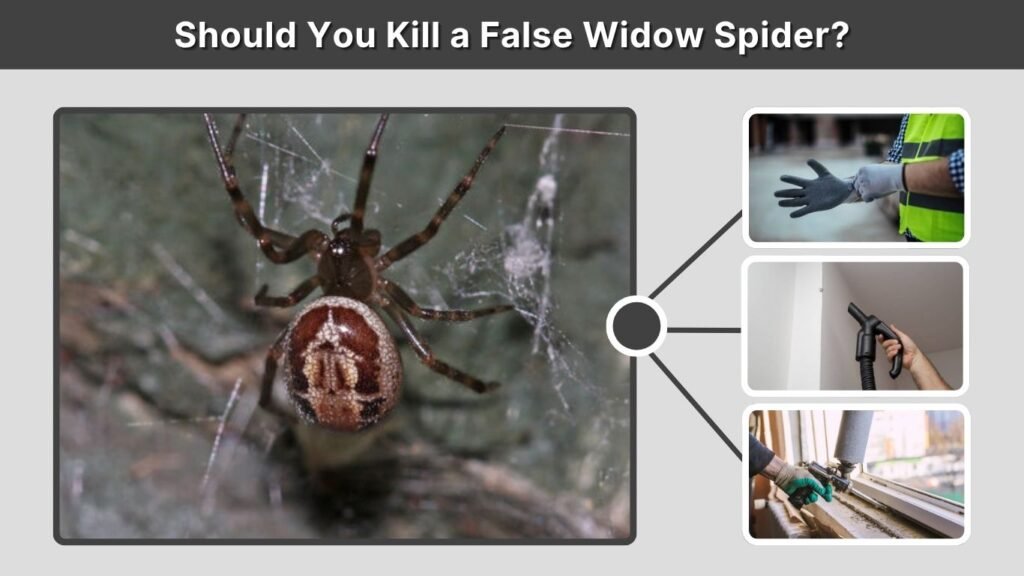
Killing a single false widow is usually unnecessary. These spiders consume flies, mosquitoes, moths, and other household pests and generally remain inside their webs.
Safer Removal and Control
- Place a container over the spider and slide a stiff card underneath.
- Wear gloves and avoid direct handling.
- Relocate it away from entrances and busy areas when locally appropriate.
- Vacuum webs and egg sacs in high-contact indoor locations.
- Empty the vacuum outside into a sealed bag.
- Seal cracks around windows, doors, and foundations.
- Reduce clutter in garages, sheds, and cupboards.
- Shake out gloves, shoes, clothing, and stored fabrics.
- Move outdoor furniture carefully.
- Contact pest control for numerous recurring spiders.
Removal is sensible when the spider occupies bedding, children’s play equipment, clothing storage, or another place where it could become pressed against someone’s skin.
FAQs
Are false widow spiders dangerous?
They are venomous, but most bites cause temporary local pain, redness, and swelling. Severe reactions are possible but uncommon.
Can a false widow spider kill a person?
Death directly caused by a confirmed false widow bite is exceptionally unlikely. Severe symptoms or infection still require immediate medical evaluation.
What does a false widow bite look like?
It may appear as a red, swollen, tender area with tiny punctures or a small blister. Appearance alone cannot confirm the cause.
Do false widow spiders infest homes?
They can become numerous where buildings provide undisturbed corners, warmth, insects, and web sites. Regular cleaning and clutter reduction usually limit them.
Do false widow spiders bite dogs?
A spider may bite a dog if trapped against its skin. Contact a veterinarian if the dog develops severe pain, swelling, weakness, vomiting, breathing difficulty, or unusual behavior.
