
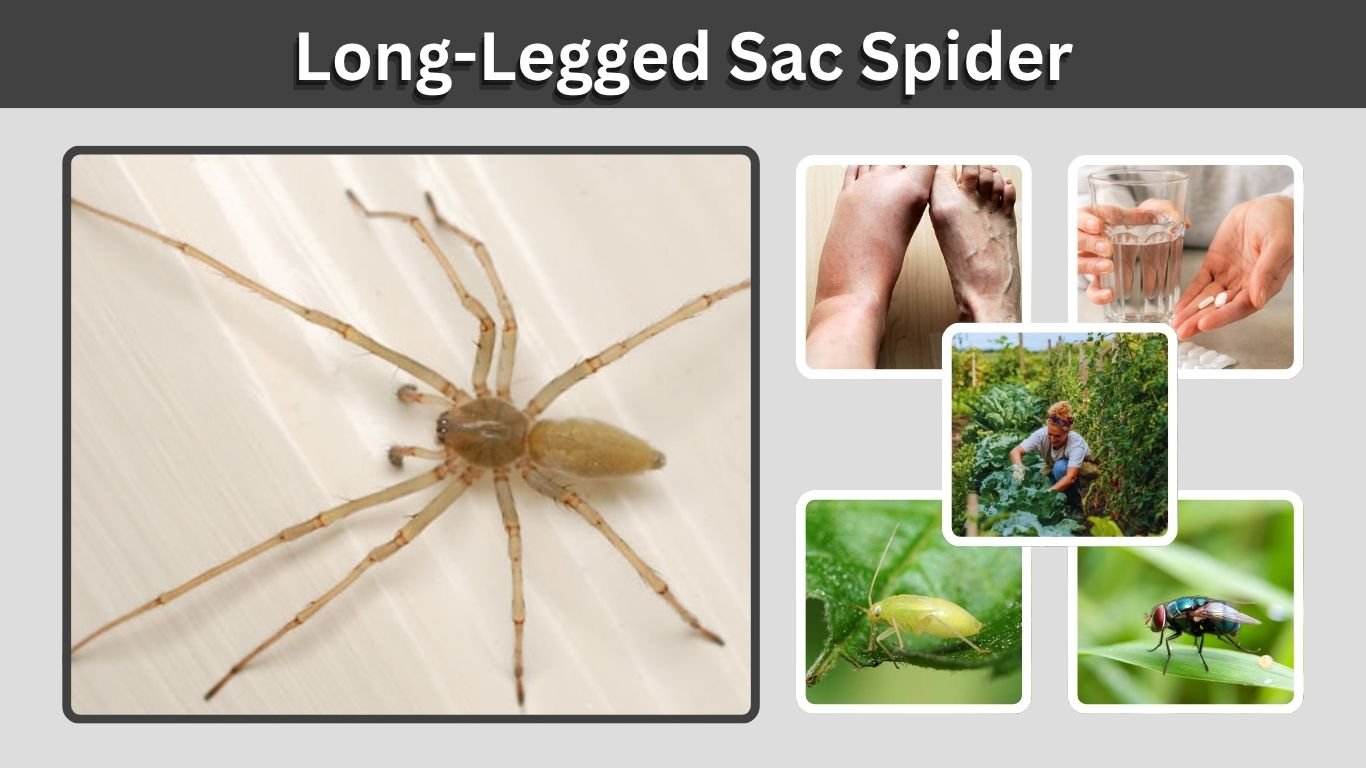
The long-legged sac spider is a small, pale hunting spider commonly found on walls, ceilings, vegetation, and inside buildings. Known scientifically as Cheiracanthium mildei, it has long front legs, darker mouthparts, and a yellow, cream, or greenish body. It rests inside a silken sac during the day and hunts insects at night. Although venomous, it is not considered dangerous to most people. Its bite can be painful and cause redness, itching, or swelling, but claims that it commonly destroys skin tissue are unsupported.
What Is a Long-Legged Sac Spider?
The long-legged sac spider is also known as the northern yellow sac spider or yellow house spider. It was introduced to North America from Europe and is now frequently encountered inside human-made structures.
Classification and Basic Facts
- Scientific name: Cheiracanthium mildei
- Family: Cheiracanthiidae
- Order: Araneae
- Other names: Northern yellow sac spider and yellow house spider
- Activity: Nocturnal
- Hunting style: Actively searches for prey
- Daytime shelter: Small silken retreat
- Medical risk: Usually limited to painful local symptoms
Unlike orb weavers and cobweb spiders, it does not depend on a large web for catching insects. It wanders at night and uses speed and venom to subdue small prey.
Long-Legged Sac Spider Identification and Size
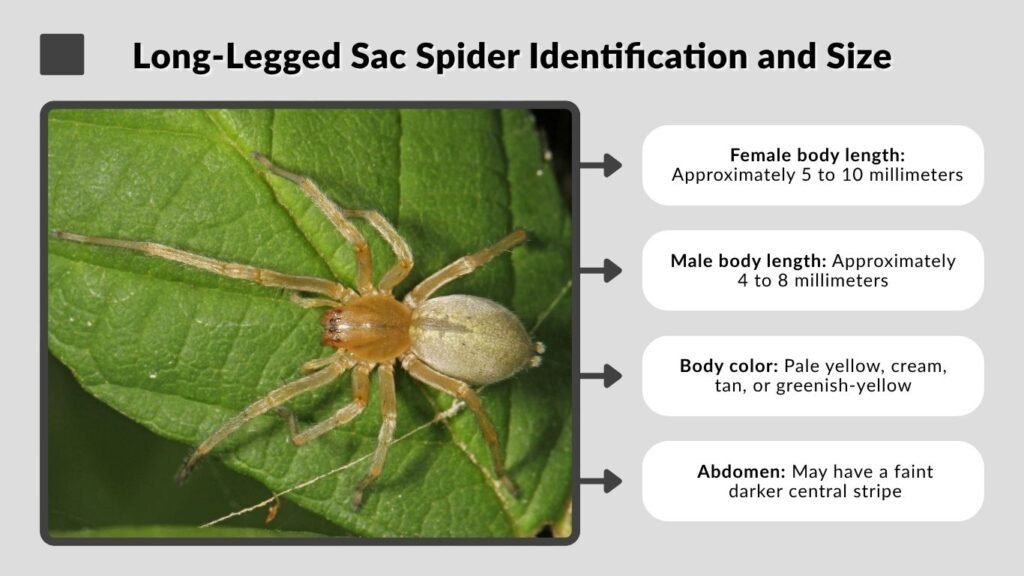
Long-legged sac spiders have slender bodies and pale coloring that helps them blend into walls, ceilings, and dry vegetation. However, many unrelated spiders have similar colors, so an ordinary photograph may not provide a definite identification.
Identification Features
- Female body length: Approximately 5 to 10 millimeters
- Male body length: Approximately 4 to 8 millimeters
- Body color: Pale yellow, cream, tan, or greenish-yellow
- Abdomen: May have a faint darker central stripe
- Mouthparts: Brown or reddish-brown
- Feet: Tips may appear darker
- Front legs: Longer than the remaining pairs
- Eyes: Eight arranged in two rows
- Body shape: Slender with a slightly pointed abdomen
Its body is generally less than half an inch long. The extended legs make it look considerably larger, sometimes approaching an inch across.
Male vs Female
Females usually have broader, heavier abdomens, particularly when carrying eggs. Males have slimmer bodies, proportionally longer legs, and enlarged pedipalps near the mouth.
Wandering males may be encountered more frequently because they travel in search of females. Both sexes can bite if trapped or pressed against the skin.
White, Green, Brown, or Black Individuals
Most individuals are pale yellow or greenish, but lighting, age, feeding, and the stage of molting can affect their appearance. The abdomen may become gray, tan, or darker after a large meal.
A genuinely black spider is unlikely to be a long-legged sac spider. Dark specimens should be evaluated for other possibilities, including cobweb, ground, or broad-faced sac spiders.
Silk Sac, Molting, and Life Cycle
The name “sac spider” refers to the small silken retreat it constructs. This shelter may be used for resting, molting, mating, laying eggs, or protecting spiderlings rather than catching food.
Where Silk Sacs Are Found
- Wall and ceiling corners
- Behind picture frames
- Beneath windowsills
- Behind furniture
- Inside folded curtains
- Under siding
- Beneath leaves and bark
- Inside boxes
- Between stored fabrics
- Around doors and window frames
The retreat often looks like a flattened white tube connecting two surfaces. The spider normally hides inside during daylight and emerges after dark.
Molting
Before molting, the spider seals itself inside a silk retreat and becomes inactive. It sheds its old outer covering and emerges with a soft, pale body.
The new exoskeleton requires time to harden. A molting spider should not be handled or disturbed because it cannot move or defend itself normally.
Eggs and Babies
A female encloses her eggs within a protected silk sac and may remain nearby to guard them. Newly hatched spiderlings stay inside briefly before dispersing.
Several tiny pale spiders around a ceiling corner can indicate that an egg sac recently hatched. The young are independent hunters rather than members of a permanent colony.
Long-Legged Sac Spider Habitat, Range, and Diet
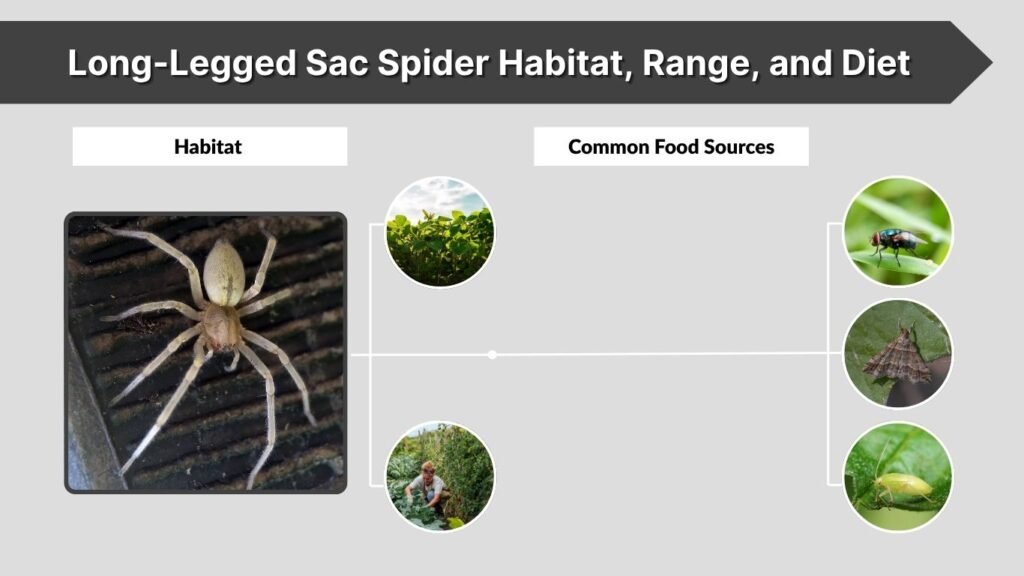
Long-legged sac spiders live both outdoors and inside buildings. Indoor environments offer warmth, daytime retreats, and a dependable supply of insects, allowing some populations to remain active throughout the year.
Geographic Range
Cheiracanthium mildei is widely established across many northern and central parts of the United States and southern Canada. It has been recorded in California, Colorado, Michigan, Ohio, Pennsylvania, Tennessee, Utah, Washington, Wisconsin, Ontario, and numerous additional regions.
California has both C. mildei and the native black-footed yellow sac spider, C. inclusum. The long-legged species is found more often inside buildings, while C. inclusum is more strongly associated with gardens and vegetation.
Other Cheiracanthium species occur in South Africa, Australia, Europe, and elsewhere. A pale sac spider found in those regions should not automatically be identified as C. mildei.
What Does It Eat?
- Flies
- Moths
- Aphids
- Leafhoppers
- Small beetles
- Mites
- Small cockroaches
- Insect larvae
- Other spiders
- Various household arthropods
It does not eat wood, clothing, or building materials. Its presence may indicate that small insects are available inside the property.
Is the Long-Legged Sac Spider Poisonous?
The spider is venomous, not poisonous. It injects venom through its fangs to immobilize prey. Touching the spider does not poison someone, although direct handling creates an unnecessary bite risk.
Its venom is not considered medically dangerous to most healthy people. A bite can still be painful, and anyone may experience an unusual allergic or inflammatory reaction.
Why Do Bites Occur?
Bites usually happen when the spider becomes:
- Trapped inside bedding
- Pressed beneath clothing
- Caught inside a shoe
- Squeezed against the skin
- Picked up with bare hands
- Disturbed inside its egg retreat
- Crushed while someone is sleeping
Because it travels at night, it encounters people more frequently than web-bound spiders. This does not mean it actively hunts or feeds on humans.
Long-Legged Sac Spider Bite Symptoms and Stages
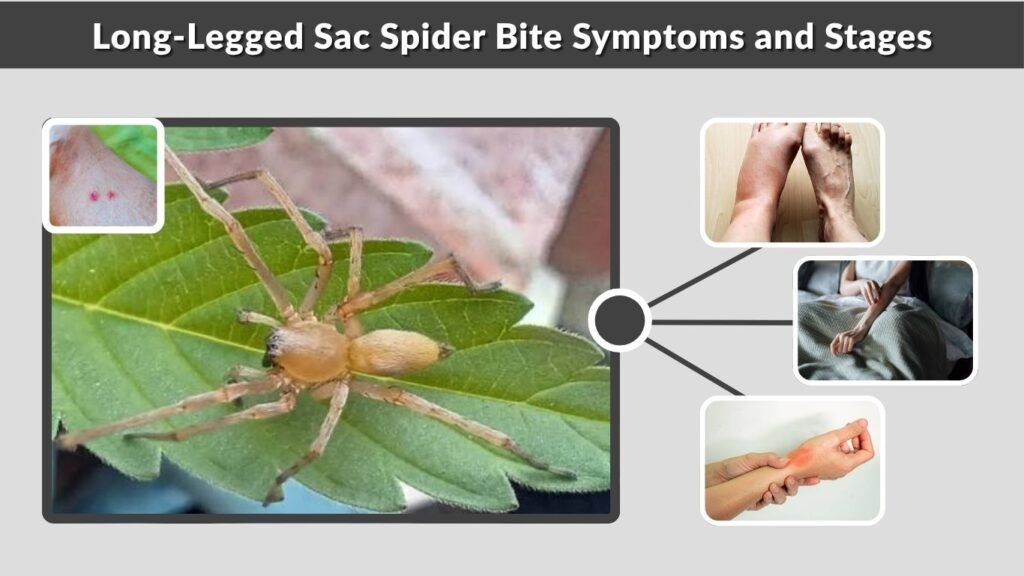
A long-legged sac spider bite commonly produces immediate sharp or burning pain. The local reaction may resemble a bee sting or another insect bite.
Common Symptoms
- Burning or stinging pain
- Redness
- Local swelling
- Tenderness
- Itching
- Small puncture marks
- Localized rash
- Warmth
- A small blister occasionally
The initial burning may last an hour or longer. Redness, swelling, rash, or blistering can develop during the next several hours. Most uncomplicated reactions improve within one or two days.
Less Common Symptoms
- Headache
- Nausea
- Feverishness
- Muscle cramps
- General discomfort
- Weakness
- Dizziness
Systemic reactions are uncommon. Fever, spreading redness, pus, or worsening pain may indicate an infection or another medical condition rather than a direct venom effect.
Does the Bite Cause Necrosis?
The long-legged sac spider was historically blamed for ulcers and tissue death. Verified evidence does not support it as a common cause of necrotic wounds.
A study covering 20 verified Cheiracanthium bites in the United States and Australia found no necrosis. A broader review found only one older case of mild necrosis involving a different European species.
A black, draining, rapidly enlarging, or ulcerated wound needs professional examination. Bacterial infections, burns, circulation disorders, and other skin conditions are often incorrectly blamed on spider bites.
Bite First Aid and Treatment
Most bites require only cleaning, cold application, and observation. Obtain professional advice if the affected person develops significant pain or symptoms beyond the bite area.
What to Do
- Wash the skin with soap and water.
- Apply a cold, damp cloth or wrapped ice pack for 10 to 20 minutes.
- Elevate an affected arm or leg when practical.
- Avoid scratching, squeezing, or opening a blister.
- Cover broken skin with a clean, non-stick dressing.
- Use an appropriate pain reliever if normally safe for you.
- Ask a pharmacist about treatment for itching.
- Photograph the area and monitor changes.
- Check whether tetanus vaccination is current.
- Contact Poison Control or a clinician if uncertain.
In the United States, Poison Control is available at 1-800-222-1222.
When to Seek Medical Care
Get prompt medical help if:
- Pain or swelling becomes severe.
- Redness spreads rapidly.
- The skin becomes increasingly hot.
- Pus, fluid, or red streaks appear.
- A blister or wound continues enlarging.
- Fever, vomiting, weakness, or muscle cramps develop.
- The bite is near the eye, mouth, or throat.
- A child or medically vulnerable person was bitten.
- Symptoms fail to improve after several days.
Call emergency services for breathing difficulty, facial or throat swelling, fainting, confusion, or another sign of anaphylaxis.
What If Venom Gets in the Eye?
Long-legged sac spiders do not spit venom. If a spider is crushed and material enters the eye, rinse with clean lukewarm water for at least 15 minutes. Remove contact lenses if easily possible.
Seek urgent eye care or contact Poison Control if pain, redness, blurred vision, light sensitivity, or irritation continues.
Long-Legged Sac Spider vs Brown Recluse
Both spiders may appear pale brown and wander indoors, but they differ in color, eye arrangement, silk retreats, and medical importance.
Key Differences
| Feature | Long-Legged Sac Spider | Brown Recluse |
| Body color | Pale yellow or greenish | Tan to medium brown |
| Eyes | Eight in two rows | Six in three pairs |
| Legs | Front pair noticeably longer | More similar in proportion |
| Feet and jaws | Often darker | Legs usually uniformly colored |
| Violin mark | Absent | May be visible |
| Silk use | Builds white resting sacs | Hides in secluded retreats |
| Bite effect | Usually painful and localized | Tissue damage possible in some bites |
| Indoor location | Walls and ceilings | Boxes, closets, and undisturbed clutter |
A suspected brown recluse should not be identified from color or the violin marking alone. Geographic range and examination by a qualified specialist are important.
Long-Legged Sac Spider vs Daddy Longlegs
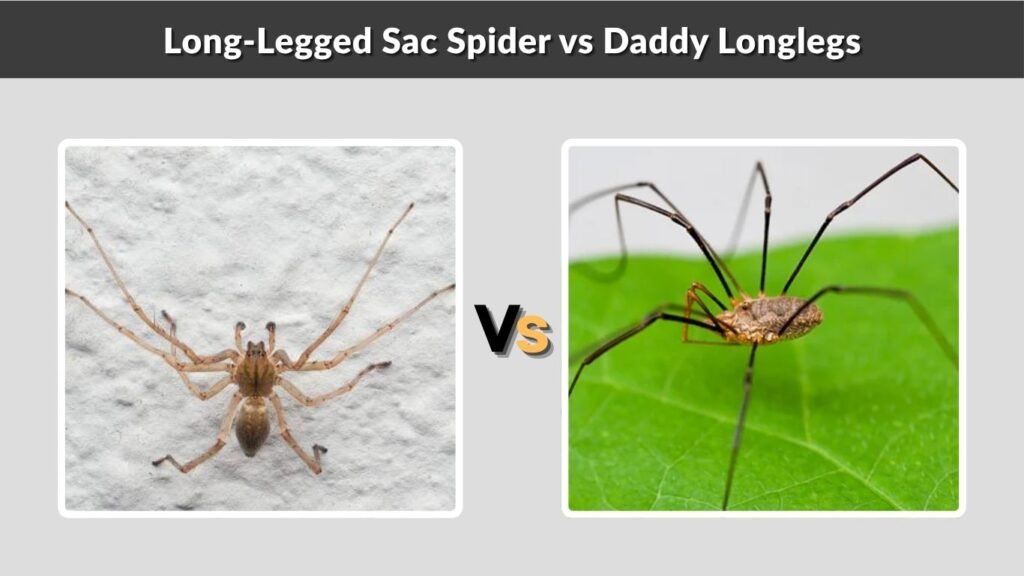
“Daddy longlegs” may refer to a harvestman or a cellar spider. Neither is the same as a long-legged sac spider.
Main Differences
Harvestmen have a single oval-looking body and do not produce silk or venom. Cellar spiders have extremely long, threadlike legs and build loose webs in corners. Female cellar spiders may carry a loosely wrapped cluster of eggs beneath their mouthparts.
Long-legged sac spiders have two obvious body sections, shorter and thicker legs, functional venom glands, and a compact white silk retreat. Their egg sacs remain protected inside silk rather than being carried like cellar-spider eggs.
How to Get Rid of Long-Legged Sac Spiders
One spider does not necessarily indicate an infestation. Recurring spiders or numerous silk sacs suggest that the building offers insects and undisturbed hiding places.
Control Methods
- Capture individual spiders with a container and stiff card.
- Vacuum spiders, retreats, shed skins, and egg sacs.
- Empty the vacuum outside into a sealed bag.
- Seal cracks around windows, doors, pipes, and foundations.
- Repair damaged screens and weather stripping.
- Reduce clutter in storage rooms and closets.
- Move beds slightly away from walls.
- Shake out shoes, clothing, towels, and bedding.
- Trim plants touching the building.
- Reduce outdoor lights that attract insects.
- Store boxes and fabrics in sealed containers.
- Contact pest control if activity remains extensive.
Broad indoor pesticide spraying is rarely the best first response. Exclusion, vacuuming, clutter removal, and reducing insect prey provide more dependable long-term control.
FAQs
Is a long-legged sac spider dangerous?
It can deliver a painful bite, but serious medical effects are uncommon. Most symptoms remain localized and improve within several days.
Is it poisonous or venomous?
It is venomous because it injects venom through fangs. It is not poisonous to touch.
How large does it grow?
The body measures approximately 4 to 10 millimeters. Its long legs make the complete spider appear much larger.
Can bite pictures confirm the spider?
No. Redness, swelling, and blisters have many possible causes. Confirmation requires witnessing the bite and accurately identifying the spider.
Should I call an exterminator?
Professional control may help when spiders and silk sacs repeatedly appear throughout a building. A single spider usually requires only careful removal and basic prevention.
