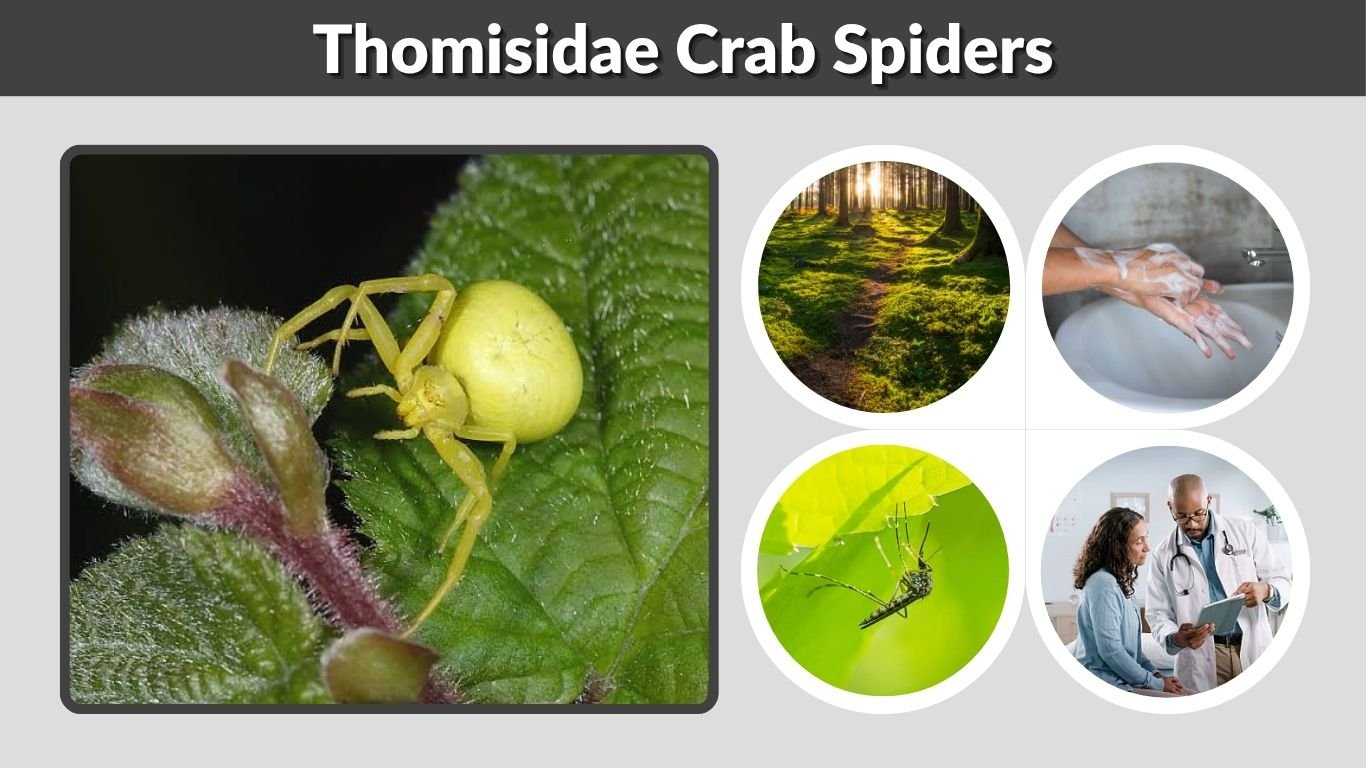
Thomisidae crab spiders are fascinating arachnids known for their crab-like legs, excellent camouflage, and unusual hunting techniques. These spiders commonly inhabit flowers, gardens, forests, and grasslands, where they wait patiently to capture unsuspecting insects. Some species can even change their body color to match surrounding flowers. With more than 2,200 recognized species worldwide, the Thomisidae family includes an impressive variety of shapes and colors. This guide explores their identification, common types, habitats, diet, behavior, and whether they are dangerous to humans.
What Are Thomisidae Crab Spiders?
Thomisidae is a large family of spiders commonly called crab spiders or flower crab spiders. The family includes approximately 172 genera and more than 2,200 recognized species worldwide. These spiders are named for their distinctive sideways movements and front legs, which resemble the claws of a crab. Unlike many other spiders, they primarily rely on camouflage and ambush hunting instead of capture webs.
Thomisidae Crab Spider Identification
- Scientific Family: Thomisidae
- Common Name: Crab Spiders or Flower Crab Spiders
- Order: Araneae
- Size: Usually a few millimeters to about 2 cm in body length, depending on species.
- Color: White, yellow, green, brown, pink, or gray.
- Eyes: Eight eyes, often arranged in two curved rows.
- Body: Broad, flattened body with a rounded or angular abdomen.
- Legs: Eight legs, with the first two pairs usually larger and stronger.
- Habitat: Flowers, leaves, tree bark, grasslands, and forests.
- Distribution: Found worldwide except Antarctica.
Physical Characteristics
Thomisidae crab spiders have broad bodies and long front legs that extend sideways. Their first two pairs of legs are typically stronger than the rear pairs, allowing them to capture insects effectively.
Many species display colors that help them blend into their surroundings. Flower-dwelling species may be white or yellow, while ground-dwelling spiders are often brown or gray.
Females are generally larger than males in many species.
Common Types of Thomisidae Crab Spiders
The Thomisidae family contains numerous species with different colors, body shapes, and hunting habitats. While flower crab spiders are especially recognizable, other members live among leaves, tree bark, and ground vegetation. The following are some well-known examples.
1. Goldenrod Crab Spider
The Goldenrod Crab Spider (Misumena vatia) is one of the best-known members of the Thomisidae family. Females are typically white or yellow, sometimes with reddish markings along the abdomen.
They commonly inhabit flowers, particularly daisies and goldenrod, where they ambush visiting insects. Females can gradually change between white and yellow coloration, helping them blend into certain flowers.
2. White-Banded Crab Spider
The White-Banded Crab Spider (Misumenoides formosipes) is recognizable by the pale band across its facial region.
Females may appear white, yellow, or pale green, while males are much smaller and often have darker front legs.
These spiders commonly inhabit wildflowers, meadows, and gardens throughout North America. They capture visiting flies, bees, butterflies, and other small insects.
3. Ground Crab Spider
Ground Crab Spiders (Xysticus spp.) are usually brown or gray with mottled markings that provide excellent camouflage.
Unlike brightly colored flower spiders, these species spend considerable time among soil, leaf litter, low vegetation, and tree bark.
They use their strong front legs to capture insects moving across the ground. Their flattened bodies and subdued coloration make them difficult to notice.
4. White Crab Spider
The White Crab Spider (Thomisus spectabilis) is a flower-dwelling species found in Australia and nearby regions.
It has a broad, flattened body and extended front legs. Females are commonly white or yellow and can adjust their coloration gradually.
These spiders often wait on flowers to catch visiting pollinators. Their excellent camouflage and patient hunting behavior make them successful ambush predators.
Where Do Thomisidae Crab Spiders Live?
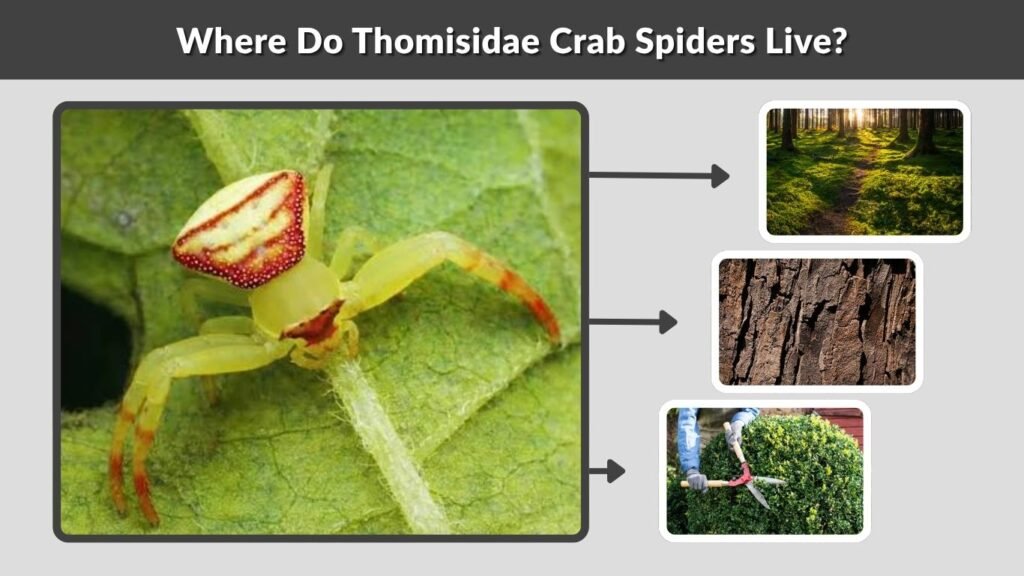
Thomisidae crab spiders inhabit numerous environments, ranging from gardens and meadows to tropical forests and dry grasslands. Different species prefer particular surfaces, including flowers, leaves, bark, and ground vegetation. Their coloration and flattened bodies help them remain concealed while hunting or avoiding predators.
Natural Habitat
Flower crab spiders commonly occupy blossoms where insects gather to collect nectar and pollen. White and yellow spiders are especially difficult to detect when resting on similarly colored petals.
Other species prefer tree bark, shrubs, forest floors, and leaf litter. Ground crab spiders often shelter beneath vegetation, while bark-dwelling species use their flattened bodies to hide in crevices.
Geographic Distribution
Thomisidae crab spiders occur across North America, South America, Europe, Africa, Asia, and Australia.
Their diversity is especially notable in warm regions, although many species also inhabit temperate environments. The specific habitat and geographic range depend on the genus and species.
What Do Thomisidae Crab Spiders Eat?
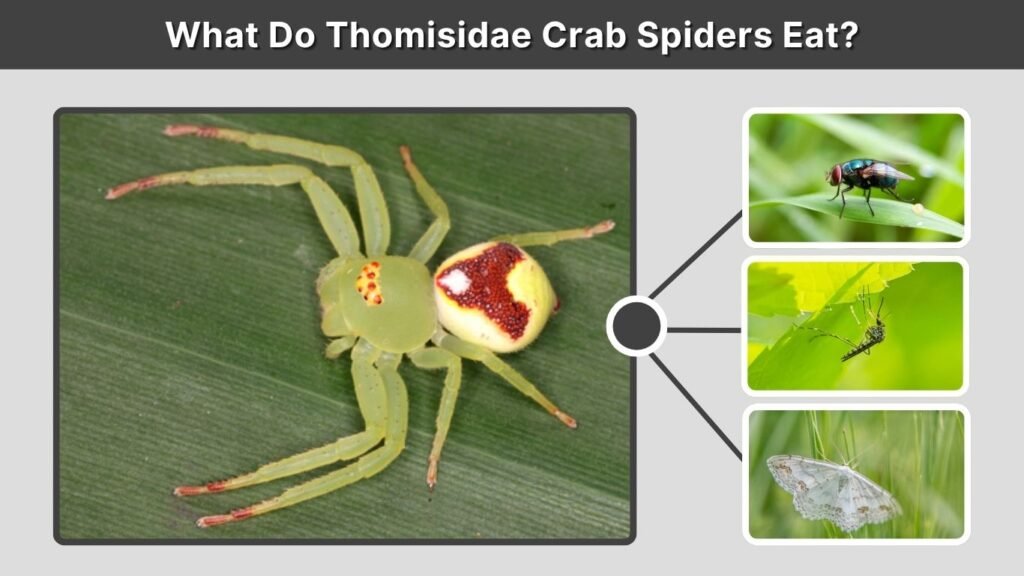
Thomisidae crab spiders are carnivorous predators that primarily feed on insects and other small arthropods. They are particularly effective hunters because they can remain motionless for long periods, waiting for prey to approach. Unlike web-building spiders, most Thomisidae capture insects directly using their strong front legs.
Common Food Sources
Their diet includes flies, mosquitoes, moths, butterflies, bees, beetles, and other small arthropods.
Flower-dwelling species frequently capture pollinating insects visiting blossoms. Some spiders can overpower insects considerably larger than themselves.
Although crab spiders sometimes consume beneficial pollinators, they also help regulate insect populations within natural ecosystems.
How Do Crab Spiders Hunt?
Thomisidae crab spiders use an ambush hunting technique. They position themselves on flowers, leaves, or other surfaces and remain nearly motionless.
When an insect moves within reach, the spider quickly extends its powerful front legs and grabs the prey. It then injects venom through its fangs to immobilize the insect.
This hunting strategy allows crab spiders to capture food without constructing elaborate trapping webs.
Can Thomisidae Crab Spiders Change Color?
Some Thomisidae species possess an extraordinary ability to change their body coloration. The Goldenrod Crab Spider is a familiar example, with females capable of gradually shifting between white and yellow.
Unlike the rapid color changes seen in some other animals, this transformation generally takes several days or longer.
Color adjustment depends on physiological processes involving pigments. The resulting camouflage may help spiders remain concealed from both predators and visiting insects.
However, not all Thomisidae species can change color, and those that do cannot necessarily match every flower color.
Are Thomisidae Crab Spiders Dangerous?
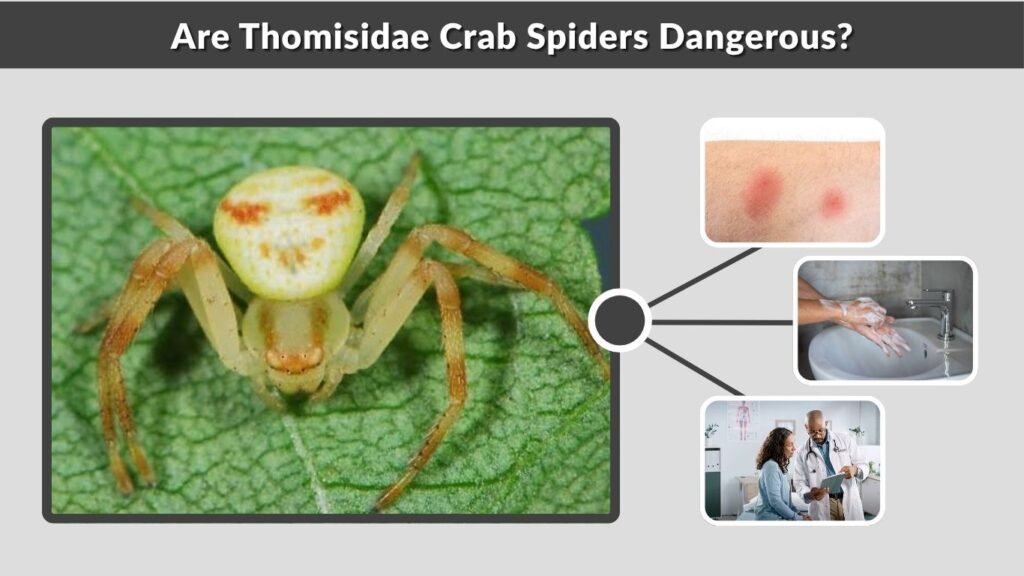
Thomisidae crab spiders possess venom that helps them immobilize prey. However, they are not generally considered medically dangerous to humans. These spiders are relatively small, avoid unnecessary confrontation, and usually remain hidden among vegetation.
Can Thomisidae Crab Spiders Bite?
Yes, Thomisidae crab spiders can bite when threatened or accidentally trapped against the skin. However, bites are uncommon.
A bite may cause temporary pain, redness, or mild swelling. Serious medical complications are not expected from typical Thomisidae bites.
Avoid handling unidentified spiders, especially in regions where medically significant species also occur.
What to Do After a Crab Spider Bite
If bitten, gently wash the affected area with soap and water. Applying a cold compress may help reduce localized discomfort and swelling.
Monitor the area for worsening symptoms. Seek medical advice if pain becomes severe, symptoms persist, or signs of infection develop.
Difficulty breathing, facial swelling, or other signs of a severe allergic reaction require emergency medical care.
Thomisidae Crab Spider Reproduction and Life Cycle
Thomisidae crab spiders reproduce sexually, and females typically lay eggs inside protective silk sacs. Depending on the species, these sacs may be attached to leaves, concealed within vegetation, or placed in sheltered locations.
Some females remain near their egg sacs and protect them until the spiderlings emerge.
Young spiders undergo several molts as they grow. Development time varies according to species, environmental conditions, and food availability.
FAQs
1. What Is the Thomisidae Family of Spiders?
Thomisidae is a family of spiders commonly called crab spiders. They are recognized by their sideways-extending legs, flattened bodies, and ambush hunting behavior. The family includes more than 2,200 recognized species worldwide.
2. Are Thomisidae Crab Spiders Poisonous?
Thomisidae crab spiders are venomous rather than poisonous. They inject venom into insects to immobilize prey. However, their venom is not generally considered medically dangerous to humans.
3. Why Are Thomisidae Spiders Called Crab Spiders?
They are called crab spiders because of their broad bodies, sideways-oriented legs, and ability to move sideways or backward. Their enlarged front legs also resemble the claws of a crab.
4. Do Thomisidae Crab Spiders Build Webs?
Thomisidae crab spiders do not typically construct webs to capture prey. Instead, they ambush insects on flowers, leaves, and other surfaces. They still produce silk for egg sacs, safety lines, and other purposes.
5. Are Thomisidae Crab Spiders Beneficial to Gardens?
Yes, Thomisidae crab spiders help control many insect populations naturally. However, some flower-dwelling species also capture beneficial pollinators, including bees and butterflies. They are part of the natural balance of garden ecosystems.
