
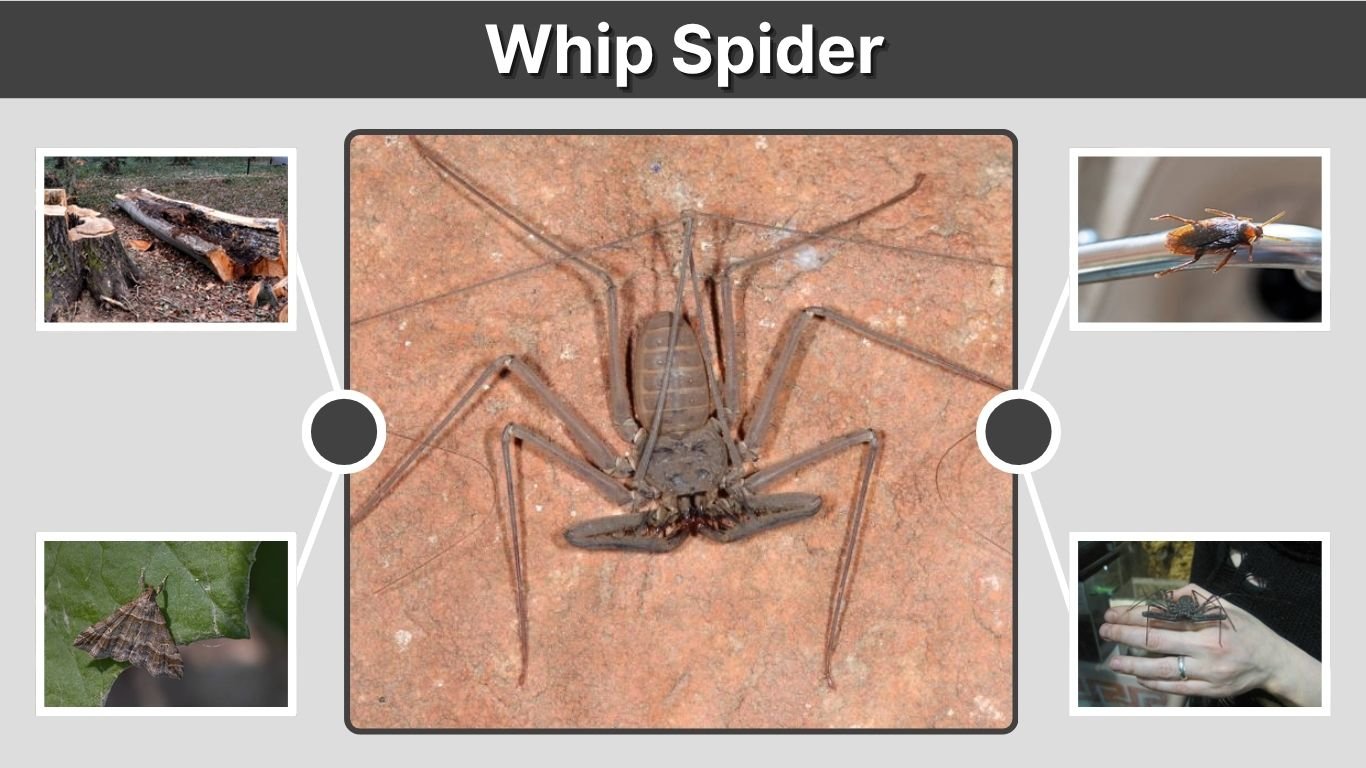
A whip spider is one of the strangest-looking arachnids, with a flat body, powerful claw-like pedipalps, and extremely long front legs that act almost like antennae. Also called a tailless whip spider or tailless whip scorpion, it may look dangerous, but it lacks both venom and a stinging tail. Whip spiders mainly live in warm, humid habitats, where they hunt insects at night. This guide covers whip spider identification, size, habitat, bites, diet, lifespan, behavior, species, and important comparisons.
What Is a Whip Spider?
Whip spiders belong to the arachnid order Amblypygi. Despite their common name, they are not true spiders and are also different from true whip scorpions, commonly called vinegaroons. Their flattened bodies and exceptionally long sensory legs help them move through narrow cracks, caves, tree bark, and rocky environments while hunting prey after dark.
Is a Whip Spider Actually a Spider?
No. A whip spider is an arachnid, but it does not belong to the spider order Araneae. True spiders usually possess venom glands and produce silk, while whip spiders do neither.
Whip spiders have eight legs, although the first pair has evolved into extremely long sensory structures. They mainly walk using the remaining six legs.
Tailless Whip Spider or Tailless Whip Scorpion
Both names commonly describe members of Amblypygi. “Tailless whip scorpion” emphasizes their similarity to scorpions, while “whip spider” refers to their spider-like appearance.
Neither name should be confused with the true whip scorpion or vinegaroon, which has a long whip-like tail.
Whip Spider Identification and Appearance
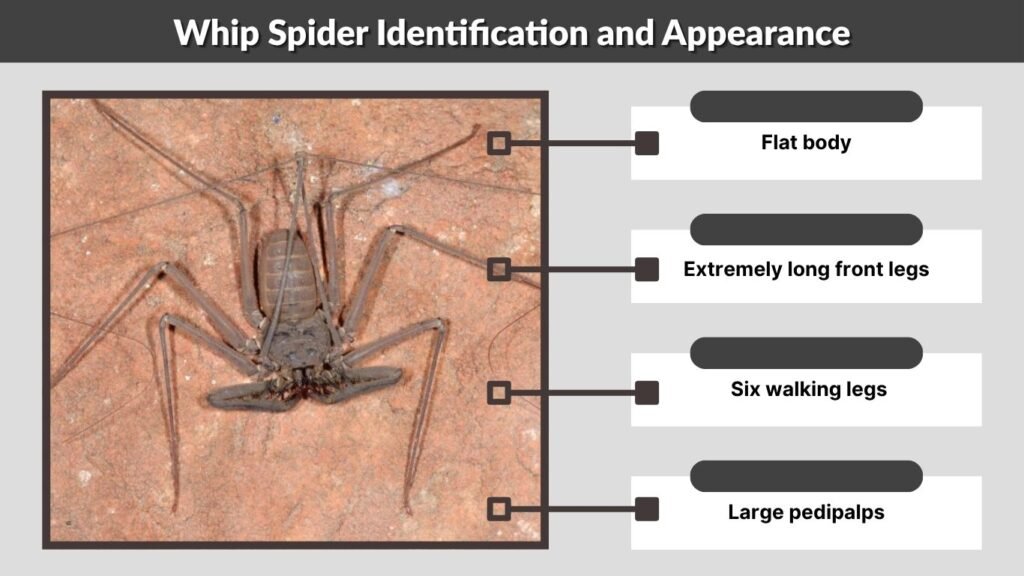
Whip spiders can appear intimidating because their bodies are broad and flattened while their limbs extend far beyond them. Their unusual anatomy is highly specialized for nocturnal hunting. Looking closely at the front legs, pedipalps, body shape, and absence of a tail makes identification much easier.
How to Identify a Whip Spider
- Flat body: Their bodies are strongly flattened, allowing them to hide beneath bark and inside crevices.
- Extremely long front legs: The first pair functions as sensory organs rather than normal walking legs.
- Six walking legs: They move primarily using three pairs of walking legs.
- Large pedipalps: Strong, spiny pedipalps are positioned in front of the body and capture prey.
- No tail: Unlike vinegaroons and scorpions, whip spiders lack a tail.
- No spinnerets: They cannot produce webs like true spiders.
- Brown or black coloration: Most species are dark brown, gray, reddish-brown, or almost black.
Whip Spider Claws and “Hands”
The structures that sometimes look like giant hands or claws are actually pedipalps. They contain spines that help trap insects before the whip spider uses its mouthparts to feed.
Species differ considerably in pedipalp length and shape. Some giant African species have especially impressive arms.
How Big Do Whip Spiders Get?
The body itself is usually relatively small, often only a few centimeters long. However, their exceptionally long sensory legs can make large individuals appear enormous.
Some giant species can have leg spans measuring several times their body length. This explains why photographs sometimes make a whip spider look much bigger than expected.
Where Do Whip Spiders Live?
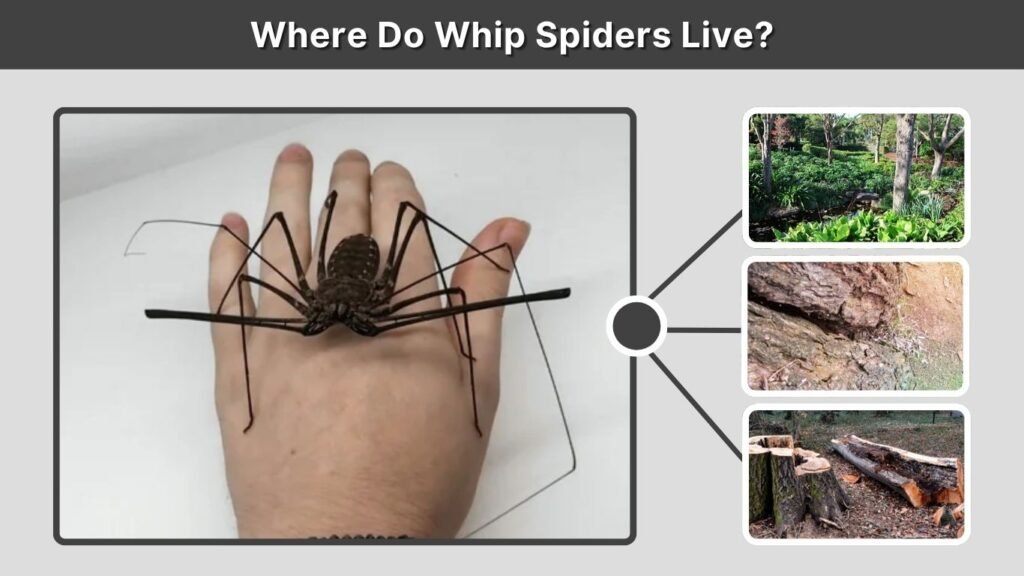
Whip spiders are most common in tropical and subtropical regions, although certain species occur in warm, dry environments as well. Because they lose moisture relatively easily, they usually spend daylight hours in protected hiding places. Their flattened bodies allow them to shelter beneath bark, rocks, logs, and inside caves.
Common Whip Spider Habitats
- Tropical and subtropical forests
- Limestone caves and cave entrances
- Beneath loose tree bark
- Rocky cracks and cliffs
- Hollow logs and fallen wood
- Humid leaf litter
- Protected areas around buildings
Whip Spiders in the United States
Whip spiders occur naturally in parts of the southern United States. They may be encountered in warm areas including Arizona and Florida, depending on species and suitable habitat.
Arizona whip spiders and Sonoran whip spiders often hide around rocky terrain and sheltered crevices during daylight before becoming active at night.
African and Other Tropical Whip Spiders
Africa contains several impressive species, including members of genera such as Damon and Euphrynichus. Whip spiders also occur across parts of Asia, Australia, Central America, South America, Mexico, and the Caribbean.
Many tropical species depend on humid microhabitats even when the surrounding environment experiences seasonal dryness.
Are Whip Spiders Dangerous?
Their appearance creates an impression of a highly dangerous predator, but whip spiders pose little threat to people. They lack venom glands, do not possess a scorpion-like stinger, and normally attempt to escape rather than attack humans. Their pedipalps are primarily weapons for capturing small prey.
Whip Spider Bite and Venom Facts
- Whip spiders are not venomous.
- They do not have a stinger.
- They cannot inject venom through their mouthparts.
- Defensive pinching is possible if the animal is restrained.
- Significant injuries to humans are uncommon.
- They normally avoid confrontation.
Is a Whip Spider Poisonous?
No. Whip spiders are neither venomous nor poisonous in the way people commonly fear. Their hunting strategy depends on physical strength and spiny pedipalps instead of venom.
A whip spider should still be handled carefully because unnecessary handling can injure the animal and may provoke defensive behavior.
Giant Whip Spider Bite
Even a giant whip spider lacks venom. A large specimen may be capable of producing a stronger defensive pinch with its pedipalps, but it is not comparable to the medically important bite of a venomous spider.
What Do Whip Spiders Eat?
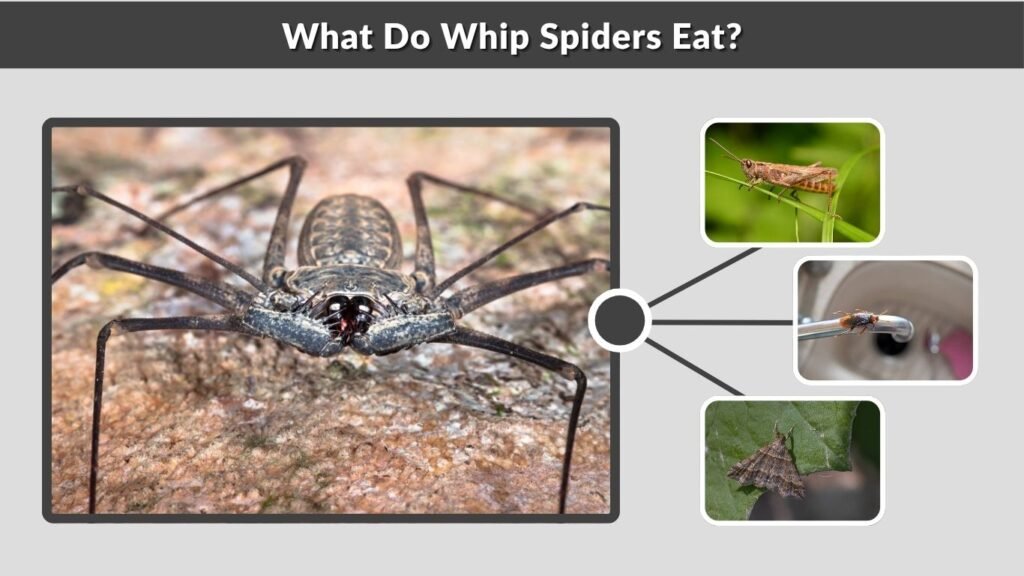
Whip spiders are nocturnal predators. Instead of building webs, they slowly explore their surroundings using their long antenniform legs to detect movement and environmental cues. Once prey is located, they quickly seize it with their spiny pedipalps.
Whip Spider Diet
Common prey includes:
- Crickets
- Cockroaches
- Moths
- Beetles
- Small flies
- Grasshoppers
- Other small arthropods
Very large individuals may occasionally overpower somewhat larger prey, but insects and other arthropods make up most of their diet.
How Whip Spiders Hunt
A whip spider often remains relatively still while extending its sensory legs around the surrounding surface. These delicate appendages can gather information about nearby objects and prey.
When an insect approaches, the whip spider rapidly closes its pedipalps around the victim. The spines prevent escape while the prey is brought toward the mouth.
Feeding in Captivity
Pet whip spiders are commonly offered appropriately sized live insects. Overfeeding should be avoided, and uneaten prey should not be allowed to continuously disturb a molting animal.
Young and recently molted whip spiders can be particularly vulnerable because their new exoskeleton remains soft temporarily.
Whip Spider Life Cycle and Behavior
Whip spiders spend much of their lives hidden away during daylight and become more active after dark. Their behavior is often more complex than their frightening appearance suggests. Sensory communication and careful exploration play important roles in interactions between individuals.
Eggs and Young
After mating, a female carries developing eggs in a protective sac beneath her abdomen. When the young emerge, they climb onto their mother’s back.
They remain there until completing an early molt and becoming capable of living more independently.
Molting
Like other arachnids, whip spiders must molt as they grow. Before molting, an individual may stop eating and become less active.
Molting is a vulnerable period. The new exoskeleton needs time to harden before normal hunting can resume.
Whip Spider Lifespan
Lifespan depends heavily on species and environmental conditions. Whip spiders generally grow slowly compared with many insects, and some can survive for several years under favorable conditions.
Captive longevity can also vary based on humidity, temperature, diet, enclosure quality, and successful molts.
Whip Spider vs Whip Scorpion vs True Spider
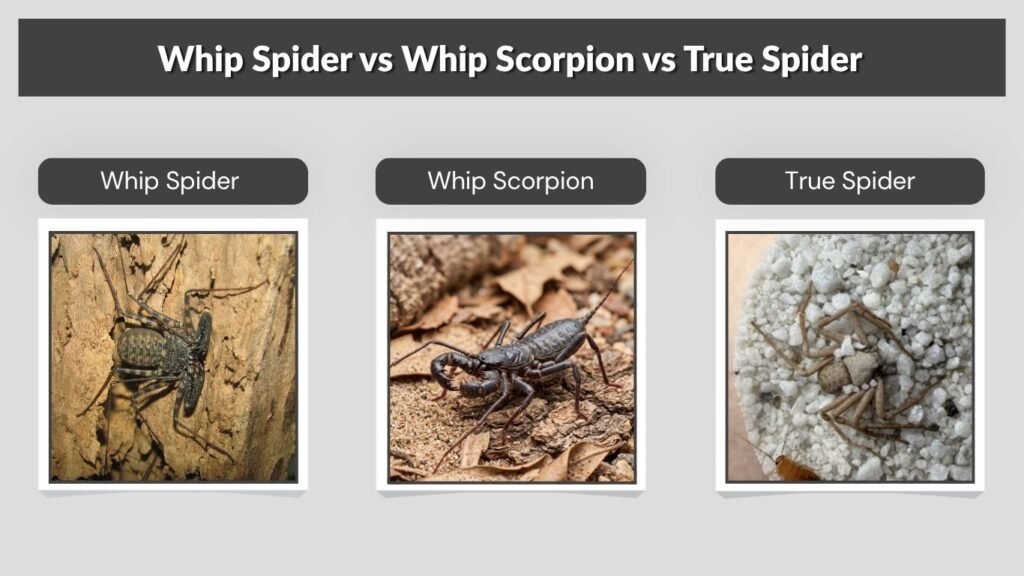
These animals are often confused because all three are arachnids. Their body structures and defensive abilities, however, are quite different. Recognizing the tail, sensory legs, silk production, and venom system makes distinguishing them much easier.
Whip Spider vs Whip Scorpion
- Whip spider: No tail and extremely long sensory front legs.
- Whip scorpion/vinegaroon: Has a thin whip-like tail.
- Whip spider: Uses powerful pedipalps to capture prey.
- Vinegaroon: Can release a defensive acidic spray.
- Whip spider: Belongs to Amblypygi.
- Whip scorpion: Belongs to Thelyphonida.
Whip Spider vs True Spider
True spiders belong to Araneae and generally produce silk. Many also possess venom for subduing prey.
Whip spiders have no spinnerets and do not build spider webs. Their oversized pedipalps mechanically capture prey instead.
Whip Spider vs Scorpion
Scorpions possess a segmented tail ending in a venomous stinger. Whip spiders have no tail or stinger.
Both possess prominent pedipalps, although those of whip spiders often resemble long, spiny grasping arms rather than classic scorpion pincers.
Keeping a Whip Spider as a Pet
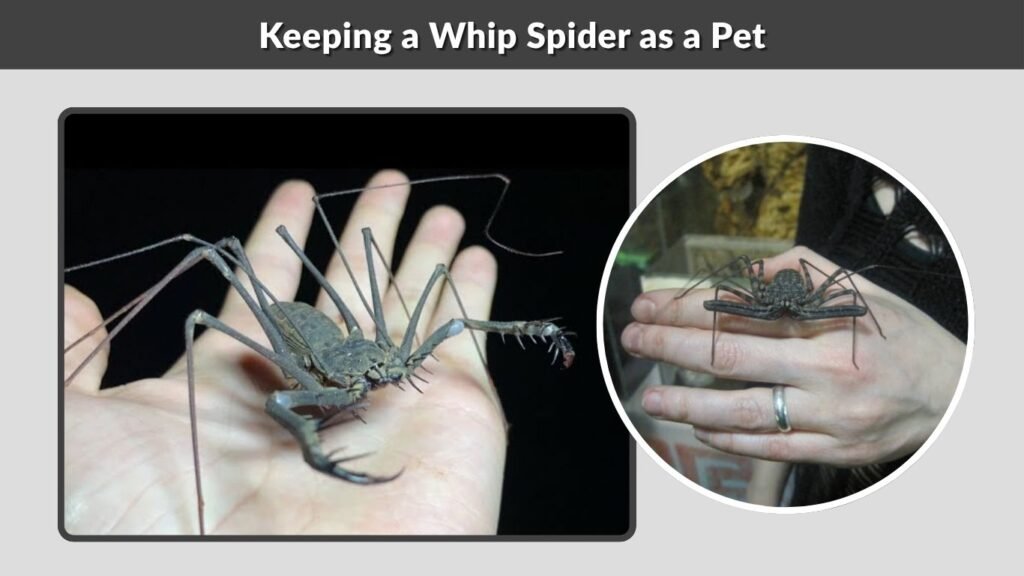
Some experienced arachnid keepers maintain species such as Damon and Euphrynichus. Their unusual appearance, nocturnal behavior, and lack of venom make them fascinating display animals. However, maintaining correct environmental conditions is important because many species depend on stable humidity and suitable surfaces for molting.
Basic Whip Spider Care
A captive whip spider generally needs a secure enclosure with good ventilation, vertical climbing surfaces, hiding places, and environmental conditions appropriate to its particular species.
Humidity should never be assumed to be identical for every species. Tropical whip spiders typically require more moisture than species adapted to comparatively dry habitats.
Live insects can be provided as food, while clean water and careful observation help maintain appropriate husbandry.
Before purchasing a whip spider, check local wildlife regulations and choose captive-bred animals whenever available rather than removing individuals from natural populations.
FAQs
1. Can a whip spider bite humans?
Whip spiders are not aggressive toward people. Defensive pinching or minor injury may occur if one is trapped or handled roughly, but serious incidents are uncommon.
2. Are whip spiders venomous?
No. Whip spiders do not have venom glands and cannot inject venom into humans or prey. They capture prey using their powerful, spiny pedipalps.
3. Where do whip spiders live?
They occur mainly throughout tropical and subtropical regions. Common habitats include forests, caves, rocky crevices, bark, logs, and other humid protected locations.
4. What was the whip spider in Harry Potter?
The strange arachnid shown during the classroom demonstration of the Unforgivable Curses in Harry Potter and the Goblet of Fire resembles a tailless whip scorpion, which is another common name for a whip spider.
5. What is the difference between a whip spider and a vinegaroon?
A whip spider has no tail and belongs to Amblypygi. A vinegaroon is a true whip scorpion belonging to Thelyphonida, has a long whip-like tail, and can release a defensive acidic spray.
