
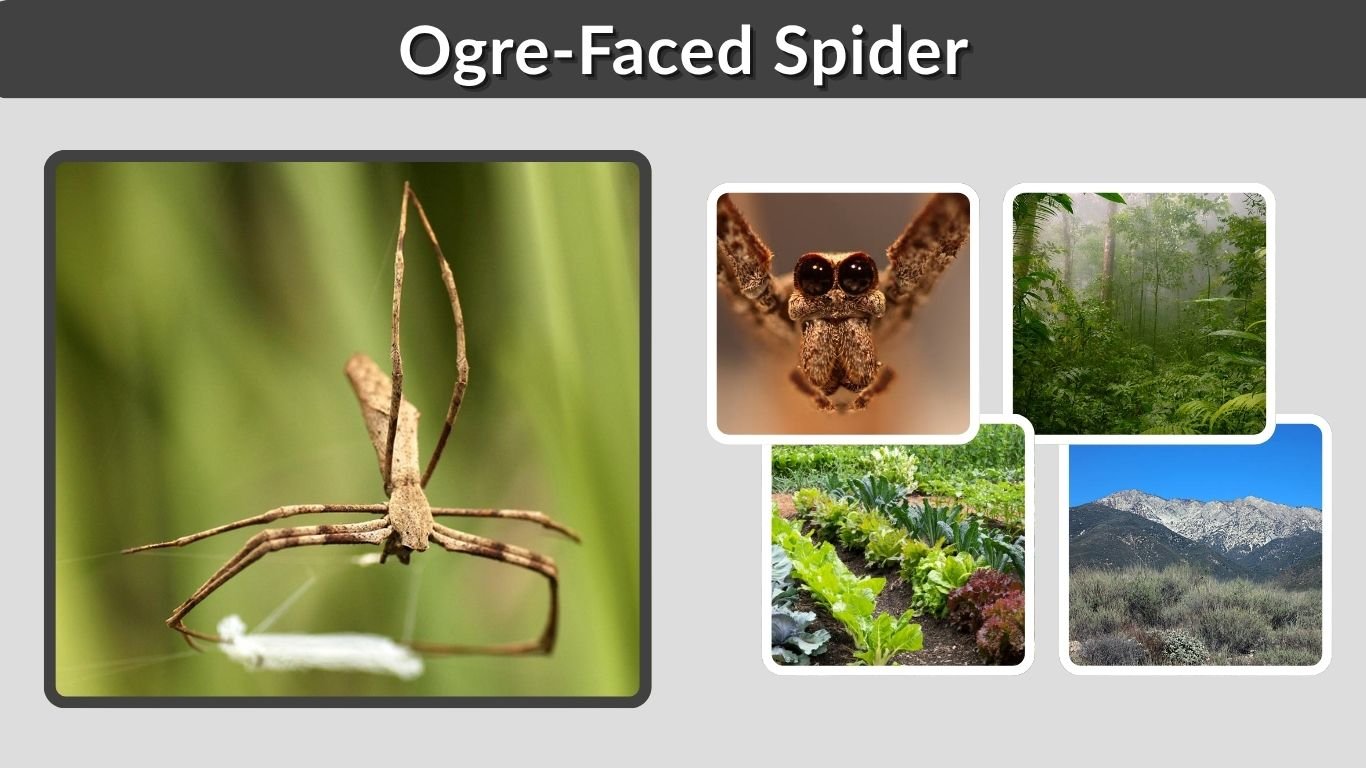
The ogre-faced spider is a remarkable nocturnal hunter known for its enormous eyes and unusual net-casting technique. Instead of waiting for insects to become trapped in a traditional web, this spider holds a small stretchy silk net between its legs and throws it over passing prey. Ogre-faced spiders belong to the net-casting spider family Deinopidae and occur mainly in warm regions. Despite their frightening appearance, they are not considered dangerous to humans. Here is a closer look at their size, habitat, vision, hunting behavior, venom, lifespan, and other fascinating adaptations.
What Is an Ogre-Faced Spider?
Ogre-faced spiders are members of the spider family Deinopidae, commonly known as net-casting spiders. Their name comes from their unusual face, which features two extremely large forward-facing eyes. These spiders are primarily active at night and use extraordinary eyesight, sensitive legs, and specialized silk nets to capture insects from vegetation or the ground.
Ogre-Faced Spider Identification
You can recognize an ogre-faced spider by several distinctive characteristics:
- Long, narrow body
- Extremely large forward-facing eyes
- Long and slender legs
- Gray, brown, or tan coloration
- Excellent camouflage against twigs and bark
- Small rectangular silk hunting net
- Usually active after sunset
- Elongated abdomen that resembles a stick
Their unusual body shape sometimes leads people to call them stick spiders or gladiator spiders.
Scientific Classification
Ogre-faced spiders belong to the family Deinopidae. Several species occur within genera such as Deinopis and related groups.
One well-known North American species historically referred to as Deinopis spinosa is famous for its impressive night vision and net-casting hunting behavior.
Ogre-Faced Spider Size and Appearance
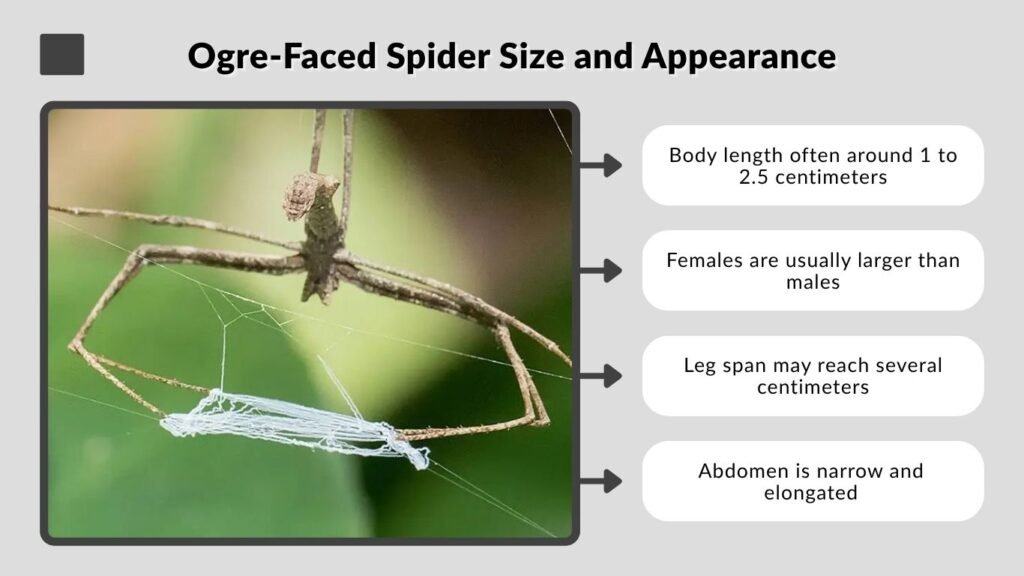
Although photographs can make these spiders look huge, their bodies are generally modest in size. Their long legs create a much larger overall appearance. Their thin, elongated anatomy also helps them blend into vegetation, where they can remain nearly invisible during daylight hours before emerging to hunt after dark.
How Big Is an Ogre-Faced Spider?
Typical size characteristics include:
- Body length often around 1 to 2.5 centimeters
- Females are usually larger than males
- Leg span may reach several centimeters
- Long legs make the spider look much larger than its body
- Abdomen is narrow and elongated
Exact measurements vary considerably between species and individuals.
Ogre-Faced Spider Face
The face is perhaps the spider’s most recognizable feature. Two enormous eyes dominate the front of the head, producing an almost alien or ogre-like appearance.
These large eyes provide exceptional sensitivity in extremely dim environments, giving the spider an important advantage when hunting at night.
Ogre-Faced Spider Size Comparison
Compared with large tarantulas or huntsman spiders, an ogre-faced spider has a relatively small body. However, its long legs make it appear significantly larger.
Its overall build is much more delicate than that of heavy-bodied spiders such as tarantulas.
Ogre-Faced Spider Eyes and Night Vision
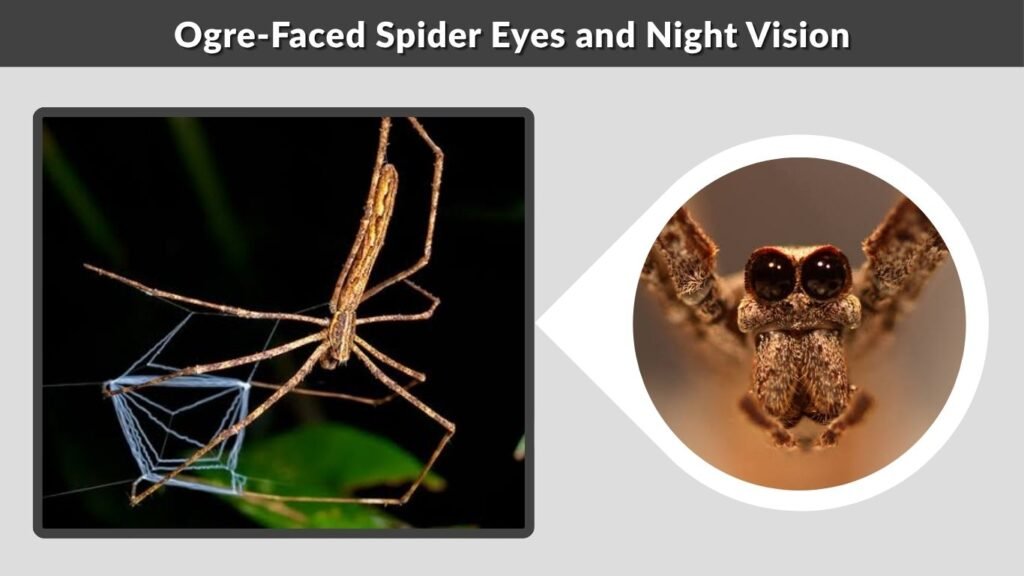
Ogre-faced spiders possess one of the most impressive visual systems among nocturnal spiders. Their unusually large principal eyes are specifically adapted for collecting light in darkness. This exceptional sensitivity allows them to detect prey movements at night, even when lighting conditions would make hunting difficult for many other spiders.
How Many Eyes Does an Ogre-Faced Spider Have?
Ogre-faced spiders have eight eyes, although two are dramatically larger than the others.
Their eyes include:
- Two enormous forward-facing principal eyes
- Six much smaller secondary eyes
- Highly light-sensitive visual structures
- Wide visual coverage for detecting nearby movement
The oversized principal eyes give the spider its characteristic facial appearance.
Why Are Their Eyes So Large?
The large eyes collect as much available light as possible. This allows the spider to detect insects while remaining relatively motionless in darkness.
Researchers have found that ogre-faced spiders can use visual information to perform extremely accurate hunting strikes.
Do Ogre-Faced Spider Eyes Melt?
Claims that their eyes literally “melt” every morning are misleading. However, the light-sensitive structures within their eyes undergo significant daily changes.
Their visual system becomes highly sensitive at night and adjusts again during daylight. This adaptation helps protect delicate light-sensitive tissues from excessive daytime illumination while preparing the spider for nocturnal hunting.
How Does an Ogre-Faced Spider Hunt?
Unlike typical orb-weaving spiders, ogre-faced spiders actively manipulate a small web with their legs. They position themselves above likely prey routes and wait almost motionlessly. When an insect approaches, the spider rapidly stretches its silk net and captures the victim in an extremely fast and precise movement.
Net-Casting Hunting Method
Their hunting process generally involves:
- Producing a small rectangular silk net.
- Holding the net between the front legs.
- Hanging upside down above a hunting area.
- Watching and sensing movement below.
- Rapidly expanding the net toward passing prey.
- Wrapping the captured insect in silk.
- Biting and feeding on the immobilized prey.
This hunting technique gives them the alternative name net-casting spider.
What Do Ogre-Faced Spiders Eat?
Their diet commonly includes:
- Moths
- Flies
- Beetles
- Crickets
- Cockroaches
- Small grasshoppers
- Other spiders
- Various crawling and flying insects
They can capture prey both in front of and behind their bodies by rapidly changing the direction of their attack.
Ogre-Faced Spider Reflexes
Ogre-faced spiders have extremely fast hunting responses. Their legs and sensory systems detect movement and help coordinate sudden attacks.
They may perform backward strikes toward flying insects or forward attacks against prey moving beneath them.
Ogre-Faced Spider Habitat and Location
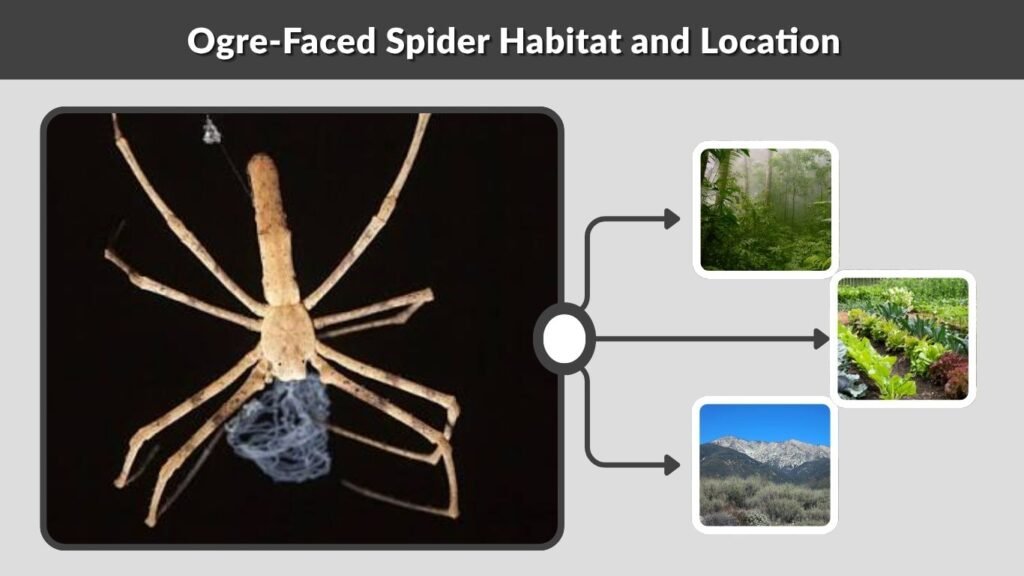
Ogre-faced spiders generally favor warm environments where insects are abundant. They often occupy vegetation, woodland edges, shrubs, and areas around tree trunks. During daylight, their narrow bodies and muted colors provide excellent camouflage. At night they move into hunting positions where insects are likely to pass.
Where Do Ogre-Faced Spiders Live?
They can be found in:
- Tropical forests
- Subtropical woodlands
- Gardens
- Shrublands
- Tree-covered areas
- Vegetation near waterways
- Warm coastal regions
Different species occupy different geographic ranges.
Ogre-Faced Spiders in the United States
Net-casting spiders occur in warmer parts of the United States, particularly in southeastern regions.
They may be found in areas such as Florida and other states with warm, humid conditions where suitable habitat and insect prey are available.
Ogre-Faced Spiders in Australia
Australia also has net-casting spiders with similar hunting adaptations. They often rest against twigs or vegetation during daylight, where their slender bodies provide excellent camouflage.
At night, they become active and prepare their silk nets.
Are Ogre-Faced Spiders Dangerous?
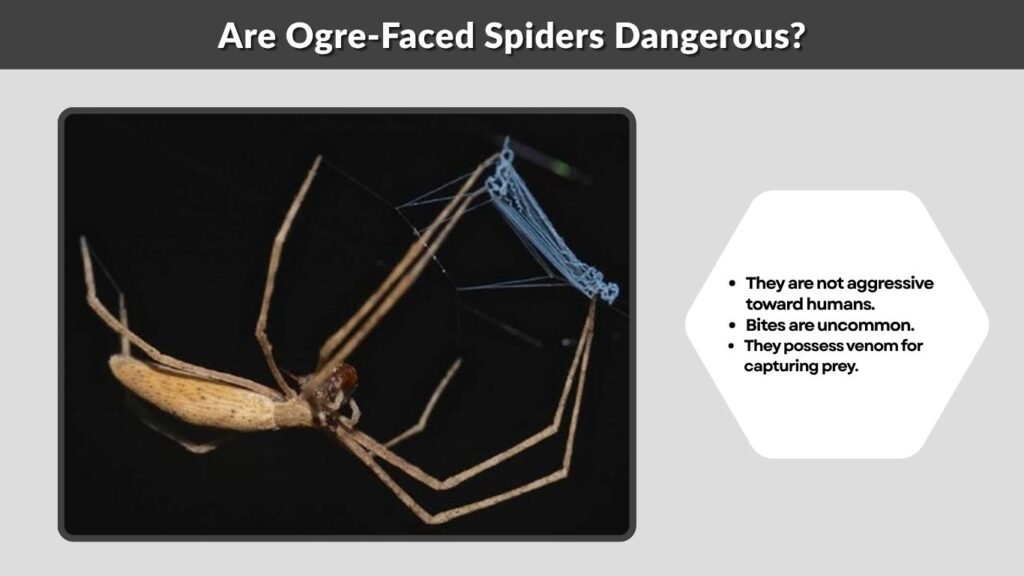
Their enormous eyes and unusual facial features can make ogre-faced spiders appear intimidating. However, they are not considered medically significant spiders. They primarily use venom to subdue small insects rather than defend themselves against people and generally avoid human contact whenever possible.
Ogre-Faced Spider Bite
Important bite facts include:
- They are not aggressive toward humans.
- Bites are uncommon.
- They possess venom for capturing prey.
- Their venom is not considered medically dangerous to healthy people.
- Defensive bites are most likely if the spider is trapped or handled.
- Mild localized discomfort may occur after a bite.
Avoid unnecessary handling and allow the spider to move away naturally.
Are Ogre-Faced Spiders Poisonous?
Ogre-faced spiders are venomous in the biological sense because they use venom when feeding on prey. However, “poisonous” is not the correct term because they do not harm predators through ingestion or contact.
Their venom is primarily adapted for relatively small arthropod prey.
Ogre-Faced Spider Life Cycle
Like other spiders, ogre-faced spiders develop through a series of molts. Their reproduction begins when males locate receptive females and successfully mate without being treated as prey. Females later produce egg sacs that protect developing spiderlings until they hatch and begin an independent life.
Ogre-Faced Spider Egg Sac
Female ogre-faced spiders produce silk egg sacs containing multiple eggs. Egg sacs may be placed in protected areas among vegetation or attached to suitable surfaces.
After hatching, young spiders gradually disperse and begin hunting smaller insects.
Ogre-Faced Spider Lifespan
Lifespan differs among species, sex, climate, and environmental conditions. Many individuals live roughly around a year or somewhat longer, although exact longevity varies.
Females may survive longer than males in some species.
Ogre-Faced Spider Adaptations
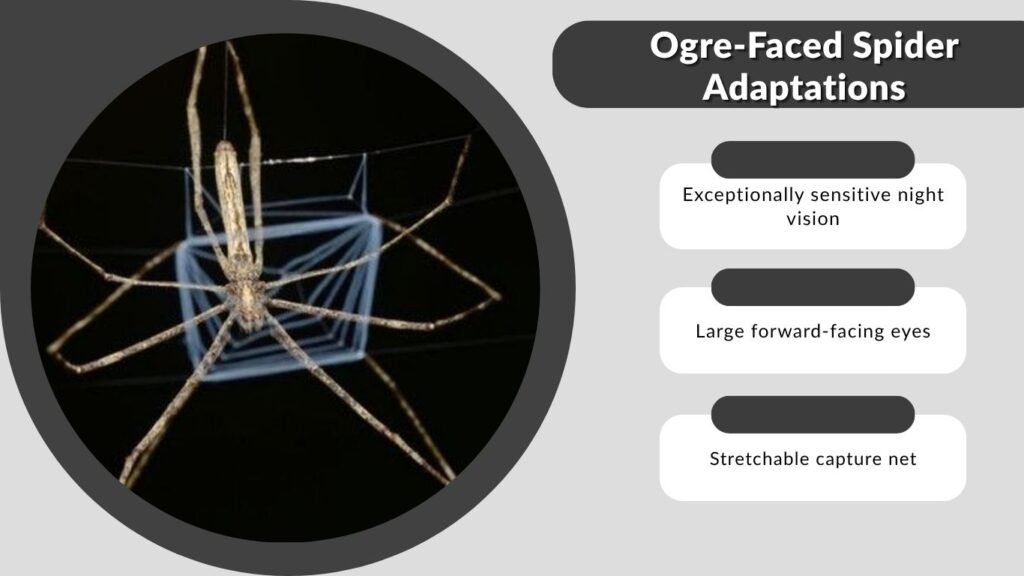
The success of ogre-faced spiders comes from several specialized adaptations working together. Their combination of advanced vision, camouflage, sensitive legs, and sophisticated silk manipulation allows them to capture prey without constructing the large permanent webs associated with many other spiders.
Major Adaptations
- Exceptionally sensitive night vision
- Large forward-facing eyes
- Stretchable capture net
- Fast attack reflexes
- Long sensory legs
- Stick-like camouflage
- Ability to detect airborne and ground movement
- Nocturnal activity that reduces daytime exposure
These adaptations make the ogre-faced spider one of the most specialized ambush hunters in the spider world.
FAQs
1. Can an ogre-faced spider bite humans?
Yes, it is physically capable of biting, but bites are uncommon because these spiders are not aggressive. Their venom is not considered medically significant to humans.
2. Why does the ogre-faced spider have huge eyes?
Its large principal eyes collect light extremely efficiently, allowing the spider to hunt insects under very low nighttime light conditions.
3. How does an ogre-faced spider catch prey?
It holds a small stretchy silk net between its legs and rapidly expands the net over passing insects before wrapping and feeding on them.
4. Where are ogre-faced spiders found?
They occur mainly in warm tropical and subtropical regions, including parts of the Americas, Australia, Africa, and other suitable areas.
5. Are ogre-faced spiders good pets?
They can occasionally be kept by experienced arachnid enthusiasts, but their specialized hunting behavior, environmental needs, and delicate build make them less suitable for beginners than many commonly kept spiders.
