
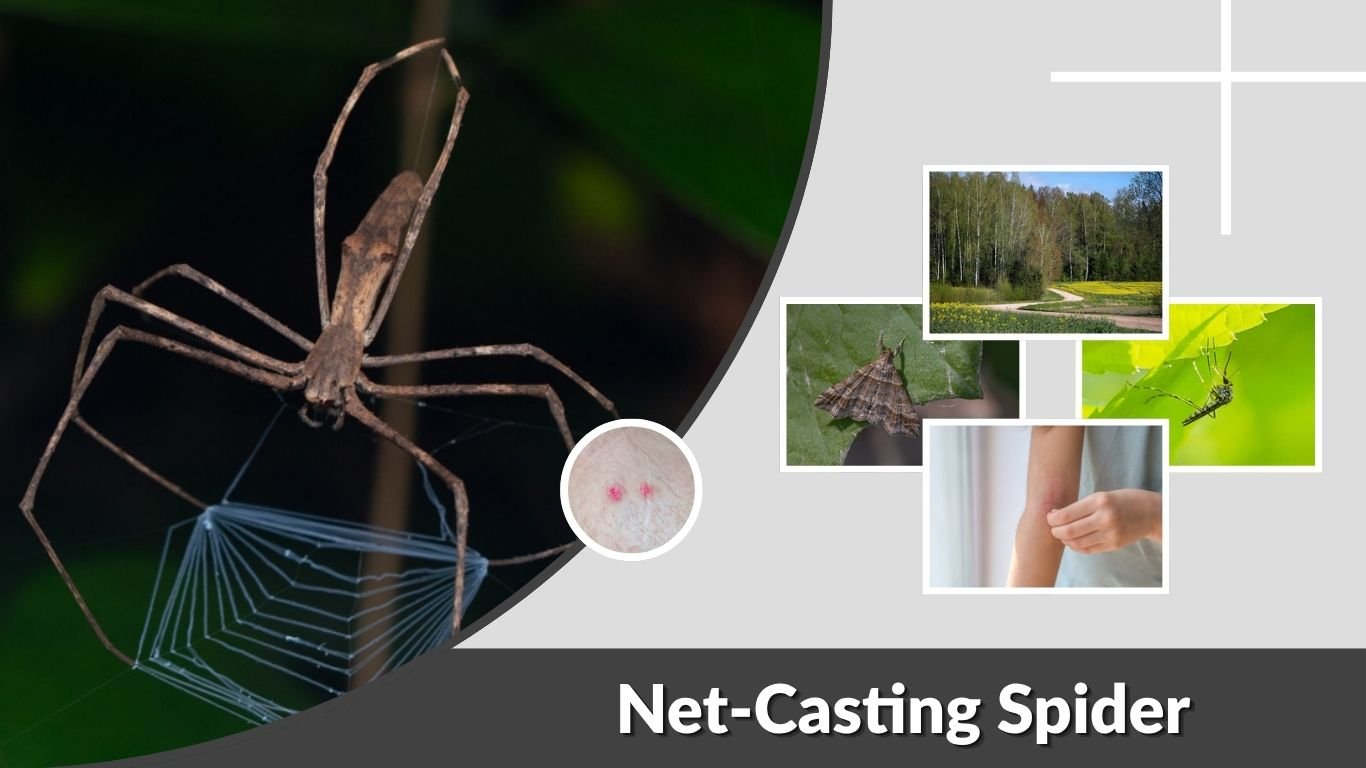
The net-casting spider is an unusual nocturnal hunter famous for catching prey with a small web held between its front legs. Often called an ogre-faced spider, it has extremely large eyes that help it detect insects in very low light. Instead of waiting for prey to become trapped in a permanent web, the spider actively throws or stretches its silk net over passing insects. Net-casting spiders occur mainly in warm tropical and subtropical regions, including Australia, Africa, and the Americas.
What Is a Net-Casting Spider?
Net-casting spiders belong to the family Deinopidae, a group known for its extraordinary hunting technique and large forward-facing eyes. Their long legs, narrow bodies, and unusual faces make them look intimidating, but they generally avoid humans. Most species spend daylight hours resting among vegetation and become active after sunset.
Scientific Classification
- Common name: Net-casting spider
- Other name: Ogre-faced spider
- Family: Deinopidae
- Order: Araneae
- Type: Nocturnal hunting spider
- Diet: Primarily insects and other small arthropods
Several species occur around the world, so appearance, size, and coloration can vary considerably.
Net-Casting Spider Size
Most net-casting spiders have relatively narrow bodies but very long legs. Depending on the species and sex, body length can range from roughly 1 to 3 centimeters, while the leg span makes the spider appear substantially larger.
Females are commonly larger and heavier-bodied than males. Their stretched legs and elongated abdomen also help them camouflage themselves against stems and branches.
Male vs. Female Net-Casting Spider
Adult males and females can look noticeably different.
- Females are generally larger.
- Males usually have slimmer bodies.
- Mature males develop enlarged pedipalps.
- Females produce and protect egg sacs.
- Both sexes have long legs and excellent nighttime vision.
Males typically spend more time searching for potential mates once mature.
Net-Casting Spider Eyes and Face
The face is one of the spider’s most recognizable features. Ogre-faced net-casting spiders are famous for their enormous eyes, which can give them an almost alien appearance. These eyes are an important adaptation for hunting after dark, allowing the spider to detect prey movement when very little light is available.
Why Are Their Eyes So Large?
Net-casting spiders rely heavily on vision while hunting at night. Their enlarged principal eyes are extremely sensitive to available light.
This allows the spider to identify movement beneath its resting position and accurately strike insects with its web. During daylight, it usually remains hidden and motionless, relying more on camouflage than active vision.
What Does the Face Look Like?
Viewed from the front, the spider’s large eyes can create the appearance of a frightening or exaggerated face. This resemblance inspired the common name “ogre-faced spider.”
Despite its dramatic appearance, the spider’s face is primarily specialized for detecting prey rather than threatening predators or humans.
Night Vision
Their visual system is exceptionally well suited to darkness. Large eyes capture available light efficiently, allowing the spider to hunt when many insects are active.
Unlike spiders that rely mainly on vibrations from a large web, net-casting spiders combine vision, body position, silk, and rapid movement to make successful nighttime attacks.
How Does a Net-Casting Spider Hunt?
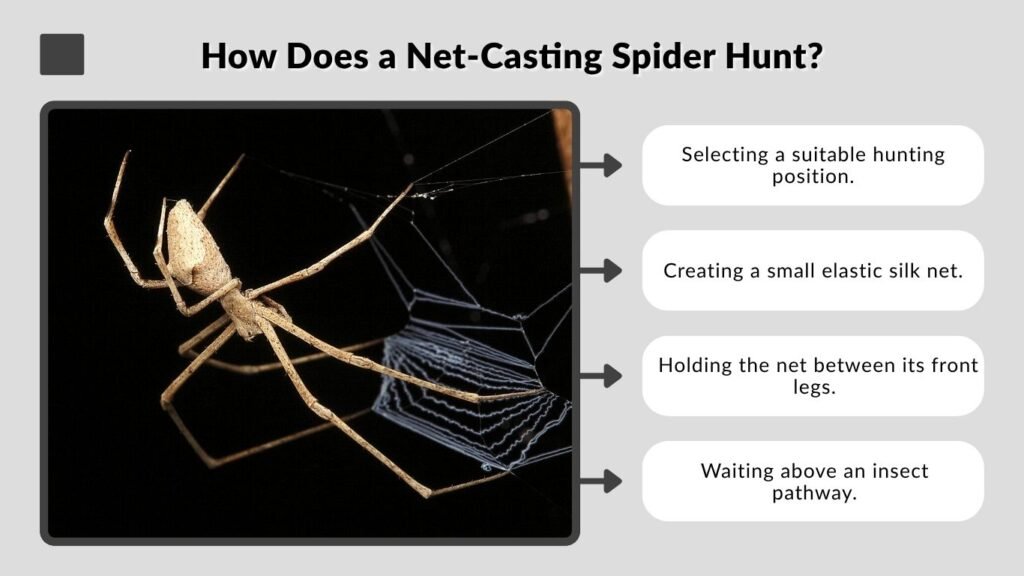
Unlike traditional orb-weaving spiders, net-casting spiders create a small rectangular piece of stretchy silk. They hold this net between their front legs while hanging above a surface. When an insect moves into the correct position, the spider rapidly lunges and expands the silk over its prey.
Net-Casting Hunting Steps
The spider’s hunting method generally involves:
- Selecting a suitable hunting position.
- Creating a small elastic silk net.
- Holding the net between its front legs.
- Waiting above an insect pathway.
- Detecting approaching prey.
- Stretching the net over the insect.
- Wrapping and biting the captured prey.
This method is dramatically different from simply waiting in the center of a permanent web.
What Does the Web Look Like?
The hunting net is relatively small and usually rectangular or square rather than a large circular structure.
Important characteristics include:
- Highly elastic silk
- Small mesh-like construction
- Held directly by the spider
- Expanded during an attack
- Used to trap insects at close range
Under certain lighting conditions, the silk can appear bluish or silvery because of how light reflects from the threads.
Catching Prey
When prey approaches, the spider can suddenly extend its legs and stretch the web dramatically. The flexible silk surrounds the insect and prevents escape.
The spider then restrains the prey and delivers venom through its fangs. The venom helps immobilize the insect before feeding begins.
Are Net-Casting Spiders Venomous?
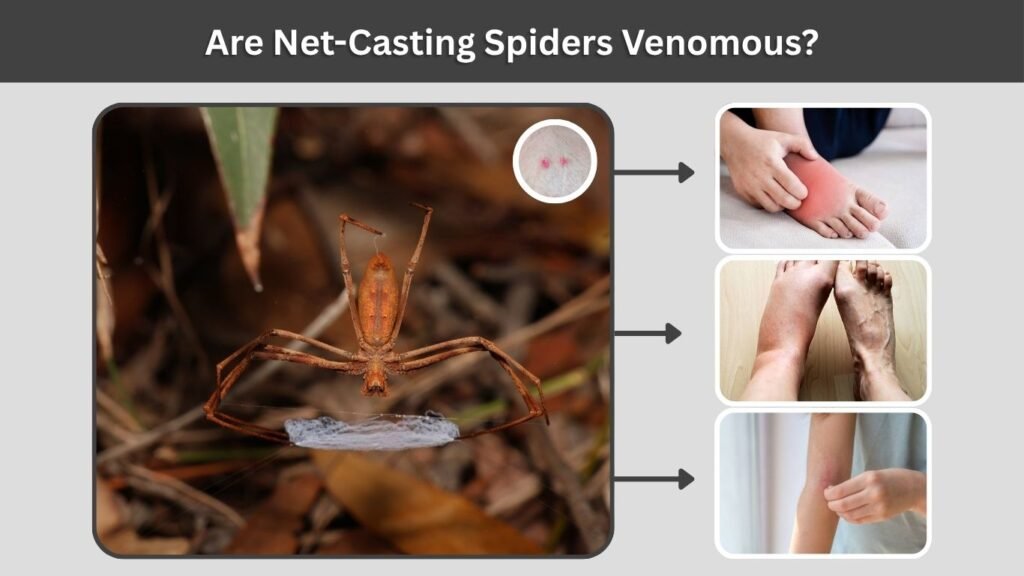
Net-casting spiders are venomous in the biological sense because they use venom to immobilize prey. However, they are not considered particularly dangerous to humans. Their venom is primarily adapted for controlling small insects and other arthropods rather than defending themselves against people.
Net-Casting Spider Bite
Bites are uncommon because these spiders are shy and normally try to escape when disturbed.
If a bite occurs, possible effects may include:
- Localized pain
- Mild redness
- Temporary swelling
- Itching
- Minor irritation around the bite
Anyone who experiences severe or unusual symptoms following any suspected spider bite should seek medical advice.
Are They Poisonous?
Net-casting spiders are better described as venomous rather than poisonous. Venom is delivered through a bite, while poison generally causes harm after being touched, swallowed, or absorbed.
Their venom helps them hunt insects, but they are not known as aggressive spiders that actively attack humans.
Are Net-Casting Spiders Dangerous?
For most people, net-casting spiders pose little threat. Their appearance, enormous eyes, and unusual hunting behavior can make them seem dangerous, but they normally prefer avoiding contact.
Leaving an outdoor net-casting spider undisturbed is usually the simplest approach.
Net-Casting Spider Habitat and Distribution
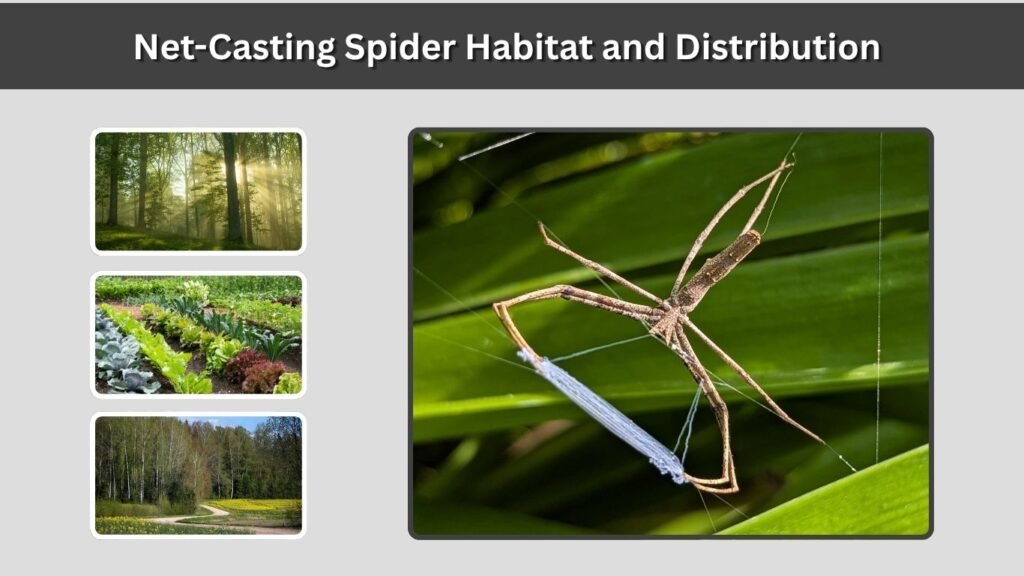
These spiders generally favor warm environments with vegetation, insects, and sheltered daytime resting areas. Different species occur across several continents, so net-casting spiders can be found in tropical forests, gardens, woodland edges, and suburban areas where suitable conditions are available.
Net-Casting Spiders in Australia
Australia supports several net-casting spider species. They may be encountered in gardens, forests, shrubs, parks, and wooded suburban environments.
They are reported from regions around cities such as:
- Brisbane
- Sydney
- Melbourne
- Areas of Victoria
- Warm eastern Australian habitats
They can be difficult to notice during daylight because their elongated bodies resemble twigs or pieces of vegetation.
Net-Casting Spiders in the United States
Net-casting spiders also occur in parts of the United States, particularly warmer regions. Florida is among the areas where ogre-faced spiders can be encountered.
Their presence depends on climate, vegetation, moisture, and suitable populations of insects.
African and Malagasy Species
Africa and Madagascar also contain members of the net-casting spider family. Different species may have their own coloration, body proportions, and habitat preferences.
Names such as Cameroon or Malagasy net-casting spiders generally refer to spiders associated with those geographic regions rather than one single worldwide species.
Net-Casting Spider Diet and Daily Behavior
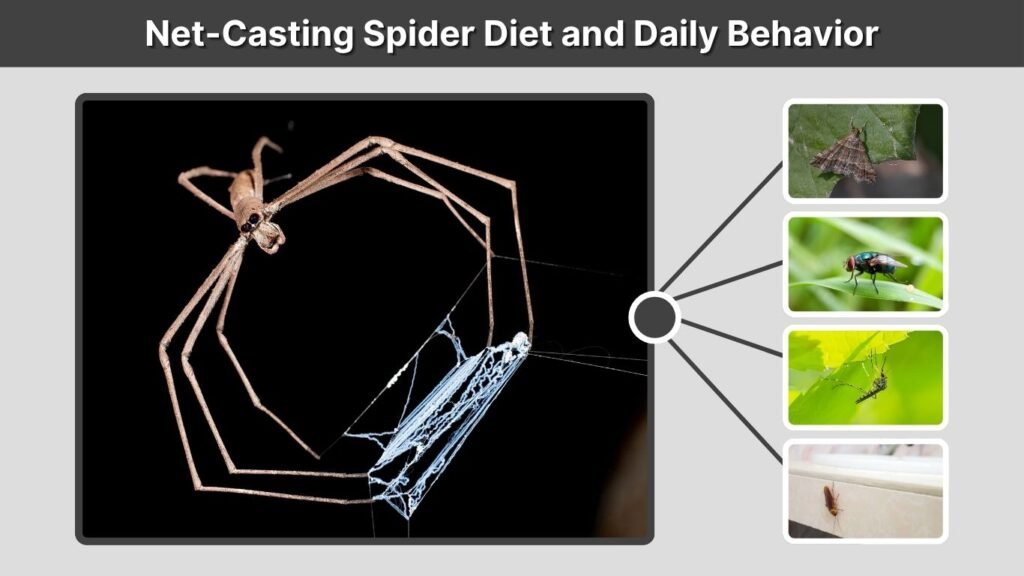
Net-casting spiders are predators that primarily hunt at night. They position themselves above locations where insects are likely to travel and use their specialized silk net to capture them. During daylight, the spider often remains stretched along vegetation, where its brown, gray, or reddish coloration provides effective camouflage.
What Do Net-Casting Spiders Eat?
Their prey can include:
- Moths
- Flies
- Mosquitoes
- Small crickets
- Cockroaches
- Beetles
- Other small insects
- Occasionally other arthropods
The exact diet varies depending on species, body size, and the prey available in the spider’s habitat.
Rufous Net-Casting Spider
The rufous net-casting spider is recognized for reddish-brown or rusty coloration that helps it blend into vegetation and tree bark.
Like other members of its group, it is a nighttime hunter that uses a small expandable silk net rather than constructing a large permanent capture web.
Daytime Behavior
During daylight hours, net-casting spiders often remain extremely still. Their long bodies and legs may be aligned with a branch or twig.
This posture makes them harder for birds and other predators to notice and allows the spider to conserve energy until nighttime hunting begins.
Net-Casting Spider Egg Sacs and Life Cycle
The reproductive cycle begins when adult males locate females. After mating, females eventually produce eggs surrounded by protective silk. Young spiders hatch as tiny versions of adults and gradually increase in size through repeated molts before reaching maturity.
Net-Casting Spider Egg Sac
A female produces a protective silk structure containing her eggs. Depending on the species, the egg sac may be suspended or attached within vegetation.
Typical characteristics include:
- Protective silk covering
- Multiple eggs inside
- Usually placed in a sheltered location
- Produced by an adult female
- Young spiderlings emerge after development
Spiderlings
Young net-casting spiders are extremely small when they first emerge. As they develop, they molt repeatedly and gradually acquire the proportions and hunting abilities seen in adults.
Young spiders also need to avoid predators while learning to capture appropriately sized prey.
Net-Casting Spider Lifespan
Lifespan varies between species and depends on environmental conditions such as temperature, food availability, and predation.
Like many spiders, net-casting spiders progress through egg, spiderling, juvenile, and adult stages. Adults ultimately reproduce, allowing the next generation to continue the cycle.
FAQs
1. Is a net-casting spider dangerous?
No. Net-casting spiders are generally considered harmless to humans and are not aggressive. Their venom is mainly used for capturing insect prey.
2. Why is it called an ogre-faced spider?
The name comes from its unusual face and enormous forward-facing eyes, which can give the spider an exaggerated, ogre-like appearance.
3. How does a net-casting spider catch its prey?
It holds a small elastic silk net between its front legs and rapidly stretches the net over an insect when the prey comes within striking distance.
4. Where do net-casting spiders live?
They occur mainly in tropical and subtropical regions, including parts of Australia, Africa, Madagascar, the Americas, and warmer areas of the United States.
5. Do net-casting spiders build normal spider webs?
Not in the same way as orb weavers. They make a small stretchy hunting net that is physically held between their legs and thrown or stretched over prey.
