
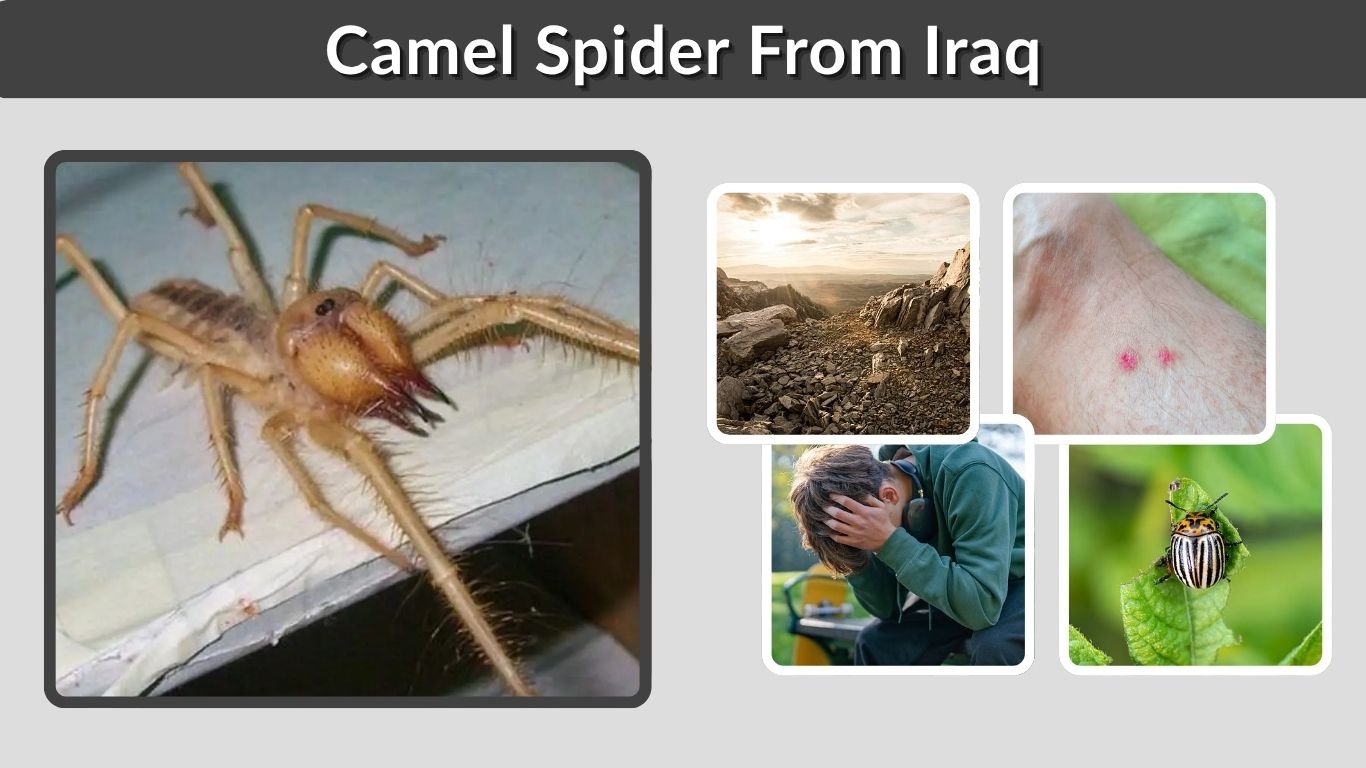
The camel spider from Iraq became internationally famous during the Iraq War after dramatic photos and stories circulated online showing what appeared to be enormous desert spiders. In reality, camel spiders are large, fast-moving arachnids, but many stories about their size, speed, venom, and attacks on soldiers were greatly exaggerated. They are not true spiders and do not have venom. Instead, these desert predators belong to the order Solifugae and use powerful jaws to capture insects and other small animals.
What Is an Iraq Camel Spider?
The Iraq camel spider is a solifuge, an arachnid belonging to the order Solifugae. Camel spiders are related to spiders and scorpions because all belong to the class Arachnida, but camel spiders form their own separate group.
They are also commonly called wind scorpions, sun spiders, or solpugids. More than 1,000 species of Solifugae are known worldwide, with many adapted to hot, dry environments such as those found across the Middle East.
Identification
- Order: Solifugae
- Animal group: Arachnid
- Color: Usually tan, yellowish-brown, or sandy brown
- Body: Hairy and segmented
- Legs: Long and adapted for rapid movement
- Jaws: Large paired chelicerae
- Venomous: No
- Web: Does not build a spider web
- Habitat: Deserts and other dry environments
- Diet: Mainly insects and other small animals
How Big Is a Camel Spider in Iraq?
Stories about the giant camel spider in Iraq often make these arachnids sound much larger than they really are.
Large solifuges can have an impressive overall leg span, but their actual body is only several centimeters long. Near Eastern camel spiders featured in the famous Iraq photographs had body lengths of roughly 4–5 cm, although including their legs makes them look considerably larger.
Some larger solifuges elsewhere can approach roughly 12 cm when their legs are included.
Are Full-Grown Iraq Camel Spiders Huge?
A full-grown Iraq camel spider can certainly look large and intimidating, especially because of its long legs and oversized jaws.
However, claims that they grow as large as dinner plates or have bodies nearly a foot long are false.
Their unusual proportions, rapid movement, and enormous-looking jaws can make them appear much bigger than an ordinary spider.
Giant Camel Spider Iraq Photo: Was It Real?
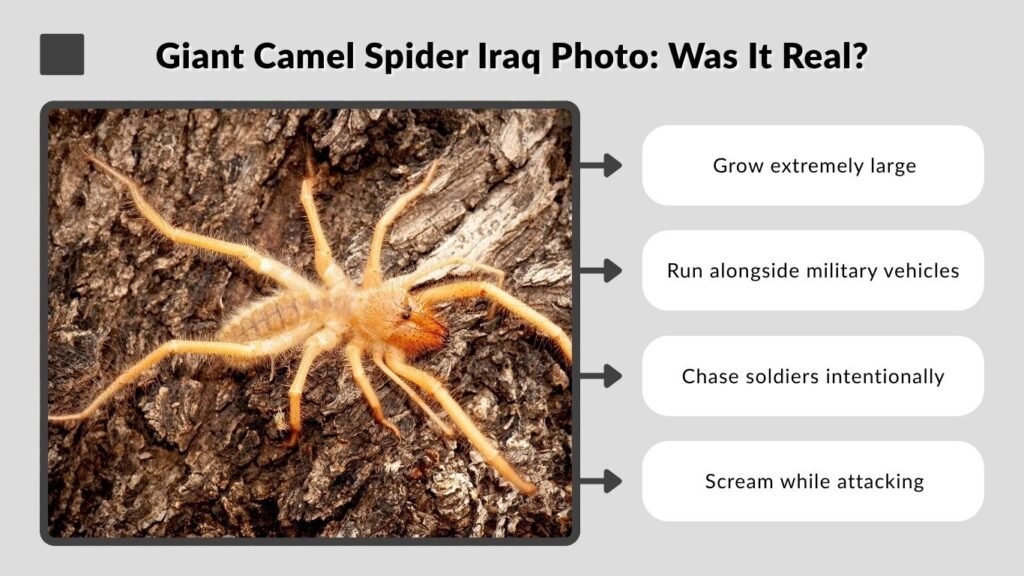
One of the most famous images from the Iraq War showed two camel spiders hanging near a soldier. Because the animals were positioned very close to the camera, they appeared enormous compared with the person standing farther behind them.
The photograph itself was real, but its apparent scale was misleading.
The Burke Museum notes that the camel spiders in the famous 2004 image were only around 4 cm in body length. Forced perspective made them appear many times larger.
Iraq Camel Spider Hoax Explained
The Iraq camel spider hoax was therefore not necessarily a fake photograph. Instead, exaggerated descriptions were attached to a real picture.
Stories claimed that camel spiders could:
- Grow extremely large
- Run alongside military vehicles
- Chase soldiers intentionally
- Scream while attacking
- Inject powerful venom
- Eat the flesh of sleeping humans or camels
These claims contributed heavily to the creature’s frightening reputation, but several of them are myths.
Are Camel Spiders From Iraq Venomous?
No. Camel spiders do not have the venom-delivery system found in true spiders and are not considered venomous to humans.
Instead of venom, they rely on enormous paired jaws called chelicerae.
These jaws can cut, crush, and tear prey. Relative to the camel spider’s body, they are extremely powerful and are one of the animal’s most distinctive features.
Can an Iraq Camel Spider Bite Humans?
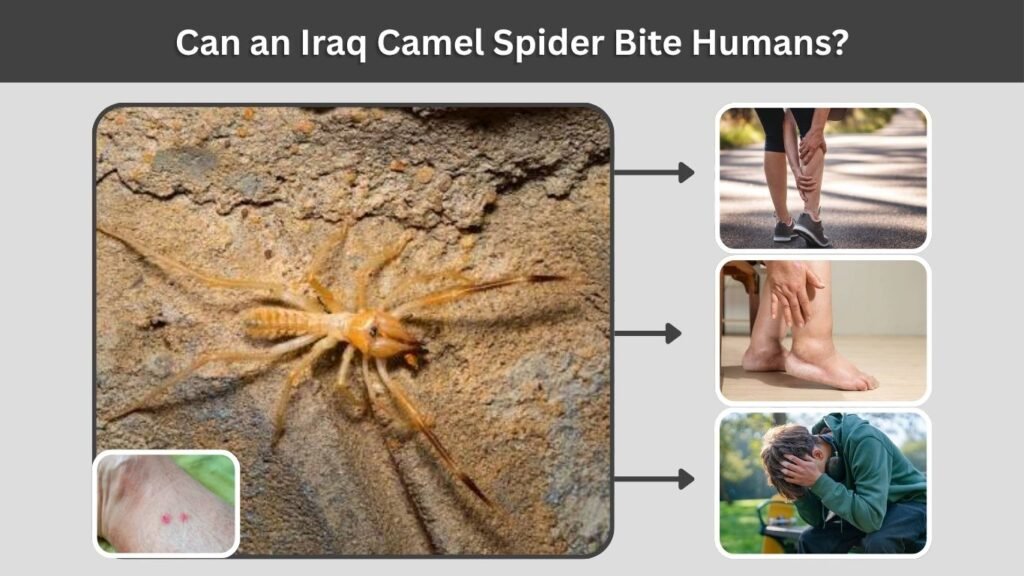
Yes. A camel spider can bite if it is grabbed, trapped, or handled.
Because its jaws are strong, a large individual could potentially break the skin and cause a painful wound. However, the bite does not inject venom.
The main concerns following a significant bite are ordinary wound problems such as:
- Pain
- Bleeding
- Swelling
- Local irritation
- Possible infection if the wound becomes contaminated
Camel spiders do not normally seek humans as prey.
How Fast Can an Iraq Camel Spider Run?
Camel spiders are surprisingly fast for arachnids, which probably helped inspire their legendary reputation.
Some sources estimate that large solifuges can reach speeds approaching roughly 10 mph (16 km/h) under favorable conditions, although claims that they run 25–30 mph are exaggerated.
Their speed allows them to catch insects and rapidly escape threats.
Why Do Camel Spiders Chase Soldiers?
Camel spiders may appear to chase a person, but they are generally not trying to attack them.
Many solifuges avoid intense sunlight and seek shade. A person walking through an exposed desert creates a moving shadow, and a camel spider may run toward or alongside that shadow while attempting to remain out of direct sunlight.
This behavior can easily look like an aggressive pursuit.
Camel Spider Iraq Soldiers and War Stories
Camel spiders became particularly famous among American and coalition soldiers during the Iraq War.
The hot, dry environment of military camps and barracks provided suitable places for desert arthropods. Soldiers encountering these unfamiliar, fast-moving arachnids sometimes photographed them, filmed them, or shared stories online.
In 2004, one photograph circulated especially widely and contributed to claims of gigantic Iraq camel spiders. The combination of forced perspective and dramatic descriptions helped turn an ordinary desert arachnid into an internet legend.
What Do Camel Spiders in Iraq Eat?
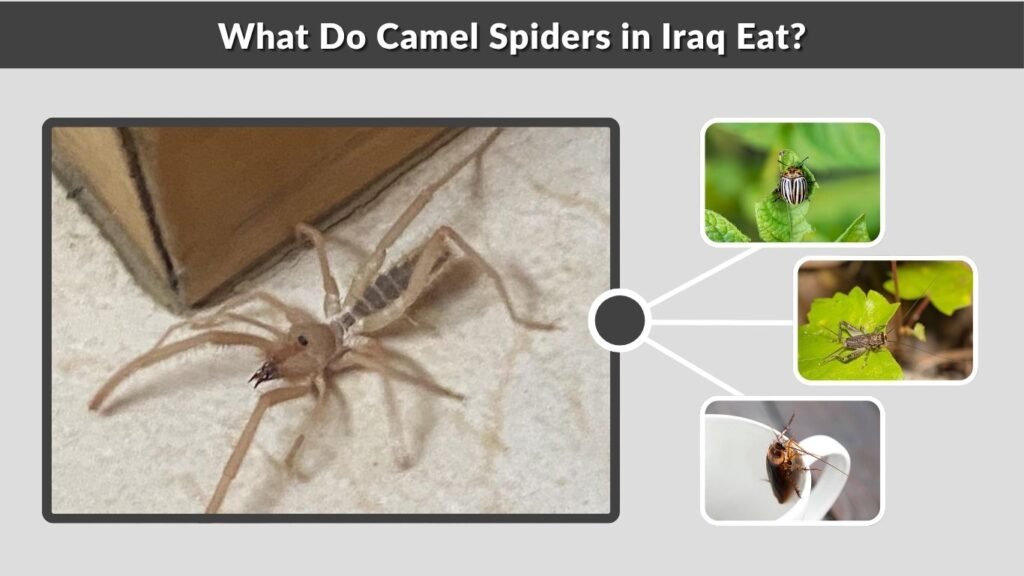
Camel spiders are active predators rather than web-building hunters.
They commonly prey on:
- Beetles
- Crickets
- Grasshoppers
- Cockroaches
- Termites
- Other arachnids
- Small desert invertebrates
Large species may occasionally overpower small vertebrates when the opportunity arises.
Their large jaws break food into manageable pieces before it is consumed. National Geographic describes solifuges as formidable predators with extremely powerful jaws relative to their body size.
Camel Spider vs Scorpion in Iraq
Both camel spiders and scorpions inhabit dry environments in the Middle East, so encounters between them are possible.
A camel spider relies mainly on speed and powerful jaws, whereas a scorpion possesses pincers and a venomous stinger.
The outcome of a camel spider vs. scorpion encounter would depend on factors such as:
- Species
- Relative size
- Which animal attacks first
- Strength of the scorpion’s pincers
- Ability of the camel spider to avoid the stinger
Videos showing captive camel spiders fighting scorpions do not necessarily represent normal behavior in the wild.
Where Do Camel Spiders Live in Iraq?
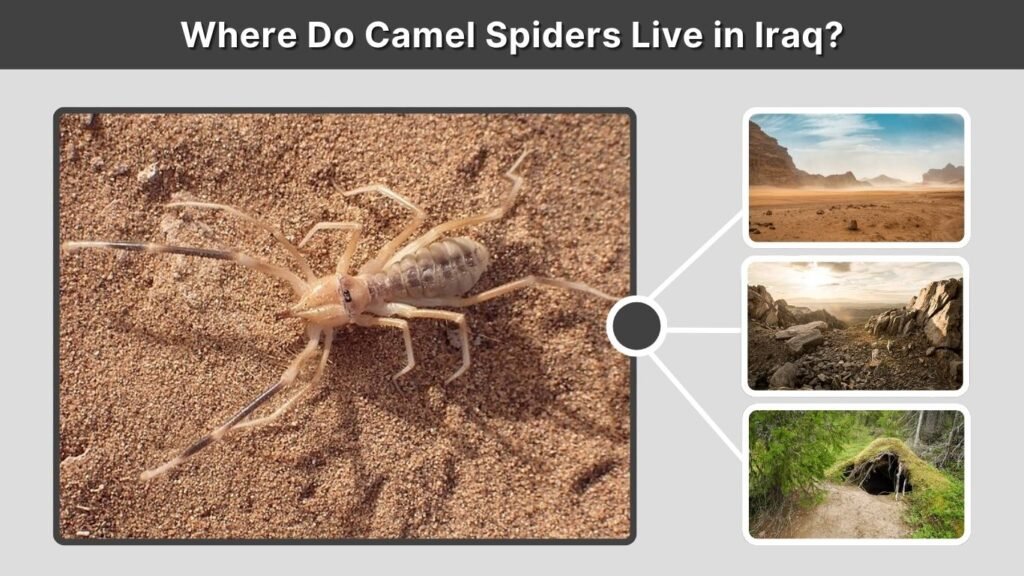
Camel spiders are well suited to Iraq’s dry and semi-arid landscapes.
They may be found in:
- Deserts
- Dry plains
- Rocky areas
- Sandy ground
- Burrows
- Under stones
- Around buildings
- Military camps and barracks
Many species are most active during cooler periods or at night, avoiding the intense heat and sunlight of the day.
Interesting Iraq Camel Spider Facts
- Camel spiders are not true spiders.
- They belong to the arachnid order Solifugae.
- They are also called wind scorpions and sun spiders.
- Camel spiders do not possess a venomous sting.
- Their large jaws are called chelicerae.
- They can run remarkably quickly for an arachnid.
- They usually avoid intense sunlight.
- Their diet consists mainly of insects and other small animals.
- The famous giant Iraq camel spider photograph used a misleading perspective.
- Stories about camel spiders eating camels or hunting humans are myths.
FAQs
Are Giant Camel Spiders in Iraq Real?
Camel spiders certainly live in Iraq, and some are relatively large arachnids. However, photographs showing apparently enormous, dinner-plate-sized camel spiders are generally misleading because of perspective.
How Big Is a Full-Grown Iraq Camel Spider?
Large individuals have bodies measuring only several centimeters, although their long legs make their total span considerably greater. They do not reach the enormous sizes suggested by internet legends.
Is an Iraq Camel Spider Bite Deadly?
Camel spiders are not venomous, and their bites are not normally considered deadly. However, their powerful jaws can cause painful wounds that should be cleaned and monitored.
Why Did Camel Spiders Become Famous During the Iraq War?
Photos and stories shared by soldiers, particularly a widely circulated image from 2004, made them famous. Forced perspective and exaggerated claims made the animals look far larger and more dangerous than they actually are.
Do Camel Spiders Chase Humans?
They do not normally chase humans to attack them. A camel spider may move toward a person’s shadow while seeking relief from strong sunlight, creating the impression that it is pursuing the person.
