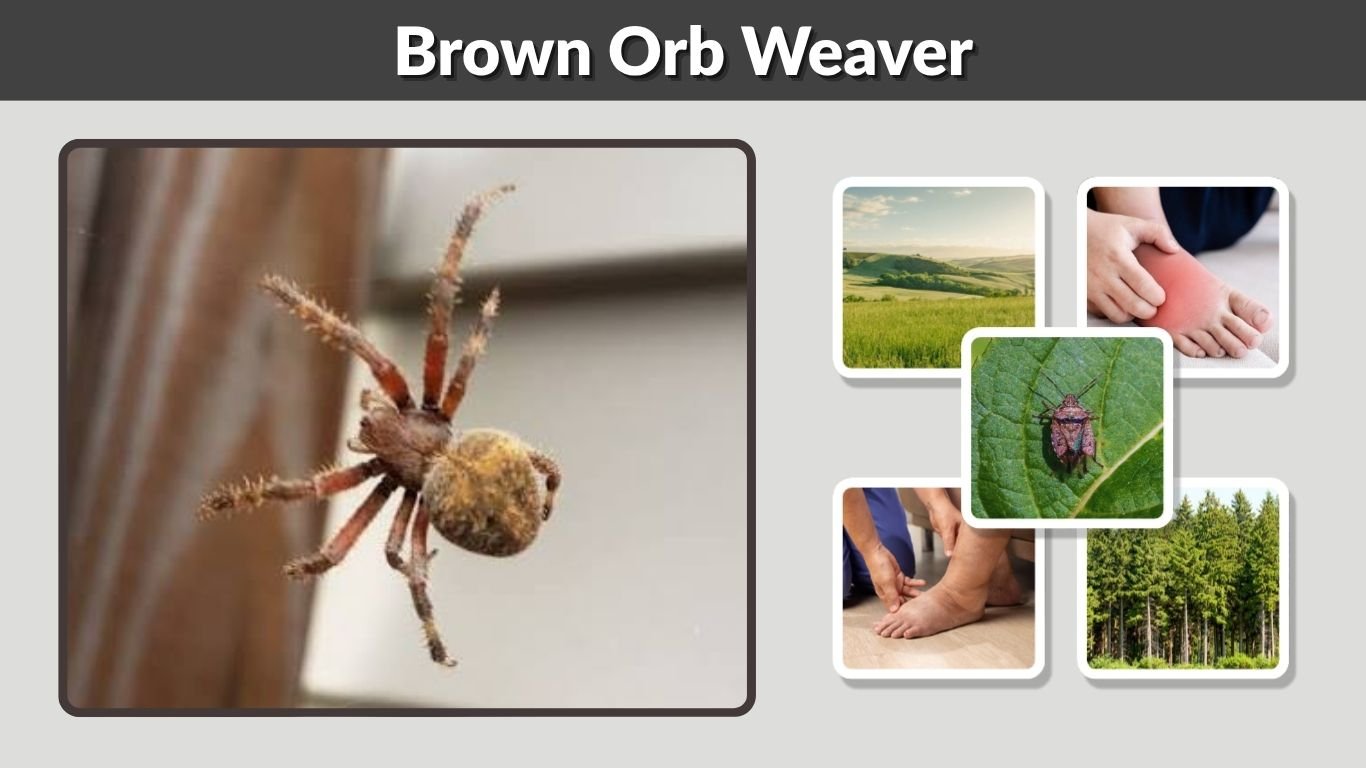
A brown orb weaver is a web-building spider recognized by its rounded abdomen, brown or tan coloring, banded legs, and large circular web. The name does not refer to one species; it is commonly used for several brown members of the orb-weaver family, Araneidae, including spotted, furrow, cross, barn, and arabesque orb weavers. Although their size and appearance can seem intimidating, these spiders are generally shy, beneficial predators that help control flying insects around gardens and homes.
Brown Orb Weaver Overview
Brown orb weavers occur in several genera and vary considerably in markings, body shape, and behavior. Most share the ability to produce an organized, wheel-shaped web containing support lines, radiating spokes, and sticky spiral threads.
| Feature | Description |
|---|---|
| Common name | Brown orb weaver |
| Family | Araneidae |
| Color | Brown, tan, grayish brown or reddish brown |
| Typical body length | Approximately 3–25 mm, depending on species |
| Diet | Flies, moths, mosquitoes, beetles and other insects |
| Habitat | Gardens, forests, fields, porches and building exteriors |
| Activity | Many species are most active at night |
| Bite risk | Low; bites are uncommon and usually cause mild local symptoms |
| Web type | Circular, wheel-shaped orb web |
Because “brown orb weaver” is a general description, an exact identification usually requires the spider’s location, size, abdominal pattern, underside markings and clear photographs from several angles.
Brown Orb Weaver Identification
Brown coloration alone is not enough to identify an orb weaver. Wolf spiders, house spiders, funnel weavers and brown recluses can also be brown, but they differ in body structure, behavior and web type.
Body Shape and Color
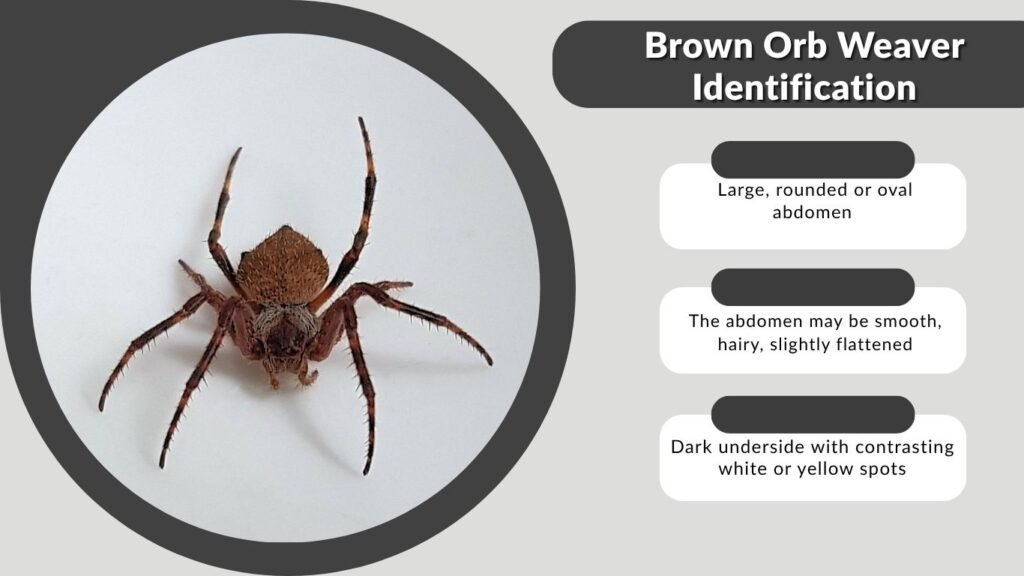
Many brown orb weavers have a large, rounded or oval abdomen attached to a smaller cephalothorax. The abdomen may be smooth, hairy, slightly flattened or covered with small bumps. Colors range from pale beige to dark chocolate brown, often with cream, gray, reddish or black markings.
Common dorsal patterns include leaf-shaped patches, crosses, wavy lines, spots and marbled markings. Some species have a dark underside with contrasting white or yellow spots. Their eight legs are usually hairy or spiny and may show alternating light and dark bands.
Distinctive Circular Web
The web is often the easiest identification clue. A typical orb web resembles a wheel, with straight silk strands radiating from the center and circular or spiral threads connecting them. These organized webs are very different from the messy cobwebs made by common house spiders.
Orb weavers normally suspend their webs between plants, tree branches, fences, porch posts or buildings. Some spiders sit head-down in the center, while others hide in a nearby leaf or sheltered retreat connected to the web by a signal thread.
Brown Orb Weaver vs. Brown Recluse
A brown orb weaver should not be confused with a brown recluse. Orb weavers usually have rounded abdomens, banded or spiny legs and conspicuous circular webs. Brown recluses have relatively plain, unbanded legs and do not build large, wheel-shaped prey-catching webs.
The supposed violin marking associated with a brown recluse is not enough for a reliable identification. Geographic range, eye arrangement and other anatomical characteristics must also be considered. Finding a brown spider near a skin irritation does not prove that the spider caused it.
Brown Orb Weaver Size
Orb-weaver size varies widely among species. According to the University of Minnesota Extension, members of this group range from about 1/8 to 1 inch in body length, or approximately 3–25 mm. The legs can make a mature spider appear considerably larger.
Female Size
Adult females are normally larger and more noticeable than males. Depending on the species, a female’s body may measure approximately 6–20 mm, although some species fall outside this range. A fully mature or egg-carrying female can have an especially swollen abdomen.
With the legs extended, a large brown orb weaver may span approximately 1–2 inches or occasionally more. This apparent size often causes alarm, but body size does not indicate that the spider is medically dangerous.
Male Size
Males generally have smaller, narrower abdomens and proportionally longer-looking legs. Mature males may stop building full webs and travel in search of females. Their enlarged pedipalps—the short appendages near the mouth—can look like tiny boxing gloves.
Sex-related size differences can be substantial. Therefore, two spiders of different shapes and sizes may still belong to the same species.
Where Do Brown Orb Weavers Live?
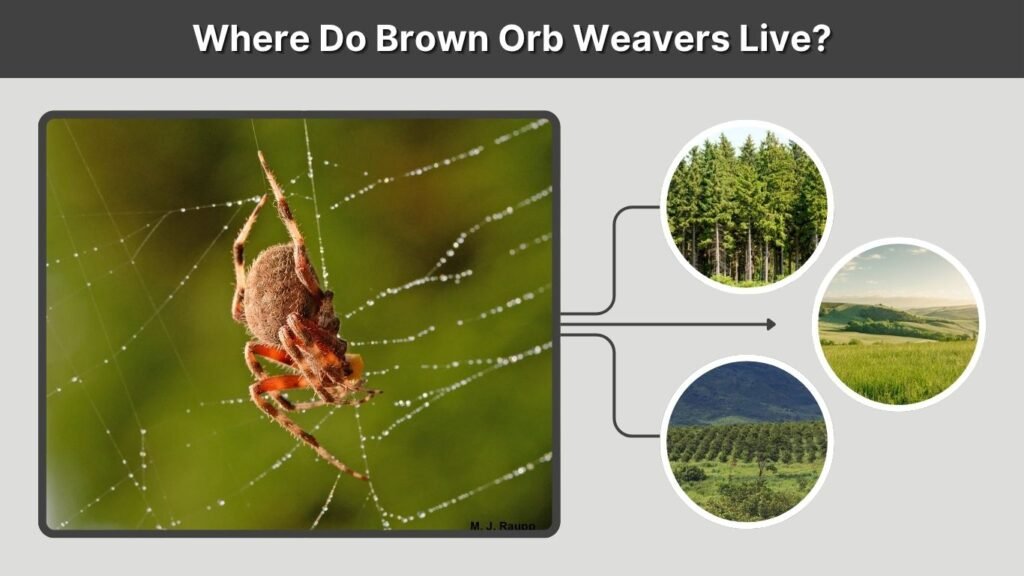
Brown orb weavers inhabit areas that offer both attachment points for a web and regular insect traffic. They are particularly common where vegetation, moisture and outdoor lighting attract flying prey.
Natural Habitat
Common natural habitats include:
- Woodland edges and forest clearings
- Meadows and grassy fields
- Shrubs, hedges and garden plants
- Wetlands and vegetation near water
- Orchards and agricultural areas
- Open spaces between trees
Their webs are commonly placed across gaps where moths, flies and other insects are likely to travel. Sheltered sites also protect the web from strong wind and heavy rain.
Around Houses and Gardens
Brown orb weavers may construct webs between porch railings, under roof eaves, beside windows, around sheds or across pathways. Artificial lights attract night-flying insects, making nearby structures productive hunting locations.
They usually live outside rather than establishing indoor infestations. A spider that enters a house has often wandered inside accidentally or been carried in with plants, firewood or outdoor equipment.
Geographic Distribution
Orb weavers are a diverse group found in many parts of the world. The species present depend on the region. For example, North American gardens may contain barn, spotted, arabesque, furrow or cross orb weavers, while similarly colored garden orb weavers occur in Europe, Asia, Australia and other regions.
An exact species identification should therefore include the country, state or province where the spider was observed.
Brown Orb Weaver Diet
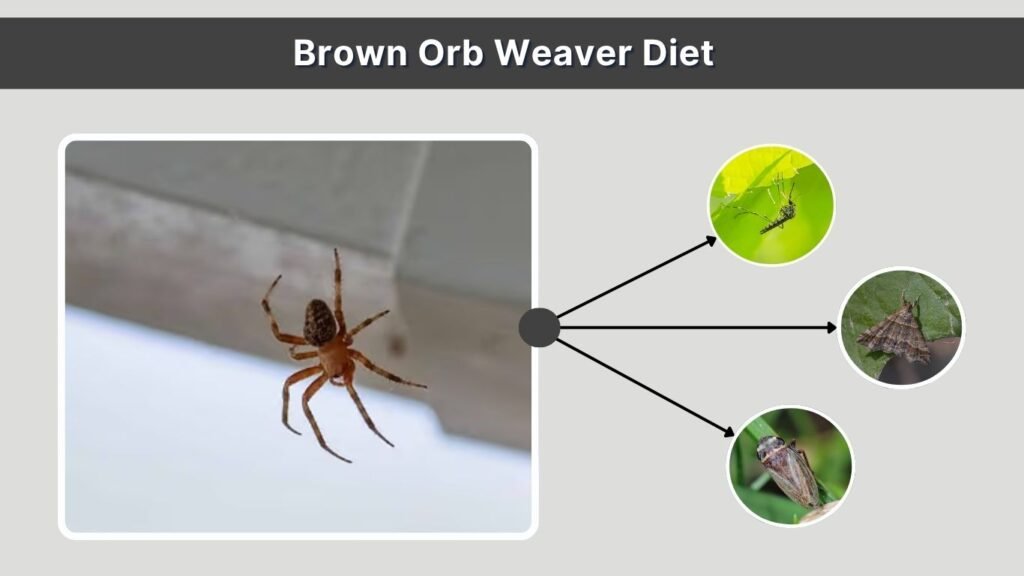
Brown orb weavers are carnivorous predators that feed primarily on insects captured in their sticky webs. Their diet changes according to habitat, season, web height and the size of available prey.
Common Prey
Their prey can include:
- Moths
- Flies
- Mosquitoes
- Midges
- Beetles
- Leafhoppers
- Small wasps and bees
- Winged ants
- Grasshoppers and crickets
- Other small arthropods
By consuming insects, orb weavers can contribute to natural pest regulation in gardens and agricultural environments. Ohio State University describes them as useful biological allies because they capture and eat many insects.
How They Catch and Eat Prey
When an insect strikes the web, its movement sends vibrations through the silk. The spider detects these vibrations through sensory structures on its legs, approaches the prey and often wraps it rapidly in silk. It then delivers venom through its fangs to immobilize the animal.
Like other spiders, an orb weaver cannot chew solid food. Digestive fluids break down the prey’s internal tissues, allowing the spider to consume the liquefied material.
Brown Orb Weaver Web and Behavior
Many brown orb weavers are nocturnal. They may remain hidden during the day and emerge in the evening to construct or repair their webs.
Web Construction
The spider begins with strong support lines and creates radiating spokes. It then adds a spiral of sticky capture silk. Some species rebuild much of their web every evening, consuming the old silk so that some of its materials can be recycled.
A large web may look fragile, but its combination of elasticity, strength and sticky capture threads allows it to absorb the impact of flying insects.
Daytime and Nighttime Activity
A nocturnal brown orb weaver may remove or damage the web near sunrise and retreat beneath bark, foliage or a building ledge. Other species remain at the hub during daylight.
When disturbed, the spider may run to the edge of the web, drop on a safety line or shake the web rapidly. These are defensive behaviors intended to avoid predators, not attempts to attack a person.
Is a Brown Orb Weaver Bite Dangerous?
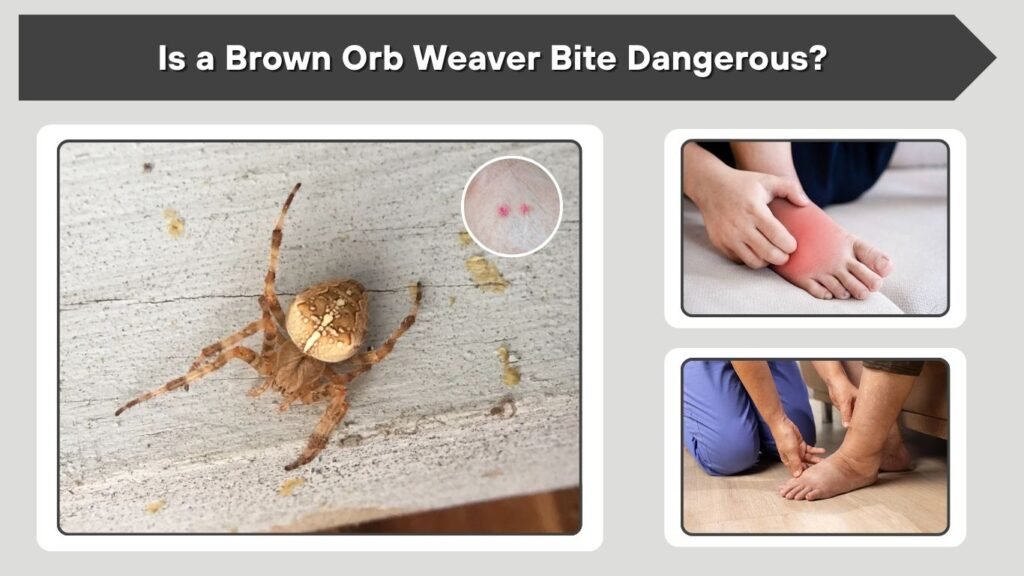
Brown orb weavers possess venom because they need it to subdue prey. However, they are not considered dangerous to most people. They are reluctant to bite and generally do so only when trapped against the skin, squeezed or handled roughly.
Possible Bite Symptoms
A confirmed orb-weaver bite may cause:
- Brief pain or stinging
- Local redness
- Mild swelling
- Itching or tenderness
- Temporary numbness in some cases
Published observations of identified orb-weaver bites primarily reported localized pain, redness and swelling. Severe reactions appear to be unusual.
What to Do After a Bite
Wash the affected area gently with soap and water. A wrapped cold pack may help reduce pain and swelling. Avoid scratching the area, and do not cut the wound or attempt to extract venom.
Seek medical advice if symptoms become severe, spread rapidly or fail to improve. Emergency assistance is appropriate for difficulty breathing, faintness, intense pain, widespread swelling or other signs of a serious allergic reaction. Children and people with known allergies may require greater caution.
Brown Orb Weaver Life Cycle
Female orb weavers produce silk egg sacs containing multiple eggs. The sac is commonly hidden in foliage, bark crevices or another protected location rather than left in the exposed center of the web.
Spiderlings hatch from the eggs and remain near the sac briefly before dispersing. Some release fine silk threads that catch the wind, carrying them to new locations in a behavior known as ballooning. The young pass through several molts as they grow.
In temperate regions, adults are often most noticeable from late summer into autumn, when females have reached their largest size and their webs are easier to see. Eggs or young spiders may survive the colder season, depending on the species and climate.
Interesting Brown Orb Weaver Facts
- The name is not species-specific. Numerous orb-weaver species can appear predominantly brown.
- Their eyesight is relatively limited. Web vibrations provide much of the information needed to locate prey and detect disturbances.
- Some rebuild their webs frequently. A spider may replace the sticky portion each night instead of using one web throughout its life.
- Females are usually much larger than males. The difference is especially noticeable in species with round, heavy abdomens.
- They help control insect populations. A web positioned near vegetation or outdoor lighting may catch numerous flying insects.
- They rarely want to enter houses. Most prefer outdoor sites where their circular webs can span open gaps.
- Web shaking is defensive. A vibrating spider is normally attempting to confuse a predator or make itself difficult to approach.
- They are prey as well as predators. Birds and certain wasps hunt orb-weaving spiders. Some wasps imitate prey vibrations to lure a spider toward the edge of its web.
FAQs
Are brown orb weavers poisonous?
Brown orb weavers are venomous, as are most spiders, but they are not poisonous. Venom is delivered through a bite, whereas poison is harmful when touched or eaten. Their venom is adapted for small prey and is not considered medically significant to most humans.
Can a brown orb weaver kill a person?
A brown orb weaver is extremely unlikely to cause a life-threatening reaction. Bites are uncommon and usually result in mild local discomfort. Anyone who develops breathing problems, spreading swelling or other serious symptoms after a suspected bite should obtain emergency medical care.
Why is a brown orb weaver on my porch?
Porches provide protected web supports and often have lights that attract moths, mosquitoes and other insects. This gives the spider a productive feeding location. Switching off unnecessary exterior lights or relocating the spider’s web can discourage it without using pesticides.
Should I remove a brown orb weaver?
Removal is generally unnecessary when the web is in an undisturbed garden location. If it crosses a doorway or walkway, use a long tool to remove the web while the spider is absent, or carefully move the spider outdoors without touching it directly.
How long do brown orb weavers live?
Lifespan differs among species and climates. Many temperate orb weavers complete their life cycle within roughly one year, with adults dying after mating and egg production. In warm regions, seasonal timing and survival may differ, so the species must be known for a precise estimate.
