
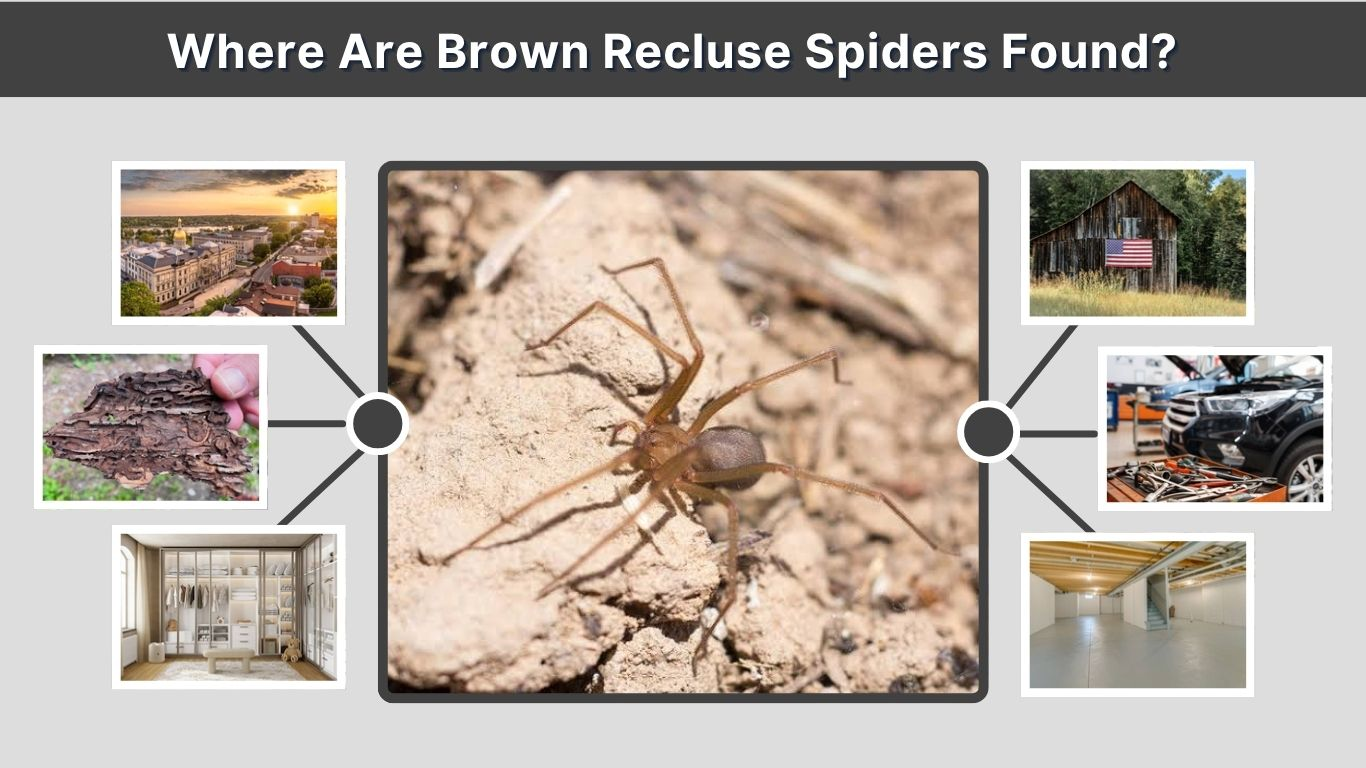
Brown recluse spiders are found mainly in the south-central and Midwestern United States. Although many people fear them across the country, the true brown recluse spider, Loxosceles reclusa, has a much smaller range than most people think. Reports from places like California, New York, Washington, Oregon, and much of the Northeast are usually misidentifications or rare transported spiders. Understanding where brown recluse spiders are actually found can help you avoid panic, identify risks correctly, and know when a brown spider is probably something else.
Where Are Brown Recluse Spiders Found in the U.S.?
The brown recluse spider is most strongly associated with the central and southern parts of the United States. The University of Kentucky says the brown recluse is found throughout the south-central and Midwestern United States, and recluse spiders are rare outside their native range.
A commonly used range description places the brown recluse from southeastern Nebraska to southwestern Ohio, then south into northwestern Georgia and Texas. Occurrences outside that range are considered very rare.
Main Brown Recluse Range
Brown recluse spiders are most likely to be found in or near these states:
- Missouri
- Arkansas
- Kansas
- Oklahoma
- Tennessee
- Kentucky
- Illinois
- Indiana
- Iowa
- Alabama
- Mississippi
- Louisiana
- Texas
- Georgia
- Nebraska
- parts of Ohio
Penn State Extension lists the brown recluse as established in sixteen states: Alabama, Arkansas, Georgia, Illinois, Indiana, Iowa, Kansas, Kentucky, Louisiana, Mississippi, Missouri, Nebraska, Ohio, Oklahoma, Tennessee, and Texas.
Brown Recluse Spider Range Map: What It Means
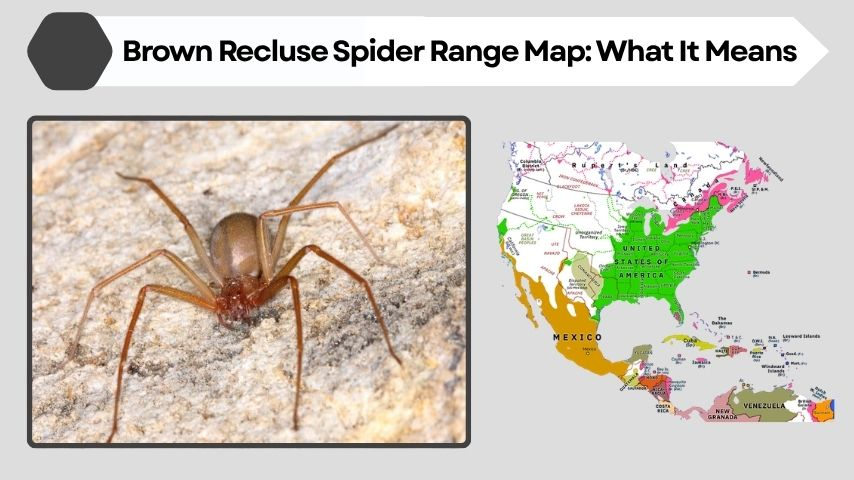
A brown recluse range map shows where the spider has established populations. It does not mean every house in those states has brown recluse spiders. Even inside the range, they may be common in some counties and uncommon in others.
For example, brown recluse spiders are very common in parts of Missouri, Kansas, Arkansas, Oklahoma, Tennessee, and Kentucky. In other states near the edge of the range, they may be much less common or found mainly in specific areas.
Core Range vs. Rare Sightings
It helps to separate brown recluse locations into two groups:
| Category | Meaning | Example |
|---|---|---|
| Core range | Established populations are common or expected | Missouri, Arkansas, Kansas, Oklahoma |
| Edge range | Present but may be less common in some areas | Ohio, Indiana, Georgia, Iowa |
| Outside range | Usually misidentified or transported | California, New York, Washington, Oregon |
This is important because people often report brown recluse spiders in states where they do not normally live.
Are Brown Recluse Spiders Found in California?
The true brown recluse spider is not established in California. California does have some related recluse spiders, especially in desert regions, but those are not the same as the brown recluse.
Many brown spiders in California are mistakenly called brown recluses. A spider may be brown, fast-moving, or found indoors, but that does not make it a brown recluse. Color alone is not enough for identification.
A rare brown recluse could be transported into California in boxes, furniture, or shipments from a range state. However, one transported spider does not mean there is a breeding population.
Are Brown Recluse Spiders Found in New York?
Brown recluse spiders are not considered established in New York. Reports from New York, including Long Island, are usually caused by misidentified spiders or skin wounds blamed on brown recluse bites.
This is a common problem in many northern and coastal states. People may see a brown spider indoors and assume it is dangerous. In reality, most brown spiders in New York are common house spiders, yellow sac spiders, wolf spiders, cellar spiders, or other local species.
Are Brown Recluse Spiders Found in Colorado?
Brown recluse spiders are very rare in Colorado. Colorado State University Extension says the spider can be common in and around homes in eastern Kansas, Missouri, Arkansas, Louisiana, Oklahoma, parts of Texas, and some other states, but when it is found outside its normal range, it is usually transported and rarely becomes established.
So, a brown recluse in Colorado is possible but not likely. Many spiders in Colorado have brown bodies and are mistaken for brown recluses.
Are Brown Recluse Spiders Found in Florida?
Brown recluse spiders are not widespread throughout Florida. Some recluse spiders have been reported in parts of the state, but Florida is not usually considered a major brown recluse state compared with places like Missouri, Arkansas, Kansas, Oklahoma, Tennessee, or Kentucky.
People in Florida often confuse other brown spiders with brown recluse spiders. If a spider is found in Florida, it should be identified carefully before assuming it is a brown recluse.
Where Are Brown Recluse Spiders Found Indoors?
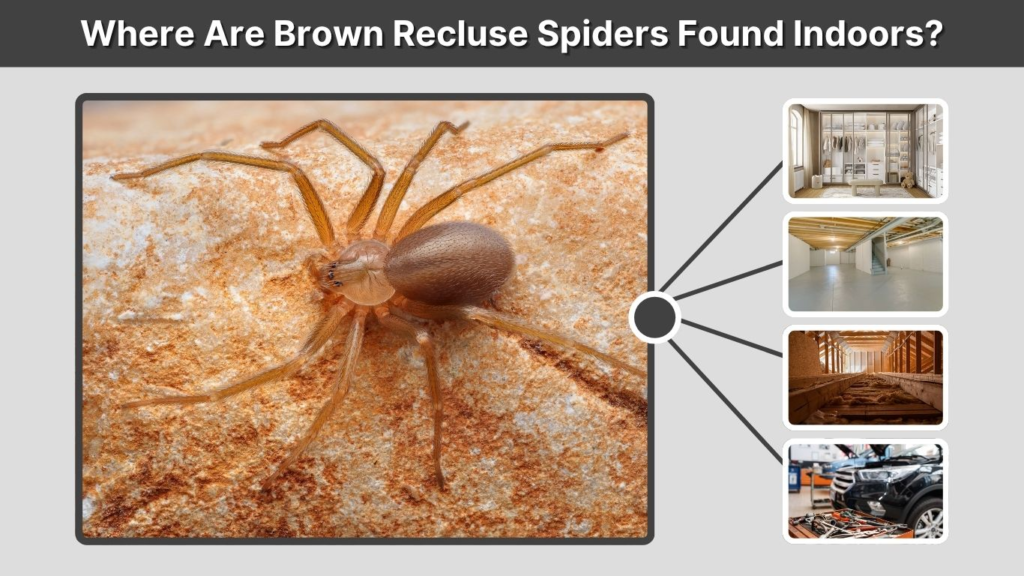
Brown recluse spiders like dark, dry, quiet, and undisturbed areas. Indoors, they often hide where people rarely clean or move items. They do not usually stay in open, busy areas.
Common indoor hiding places include:
- closets
- basements
- attics
- garages
- crawl spaces
- storage rooms
- cardboard boxes
- behind furniture
- under beds
- wall voids
- shoes and boots
- folded clothes
- stored bedding
- old papers and clutter
NC State Extension notes that indoors, brown recluse spiders commonly hide in bathrooms, attics, cellars, and storage areas. Problems often happen when people are accidentally bitten by spiders hiding in stored clothing, shoes, boots, or cardboard cartons.
Where Are Brown Recluse Spiders Found Outdoors?
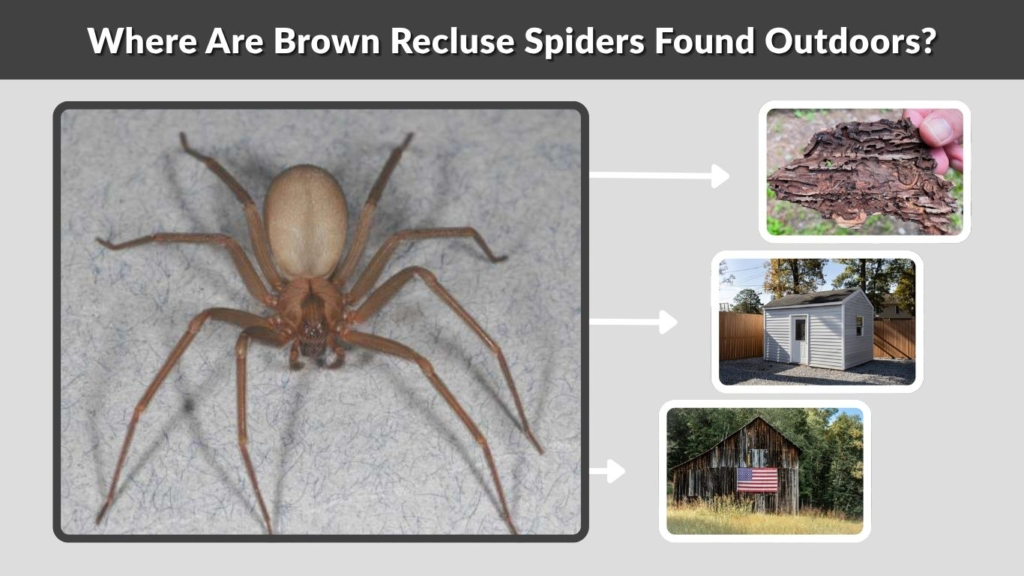
Outdoors, brown recluse spiders prefer sheltered places where they can hide during the day. They are not usually seen crawling openly in sunlight. They are nocturnal hunters and spend much of their time hidden.
Common outdoor habitats include:
- rock piles
- log piles
- woodpiles
- under bark
- sheds
- barns
- leaf litter
- brush piles
- crawl spaces
- under debris
- around old boards or building materials
Alabama Extension explains that in nature, brown recluse spiders live in dry places such as caves, rock piles, and log piles. Around homes, they may be found under woodpiles, overhangs, tree bark, leaf litter, brush, wall voids, and crawl spaces.
Are Brown Recluse Spiders Found in Groups?
Brown recluse spiders are not social insects like ants, bees, or termites. They do not form organized colonies. However, many brown recluse spiders can live in the same house or building if conditions are right.
This means one home may have many individuals, especially in areas where brown recluse spiders are common. They may share the same general environment but still behave as solitary spiders.
Why Several May Be Found in One House
A house may support many brown recluse spiders if it has:
- many hiding places
- lots of clutter
- cardboard boxes
- insect prey
- quiet storage areas
- cracks and wall voids
- low disturbance
Finding one brown recluse in a range state may mean more are nearby. But finding one brown spider outside the brown recluse range does not prove an infestation.
How to Tell If a Spider Is Really a Brown Recluse
Because many spiders are brown, misidentification is very common. A brown recluse usually has a plain brown body, long legs, and a dark violin-shaped mark on the front part of the body. However, the violin mark is not always reliable because other spiders can have dark markings too.
The eye pattern is more useful. Brown recluse spiders have six eyes arranged in three pairs, while most spiders have eight eyes. Colorado State University Extension highlights this six-eye arrangement as an important identification feature.
Quick Identification Table
| Feature | Brown Recluse |
|---|---|
| Scientific name | Loxosceles reclusa |
| Main range | South-central and Midwestern U.S. |
| Body color | Light to medium brown |
| Eye pattern | Six eyes in three pairs |
| Web type | Irregular retreat web |
| Behavior | Shy, hidden, nocturnal |
| Common hiding spots | Boxes, closets, attics, basements, garages |
States Where Brown Recluse Reports Are Often Misleading
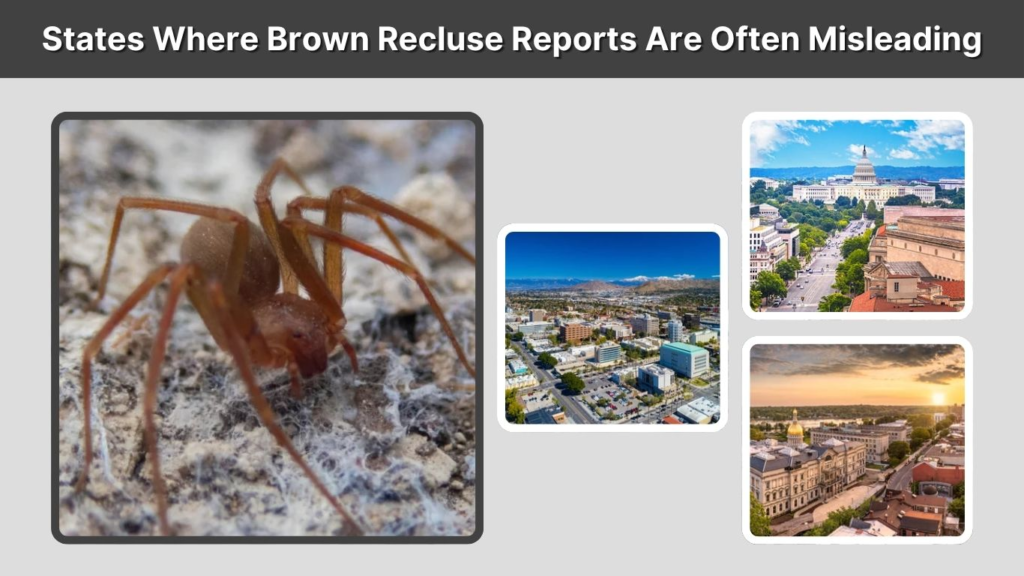
Brown recluse reports are often misleading in states outside the natural range. This includes many states in the West, Northeast, and far North.
Reports are often doubtful in places such as:
- California
- Oregon
- Washington
- New York
- New Jersey
- Connecticut
- Massachusetts
- Maine
- Alaska
- Montana
- Idaho
- most of Canada
That does not mean a transported individual is impossible. It only means established populations are not expected.
Why Location Matters Before Blaming a Bite
Many skin wounds are blamed on brown recluse bites even when the spider does not live in the area. This can be a problem because skin infections, allergic reactions, tick bites, bed bug bites, and other medical issues may look similar.
If you have a painful or worsening sore, it is better to seek medical care than assume it is a brown recluse bite. A confirmed bite usually requires seeing or capturing the spider and having it identified.
FAQs
Where are brown recluse spiders mostly found?
Brown recluse spiders are mostly found in the south-central and Midwestern United States. They are especially associated with states such as Missouri, Arkansas, Kansas, Oklahoma, Tennessee, Kentucky, Illinois, Indiana, Alabama, Mississippi, Louisiana, and Texas.
Are brown recluse spiders found in every state?
No. Brown recluse spiders are not found in every state. They have a limited natural range, and reports from many western, northeastern, and far northern states are usually misidentifications.
Are brown recluse spiders found in houses?
Yes, they can be found in houses within their natural range. They hide in dark, quiet places such as closets, basements, attics, garages, storage boxes, shoes, and folded clothing.
Where are brown recluse spiders found outdoors?
Outdoors, brown recluse spiders are found in dry, sheltered places such as rock piles, log piles, woodpiles, under bark, leaf litter, sheds, barns, and crawl spaces.
Are brown recluse spiders found in California or New York?
The true brown recluse is not established in California or New York. Reports from those states are usually caused by misidentified spiders or rare transported individuals.
