
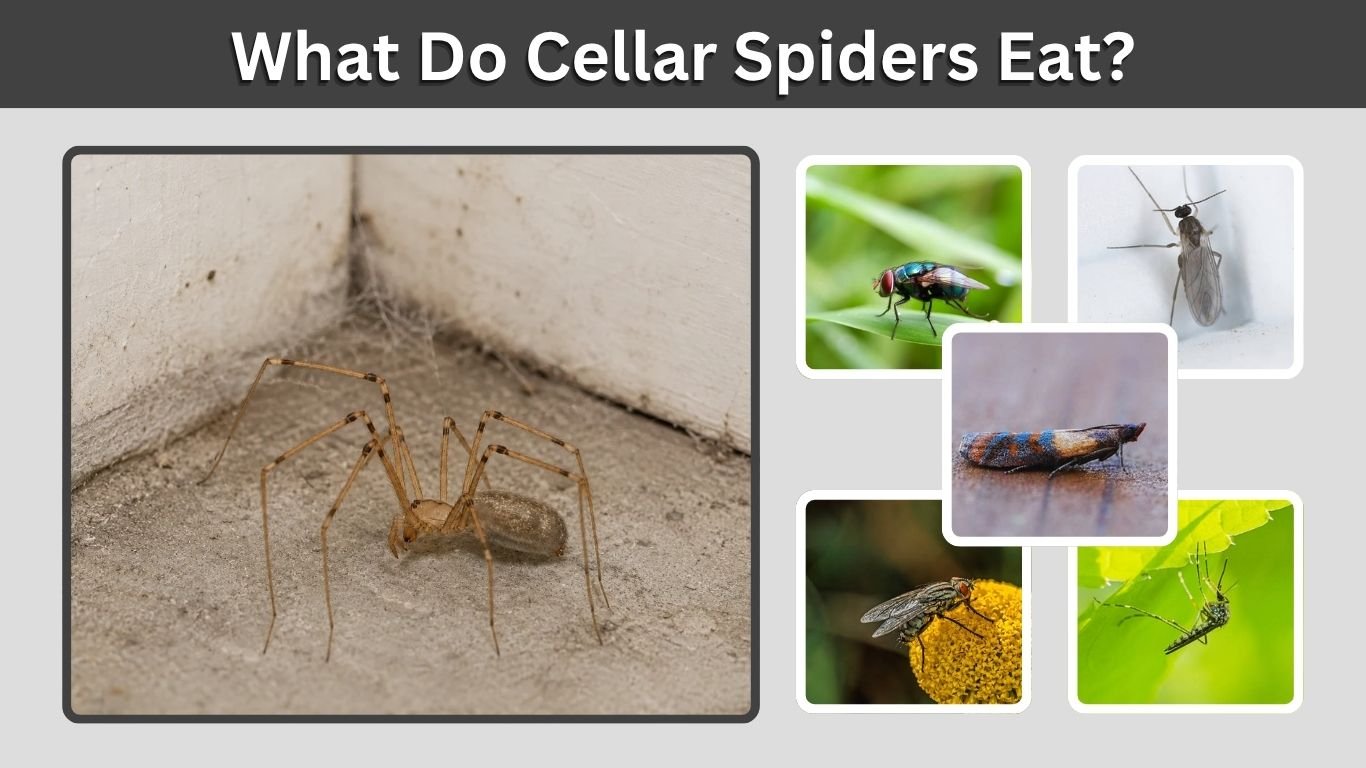
Cellar spiders are common household arachnids recognized by their extremely long, slender legs and delicate, tangled webs. But what do cellar spiders eat, and can they help control unwanted pests? These spiders primarily feed on small insects, including flies, gnats, and mosquitoes, while also hunting other spiders. Some can capture prey larger than themselves using specialized silk-wrapping techniques. Understanding their feeding habits reveals why cellar spiders frequently inhabit basements, garages, and quiet indoor corners. This guide explores their natural diet, hunting methods, feeding frequency, and ecological benefits.
What Do Cellar Spiders Eat?
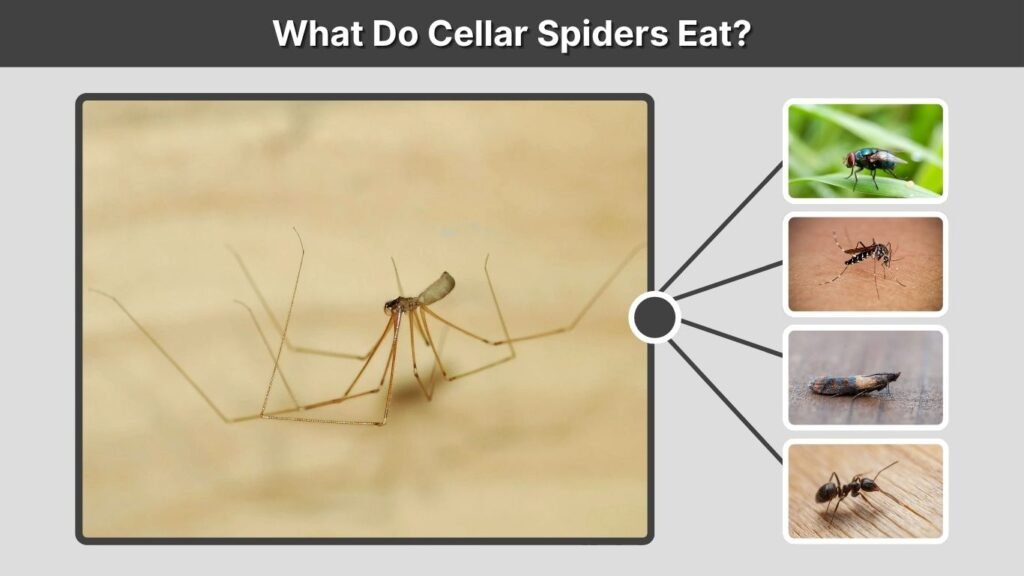
Cellar spiders primarily consume small insects and other spiders that enter their webs. The long-bodied cellar spider (Pholcus phalangioides) is an opportunistic predator, meaning it takes advantage of suitable prey rather than relying on one particular insect species. Its diet varies according to location, prey availability, and spider size. Household environments provide numerous potential food sources.
Common Insects Cellar Spiders Eat
Cellar spiders can capture various household insects, including:
- Flies: Houseflies, fruit flies, and other small flying insects.
- Mosquitoes: Small mosquitoes that become trapped in their webs.
- Gnats: Tiny flying insects commonly found around indoor plants and damp areas.
- Moths: Small moths that accidentally encounter tangled silk.
- Ants: Wandering ants that enter a web and become trapped.
- Cockroaches: Small roaches or nymphs that can be restrained with silk.
- Beetles: Small beetles that become entangled in suitable webs.
- Small wasps: Tiny wasps that are successfully trapped and immobilized.
Do Cellar Spiders Eat Roaches and Bed Bugs?
Cellar spiders can capture small cockroaches, particularly younger individuals that enter their webs. However, larger roaches may escape or avoid the webs entirely.
Bed bugs are not considered a regular food source. Although an occasional bed bug could become prey, cellar spiders cannot reliably control an infestation.
Professional pest management is more effective for established cockroach or bed bug problems.
Do Cellar Spiders Eat Other Spiders?
One of the most interesting characteristics of cellar spiders is their ability to hunt other spiders. This behavior, called araneophagy, occurs in several members of the cellar spider family Pholcidae. Some species invade neighboring spider webs, imitate vibrations associated with trapped prey, and attack the resident spider. Their long legs and silk-wrapping abilities help them capture potentially dangerous opponents.
What Types of Spiders Do Cellar Spiders Eat?
Cellar spiders may prey on:
- House spiders: Common indoor web-building spiders.
- Larger house spiders: Individuals that can be restrained despite their greater size.
- Jumping spiders: Possible prey under favorable circumstances, although jumping spiders may also hunt cellar spiders.
- Other cellar spiders: Cannibalism occasionally occurs.
- Recluse spiders: Some predatory interactions have been documented, but they are not dependable prey.
Do Cellar Spiders Eat Black Widows?
Cellar spiders are capable of hunting other web-building spiders, and black widows may occasionally become prey.
However, it would be misleading to suggest that every cellar spider regularly captures black widows or provides reliable protection against them.
Their success depends on the spider species, relative size, web arrangement, and circumstances of the encounter.
Do Cellar Spiders Eat Brown Recluses?
Predatory interactions involving cellar spiders and brown recluses have been investigated scientifically.
However, research indicates that cellar spiders are not reliable biological control agents for brown recluse populations.
Their webs often occupy different parts of buildings, limiting encounters. Homeowners should not rely on cellar spiders to eliminate medically significant spiders.
How Do Cellar Spiders Catch and Eat Their Prey?
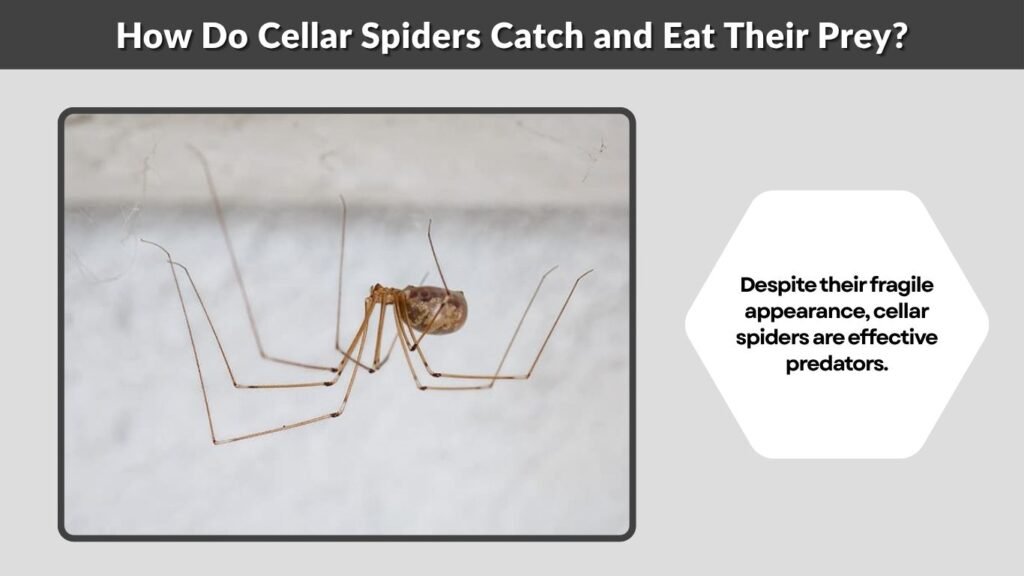
Despite their fragile appearance, cellar spiders are effective predators. They construct irregular, three-dimensional webs that intercept passing insects. Rather than overpowering prey through strength alone, they use sensitive legs, rapid silk wrapping, and venom. These adaptations allow them to capture a variety of insects and spiders while reducing the danger of direct physical contact with struggling prey.
Step-by-Step Cellar Spider Hunting Process
- Detecting movement: The spider senses vibrations when prey contacts its web.
- Locating prey: It follows vibrations to determine the insect’s position.
- Approaching carefully: Its long legs help it maintain distance from struggling prey.
- Wrapping with silk: The spider throws and winds silk around the captured animal.
- Injecting venom: It bites the immobilized prey to subdue it.
- Digesting food: Digestive fluids break down tissues so the spider can consume liquefied nutrients.
Why Do Cellar Spiders Vibrate Their Webs?
Cellar spiders sometimes shake or whirl rapidly when disturbed.
This behavior is generally defensive rather than a direct feeding strategy. The rapid movement may make the spider difficult for predators to locate or attack.
During hunting, controlled vibrations and silk movements help the spider interact with captured prey.
How Often Do Cellar Spiders Eat?
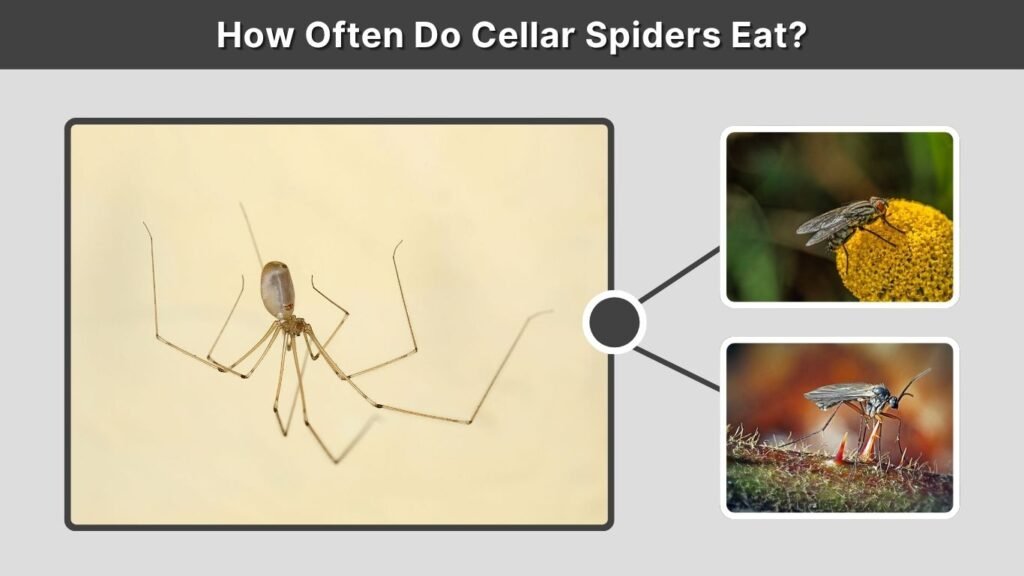
Cellar spiders do not follow a fixed feeding schedule. Their food consumption depends on prey availability, body size, temperature, developmental stage, and reproductive condition. A spider living near abundant flying insects may feed more frequently than one occupying a quiet basement corner. Like many spiders, cellar spiders can survive periods without catching food, provided environmental conditions remain suitable.
How Long Can Cellar Spiders Go Without Food?
Cellar spiders may survive several days or longer without feeding, depending on their condition and access to moisture.
There is no universal fasting period applicable to every species or developmental stage.
A spider remaining motionless in its web is not necessarily starving. It may simply be waiting for another suitable insect to arrive.
What Do Baby Cellar Spiders Eat?
Young cellar spiders consume small prey appropriate for their body size.
Tiny flies, gnats, and other soft-bodied insects can provide nourishment.
As juveniles grow and molt, they become capable of handling larger prey. Successful feeding contributes to normal development and eventual maturity.
Do Cellar Spiders Eat Each Other or Their Mates?
Cannibalism occurs in some cellar spiders, although it is not their primary feeding strategy. Interactions between individuals may involve competition, territorial encounters, or mating behavior. Both males and females have been observed consuming other spiders of their own species. Nevertheless, these events should not be interpreted as inevitable outcomes whenever two cellar spiders encounter one another.
Do Female Cellar Spiders Eat Their Mates?
Sexual cannibalism is possible, but female cellar spiders do not routinely consume every male after mating.
Mating behavior involves careful physical interactions that differ from ordinary prey capture.
The outcome depends on species, individual behavior, and environmental circumstances.
Do Cellar Spiders Eat Their Babies?
Female cellar spiders typically carry their eggs in a loose silk bundle held near their mouthparts.
After hatching, spiderlings remain nearby temporarily before dispersing.
Eating their offspring is not a normal defining characteristic of cellar spider reproduction, although cannibalism among spiders can occur under particular conditions.
Are Cellar Spiders Beneficial for Household Pest Control?
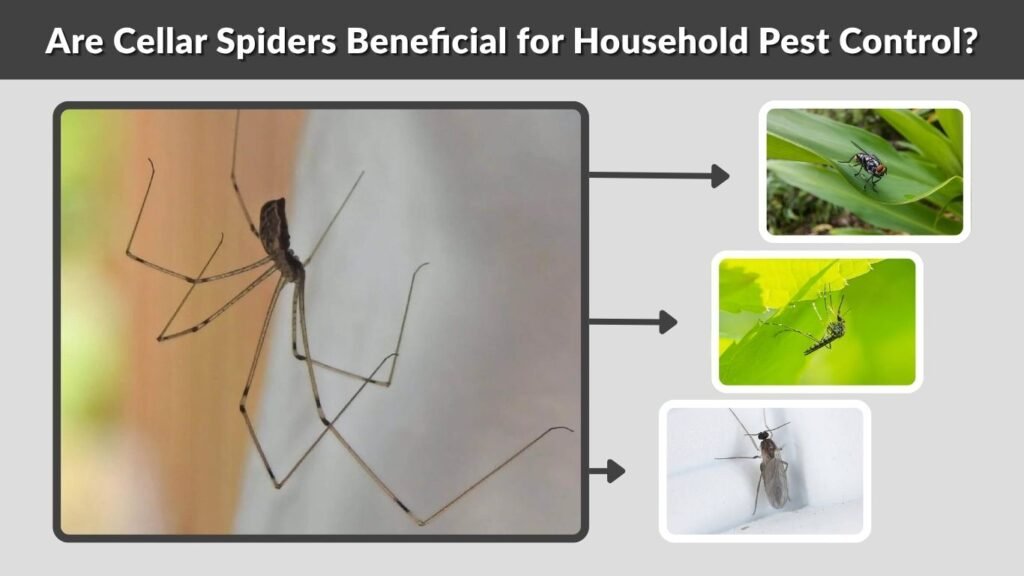
Cellar spiders can contribute to natural pest control by capturing insects that wander or fly through indoor spaces. Their presence may reduce some local insect activity, particularly where webs remain undisturbed. However, they cannot eliminate established infestations or replace effective sanitation and exclusion measures. Their benefits are best understood as part of a broader household ecosystem.
Household Pests Cellar Spiders May Help Reduce
- Small flies: Capturing flying insects around indoor corners.
- Mosquitoes: Occasionally catching mosquitoes that enter buildings.
- Gnats: Trapping small flying insects near household environments.
- Small cockroaches: Capturing individuals that encounter their webs.
- Other spiders: Reducing some spider encounters through predation.
Should You Leave Cellar Spiders in Your House?
Cellar spiders are generally harmless to people, and their venom is not considered medically significant to humans.
Leaving a few undisturbed spiders in garages, basements, or quiet corners can provide minor natural pest control.
However, excessive webbing may become a nuisance. Regular cleaning and reducing indoor insect populations can help manage their numbers.
FAQs
Cellar spiders attract curiosity because their delicate appearance contrasts with their ability to capture other spiders. Many homeowners wonder whether they eat dangerous species, consume unusual household insects, or survive without regular feeding. The answers depend on prey availability and circumstances. These frequently asked questions clarify several common misunderstandings about cellar spider diets and hunting behavior.
1. Do Cellar Spiders Eat Mosquitoes?
Yes. Cellar spiders can capture and consume mosquitoes that become trapped in their webs, although they cannot eliminate an entire mosquito population.
2. Do Cellar Spiders Eat Silverfish?
They may occasionally catch silverfish that enter their webs, but silverfish are not recognized as a major component of their typical diet.
3. Do Cellar Spiders Eat Fleas or Ticks?
Occasional predation on small arthropods is possible. However, cellar spiders are not effective flea or tick control agents because these pests rarely encounter their suspended webs.
4. Can Cellar Spiders Eat Larger Spiders?
Yes. Their silk-wrapping techniques sometimes allow them to capture spiders larger than themselves, including certain house spiders.
5. What Animals Eat Cellar Spiders?
Predators can include birds, lizards, and other spiders. Some jumping spiders specialize in hunting web-building spiders, including cellar spiders.
