
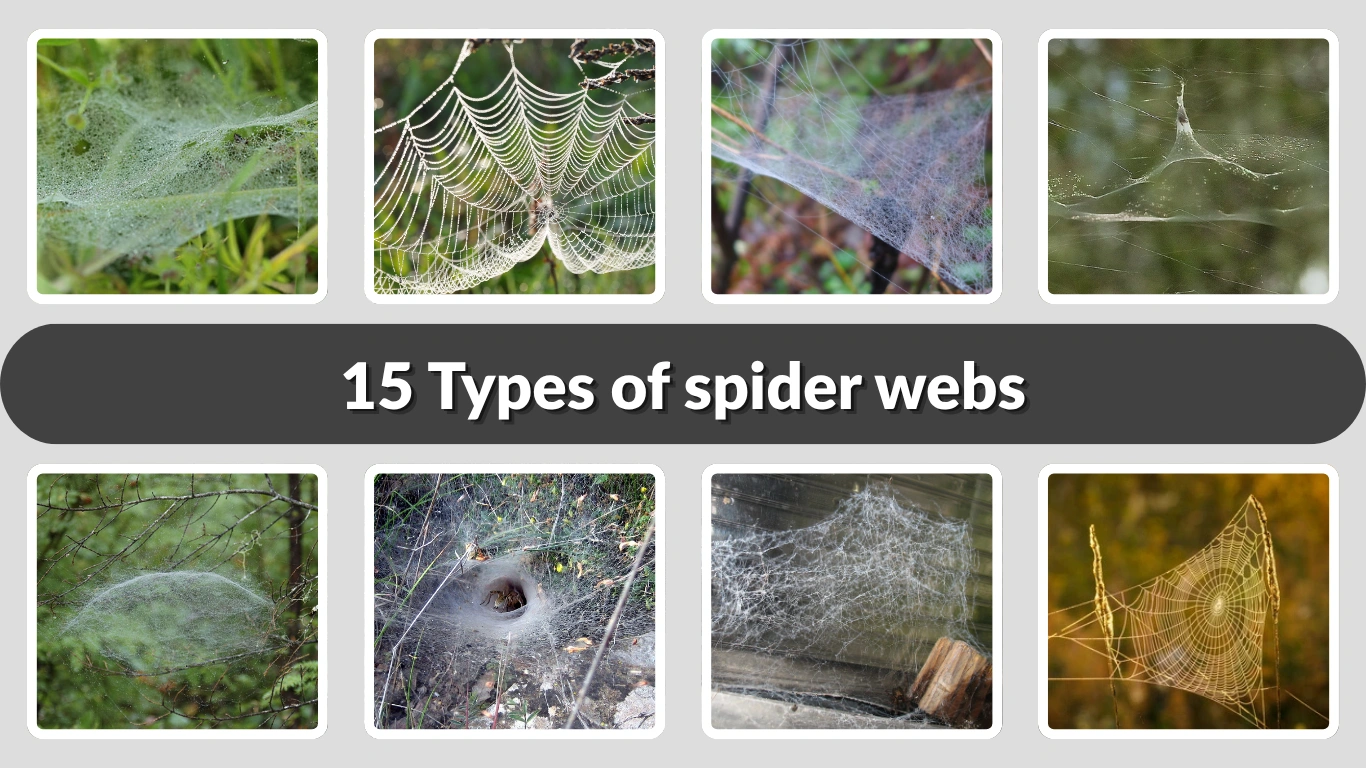
Spider webs come in an incredible variety of shapes and designs, each crafted with precision to suit the hunting style of the spider that builds it. From delicate sheet webs to complex three-dimensional tangles, every structure has a purpose. These webs serve as traps, shelters, warning systems, and even nurseries. Understanding their forms reveals the remarkable engineering skills spiders use to survive in every environment.
1. Orb Web

The orb web is the classic, wheel-shaped web known for its symmetry, strength, and efficiency. It is built to catch flying insects and is one of the most recognizable web types in the spider world.
Identification
- Circular, wheel-like structure
- Radiating spokes connected by spiral threads
- Highly symmetrical design
- Sticky capture spiral to trap flying insects
How Orb-Weaving Spiders Build It
Orb-weaving spiders begin by releasing a silk thread into the air until it catches onto a surface. They then construct a bridge line, add radiating spokes, and finally spin the sticky spiral from the center outward to complete the web.
Crafting Precision (Web-Honing Process)
The spider reinforces weak lines, replaces damaged spirals, and fine-tunes tension across the structure. This ensures both strength and elasticity so the web can absorb the impact of flying insects.
Where Orb Webs Are Found
You’ll find orb webs in gardens, forests, between branches, across open spaces, near lights, and sometimes even on porches. They are typically placed where flying insects are common.
2. Funnel Web

The funnel web is a sheet-like web that narrows into a tunnel where the spider waits in ambush. It is designed for speed, surprise, and rapid prey capture rather than sticky trapping.
Identification
- Broad, flat sheet of silk
- Distinct funnel-shaped tunnel at one end
- Not sticky, relies on speed instead of glue
- Often appears dense, layered, or slightly curved
- Vibrates easily when touched, alerting the spider
How Funnel-Web Spiders Build It
The spider begins by laying a thin sheet of silk across grass, leaves, or ground debris. It gradually thickens the surface and then creates a silk-lined tunnel retreat where it hides. From this hideout, it connects structural lines outward to anchor the sheet.
Precision in the Lair (Web-Honing Process)
Funnel-web spiders constantly reinforce weak areas and expand the sheet as needed. They patch tears quickly and add new radial threads to improve vibration sensitivity, ensuring they can detect the smallest movement on the sheet.
Where Funnel Webs Are Found
These webs are commonly found in grass, bushes, low shrubs, corners of buildings, and under rocks or logs. They favor areas with moisture, dense foliage, or shade — ideal for stealth and quick ambushes.
3. Sheet Web

The sheet web is a horizontal, densely woven platform of silk that acts as a trap for insects flying or falling onto it. Many sheet webs appear messy from above but are highly engineered underneath.
Identification
- Horizontal or slightly curved silk sheet
- Looks like a fine mat or platform
- Multiple supporting threads above and below
- Insects fall onto the sheet or bounce into the hidden trap lines
- Often appears as a messy “cloud” of lines from a distance
How Sheet-Weaving Spiders Build It
A sheet-weaver begins by anchoring vertical frame lines to surrounding branches or grass blades. It then creates a dense, layered horizontal mat. Above the sheet, the spider spins a loose maze of threads that knock insects downward. Below the sheet, it builds sensitive fibers where it hangs upside down, waiting to attack.
Engineering the Trap (Web-Honing Process)
The spider thickens the sheet over time, repairing breakages, tightening sagging areas, and adjusting support threads for better insect deflection. Fresh layers are added regularly to maintain strength and tension.
Where Sheet Webs Are Found
Sheet webs are typically found in tall grass, bushes, forest understories, fences, hedges, and shaded garden corners. They thrive in places with steady airflow and abundant small insects.
4. Tangle Web

A tangle web is an irregular, three-dimensional mass of sticky silk threads that appears messy but is strategically engineered. These webs are built to confuse, trip, and entangle insects from any direction.
Identification
- Chaotic, three-dimensional structure
- Sticky silk strands arranged without symmetry
- No central hub or obvious pattern
- Often has anchor lines connecting to multiple surfaces
- Some species create “trip lines” suspended in mid-air
How Tangle-Web Spiders Build It
The spider begins by anchoring long threads in multiple directions. It works erratically—intentionally creating a disorderly framework. After laying the structural lines, it adds sticky capture threads throughout the web, especially around areas where prey is most likely to collide.
Tangled Mastery (Web-Honing Process)
These spiders strengthen key anchor lines, replace dried-out sticky strands, and expand the web outward over time. They frequently add trap lines and adjust tension to ensure insects get snagged when brushing even a single thread.
Where Tangle Webs Are Found
Tangle webs are often found in corners of buildings, under eaves, in basements, shrubs, tree hollows, fences, and cluttered outdoor areas. They thrive in spaces with irregular surfaces to anchor their chaotic design.
5. Cobweb

Cobwebs are the classic messy webs associated with house spiders. Though they look disorganized, cobwebs are specialized snares designed with sticky, sagging strands to trap wandering insects.
Identification
- Asymmetrical and messy in appearance
- Consists of sticky, fine, sagging threads
- Often built in corners or enclosed spaces
- Has a small retreat where the spider hides
- Accumulates dust if abandoned
How Cobweb Spiders Build It
Cobweb spiders start by creating a scaffold of support threads in corners or crevices. They then weave sticky capture lines irregularly across the structure. Over time, they create a loose network of threads positioned to trap insects crawling or flying nearby.
Web Maintenance Ritual (Web-Honing Process)
These spiders rebuild sections regularly, pulling down old strands and replacing them with fresh sticky silk. They tighten drooping threads, add new sticky lines, and expand the web as the environment changes.
Where Cobwebs Are Found
Cobwebs commonly appear indoors—behind furniture, in window corners, attics, basements, closets, garages—and outdoors in sheltered spots like porch corners or under steps. They form where insects wander rather than fly.
6. Triangle Web

The triangle web is a unique, geometric web shaped like a narrow triangle or wedge. It works like a slingshot trap, allowing the spider to pull the tensioned web and snap it forward to catch prey.
Identification
- Distinct triangular or wedge-shaped design
- Tight, tensioned lines forming a flat sheet
- One corner held by the spider to maintain tension
- No sticky spirals — relies on impact, not glue
- Minimal frame with precise, straight silk lines
How Triangle-Web Spiders Build It
The spider begins by constructing a rigid frame in the shape of a triangle. It then fills the interior with parallel, tightly stretched lines. One end is held by the spider, which pulls the web backward to increase tension, using it as a mechanical spring.
Snare Tension Craft (Web-Honing Process)
The spider frequently checks line tension, repairing slack threads and reinforcing anchor points. The web must maintain elasticity, so the spider replaces worn strands often to ensure maximum snap force when releasing the trap.
Where Triangle Webs Are Found
These webs are typically found in bushes, shrubs, forest edges, and sunny outdoor vegetation. They appear in places where small flying insects pass through gaps in foliage.
7. Spiral Orb Web

The spiral orb web is an advanced, highly refined version of the classic orb web. It features a precise spiral of sticky silk arranged over radiating spokes, optimized for catching fast, airborne insects.
Identification
- Circular web with a visible spiral pattern
- Thick radiating spokes from a central hub
- Sticky spiral silk placed evenly from center outward
- Strong frame lines forming an outer border
- Looks symmetrical and refined compared to standard orb webs
How Spiral-Orb Spiders Build It
The spider begins by creating a strong frame and spokes. It first spins a temporary spiral to space the structure correctly, then replaces it by laying the permanent sticky spiral from the center outward. Each loop is positioned carefully to maintain even spacing and optimal tension.
Spiral Perfection (Web-Honing Process)
These spiders monitor the web constantly, repairing damaged spirals and reinforcing spokes. They often rebuild large sections daily to ensure the sticky silk remains fresh and effective. Adjustments are made to maintain geometry, tension, and elasticity.
Where Spiral Orb Webs Are Found
You’ll find spiral orb webs in gardens, forests, hedgerows, tall grasses, open clearings, and near lights. They are built in places with steady airflow where flying insects frequently travel.
8. Bowl and Doily Web

The bowl and doily web is a two-layered trap consisting of an upside-down bowl suspended over a flat silk sheet (the “doily”). Together, they create a clever system that funnels insects downward into the spider’s reach.
Identification
- Dome-shaped silk “bowl” above a flat, horizontal “doily”
- Two clearly separated layers of silk
- Bowl is stretchy, doily is dense and finely woven
- Spider usually hides underneath the bowl
- Complex network of supporting lines above the structure
How Bowl-and-Doily Spiders Build It
The spider starts by creating a horizontal platform—the “doily.” Once the base is complete, it constructs the bowl by pulling silk upward and attaching it to overhead frame lines. Finally, it adds vertical support threads between the bowl and doily to stabilize the structure.
Layered Trap Engineering (Web-Honing Process)
This spider maintains the web by tightening the bowl, rebuilding sagging areas, and reinforcing the doily whenever holes appear. It constantly adds new threads to ensure insects that hit the upper lines fall into the bowl and onto the doily below.
Where Bowl and Doily Webs Are Found
These webs are commonly found in shrubs, forest edges, tall grass, berry bushes, and low vegetation. They thrive in areas where small flies and gnats frequently move through layered foliage.
9. Mesh Web

A mesh web is a loosely woven, three-dimensional network of irregular silk layers. Though it looks chaotic, it is designed to intercept insects from multiple directions—ideal for catching small, fast-moving prey.
Identification
- Loosely constructed, cloud-like network of lines
- Multiple overlapping layers of silk
- No central hub or symmetrical pattern
- Often forms a vertical or slanted wall of threads
- Sticky strands scattered throughout the structure
How Mesh-Web Spiders Build It
The spider begins by creating a three-dimensional scaffold among twigs or artificial structures. It then fills the interior with loosely spaced threads, connecting them at multiple angles. Sticky silk strands are added irregularly to increase trapping efficiency.
Tangled Architecture Refinement (Web-Honing Process)
Mesh-web spiders reinforce structural lines and add new intersections daily. They patch gaps, replace dried sticky lines, and expand the mesh outward as insects begin to hit new areas. This ongoing refinement keeps the web dense and responsive.
Where Mesh Webs Are Found
You’ll find mesh webs in bushes, tree branches, window corners, garden plants, and cluttered vegetation. They are especially common where small insects swarm or follow irregular flight paths.
10. Dome Web

A dome web is a curved, semi-spherical silk structure that acts like a flexible net. Insects hitting the top slide or fall through openings, where the spider waits underneath to capture them.
Identification
- Rounded, dome-like silk structure
- Dense, curved sheet stretched like a canopy
- Network of supporting lines above the dome
- Spider hides on the underside
- Not sticky — relies on structure and gravity
How Dome-Web Spiders Build It
The spider begins by creating a wide circular frame. It then weaves a tight, curved silk sheet by pulling strands downward to create the dome shape. Supporting lines are added above the structure to keep the canopy elevated and stable.
Curved Net Precision (Web-Honing Process)
Dome-web spiders regularly reinforce the dome’s curvature, tightening sagging sections and repairing tiny punctures made by struggling insects. They strengthen overhead supports and add new fibers as weather or tension affects the shape.
Where Dome Webs Are Found
Dome webs are often seen in tall grass, forest floors, bushes, meadows, berry patches, and shaded garden areas. They thrive in places where insects brush against the dome while flying close to vegetation.
11. Lace Web

Lace webs resemble delicate pieces of fabric, with intricate, lacy patterns created through tight, overlapping silk. These spiders use the web as both a trap and a retreat, hiding in a tube-like entrance.
Identification
- Lace-like pattern with fine, woven detail
- Dense sheet connected to a tubular retreat
- Sticky lines mixed into the surface
- Appears like a textured fabric of silk
- Spider hides inside a funnel-shaped tunnel
How Lace-Web Spiders Build It
The spider constructs a tubular retreat first, usually in a crack or crevice. It then spins a finely woven sheet radiating outward, layering dense lines to form its lace-like texture. Sticky threads are added along pathways where insects crawl.
Threadwork Refinement (Web-Honing Process)
Lace-web spiders constantly add new layers, strengthen the retreat tube, and mend holes in the sheet. They reinforce edges, thicken frequently traveled areas, and extend the sheet gradually as they grow.
Where Lace Webs Are Found
These webs are typically found on walls, tree bark, rock crevices, logs, fence posts, and brick surfaces. They favor damp, shaded environments where crawling insects are abundant.
12. Tent Web

A tent web is a multilayered, tent-shaped silk structure that resembles a canopy stretched over vegetation. It is designed to channel insects downward, where the spider waits in ambush.
Identification
- Distinct tent or canopy shape
- Multiple layers of finely woven silk
- Slanted or pitched roof-like structure
- Supporting threads attached to nearby stems
- Spider commonly hides beneath the canopy
How Tent-Web Spiders Build It
The spider first anchors long silk lines across branches or tall grass. It then pulls these lines downward to form the slanted tent shape. Once the main roof is set, the spider weaves additional layers to thicken the canopy and create internal pathways.
Canopy Craft Refinement (Web-Honing Process)
Tent-web spiders routinely tighten roof lines, patch holes, and add extra layers where insect traffic is highest. They strengthen anchor points and adjust the slope of the tent to increase the likelihood of prey sliding downward.
Where Tent Webs Are Found
These webs are usually found in bushes, shrubs, dense vegetation, low tree branches, and garden plants. They thrive in humid, shaded areas where insects crawl or fly close to foliage.
13. Hammock Web

A hammock web is a curved, net-like sheet stretched like a suspended cradle. It gently sags in the middle, creating a versatile trap that catches insects falling or flying into it.
Identification
- Curved, hammock-shaped silk sheet
- Loose but strategic tension across the structure
- Supported by numerous anchor threads around the edges
- Spider often waits beneath or near the center
- Appears like a delicate, hanging net
How Hammock-Web Spiders Build It
The spider first lays down strong perimeter lines, creating a suspended frame. It then weaves a flexible, central sheet, allowing it to sack slightly under its own tension. The spider reinforces the dips and edges to maintain the signature cradle shape.
Suspended Net Fine-Tuning (Web-Honing Process)
Hammock-web spiders frequently tighten the sheet, adjust sag depth, and rebuild weakened regions. They add new layers to the bottom to improve insect capture and reinforce edge supports to keep the web suspended evenly.
Where Hammock Webs Are Found
These webs are common in shrubs, tall grasses, forest understories, and garden beds. They excel in areas where insects drift through vegetation or fall from leaves above.
14. Purse Web

A purse web is a thick, tube-like silk structure built along the ground or vertically up tree bark. The spider lives inside the tube, ambushing prey from within by biting through the silk wall and pulling victims inside.
Identification
- Thick, tubular silk structure
- Looks like a “purse” or sock-shaped sleeve
- Blends with soil, bark, moss, or debris
- Entrance often camouflaged
- Spider lives fully inside the tube
How Purse-Web Spiders Build It
The spider begins by spinning a long silk tube, either on the ground or up tree bark. Once the tube is complete, it anchors and camouflages the exterior with debris, soil, or leaf litter. The interior is smooth, allowing the spider to move quickly.
Subtle Ambush Craft (Web-Honing Process)
Purse-web spiders reinforce the tube walls regularly and patch weak spots created when they attack prey. They add new silk to maintain thickness and update camouflage using nearby materials to keep the hideout hidden.
Where Purse Webs Are Found
Purse webs are found on forest floors, along tree trunks, under logs, beside rocks, and in shaded woodland areas. They thrive in places with plenty of crawling insects moving past the tube.
15. Platform Web

A platform web is a flat or slightly curved horizontal sheet designed as a landing zone for insects. It often includes supporting lines above or around the platform to guide prey downward.
Identification
- Flat or gently curved horizontal silk platform
- Dense, opaque-looking sheet
- Supporting threads above or around the platform
- Spider waits below or on the edge
How Platform-Web Spiders Build It
The spider begins by spinning a strong perimeter frame among twigs or leaves. Inside this frame, it layers silk densely to form a solid platform surface. Additional support lines are woven overhead to direct flying insects toward the platform.
Precision Sheet Structuring (Web-Honing Process)
Platform-web spiders smooth out uneven areas, repair tears, and add fresh silk layers regularly. They adjust the tension to keep the platform stable and rebuild guiding lines to increase the chance of prey dropping onto the sheet.
Where Platform Webs Are Found
These webs are common in bushes, under low tree branches, in thick vegetation, and among shrubs. They are often located where flying insects skim just above plants, making them ideal interception zones.
