
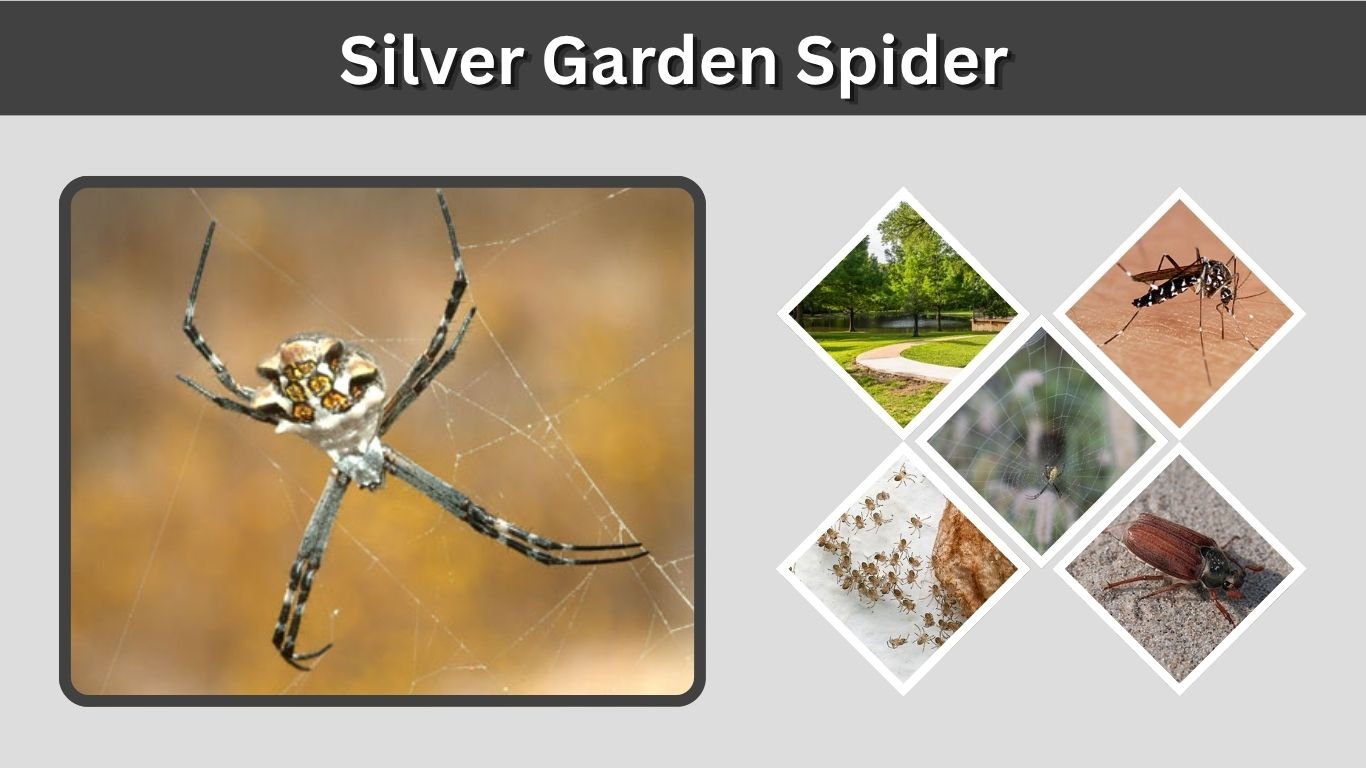
The silver garden spider is an eye-catching orb-weaver recognized by its metallic body, long banded legs, and decorative silk web. Its scientific name is Argiope argentata, and it belongs to the same genus as yellow and banded garden spiders. This spider lives in warm, sunny habitats where it captures flies, moths, grasshoppers, and other insects. Although its size and coloring can appear intimidating, it is not considered dangerous to people. Here is how to identify the species and understand its behavior, web, diet, bite, and life cycle.
What Is a Silver Garden Spider?
The silver garden spider, also called the silver argiope, is an orb-weaving spider found across warm areas of the Americas. The word argentata means silvery, referring to the reflective hairs and scales covering its cephalothorax and abdomen. Females construct conspicuous circular webs in shrubs, gardens, grasslands, and other sunny locations.
Identification and Appearance
A female silver garden spider typically has:
- A shiny silver or white cephalothorax
- A flattened, angular abdomen
- Silver, yellow, black, brown, and orange markings
- Several pointed or lobed projections on the abdomen
- Long legs with contrasting dark and light bands
- A body measuring approximately 12 millimeters
- A leg span that makes her appear considerably larger
- A resting posture with her legs paired into an X shape
Individual coloring varies. Some females appear bright metallic silver, while others have more yellow, brown, or black across the abdomen.
Blue and Silver Garden Spiders
A “blue silver garden spider” is usually a silver garden spider reflecting blue light rather than a separate species. Its silvery hairs and scales can look blue, white, greenish, or metallic depending on the lighting, camera settings, and viewing angle.
Photographs taken in shade may produce particularly strong blue tones. Identification should therefore consider body shape, abdominal projections, leg bands, and web structure rather than color alone.
Male vs. Female
Female silver garden spiders are substantially larger and more colorful than males. The females build the large, visible webs normally noticed by gardeners.
Males are small, narrow-bodied, and relatively inconspicuous. An adult male may measure around four millimeters and can sometimes be found near the edge of a female’s web. The size difference helps reduce competition because males are primarily focused on locating mates rather than maintaining large capture webs.
Silver Garden Spider Web
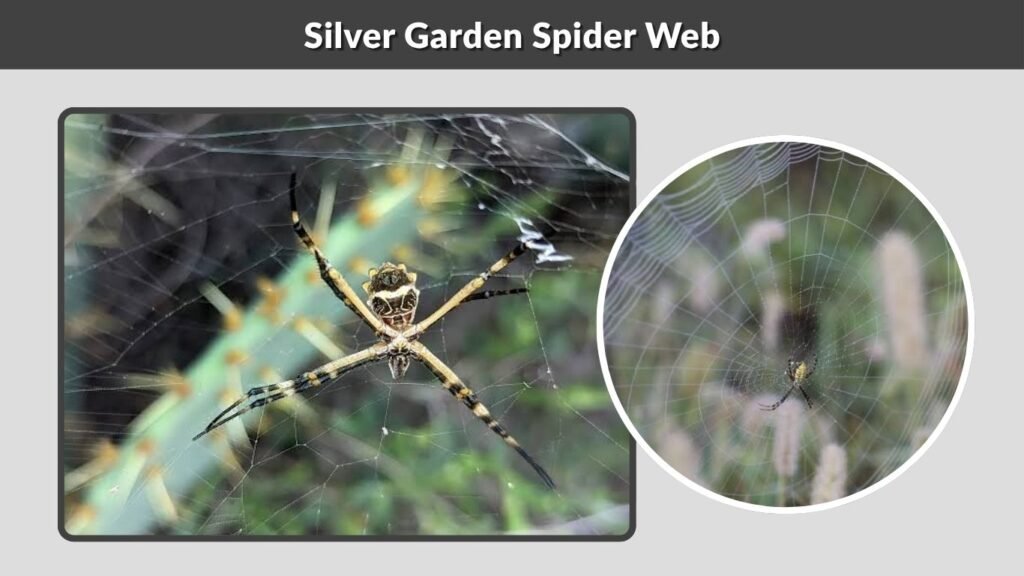
The spider produces a vertical orb web stretched between shrubs, tall grasses, fences, or garden plants. The web consists of strong supporting lines, radiating spokes, and a sticky spiral designed to intercept flying or jumping insects. The female usually waits at the center with her head pointing downward.
Web Stabilimentum
A silver garden spider frequently adds thick white silk decorations known as stabilimenta. These may form a partial or complete X around the center of the web.
Not every web has the same design. Researchers have documented numerous arrangements containing one to four decorative arms. These structures may help make the web visible to large animals, attract certain insects, provide camouflage, or protect the spider, but scientists continue to investigate their precise functions.
Why Does the Spider Sit in an X Shape?
The spider holds its legs in four pairs, creating an X that aligns with the silk decoration. This posture can break up the outline of its body and make it less recognizable to predators.
The position also keeps its legs in contact with multiple web lines. Vibrations travelling through the silk immediately alert the spider to trapped prey, an approaching mate, or a possible threat.
What Happens When the Web Is Disturbed?
When mildly disturbed, the spider may rapidly shake the entire web. The vibration makes its body appear blurred and can discourage birds, lizards, or other predators.
If the threat continues, the spider may drop into nearby vegetation while attached to a safety line. It generally prefers escape over confrontation and does not jump from the web to attack people.
Silver Garden Spider Habitat and Geographic Range
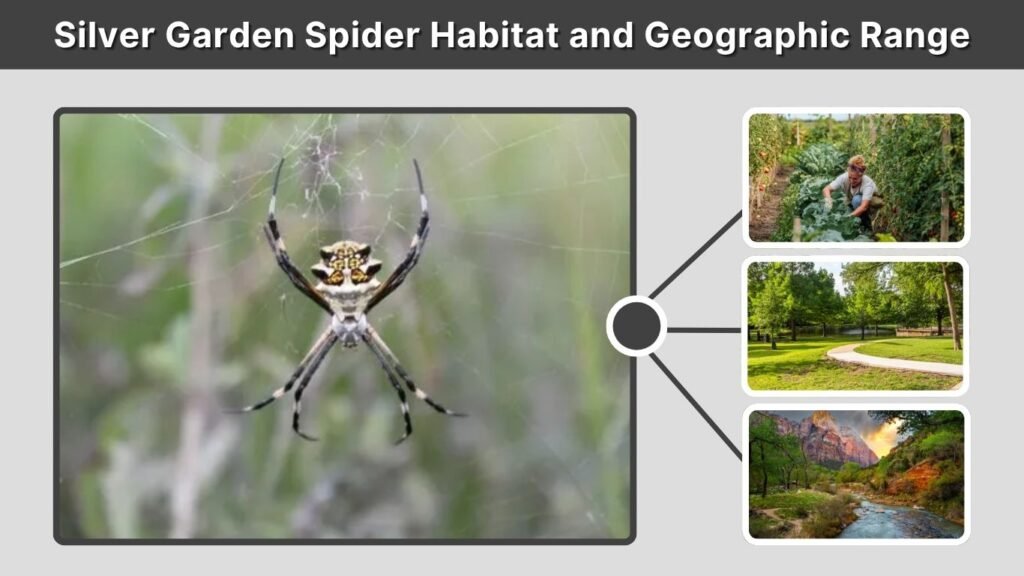
Silver garden spiders prefer sunny, warm locations containing sturdy plants that can support their webs. They are particularly associated with tropical and subtropical climates but extend into several southern and western parts of the United States.
Where Do Silver Garden Spiders Live?
Their range includes:
- Southern California
- Arizona
- Florida
- Mexico and Central America
- Caribbean islands
- Much of South America
- Areas extending south into Argentina
In the United States, established populations are best known from southern California, Arizona, Florida, and nearby warm regions. New Mexico State University describes the species’ general distribution as extending from these states south to central Argentina.
Silver Garden Spiders in California
The spider occurs in warm parts of California, especially southern coastal and inland areas. San Diego gardens, parks, canyons, and open scrubland can provide suitable habitat.
Its web may appear between ornamental shrubs, cactus plants, tall weeds, or fence supports. The spider becomes more noticeable when females mature and construct larger webs.
Are Silver Garden Spiders Found in Arkansas?
Arkansas is outside the species’ best-established U.S. range. A silver-looking garden spider found there is more likely to be a banded garden spider, yellow garden spider, or another orb-weaver.
Occasional transported or unusual records may occur, so a photograph and location data are necessary for reliable identification. The markings on the abdomen and the shape of the silver patches provide better evidence than color alone.
Silver Garden Spider vs. Banded Garden Spider
The names “silver garden spider” and “silver-banded garden spider” are sometimes used inconsistently online. However, the true silver garden spider and banded garden spider are separate species.
Important Differences
| Feature | Silver Garden Spider | Banded Garden Spider |
| Scientific name | Argiope argentata | Argiope trifasciata |
| Abdomen | Angular with silvery lobes | Oval with narrow horizontal bands |
| Main colors | Metallic silver, yellow, black and brown | Silver, white, yellow and black |
| U.S. range | Mainly warm southern and western areas | Widespread across much of the country |
| Web decoration | Often forms an X or several thick arms | Frequently forms a vertical zigzag band |
The yellow garden spider, Argiope aurantia, is another relative. It has a more rounded abdomen with bold yellow and black patches rather than an extensively silver surface.
Silver Garden Spider Food and Hunting Behavior
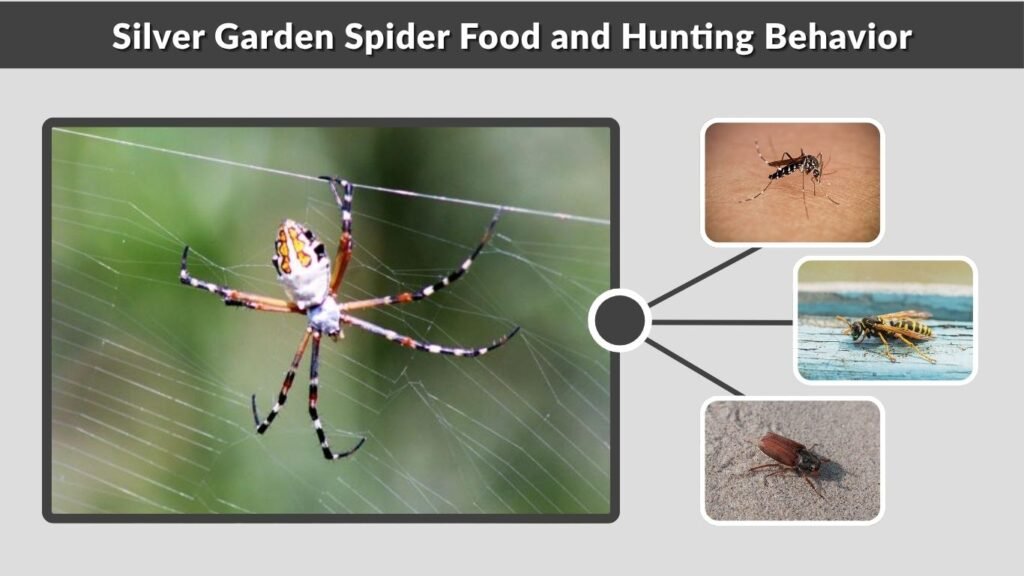
The silver garden spider is a patient ambush predator. It does not chase insects across the garden. Instead, it depends on its sticky orb web to intercept prey and transmit vibrations to its waiting legs.
What Do Silver Garden Spiders Eat?
Their diet can include:
- Flies and mosquitoes
- Moths and butterflies
- Bees and wasps
- Grasshoppers and crickets
- Beetles
- Leafhoppers
- Dragonflies
- Other web-sized insects
Large females can subdue relatively powerful insects. However, very small insects sometimes pass through the web’s wide mesh without becoming trapped.
How Does It Capture Food?
When an insect hits the web, the spider moves toward the vibration and rapidly throws sheets of silk around the prey. This wrapping restricts movement and reduces the chance of injury to the spider.
The spider then delivers venom through its fangs and begins digesting the insect internally. It later consumes the liquefied tissues and may remove the dry remains from its web.
Benefits in the Garden
Silver garden spiders provide natural control of many flying and plant-feeding insects. They do not eat leaves, damage flowers, transmit plant diseases, or infest buildings.
Leaving an undisturbed web in a quiet part of the garden can support local biodiversity and reduce insect numbers without pesticides. The spider generally remains close to its web unless disturbed, mating, or searching for a better location.
Is the Silver Garden Spider Poisonous?
The silver garden spider is venomous, as it uses venom to subdue insects, but it is not poisonous and is not considered medically dangerous to healthy people. “Poisonous” describes something harmful when eaten or touched, while “venomous” describes an animal that injects venom.
Does a Silver Garden Spider Bite?
A bite is possible if the spider is trapped against the skin, squeezed, or handled roughly. Bites are uncommon because the spider normally retreats, drops from its web, or shakes the silk when threatened.
Possible temporary symptoms include:
- Mild to moderate localized pain
- Redness around the bite
- Minor swelling
- Itching or tenderness
- A small pair of puncture marks
Wash the area with soap and water and apply a wrapped cold pack for short intervals. Seek medical assistance if severe pain, breathing difficulty, spreading swelling, vomiting, or other serious symptoms develop. Children or individuals with known severe allergies may need additional caution.
Life Cycle and Reproduction
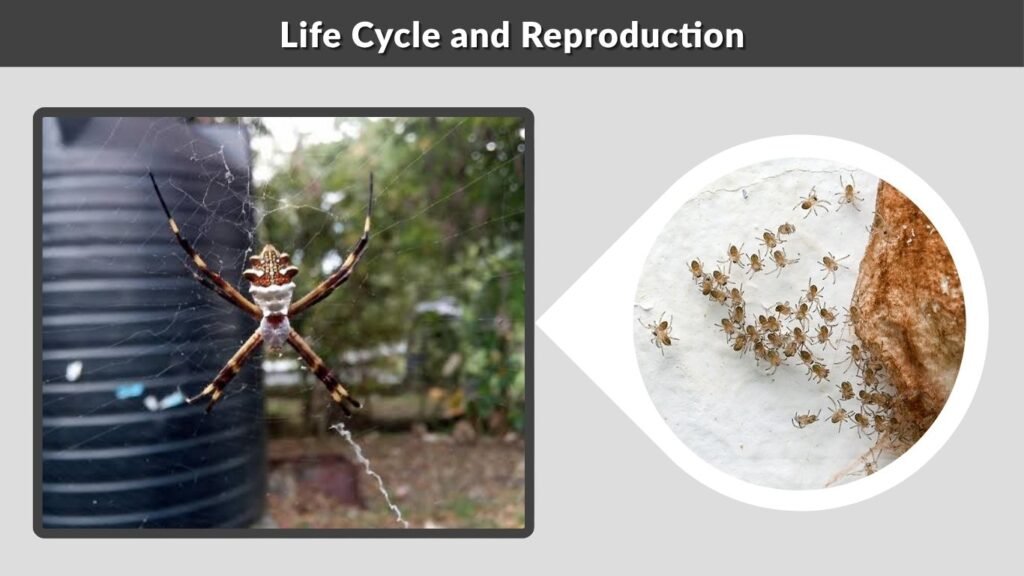
The silver garden spider begins life inside a protective egg sac. Spiderlings emerge when temperature and environmental conditions are suitable. After dispersing, they build small webs and molt repeatedly while growing.
Mating and Egg Sacs
A mature male approaches a female carefully and communicates through controlled vibrations in her web. After mating, the female produces eggs and encloses them within layers of silk.
The outer covering helps protect the eggs from weather and some predators. Depending on climate and food availability, a female may produce more than one egg sac.
Lifespan
In seasonal climates, silver garden spiders generally complete their life cycle within approximately one year. Adults become most noticeable during the warmer months, and females may die after reproducing.
In tropical areas with consistently warm weather, breeding seasons and development can be less restricted. Several life stages may be present during much of the year.
Predators and Defensive Behavior
Birds, lizards, wasps, frogs, and other spiders may prey on silver garden spiders or their eggs. Parasitic insects can also attack egg sacs.
The spider relies on camouflage, web shaking, its X-shaped posture, rapid silk wrapping, and dropping from the web to avoid danger. Its reflective body may also make its outline difficult to recognize under bright sunlight.
FAQs
Are silver garden spiders dangerous?
No. They possess venom for capturing insects but are not considered dangerous to people. Bites are uncommon and usually cause only localized symptoms.
Should I remove a silver garden spider?
Removal is unnecessary when the web is in an unused part of the garden. If it blocks a walkway, gently move the spider and web with a long stick to nearby vegetation.
Do silver garden spiders go inside houses?
They strongly prefer outdoor vegetation where they can build large orb webs. They may occasionally wander indoors but do not normally establish household infestations.
How large does a silver garden spider get?
An adult female’s body is commonly around 12 millimeters long, while the legs make her appear much larger. Males are considerably smaller, often measuring about four millimeters.
Is a silver garden spider the same as a banded garden spider?
No. The silver garden spider is Argiope argentata, while the banded garden spider is Argiope trifasciata. They are closely related but have different abdominal patterns and distributions.
