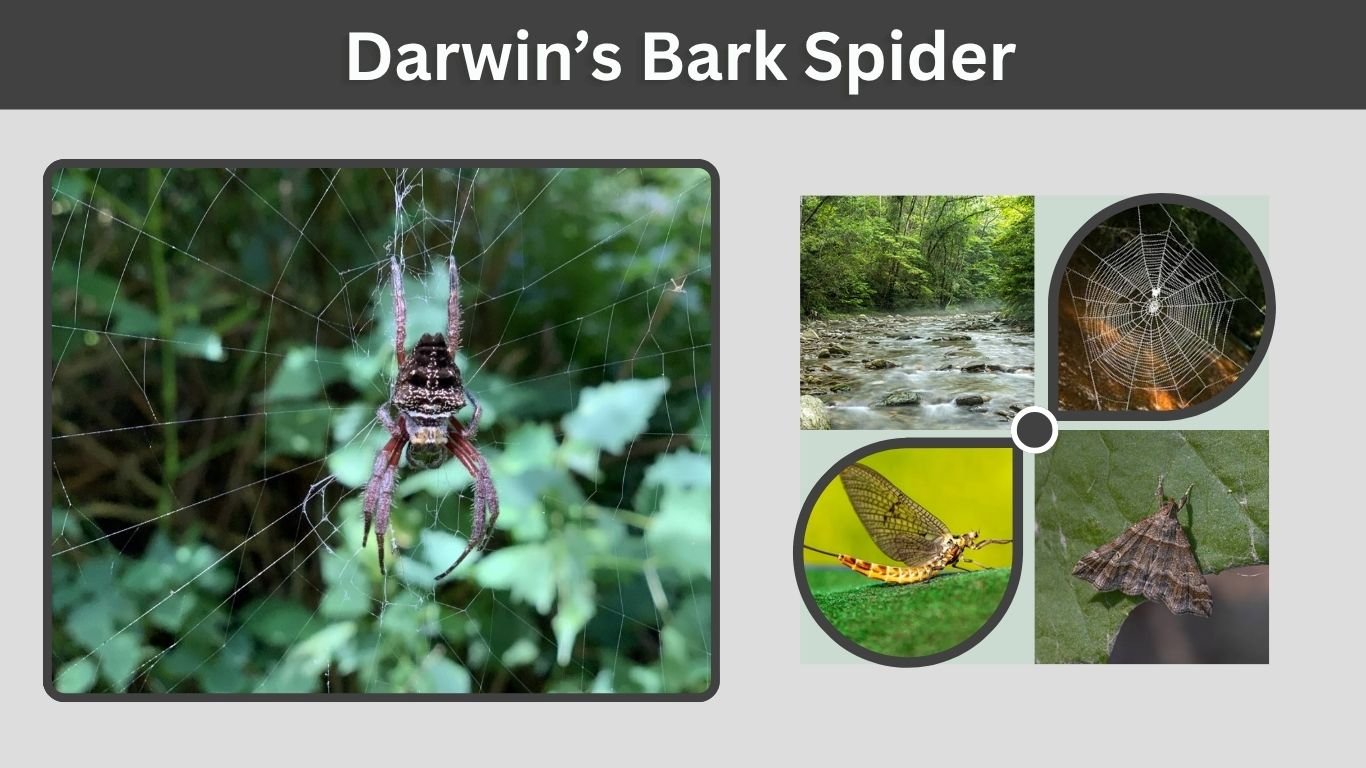
Darwin’s bark spider is a remarkable orb-weaver from Madagascar that constructs enormous webs across rivers, streams, and lakes. Scientifically named Caerostris darwini, it produces exceptionally tough silk capable of absorbing tremendous energy before breaking. Its river-spanning anchor lines can reach 25 meters, while the central capture web may cover nearly three square meters. Despite these impressive dimensions, the spider itself is relatively small and relies heavily on barklike camouflage. This guide explores its appearance, habitat, web construction, silk strength, diet, bite, reproduction, and lifespan.
What Is Darwin’s Bark Spider?
Darwin’s bark spider is a member of the orb-weaver family Araneidae. Researchers scientifically described the species in 2010 and named it after Charles Darwin. It belongs to Caerostris, a genus of spiders known for flattened bodies, nocturnal behavior, barklike patterns, and extreme differences between male and female body sizes.
Identification and Appearance
A female Darwin’s bark spider typically has:
- A body measuring approximately 18–22 millimeters
- A broad, irregularly shaped abdomen
- Brown, gray, black, and pale markings
- White or silvery hairs across parts of the body
- Small humps or projections on the abdomen
- Long, powerful legs
- A rough surface resembling tree bark
- A flattened resting posture during daylight
Its mottled appearance makes the spider extremely difficult to locate when resting against bark. The body’s bumps, shadows, and uneven colors imitate natural cracks, lichens, and broken wood.
Male vs. Female Darwin’s Bark Spider
Females are much larger and heavier than males. A mature male may measure only about six millimeters, roughly one-third of a large female’s body length.
Males are generally reddish-brown, more slender, and less heavily built. They do not construct the enormous capture webs associated with females. Instead, mature males spend much of their time locating females and waiting near their webs for mating opportunities.
Is It the Biggest Spider?
Darwin’s bark spider is not the world’s biggest spider by body size, weight, or leg span. Tarantulas and giant huntsman spiders grow considerably larger.
Its record comes from web construction. The species produces the largest known orb-shaped capture webs and some of the longest bridge lines documented among spiders. Therefore, references to the “biggest Darwin’s bark spider” usually describe its web rather than the spider’s body.
Darwin’s Bark Spider Web
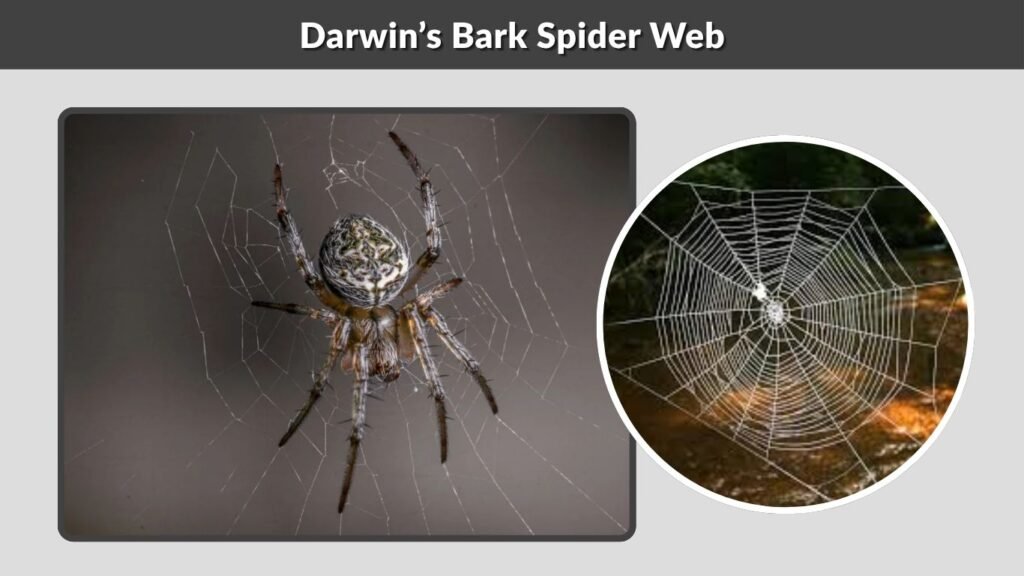
A female constructs her orb above a river or other body of water, placing the sticky capture section in the flight path of aquatic insects. This position provides access to food that most forest-dwelling spiders cannot reach, but it requires unusually long support lines and silk capable of surviving wind, rain, and struggling prey.
How Large Is the Web?
Documented web measurements include:
- Anchor or bridge lines reaching 25 meters
- Orb-shaped capture areas covering up to 2.8 square meters
- Webs suspended directly above rivers and streams
- Capture areas containing numerous insects simultaneously
- Supporting lines connected to vegetation on opposite banks
The 2.8-square-meter measurement refers to the central sticky orb, not the entire structure. When the long bridge lines are included, the web occupies a substantially greater span.
How Does the Spider Build Across a River?
The spider releases a large quantity of light bridging silk into the wind. Air currents carry the loose line across the water until it catches on a branch or other support on the opposite bank.
The spider strengthens this initial connection by crossing it and adding additional silk. It then creates radial lines and constructs the sticky orb beneath the main bridge. This method allows the spider to establish a web without walking through the water or travelling around the riverbank.
Why Does the Web Not Break?
A river-spanning web must survive changing wind, falling water droplets, debris, and the impact of rapidly flying insects. Its silk combines high tensile strength with exceptional elasticity.
Instead of snapping immediately under sudden force, the silk stretches and absorbs energy. The web’s simplified architecture and reinforced upper radial lines also distribute forces throughout the structure.
Darwin’s Bark Spider Silk Strength
The spider’s dragline silk is famous for its toughness. In material science, toughness describes the total energy a material absorbs before breaking. It is different from strength, which measures how much stress the material can withstand, and elasticity, which describes how far it can stretch.
How Tough Is the Silk?
Laboratory measurements found that:
- Dragline silk averaged about 350 megajoules per cubic meter in toughness
- Exceptional samples reached approximately 520 megajoules per cubic meter
- Some fibers stretched more than half their original length
- The silk was more than twice as tough as previously measured spider silks
- By weight and volume, it absorbed over ten times more energy than Kevlar before breaking
Saying the silk is “ten times stronger than Kevlar” is misleading. The research compared toughness, not every form of material strength. Its performance results from the combination of strength and unusual extensibility.
Why Is Its Silk So Tough?
Spider silk is made primarily from proteins called spidroins. Different silk glands produce fibers for bridge lines, web frames, sticky capture spirals, wrapping prey, and protecting eggs.
Genomic and silk-gland research indicates that Darwin’s bark spider possesses a familiar assortment of spidroins but expresses and combines them in ways that contribute to exceptional performance. Its silk’s ability to stretch without immediately breaking is especially important.
Can the Silk Be Used for Armor?
Researchers are interested in spider silk for lightweight protective materials, medical sutures, artificial tissues, ropes, and impact-resistant fabrics. However, Darwin’s bark spider silk armor is not currently a commercially available product.
Harvesting natural silk directly from spiders is difficult because spiders produce limited amounts and generally cannot be farmed like silkworms. Scientists are therefore investigating whether engineered microbes, plants, or other organisms could manufacture similar proteins at a practical scale.
There is no simple “Darwin’s bark spider web formula.” Reproducing the material requires understanding both its protein composition and how the spider’s glands process those proteins into fibers.
Habitat and Geographic Location
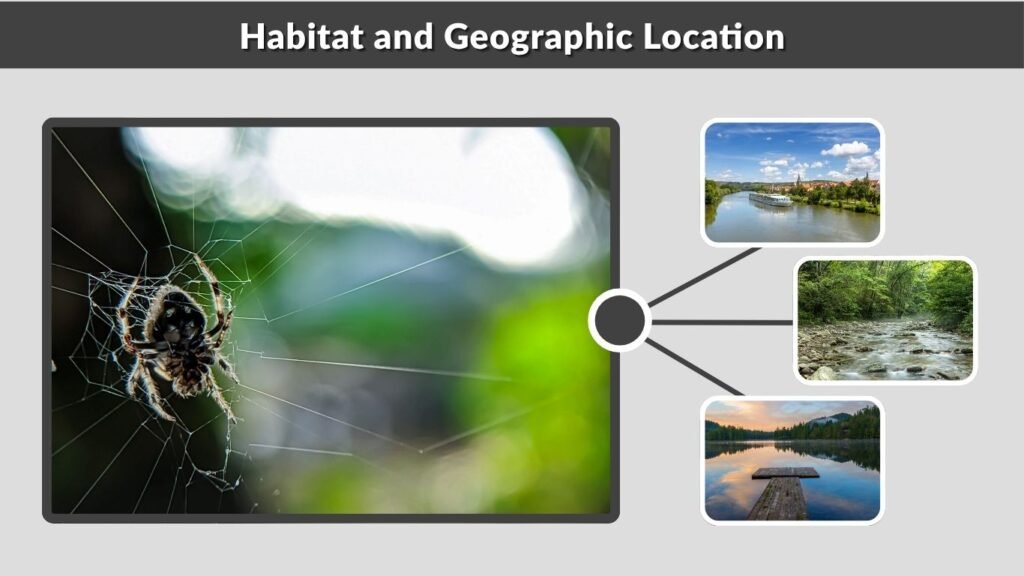
Darwin’s bark spider is native to Madagascar, an island known for high levels of wildlife found nowhere else. It inhabits humid forest environments containing rivers, streams, lakes, and vegetation capable of supporting its long bridge lines.
Where Does Darwin’s Bark Spider Live?
It has been documented in and around rainforest habitats, including areas associated with Andasibe-Mantadia National Park. Females select locations where vegetation on both sides of a waterway can support a web.
Its known distribution is limited, and the species is not naturally found in North America, Europe, or mainland Africa. A large bark-colored spider in Arizona, Arkansas, or another U.S. state is therefore a different species.
Bark Camouflage
During the day, the spider may leave the center of its web and flatten itself against a branch. Its uneven abdomen and mottled coloring allow it to blend into the tree.
This camouflage protects it from birds and other visually hunting predators. The spider becomes more active around its web during lower light or when vibrations indicate captured prey.
Darwin’s Bark Spider Diet and Hunting Behavior
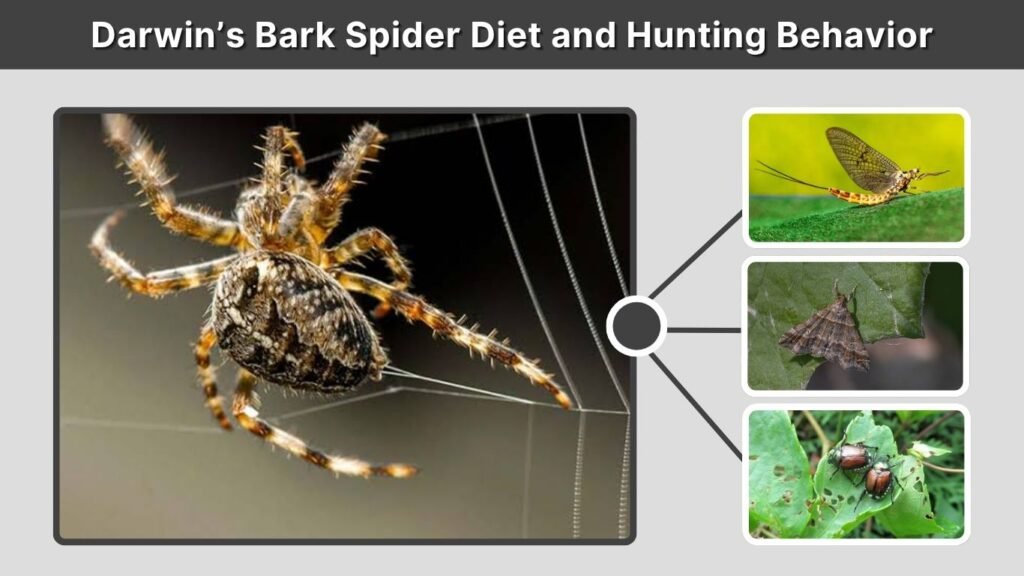
Darwin’s bark spider feeds on insects flying above water. Rivers act as natural travel corridors for aquatic insects, giving the spider access to concentrated prey that may be unavailable within dense vegetation.
What Does It Eat?
Its prey can include:
- Mayflies
- Dragonflies and damselflies
- Caddisflies
- Bees and wasps
- Moths
- Flies
- Beetles
- Other medium-sized flying insects
Researchers have observed webs containing many mayflies simultaneously. Large webs also allow females to capture insects that might escape from a smaller or weaker orb.
How Does It Capture Prey?
When an insect strikes the sticky spiral, vibrations travel through the radial threads. The spider moves toward the prey, restrains it with silk, and delivers a venomous bite.
The venom begins immobilizing and digesting the insect. The spider later consumes the liquefied internal tissues. Unwanted debris or empty remains may be removed to preserve the web’s effectiveness.
Is Darwin’s Bark Spider Poisonous?
Darwin’s bark spider is venomous rather than poisonous. It injects venom through its fangs to subdue insect prey, but no evidence indicates that it poses a serious medical danger to humans.
Bite and Venom
A defensive bite might occur if the spider were squeezed, trapped against the skin, or handled. However, its reclusive habitat and avoidance behavior make human bites unlikely.
Any bite would be expected to cause localized symptoms similar to those produced by many orb-weavers, such as temporary pain, redness, itching, or swelling. The species’ effects on humans have not been extensively documented. Serious symptoms following any unidentified spider bite require medical evaluation.
Darwin’s Bark Spider Reproduction and Life Cycle
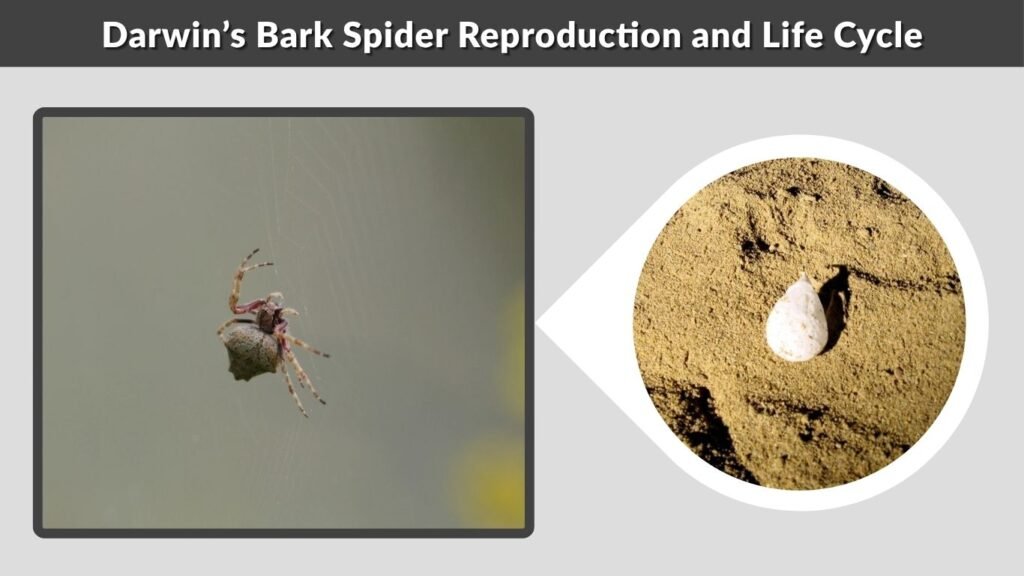
The mating behavior of Darwin’s bark spiders reflects the dramatic size difference between the sexes. A small male approaches the female carefully and communicates through vibrations on her web.
Mating Behavior
Males may remain near immature females and attempt to mate shortly after the female’s final molt. Recorded behaviors include mate guarding, wrapping the female with silk, mating plugs, and occasional sexual cannibalism.
These behaviors can improve a male’s chances of fathering offspring while reducing access for competing males. However, not every mating interaction ends in cannibalism.
Egg Sacs and Spiderlings
After mating, a female places her eggs inside a protective silk sac. The sac shields the developing eggs from moisture, environmental changes, and some predators.
Young spiderlings hatch with the instinctive ability to produce silk. They initially create tiny webs and molt repeatedly as they increase in size. Only mature females are capable of constructing the enormous webs associated with the species.
Lifespan
The exact lifespan of Darwin’s bark spider in natural conditions has not been thoroughly established. Development depends on temperature, rainfall, food availability, predation, and seasonal conditions.
Like many orb-weavers, individuals pass through egg, spiderling, juvenile, and adult stages. Females are expected to live longer than adult males, which invest much of their remaining lifespan in finding mates.
Darwin’s Bark Spider vs. Other Bark Spiders
“Bark spider” is a broad common name applied to several unrelated spiders that live on or resemble tree bark. Appearance alone does not mean they are closely related.
Commonly Confused Spiders
- Bark crab spiders: Flattened ambush hunters belonging to the crab spider family
- Broad-headed bark spiders: Bark-dwelling spiders unrelated to Darwin’s species
- Bark huntsman spiders: Fast, flattened hunters that do not make capture webs
- Bark jumping spiders: Small visual hunters that leap onto prey
- Bark lynx spiders: Active hunters with long, spiny legs
- African bark spiders: Other members of the genus Caerostris
Darwin’s bark spider can be confirmed by its Madagascar location, female anatomy, river-spanning orb web, and species-specific structural features.
FAQs
Is Darwin’s bark spider dangerous?
It is not regarded as dangerous to humans. Its venom is intended for insects, and confirmed human bites appear to be extremely rare.
Is Darwin’s bark spider the biggest spider?
No. Many tarantulas and huntsman spiders are much larger. Darwin’s bark spider is famous for producing the largest known orb webs.
How strong is Darwin’s bark spider silk?
Its silk has an average measured toughness of approximately 350 megajoules per cubic meter, with exceptional fibers reaching about 520 megajoules per cubic meter.
Where can Darwin’s bark spider be found?
It is native to Madagascar and lives around forested rivers, streams, and lakes where it can suspend webs above the water.
Can you buy Darwin’s bark spider silk?
It is not ordinarily available as a commercial fiber or fabric. Research laboratories study the silk’s proteins and investigate methods for creating similar engineered materials.
